Author: mascara
Michelle Cahill reviews This Devastating Fever by Sophie Cunningham
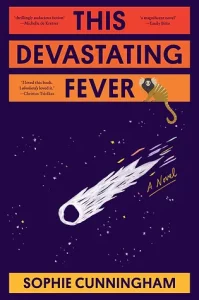 This Devastating Fever
by Sophie Cunningham
ISBN 9781761150937
Reviewed by MICHELLE CAHILL
I go on believing in the power of literature, and also in the politics of literature.
—- Adrienne Rich
Sophie Cunningham messaged me on Twitter when I was working on the edits of my novel, Daisy & Woolf, then titled, Woolf, to ask what my novel was about, as she was also writing a novel on the Woolfs, Leonard in particular, This Devastating Fever. As it turned out, in 2022, we both published metafictional novels whose peripatetic Australian narrators, Alice and Mina re-examine Bloomsbury.
Mascara Varuna Writers’ and Editors’ Residency Longlist
Continue reading for only $5 per month
Subscribe for full access to Mascara Literary Review or login
Anneliz Marie Erese
Anneliz Marie Erese
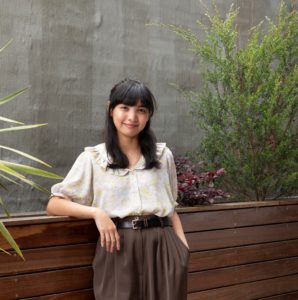 Anneliz Marie Erese is a Filipino writer whose works have appeared or are forthcoming in The Saturday Paper, Meanjin, Island Online and Cordite Poetry Review, among others. She has previously received writing prizes such as the Nick Joaquin Asia Pacific Literary Awards (2019) and the Deakin Postgraduate Prize in Writing and Literature (2022). She was also the 2022 Deborah Cass Prize winner. Most recently, she was awarded a scholarship to Faber Writing Academy at Allen & Unwin. She lives on the unceded lands of the Wurundjeri people.
Photo Credit: David Patston
International
I found a place in a five-bedroom house share in Hawthorn with two students like myself and a paramedic. The landlord also lived with us – a mid-thirties contractor who disappeared to his beach house in Point Lonsdale for two weeks at a time. The place was enormous and charming and a bit rundown, but wherever I went there was light. Even in the bathroom. I would lay for a long time in the tub looking up through the skylight and see nothing but white. There were wooden floors throughout. An updated, working oven. There was a kitchen bench and bar stools and the dining table sat eight. I picked a different chair each time.
=================================Continue reading for only $5 per month
Subscribe for full access to Mascara Literary Review or login
Gayatri Nair
 Gayatri Nair is an Indian-Australian writer, poet and DJ based on the land of the Wangal people of the Eora nation in Sydney’s inner west. She is a member of Sweatshop: Western Sydney Literacy Movement, has qualifications in Law and Arts, and is working in human rights policy, research and advocacy. She is passionate about pride in cultural identity and using art to affect change. Gayatri has been published in Sweatshop Women Volumes 1 and 2, Red Room Poetry, Mascara Literary Review, The Guardian and Swampland Magazine.
Mystics
Last night you saved my life
There was a fire in the building
and I would have slept through it
But you woke me up and we survived
Earlier that day we had seen the impossible
The unbelievable
Whales breaching out past the rocks
An island which I later looked up, called ‘Rangoon’
‘How racist’ I said, the old term for Yangon
A place I once had a visa to but had never been
And we wouldn’t have seen the whales
But for a lone woman on the beach
who told us to look
No phones no cameras,
nothing to capture it
So I’m writing it down now
You said this is where we would consummate our love
And I said ‘yuck isn’t that like about marriage,’
and ownership of a woman through making an heir
But this morning I googled consummate love
it said it was ‘the complete form of love, representing an ideal relationship which people strive towards… it is the ideal kind of relationship’
I can’t stop laughing at the way
you carried the car keys above your head
swimming with one hand raised through the estuary to the beach
Twice people stopped to ask if you were ok
And I wonder if we can ever go back there?
Like an ending in a Satyajit Ray film
But I don’t think I have a visa to that country anymore.
Christopher Cyrill
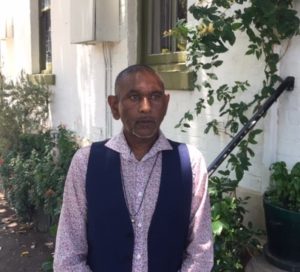 Christopher Cyrill is the author of the novels The Ganges and its Tributaries and Hymns for the Drowning. He has also published numerous stories, articles and written a number of broadcasted radio plays. For many years he was the fiction editor of HEAT and the fiction editor of Giramondo Publishing. Cyrill has taught at Sydney University and Macquarie University and currently runs his own writing academy mentoring writers.
Index of First Lines
Edited by I.V.A Sumac
Notes:
He says, Poetry should make the visible a little hard to see – This is a paraphrase of Line 21 of “The Creations of Sound” by Wallace Stevens, page 310. The Collected Poems of Wallace Stevens, Faber and Faber, London, 1954.
Tack and sheet chanty, ‘aul away St. Joe. – This is a partial quote from “Haul Away, St. Joe” a traditional sea shanty/chanty/forecastle song. Sourced from: https://www.whalingmuseum.org/
There’s a day for the hunter, a day for the prey – This is a quote from “A Day for the Hunter, a Day for the Prey” by Leyla McCalla Track taken from “A Day for the Hunter, A Day for the Prey” – Leyla McCalla : May 27th 2016 on JazzVillage Music video directed by Claire Bangser
https://www.youtube.com/watch?v=czmaR4wVqoQ
Vyacheslav Konoval
Continue reading for only $5 per month
Subscribe for full access to Mascara Literary Review or login
Lesh Karan
Lesh Karan
 Lesh Karan is a Naarm/Melbourne-based writer and poet. Her work has been published in Best of Australian Poems 2022, Australian Poetry Journal, Cordite Poetry Review, Island, Mascara Literary Review and Rabbit, amongst others. Lesh is currently completing a Master of Creative Writing, Publishing and Editing at the University of Melbourne. She’s of Fiji Indian heritage.
The Floor
She took off her earth-caked shoes
and put them on the floor. On the floor,
she stacked her old notebooks and red pens
Continue reading for only $5 per month
Subscribe for full access to Mascara Literary Review or login
Morgaine Riley
Continue reading for only $5 per month
Subscribe for full access to Mascara Literary Review or login
Nilofar Zimmerman
 Nilofar Zimmerman is a writer and lawyer living in Sydney. She is currently undertaking a Master of Creative Writing at the University of Sydney and was the runner-up in the 2022 Deborah Cass Prize for Writing.
Kaa
Girl dangled her legs over the back of the truck and swung them playfully while she watched Papa and Brother. The first thwacks of the machetes were jarring. Thwack. The stem. Thwack. The leaves. Thwack. The cane trimmed for transportation. But their rhythms quickly became melodic, like an ode to the rains that had come down enough and the sun that had taken over in time.
Half-way through the first row, Papa left Brother and walked further into the field to inspect the crops, disappearing beneath a canopy of green. Girl slid down from the back of the truck, her bare feet landing gently on the dirt. As she moved towards the maze of sugarcane, Brother stopped and watched her.
The thwacks were muffled as she ran deeper into the field among the rows of brown stalks and green leaves, which brushed her body as she weaved through the narrow spaces between the rows. She was Mowgli now. She crouched down into a gap where the stems of two plants had bowed towards each other to form a small hollow. It was the perfect den for a wolf-child. Baloo came to visit in the den and the bear told her stories about the law of the jungle as she paced along the soil on her hands and knees, practising her hunting skills. Don’t fight with the lords of the jungle, he told her. Bears, tigers, panthers – they must all be respected, just like the pack. Do you remember the pack, Mowgli?
As she pulled aside a stalk of sugarcane searching for prey she nodded and repeated to herself, the strength of the wolf is the pack and the strength of the pack is the wolf. She pretended Rikki Tikki Tavi, the mongoose, was hiding behind the stalks and pounced over and over again, practising her surprise attack. A faint thwacking began pulsating towards her and she crouched on her legs with her back straight and her head up, still and listening like a wolf alone in the darkness. The thwacking slowly became louder as the field fell in line with the season. Run, Mowgli, Run, she thought. Shere Khan is coming.
When the light waned, Papa called for Brother to put his tools down and store them in the trailer of the truck. Girl sat in the cabin of the truck wedged between Papa and Brother. The air inside was thick with sweat and exhaustion and their wet bodies jolted against one another as they drove along the dirt road running down the middle of the sugarcane fields for the three-minute journey to the house. The dirt road led to a two-bedroom house made of light blue weatherboard with a corrugated silver tin roof, which was fenced in by the fields on each side and dusted with dirt blown up from the ground.
As she walked into the house, Girl was hit by the sweet smell of the tropics mixed in with the warm air that filled the living room. The fruit bowl on the counter of the adjacent kitchen was overflowing with pineapples, mangoes and a bag of apples from yesterday’s trip to the market. She picked up an empty pitcher from a dining table with a white tablecloth and a clear plastic covering on top and took the pitcher to the sink to fill it with water. She began carefully measuring out spoons of Tang and mixed the orange crystals into the water, tapping the rim of the spoon three times on the rim of the pitcher when the drink was ready, just like Mama used to.
Brother shouted for his drink as he lay sprawled on the green linoleum floor in front of the television with his back against the foot of the sofa. Papa sat in his armchair under the gentle whipping of the ceiling fan, sorting through mail. Girl climbed onto her step stool, slowly pouring the orange drink into two glasses and adding three ice cubes to each. ‘Here’s a cold drink, Papa,’ she said, using both hands to pass him the glass.
His face broke into a smile. ‘What would I do without you, sweet pea?’
Brother stared at her as she handed him the second glass. ‘I’m hungry,’ he said, his eyes red and impenetrable. Kaa, thought Girl, as she returned to the kitchen to put on a pot of beans. No. The snake is Mowgli’s friend.
She picked up an apple and began methodically dicing it for Brother, just like Mama had taught her. As she went to hand Brother the apple, she stopped to watch the laughter coming from the television screen and couldn’t help smiling along with the laugh track as the family on the screen gesticulated with frustration at one another. As soon as Girl placed the apple in front of Brother, he began scooping handfuls from the bowl, his eyes always on the screen. Brother began to cough and Papa let out a chuckle as he leant down to tap Brother’s back. ‘Go easy, boy,’ he said. ‘The market isn’t running out of apples.’ Brother smirked and continued staring ahead, putting another large handful in his mouth.
Papa beckoned Girl. ‘You have a package from Cousin Sister’. She clasped the brown envelope with both hands, brushing her fingers over the top right corner, which was filled with stamps bearing the Statue of Liberty. Cousin Sister was Mama’s favourite niece. She was a manager of Wendy’s now in San Francisco, Mama had told Papa proudly. She had 20 employees working under her, Girl remembered Mama saying with a smile so wide, Girl could almost see Mama’s back molars. Had left that man, Mama told Papa. He punched her and she punched back. Found a place in a shelter and never went back to him. America was really something, wasn’t it? Girl remembered the way Mama and Papa nodded their heads in agreement. America really was something.
Girl tore open the package and jumped with delight. ‘Another Babysitter’s Club book, my fourth one. It’s Mary-Anne Saves the Day,’ she said to no one in particular, waving the book in front of her. She opened the first page and sounded out the unfamiliar words, just like Mama had taught her. As she walked back towards the stove, she pictured herself walking through the tree-lined streets of Stoneybrook, Connecticut, through the front door of a weatherboard house and up the stairs to Claudia’s bedroom for the club meeting. Where have you been, Girl? They would say. Come and join us.
Girl looked out the kitchen window as she dried the last dish but outside everything had merged into darkness. She hung up the tea towel for the morning and went to get ready for bed, washing away the day under a cool shower before haphazardly drying herself and wrapping the towel around her body, eager to read her new book. She darted across the hallway into the bedroom and straight to the dresser sitting between her bed and Brother’s bed. She straightened Mama’s photograph of Princess Diana, which was hanging askew above the dresser and pulled out her clothes from the top drawer. As she slipped on her underwear, she remembered Mama’s old atlas on the bookshelf. She pulled it off the shelf and crouched over it. She flicked through the index looking for ‘S’ and ran her finger down the page but she couldn’t find Stoneybrook, Connecticut anywhere. She found Stamford, which was close enough. The babysitters sometimes went there. It was real. She found the map and was tracing the east coast of America with her finger when she felt movement near the door. She looked up to see Brother standing at the bedroom doorway, staring at her, his eyes darting with curiosity across her naked torso. She quickly picked up her nightie from the floor next to her, pulled it on and went to push past him. He put out a long arm and blocked the doorway. She returned his stare. He relented and she ran over to Papa, who was reading in his armchair.
‘What is it?’ Papa asked.
Girl looked over at Brother, who was walking over to the television. Remember the law, Mowgli. The wolf that follows it will prosper. Keep peace with the lords of the jungle.
‘Nothing,’ she said.
Throughout the market, dotted with plastic tables topped with crates of fruit and vegetables, stall holders sat on folding chairs playing cards or throwing around lethargic banter under the sun. Girl hopped and skipped over the dry dirt, breaking the market’s docile rhythm as she followed Papa to the truck for the hour-long drive from town back home. She held a large piece of taro like a rugby ball and pretended to toss it to Papa. He laughed as he loaded the truck and handed Girl a bag of apples to hold in her lap
‘We wouldn’t want these to get bruised,’ he said to Girl as he climbed into the driver’s seat. ‘Brother has been working very hard.’
Girl fiddled with the dial on the radio with one hand while carefully holding the bag in her other hand as they jostled down the dirt road, following the island’s curve along the coast. The radio crackled as she turned the dial and once she landed on the right song, she nestled back into her seat. Roam if you want to, the B-52s sang to her from across the ocean. Roam around the world. Roam if you want to. Without wings, without wheels. She gazed out the open window at the Pacific Ocean stretching endlessly to their left, her bare arms peeling away from the warm leather seat like sticky tape as she sat up to get a better look.
‘Papa,’ she said, ‘How long would it take to get to America?’.
‘It would take many hours, my darling.’
‘Would I need to take an aeroplane, Papa?’
‘Yes, you would. A large plane. It would cost a lot of money.’
‘Papa, I want to earn money to buy a plane ticket and live in America. I’ll work in a restaurant and have a big American house, just like the Babysitter’s Club.’
Papa chuckled. ‘What about your Papa, my darling? If you lived in America, who would look after me?’
Girl smiled at Papa, then looked out across the windscreen at the ocean to the left and field after field of sugarcane on the right. ‘Of course, Papa. Don’t worry, I’ll always look after you.’
They arrived at the house as the light was starting to fade and Brother was pulling up on his bicycle. Girl put the bag of apples on the seat and slid from the truck before carefully lifting the bag out with both hands. She walked over to the front door watching over her shoulder as Papa patted Brother on the back.
‘You’re doing a fine job, boy,’ Papa said. ‘I think we’ll get a good price for the harvest this year. In a few weeks, we’ll be ready to the take the first batch to the mill.’
Girl walked straight to the kitchen counter, taking an apple from the bag and washing it. As she slowly diced the apple for Brother, she remembered Mama’s gentle encouragement. A little smaller, a little smaller, Mama would say to Girl, showing her how to cut the apple.
Girl sat in her nightie on a bundle of cane under the moonlight, watching Papa tie down the stacks of cane piled high onto a large trailer attached to the truck.
‘Can I have a go, Papa?’
‘I’m sorry, my darling, I need to make these very tight. Otherwise, I’ll be dropping parcels of cane all the way along the coast.’
‘Why can’t I come with you, Papa?’ Girl said. The bundle of cane she was sitting on jiggled slightly as she fidgeted one leg.
‘Who will look after Brother while he carries on with the cutting? That is your important job for the harvest and I know you will do it well. Now it’s time for bed for all of us. I’ll be leaving at first light, but I should be back at night.’
Girl woke up several hours later and looked across the dark room. Slap. Slap. Slap. The sound was faint but certain. She could just see Brother’s eyes fixed on her from his bed, his hand moving up and down under the covers. Her heart was beating quickly and forcefully.
Kaa.
Kaa is watching.
Kaa is waiting.
She took a deep breath before getting out of bed and walking softly across the hallway to Papa’s room. She lay down in bed next to him and closed her eyes.
Remember, Mowgli, remember. If you fight with one of the pack, you must fight him alone and afar. Lest the pack be brought into the quarrel. Lest the pack be brought into war.
With Papa gone at sunrise, Girl spent the morning at the house doing her jobs. Papa will be so pleased, she thought, as she wiped the dirt from the outside of the doors and windows. She imagined she was Pippi Longstocking getting Villa Villekulla ready for her sea captain father who was coming home from an expedition. As she pulled towels down from the clothesline, she put her face to them and breathed deeply. They smelled like Mama to her. A mixture of detergent and the crisp cleanliness that only came from a day of baking in the hot sun.
At lunchtime, Girl packed a shopping bag with a thermos of Tang and a plastic container of fried cassava, rice and beans and walked down to the field nearest to the house, which hadn’t been cut yet, squinting into the distance to look for Brother among the sea of green. She took a deep breath and walked further down the dirt road along the edge of the field, holding the bag with one hand and brushing the leaves of the sugarcane with her other hand. As she wiggled her fingers in the empty space between one of the rows, a hand lunged forward and grabbed her wrist tightly, pushing her against the crops. ‘You’re late,’ Brother said, glaring at Girl, his face and chest centimetres from her own, the beads of sweat on his forehead hovering over Girl like they were daring her to move. She dropped the bag onto the soil and as Brother released his grip, she clutched her wrist and ran deeper into the field, weaving between the rows of sugarcane and looking for a path through the jungle.
*
Brother came in after the day of felling, slumping down at the dining table and turning on the television. His shirt was wet; the day’s heat had defeated him. On cue, Girl began cutting his apple. A little bigger, she thought, a little bigger. She put the bowl of apple in front of Brother and turned towards the sink to prepare the pitcher of Tang. Measure the powder carefully. Mix it into the water, just like Mama said to. Then a hard thumping interrupted her evening ritual.
She turned around to see Brother holding his throat with one hand and banging the other on the dining table. She dropped her spoon and stumbled backwards in surprise, catching herself against the counter. Kaa was gasping for air. His steely eyes demanded attention. Help me. Mowgli, you must help me.
Girl stood immobilised. She began to move forward but hesitated and turned back to the pitcher, closing her eyes.
Drink deeply but never too deep, Kaa. That is the way of the jungle. Mowgli watched as Kaa struggled for breath until finally, the snake fell to the jungle floor with a thud, its gaze fixed towards some distant place.
Girl opened her eyes and turned towards the dining table, swiping the tears off her face with both hands. Then she reached into a cupboard and picked up a packet of rice. Papa will be hungry.
T.L
Continue reading for only $5 per month
Subscribe for full access to Mascara Literary Review or login
Min Chow
Continue reading for only $5 per month
Subscribe for full access to Mascara Literary Review or login
Peter Ramm
 Peter Ramm is a poet and teacher who writes on the Gundungurra lands of the NSW Southern Highlands. His debut poetry collection Waterlines is out now with Vagabond Press. In 2022 he won the prestigious Manchester Poetry Prize. His poems have also won the Harri Jones Memorial Award, The South Coast Writers Centre Poetry Award, The Red Room Poetry Object, and have been shortlisted in the Bridport, ACU, Blake, and the Newcastle Poetry Prizes. His work has appeared in Westerly, Cordite, Plumwood Mountain, The Rialto, Eureka Street, and more.
The Sedulity of Soldier Crabs
Red, red is the sun,
Heartlessly indifferent to time,
The wind knows, however,
The promise of early chill.
—Matsuo Bashō
It’s Boxing Day and the sun climbs a lattice work of cirrus clouds, dripping like treacle in the early afternoon. The sandflats are rinsed with the voices of a hundred children and the air teems with the smell of last week’s storm washing through the estuary after its journey down the Woodstock and Stoney Creeks. The inlet runs emerald green and blue in the deep places and three channel markers meander their way towards the point like a set of mis-thrown darts.
Whiting like razors
In the water; each one cuts
A new memory.
II.
This is Yuin country, and it remembers a time before its wealth was burnt in the lime pit at Dolphin Point and hauled by the Burrill Lake Timber company to Sydney; its cedar, iron bark and mahogany forests floated out to sea. A plaque on the Princess Highway recounts how the rock shelter on the lake’s edge makes children of the pyramids and the language the king used to claim the geology of the place—the basalt and siltstone forty million years in the making.
Fourteen cormorants
Take wing; time written cursive
In pages of sea grass.
III
Now, my son’s fingers are little clumps of sand in mine and we run ankle deep across the bar—legs lurching like the loose brush strokes of an infant artist. The pools and pockets of water gleam like the scaled side of a great bream for hundreds of yards before us. He says I’m a sea monster; a shark, an octopus, a crab or whatever he wants me to play. All he knows is the next footfall, and more often, the fall of laughter and salt and the cast net of his father’s arms.
Onshore, paddle boards
Consume the car park, staking
Out their own claim.
IV
I grasp at his arm before he lands on the blue back of a lone soldier crab—an ancient of days, his bone-striped legs the first to walk this water. Sitting. Still. Sifting the sand against the budding toes of my boy. There’s music in the dactyls of his claws, in the iambs of his movement, in the breath of my toddler. Together, they share the notes of time, a semibreve on the boy’s lips—a pause, a new sonata strung in his mind. But he wants to squish it
—Feel the crush of bone
And shell in the webs of feet.
There’s so much to learn.
V
The wind winds us up, it blows purple on our skin and black on the faces of a pair of pied oystercatchers, who pry the sand for the living, weighing the hour like Anubis, with beak and feather. Still, the crab remains. Long after we’ve passed. Out there—a relic of the tides, the small cadences of the cosmos marked in the milky way of its shell. We finish by skimming on the board, the boy riding it like a comet over the water, and I, collapsing Phaethon, at the reins.
Coolness in the shade
Of the wind. Always, the end
Begs quiet and time.
Alicia Marsden in conversation with Michelle Cahill
Continue reading for only $5 per month
Subscribe for full access to Mascara Literary Review or login
Ben Hession reviews Sydney Spleen by Toby Fitch
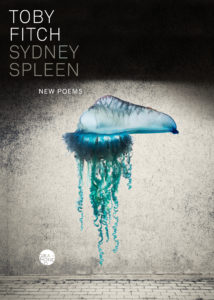 Sydney Spleen
by Toby Fitch
ISBN 9781925818758
Reviewed by BEN HESSION
Sydney Spleen is the latest collection of poetry by Toby Fitch. Its title alludes to Charles Baudelaire’s volume of prose poems, Paris Spleen. Whilst for Baudelaire, there was a desire to import the expansiveness and consequent wider palette of nuances of prose into poetry, Fitch, in his collection, utilizes a mix of styles, including prosaic lyricism and a continuation of his experimentations with form and language as seen in Rawshock and Bloomin Notions of Other and
Beau.
Laura Pettenuzzo reviews Open Secrets Ed. Catriona Menzies-Pike
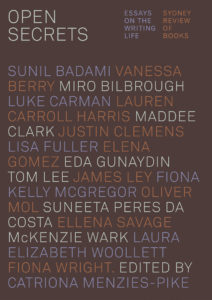 Open Secrets
Ed. Catriona Menzies-Pike
ISBN 9780648062165
Reviewed by LAURA PETTENUZO
As both a reader and writer, I was eager to dive into Open Secrets, to immerse myself in the wisdom of those with far more literary experience. As a disabled writer still shielding from COVID-19 and knowing that many of these pieces were written at the height of nation-wide restrictions, I was curious to see how (or if), the authors would engage with the impact of the pandemic. I came away from Open Secrets feeling simultaneously impressed, soothed and challenged. The multiplicity of my reaction affirmed the cohesiveness of the collection.
There’s no magical thinking here, no waxing lyrical about the elusive muse and the passion that more than makes up for the lack of recognition or remuneration awarded to writers in so-called Australia. This is a collection that boldly confronts the realities of the writing life, particularly during a pandemic: the challenge of making ends meet, the additional pressures for those living on the intersections of marginalized identities and despite it all, a commitment to the written word.
Open Secrets asserts the imperative to address the lack of recognition and compensation for writers in so-called Australia. As Catriona Menzies-Pike notes in the introduction, we live in a world that “measures value in dollars and widgets and accords so little to literature”. Fiona Kelly McGregor’s ‘Acts of Avoidance’ lists the pay rates for the publications she’s written for in the last few years and adds that, disappointingly, “these rates have remained the same since 2017.” In ‘Award Rate’ Laura Elizabeth Wollett recounts being shortlisted for the Prime Minister’s Literary Awards (PLA). In an imagined acceptance speech, she says, “Thanks for the money. It’s a lot. I wish there was more to go around”. Despite her simple aspiration “to live and write,” Woollett doubts her ability to write if she wins the PLA, asking her husband, “What if I get so comfortable, I stop trying?” Her fears are echoed by other contributors, for different reasons.
No excavation of the writing life would be complete without a focus on imposter syndrome, which Open Secrets tackles with a frankness and vulnerability that called out to my own sense of writerly inadequacy. While Elena Savage Lisa Fuller’s ‘Fight or Flight’ confronts “the horrors of the blank screen” and the “urge to run” that it evokes. It is both heartening and disappointing that success does not dispel the “dark passenger,” as Fuller calls her disparaging self-talk. There are few Australian authors who have known as much success as Fuller in recent years, yet she describes being gripped by “absolute terror.” Receiving an email from a student wrestling with similar doubts, Fuller tells them, “The only way through is never to stop writing or learning.” ‘Fight or Flight’ was written as Fuller was “trapped inside [her] house,” during lockdowns, an experience that stifled some writers and galvanized others.
Several essays in Open Secrets explored the experience of writing (or attempting to write) amidst a global pandemic. For instance, Suneeta Peres da Costa described her mother visiting her unmasked, proclaiming, “COVID-19 is not contagious!” Throughout De Costa’s piece is the refrain, “I’m supposed to be writing this essay on technology,” even as she describes all the activities she does which are not writing. Peres da Costa captured the universal struggle of the literary craft, which, for some, was exacerbated by lockdowns: the way it seems we sometimes have to grapple with ourselves to simply sit down and do the work. She masterfully evoked the sense of futility of that work given all that was unfolding in the world, wondering if it “will matter even less now than any time before, given relative prospects of dying from an incurable virus”. But it was Fiona Wright’s piece, ‘On Being A Precedent’ with which I related most, which explicitly and bravely illuminated the ableism inherent in so much of the pandemic response and the writing life. Wright rejected the notion of a “new normal” because its precursor (normal) is so often “something that rejects us regardless of whether or not (and consciously or not) we mould ourselves to fit”. For Wright, and for many disabled people, the pandemic and restrictions brought a rare and unfamiliar sense of alignment with the able-bodied world, as well as opportunities to work and socialize that had previously been deemed impossible. Wright’s piece concludes with her defeated observation that she can only “watch on as wider society refuses to adapt for people like me, or to change”. The world, Wright noted, is vastly inaccessible to those of us with disability, as is much of literature.
The complexity of prose and ideas in some of the essays, ironically, mean that it is only accessible to a well-educated and/or highly literate audience. Writing, however, does not have to be intricate to the point of inaccessibility to be beautiful, engaging, and successful. I imagine this collection may have had a wider potential audience if it approached some of its ideas in a way with which readers with varying levels of literacy and/or education could more easily engage.
Open Secrets is not so much a celebration of the writing life as it is a collective, frustrated lament at the economic uncertainty with which creatives in this country must live, the impact of the ongoing pandemic and the long and often arduous and emotionally fraught writing process. And yet, each of the writers continue to sit down at their desk, at a table in their local café, in a park, pouring words onto a page or a screen. They believe, as one day I hope we all will, that literature and humanities mean “having a natural interest in the true, beautiful and the good,” which is worth all the rest.
LAURA PETTENUZZO (she/her) is a disabled writer living on Wurundjeri country. She has a Masters in Professional Psychology and writes Plain and Easy English for various organisations. Her words have appeared in SBS and The Age. Laura is also a member of the Victorian Disability Advisory Council.
A distinct personal vocabulary by Audrey Molloy
A distinct personal vocabulary by Audrey Molloy
 Audrey Molloy is an Irish-Australian poet based in Sydney. Her debut collection, The Important Things (The Gallery Press, 2021), received the 2021 Anne Elder Award and was shortlisted for the 2022 Seamus Heaney First Collection Poetry Prize. Ordinary Time, a collaboration with Anthony Lawrence, was published by Pitt Street Poetry in 2022. She has an MA in Creative Writing (Poetry) from Manchester Metropolitan University. Her work has appeared in Meanjin, Cordite, Overland, Magma, The North, Poetry Ireland Review, Mslexia, and Stand.
A distinct, personal vocabulary as a key device in creating intimacy in the work of Natalie Diaz and Nii Ayikwei Parkes
How does poetry draw you in? Are there certain poems you feel you inhabit, almost as though you have lived them? Questions of intimacy in poetry have always intrigued me. When reading poetry, it’s possible to simply enjoy the effect, without having to lift the curtain to see the mechanism at work. But in order to write intimacy well, it is useful to understand various techniques that can be employed by the poet.
=================================Continue reading for only $5 per month
Subscribe for full access to Mascara Literary Review or login
Stuart Barnes
Continue reading for only $5 per month
Subscribe for full access to Mascara Literary Review or login
Sher Ting Chim
 Originally from a sunny island in Southeast Asia, Sher Ting is a Singaporean-Chinese currently residing in Australia. She is a 2021 Writeability Fellow with Writers Victoria and a Pushcart and Best of The Net nominee with work published/forthcoming in Pleiades, Colorado Review, OSU The Journal, The Pinch, Salamander, Chestnut Review, Rust+Moth and elsewhere. Her debut chapbook, Bodies of Separation, is forthcoming with Cathexis Northwest Press, and her second chapbook, The Long-Lasting Grief of Foxes, is forthcoming with CLASH! Books in 2023. She tweets at @sherttt and writes at sherting.carrd.co
Bak Kut Teh
肉: You peel the chilli, layer by layer, unearthing a clot of
seeds from its copper pith. The soup simmers on the stove,
frothing sunset gold over the blue-gas flames, drowned out by
radio talk of the day’s weather.
How’s your day at school?
The meat melts off the bones in the pressure cooker, pork fat
dripping from softened limbs like snow from black root on a
winter morning.
It’s fine.
You sift the remaining bone-stock with a colander, flushed
with thyme and aniseed. You tell me to scrape the flesh off the
bones with a knife and laugh when my fingers slip, wrangling
silver against each cord-like sinew.
Honey, there’s more than one way
to get to the heart of things,
You whisper as you pull out a larger knife and, taking the pig
trotter from my hands, whistle each hardened tendon – splitting
the ropes – off of the skeleton flower.
骨: Some nights, snow swathes the streets in silent, sleet-wet
pavements. You call me on the phone while you’re peeling an
orange, and like muscle memory, I say I’m busy, distracted.
Okay then listen to me.
You tell me about the lady who stops by the store every day,
never buys anything, just stares at the row of wooden horses.
You tell me how you walked the extra mile to get your
favourite diner coffee, chortling eggs and beans while watching
the busker ignite one-half of a weary skyline. This way, you
can tell your friends we still talk.
There’s more than one way
to get to the heart of things
茶: You tell me about driftwood, sangria, cherry blossoms and
tea, while splitting an orange down the middle, spooning the
seeds off its insides. I fall asleep, cord entwined around my
finger, having heard all about your day. You listen to the rise
and fall of my breath, dip a slice of orange into your cup of tea,
Long over-steeped, almost bitter to taste, still waiting to hear
mine.