Author: mascara

Dean Mokrozhaevy

Dean Mokrozhaevy moved to Australia in 2008 and grew up reading and writing in various suburbs of Sydney. They use their writing to work through their emotions and make something meaningful out of distress. Outside of their writing endeavours they also enjoy bushwalking, watching moon jellyfish in the Sydney harbour and sewing with their assistant Concrete the cat.


Foundation

Everything’s fixed up.
Everything but the pink stain in the kitchen grout.
I told you I wanted to keep it.

I don’t know what you were preparing for
But I think you’re done now.

I can’t tell what you’re feeling anymore.
Not from your face.
Your hands are still gentle
You still hold the back of my head when we sleep
You still let me sink into your body and cover us with the
blanket.

You say that the paint is peeling

But I like it

You say that you’re scared

But I’m here

You say that you love me and that you’ll always love me and that I’m the best thing that’s
ever happened to you

And I tell you that we still have decades to love
each other

You give a chuckle and change the subject


Note

When I wake up
You aren’t there.
The sunrise paints gold on the sheets
Not on your face.

I get out of the gold.
It’s not mine.
It’s yours.

The shower’s off.
The living room is empty.
There’s no one in the kitchen.

There’s a note on our shoe cabinet.
Your keys are the paperweight.

I love you.
I’m sorry.

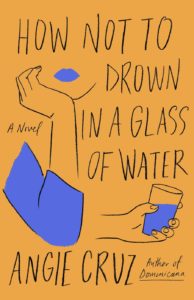
Natalia Figueroa Barroso reviews How not to Drown in a Glass of Water

How not to Drown in a Glass of Water

by Angie Cruz

Macmillan

Reviewed by NATALIA FIGUEROA BARROSO
 

Over a round of yerba mate is where I’ve heard the best storytellers. In these circles of trust, tongues and tales become tangible and ideas are formed. Before the written word came to lay claim of colonial histories around the world, this is how my ancestors passed on our truths in conversations as such. And precisely in this manner is how Angie Cruz’s fourth novel How Not to Drown in a Glass of Water speaks to us. The title’s even a clue. One that gringos may miss. In Latin America we use an expression that reminds us not to sweat small stuff. But of course, we don’t say it that way, instead we tell you, ‘No te ahogues en un vaso de agua’ which directly translates to, ‘Don’t drown in a glass of water’. And usually, 99.999 per cent of the time when you’re warned by members of our community by this idiom it’s because you’ve just desahogarte with them. Which the chatty protagonist of Cruz’s latest novel, Cara Romero, perfectly translates as, “Desahogar: to undrown, to cry until you don’t need to cry no more.” 

Continue reading

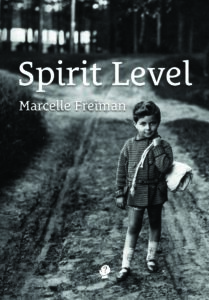
Adam Aitken reviews Spirit Level by Marcelle Freiman

Spirit Level

by Marcelle Freiman

Puncher and Wattmann, 2021

ISBN 9781922571144

Reviewed by ADAM AITKEN

Marcelle Freiman’s collection poems Spirit Level, her third book, surely deserves Jill Jones’ endorsement as a book where ‘clarity of memory [sits] alongside a shimmer of location’, whose ‘presences and absences’ are to be savoured. As restless, dynamic, and ‘unsettled’ as her earlier two collections, White Lines and Monkey’s Wedding, (which I reviewed on its publication). This new collection is structured into two parts, the first contains many poems about memories: of childhood in South Africa, of Freiman’s student days as an anti-Apartheid activist, and of parents and Jewish relatives killed and dispersed by the Holocaust. The second part of the collection explores various subjects, with many poems with Australian locations and subjects, including a number of poems on art and photography. Together the poems provide a vivid picture of the life of a South African migrant now settled in Australia. The deeper theme is the poet’s engagement with the past, not so much as nostalgia, but about how her present sensibility is now ineluctably imbricated with these memories. The poems bring a sense of presence to memory and amplify memory’s affective power, because the affect is often tied to traumatic events.

Freiman is clearly aware of the issues around South African history and questions of identity, and she is keenly sensitive to the way the ‘other’, the non-white or the indigenous is represented in this collection. Freiman examines white privilege and she empathises with those whose suffering is and was qualitatively different to her own. The collection shines a critical light on how poetry can be written on what it means to be a white woman who grew up in South Africa during Apartheid. Freiman is aware that privilege is complex, and that oppression comes from multiple directions, for she is a woman and a Jew who has migrated twice and feels the loss of her ancestors in WW2. The poems emphasise Freiman’s constant meditation on her motivations for leaving one home to make another in the postcolonial settler country of Australia. Other poems pose spiritual questions, for example, what a Jewish idea of faith could mean in a violent secular world that has done so much to sunder that faith.

Other poems grapple with the question of the settler’s place in the (colonised) landscape of savanna and desert, and with the aesthetic challenges for both poets and visual artist. Each poem is in one way or another about the way who we are much depends on what we choose to remember or forget. Being South African in Australia Freiman does NOT elide racism and many of the poems re-frame the settler as falling far short of a land or state that promises a settled and comfortable existence. As such some of the poems of place ironise a tradition of pastoral idyll. In the poem ‘In Forster (Sand up the Coast)’, Freiman acutely feels how identity, landscape and place are profoundly estranged. The poem considers the fate of Scottish woman Eliza Fraser, who was shipwrecked on a traditional Aboriginal island off Queensland. The poem figures the settler/castaway as a prodigal who must learn to adapt to new surroundings:

And I think of Eliza Fraser
            in her fringe of leaves
on an island of sand
alien, harsh as salt
and beautiful
the pools of water filtered clean
            through the grains –
how she had no choosing,
had to find in the straps
of the leaf bracts,
            learn how to seek out
the toughness

and her feet scratched and bare
were pushing down,
            sucked into sand
            as the wind blew
            her green and leathery.

In other poems there is a strong post-romantic lens, (signalled from the start by the books’ epigraph from David Malouf:

‘The world not as it was, or as
we were, but as we find ourselves
again in its presence.’

David Malouf, ‘A la Recherche,’ An Open Book, 2018

Freiman’s poems about her childhood are seen through a lens of Wordworthian/Blakean innocence, and from there the critical context builds to a critique of settler “innocence” assumptions themselves. ‘The Dam’, a poem about her childhood holidays in South Africa, ambivalently deconstructs the figure of the innocent childlike visionary. ‘The Dam’ is a superb example of nostalgia with a sting to it, as the nostalgia becomes a critique of apartheid’s power over her as a child. The holidays are idyllic, and Freiman learns the workings of windmill pumps. But as in traditional pastoral Freiman acknowledges the other. We learn of Jacob, her family’s black worker, ‘who helped me to see which side of the scale was mine’. In this way the poem is driven by a need to speak truth to the past.

Poems about the poet’s university days in the end days of Apartheid period are fascinating and give a nuanced idea of her and her father’s strategies for rebellion. Her style is both lyrical and investigative, and her history is accessible, clear, and vividly described. Without being didactic the poems provide a rich recollection of Freiman’s South Africa and its contradictions, its beauty and ugliness. It deals with guilt too, the guilt of leaving, and the sorrow of having lost her Jewish ancestors in the Holocaust in Europe. Freiman takes the strengths of lyricism and combines it with a strong documentary base.

Freiman also address historical gaps and lacunae, silences and absences that haunt postcolonial spaces. The poem ‘Country of my birth, written 27 June 2013’ Freiman names South Africa ‘a country of misery’ and mentions the mine dumps and townships like Soweto, and asks

‘How did I love (hate a country
Where I knew so much silence?

This poem spans a period of her childhood to her student days as a student activist. With superb simplicity and a devastating pun on the word “white” she writes

I had no language
            for the lost –

we lived in white houses of indifference

She goes on to ask parenthetically ‘(Can childhood draw blame?)’. Her father was able to survive and helped black South Africans as well, by bribing officials, for he had

‘ worked the system / and kept it quiet – the whispered names / the safe houses of the 1960s / for friends in banished parties’.

Freiman recounts how white citizens were literally kept in the dark about what was happening to Black South Africans, and white opponents of Apartheid were regularly harassed and victimised by the police.

Such questions about the blindness of colonial oppression are raised again in ‘Gold Miner’s Hut, Hill End 1872’, Freiman describes herself viewing a photograph by the early Australia photographer Holtermann. Her eye is withering: ‘Soaring eucalypt frames the foreground’. Freiman is reminded of Constable or Corot, a pastoral idyll with ‘cosy hut’ and smoking chimney. Crucially the mythic fiction behind the work is revealed.

but the ground here is unstable:
something has happened –
trees are stripped of their bark,
skin exposed out of season, broken
branches mess the valley floor

In ‘Feathered’, a fine ekphrastic poem describing an Arthur Boyd painting in the Art Gallery of NSW the text unpacks the viewing process – how does the viewer look upon Boyd’s antipodean Adam and Eve and his vision of the Old Testament parable. Freiman reads the painting as a dramatization of a colonial dilemma: the setters Adam and Eve ejected from privilege/paradise and cast into a haunted and subterranean hell.

In poems like these Freiman progressively reveals the layers of meaning in the title of Spirit Level, which is absolutely appropriate for this collection, as this is poetry that intends to do the levelling, and levelling by way of unpacking certain colonial epistemologies, and “balancing” those with the thinking of the indigenous Other. The poems achieve a “just” way of representing Freiman’s past, by way of gazing back at the past through today’s ‘presences’, a gaze solidly based in empiricism and facticity.

It is thus not surprising that Freiman pays homage to the great documentary photographer August Sander in ‘The Names – Photograph by August Sander’, a standout ekphrastic poem. Sander was a member of the Social Workers Party and made photographic portraits and catalogues his subjects by way of trade, profession, and by social status. Sander catalogued his Jewish subjects under ‘Victims of Persecution’, photography that prompts Freiman’s acknowledgement of an artist who can depict suffering and survival. Like Sander Freiman presents her history on a broad humane canvas with great empathy for the suffering endured.

Another balancing is achieved in the way Freiman uses fact alongside more oblique lyrical poems. In ‘Seven Ways of Mourning’, the effect of a suite of haiku-like stanzas gathers the metaphors for the way we mourn – ‘coins in black water, a favourite plant once mutually admired; ‘a bench / by the sea’; as well as the more traditional image of elegies, the engraved gravestone.

Forgetting is like
light on sharp edged fences,
clears spaces between

These spaces lie between the two scales, literally the space between the living and those mourned, white and black, empowered and the dispossessed.

The book is also giving voice to more traumatic ‘silences’. ‘The Mother Poems’ are enduring recollections of the murder of her own Jewish relatives in Lithuania. Here Freiman slowly unveils a matriarchal narrative, revealing in the most sensitive and respectful of ways the pain her mother and grandmother endured on learning about their death. The poem can only end where all such enquiries end, at the final barrier to our memory being the silence of the dead, as in this case her mother can’t speak of such a loss, and Freiman conveys this heavy burden. With remarkable modesty she writes of her ‘limited grappling’ and narrow vision of what her mother’s experience was.

In ‘Obliquely’, Freiman recounts her recovery in hospital in Sydney after an operation to mend a fractured skull. Freiman describes her time looking out at a view. Then one day her consciousness of her perception changes. Is it the effect of the trauma or something else she asks? Freiman experiences the aftermath of a coup de tête, the clarté du jour, or enlightening, which she terms ‘the ache of the real’. Freiman starts to perceive the most ordinary surrounds of suburban hospital with new clarity. ‘Obliquely’ is a fine poem that reminds me of the French poet Apollinaire’s own recovery from a head wound he sustained in WW1, which clearly damaged his faculties though he could be accepting rather than angry that he had suffered and survived. I read ‘Obliquely’ as a thanksgiving to the work of poets who shape memory and in turn are shaped by memory. But Freiman proposes nothing “divine”, or supernatural, just that the survival of the injured mind/body can seem ‘miraculous’, as imagination and indeed our power to remember, is magical. ‘Obliquely’ demonstrates a way to move beyond the melancholia of historical tragedy and the somewhat limited recounts of colonial histories.

Describing Freiman as ‘settler migrant poet’ does not do justice to this poet. But the book profits from Freiman’s lifetime of writing and researching (post)colonial literature. Such a career has been constantly ‘unsettled and resettled’ for a poet who has migrated twice, from her birthplace in South Africa then to the UK, hence to Australia. But such unsettling opens up so many vectors. Starting from the child’s vision of “nothing or nothingness” and then the immersing oneself in this world and this sensation is at the heart of Freiman’s writing process. The poem ‘What next?’ sheds ideological baggage and begins with no ready-made subject (or theme). Like the mind cleared, it can begin with a completely unpremeditated intention. Poems take shape in this ambivalent process of asking “what was it like, what happened, what did I NOT know what I know now?”. The question of “What next?” becomes “Where to next? Like her favourite painters, the subject of the representation can only be certain once the work is complete or abandoned. But then perhaps no collection of poems is ever ‘completed’ and no work of memory is ever complete, and no trauma is ever quite ‘cured’. Freiman’s poems are like the plants and people she most admires for their toughness, a toughness that she likens to drought resistant trees and plants in the veldt, to the spirit of old mining towns (despite their role in colonialism), and to the black South Africans who looked after her as a child and whom her father helped during the Anti-Apartheid struggle. Spirit Level is thus, a book that remembers the spirit of the survivor but looks to the future with great optimism and openness.


ADAM AITKEN’s last poetry collection is Revenants (Giramondo). He received the Patrick White Award in 2021.

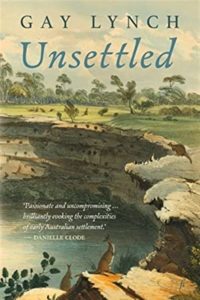
Michael Hannan reviews Unsettled by Gay Lynch

Michael Hannan reviews Unsettled by Gay Lynch

Unsettled

by Gay Lynch

Ligature Publishers

ISBN 192588323X

Reviewed by MICHAEL HANNAN
 
What does it mean to tell the stories of one’s ancestors? How do human beings endure landscapes dominated by scarcity, isolation, gruelling labour, and patriarchal cruelty? And what is the price to be paid for survival?

=================================

Continue reading for only $5 per month

Subscribe for full access to Mascara Literary Review or login

Continue reading

Martin Edmond reviews mō taku tama by Vaughan Rapatahana

mō taku tama

by Vaughan Rapatahana

Kilmog Press

Reviewed by MARTIN EDMOND


I first encountered Vaughan Rapatahana in 2010, in the pages of brief magazine, in the days when it was being edited by Jack Ross. Rapatahana’s writing was bi-lingual ― English and te reo Māori ― typographically inventive and uncompromising in its engagement with matters of world concern as much as local issues. There were Asian references. In those days, it turns out, he was living between the Philippines and Hong Kong and making a living as a teacher of languages. He has also lived in Brunei, the People’s Republic of China, Nauru and the Middle East as well as in different parts of Aotearoa: Auckland, the East Coast of the North Island, Mangakino in the Waikato. The first time I saw a book of his was when Dean Havard of Kilmog Press, the publisher of the work reviewed here, sent me a copy of China as Kafka (2013). 

Kilmog Press was founded around 2007 and, like brief, continues to this day; however, since Havard opened a bookshop, Dead Souls, in Dunedin, its once hectic rate of publication has eased somewhat. Kilmog books are distinctive: hardbacks with hand-crafted covers made as art objects by the publisher himself; with letterpress title pages and the rest of the internal matter offset printed. They are unique objects, in small editions (50 copies in this case) and marketed through the bookshop, the Kilmog website and by word of mouth. In the timid, highly institutionalised and subsidised literary economy of Aotearoa / New Zealand, Kilmog books are not often reviewed. Notwithstanding, Havard has assembled an international stable of writers chosen according to his own taste. When, for example, he read in an Australian magazine some poems by George Murray, poet laureate of St. John’s, Newfoundland and Labrador, he offered him a book: Exit Strategy (2010) was the result. Something similar may have happened with China as Kafka.

It was Rapatahana’s first book; but came out in tandem with another, Home Away Elsewhere (2011), from Hong Kong’s Proverse Press; there have been half a dozen more titles since then, including a major collection ināianei / now (2021) from Cyberwit in Allahabad, the closest Rapatahana has yet come to publishing a selected. Meanwhile this book, his ninth, mō taku tama (= for my son), collects the poems he has written for, and to, his son Blake, in the sixteen years since he died, by his own hand, aged 29, in 2005; this information appears in an author’s note at the front of the volume. ‘I cannot cease writing about Blake,’ the note continues. ‘In this way, I keep him alive.’ The direct address, the straightforwardness of the language, the refusal of sentimentalism and the documentation of raw experience, are characteristic of the poems too.

But that is not the whole story. Rapatahana is linguistically inventive in ways that few writers know how to be these days; and a complex poet who foregrounds his use of language in transformative ways. Erik Kennedy, in a recent review of ināiane / now, pointed out: ‘he is the most daring poet we have when it comes to seasoning his work with sesquipedalian lingo (that is, million-dollar words) . . . he has a more developed practice than anyone else when it comes to writing translingual poems in te reo Māori and English.’ One of the fascinations of his bi-lingual work is that it allows you to read back those arcane specimens of English vocabulary, those million dollar words, into his Māori translations of them, making both languages seem, not just stranger, but wilder and deeper too. 

Even readers who have no Māori will be intrigued by these metamorphoses; and, since Rapatahana’s work has been translated into Bahasa Malaysia, Mandarin, Italian, French, Spanish and Romanian, readers of those languages too can perform the exercise, reading back unusual words from their own languages into one they might not know well, or at all; and aiding Rapatahana in his mission ‘to push for a far wider recognition of the need to write and to be published in this tongue.’ In pursuit of this aim, and as a language teacher himself, he has co-edited two essay collections (English language as Hydra; Why English? Confronting the Hydra) which critique the rise of global English as a stripped down, utilitarian language of business and politics which cannot accommodate, let alone voice, the concerns of First Nations peoples.

Before he left Aotearoa / New Zealand for that long sojourn overseas, Rapatahana completed a doctorate at the University of Auckland. His topic was Existential Philosophy and English Literature’ and his main subject the writer Colin Wilson, whose 1956 non-fiction book, The Outsider, impacted significantly upon a whole generation. Wilson, the archetypal Angry Young Man, has been ritually disparaged by the academy ever since; he remains an outlier, an existential philosopher inquiring into, among other things, true crime and its links with mysticism and the paranormal. Rapatahana continues to write about him; perhaps because of his own outsider status. He is one of a select few Aotearoan poets who have been invited to the annual Medellin Poetry Festival in Colombia. Another sesquipedalian, Alan Brunton, was the first, in the year 2000. Since then, David Eggleton, James Norcliffe and Apirana Taylor have also gone there. This year, Tusiata Avia will be a guest. 

Rapatahana is also a well-read, generous, yet exacting literary critic, writing on poetry from Aotearoa / New Zealand and, particularly but not exclusively, upon Māori poetry and poets, in a series of commentaries published in Jacket 2. They open up a perspective upon Aotearoan literature that most Pākehā (and indeed most Māori) critics couldn’t or wouldn’t articulate. There is presently a fluorescence of writing and publishing going among Māori and Pasifika writers; but little critique, positive or otherwise, of their work. Rapatahana’s critical voice is measured, calm, inquisitive; never partial or even partisan; maintaining an inclusive stance while refusing to indulge the whims of coteries or the shibboleths of received opinion. He augments his critical and scholarly writing with hands-on teaching of the techniques and inspirations of bi-lingual poetry. 

Although most of Rapatahana’s poems are brief and to the point, nevertheless they resist easy reading. Their insistence upon bi-lingualism may strike some readers as unnecessarily oblique. Even those who have a passing acquaintance with te reo will find his translations of his own English poems into Māori challenging; the same, I assume, is true of the English versions of the poems in te reo. The Māori, for English readers, requires study and not every reader is willing or able to do that. Additionally, fragments of other languages enter the poems, especially Tagalog (Rapatahana’s wife’s native language) as well as Mandarin; along with allusions to speakers of other tongues. His habit of stretching out or breaking words up, typographically, might also act as a disincentive to some readers. Really, however, what makes Rapatahana’s work difficult for mainstream literary culture in Aotearoa / New Zealand is its confrontational nature. 

Rapatahana was born in Pātea, in south Taranaki, of Ātiawa descent; Ātiawa suffered as much, or more, than any iwi during colonisation. He has written poems about incidents in Tītokowaru’s War (1868-9) ― the massacre of children by militia at Handley’s Woodshed in 1868; Tītokowaru’s sexual transgression, and subsequent loss of mana, at the fortified pā at Taurangaika in 1869. He is also affiliated with Ngāti Te Whiti, the hapū of Te Whiti, the prophet of non-violence, whose ideal community at Parihaka was brutally sacked by government forces in 1880. In Aotearoa / New Zealand, bi-cultural teaching about the Land Wars (1845-1871), and the Musket Wars (1818-1845) which preceded them, has only this year entered the school curriculum. Pākehā do not like being reminded that the country they call their own is theirs only by conquest. Māori consider it still belongs to them. 

Rapatahana is of the same cohort as current poet laureate David Eggleton; they went to school together in South Auckland and share a belief in the transformative power of writing. However they are very different poets. Rapatahana’s poetry is spare and sharp and bristles with intent. Every word is precisely placed. His prose too is considered and exact, setting out connections between historical crimes, especially the confiscation of land, and the high rates of incarceration, homelessness, unemployment, poverty and suicide amongst Māori today. In both poetry and prose he tells stories from the past in an attempt to heal the present, and thereby make a future possible. His bi-lingual texts emphasise that the loss of te reo was just as catastrophic as land theft. Lip service to the outrage he and others still feel about these losses is common these days among the literati and their enablers; but direct experience of its effects, or engagement with them, is not. 

Rapatahana doesn’t however lay the blame for the death of his son upon the social evils land confiscation and loss of language have caused; he doesn’t blame himself either. Or not obviously. Rather he lays out the facts of an event he can neither forget nor comprehend; one which he can document but can’t resolve: hence the imperative to keep the conversation going. These poems are confronting because they insist you look, not at grief’s indulgence or its redemptive power, but at the impoverishment it causes. I think it is this, not the big or unusual words, or the foreign ones, or the stretched and broken ones, that makes the poems hard for some people to deal with. Erik Kennedy’s review of ināianei / now, which is intelligent and largely positive, was published by Landfall Review online under the derisory title ‘Prating in Alien Tongues’. 

I could go further: mainstream New Zealand poetry is still dominated (though not defined) by the school of quietude: in Ron Silliman’s words, ‘poetry’s unmarked case, and its most characteristic ― even defining ― feature is the denial of its own existence.’ A poet of this persuasion wishes their poem to appear both authored and autonomous. It usually relies upon observation and then reflection on what has been observed; sometimes with an aphorism by way of a conclusion. Often the observation is of the self; but it might also be a wave of the sea, new red buttons on an old black coat, a bike ride through the suburbs or an encounter with a bird. We are to admire the poet’s skill with words, with metaphor; their sensitivity and their embrace of ‘intimacy’; above all their wise passivity before a largely inscrutable world. Or rather, a world made briefly scrutable by the poem. 

Rapatahana’s work does not do this. I don’t mean that description, observation and / or reflection are absent from it, nor that he is unengaged; I mean he does not sentimentalise the world, the self or the other. He sets out the facts; and keeps his commentary upon them to a minimum; letting the words do the work. One of his poems begins: ‘I watched my father           die’ and ends: ‘an uncanny / vomitous / odour, // no poet could              ever / limn.’ Limn is an archaic term for the act of painting; its literary use indicates, archly, description of a landscape as much as a painting of a landscape; its contemporary equivalent is perhaps to be found in ekphrasis. But the root of limn is the same as that for ‘illuminate’; it also means ‘to light up’ and ‘to make clear’. As the last word of the poem it seems at first anomalous; but actually reverberates all the way back to the beginning and thereby articulates what has just happened: his father’s death.

Most of the poems in mō taku tama are laments which do not try to traduce the fact of death into something ‘poetic’; nor to make of this father’s grief for his son an occasion for fine writing; nor a demonstration of the nobility of his soul. Rather the poems bring before the reader the incomprehensibility of suicide and the inconsolable grief it occasions; which is, and always will be, lifelong. We are asked to contemplate, not so much the poet’s feelings, but the fact of the death that has occurred; which has, inter alia, made it impossible for him to write about it in any other way than this. There is no redemption, no closure, no way of assimilating what has happened; the only hope is, as the last words of the last poem in the book put it, ‘when I finally alight / I pray you’re waiting / at the terminus’ The omission of the full stop is of course deliberate. 

Lament is a traditional genre of Māori verse, as it is in many poetries. The Encyclopedia of New Zealand, in 1966, recorded that ‘the largest number of songs comes under the heading of laments (waiata tangi) and love songs (waiata aroha)’; and goes on to mention (among unspecified others): oriori (a lullaby); pao (a derisive song); apakura (a lament for the dead, especially one killed in battle); tuki waka (a canoe song); and whakaaraara pā (a watchman’s song). The writer of this entry, most likely Ngāti Maniapoto kaumātua and scholar Bruce Biggs, was talking about the situation as it pertained in his day; even now, most non-Māori New Zealanders will know only the words and tunes of a few popular songs, the bi-lingual National Anthem, and the haka that precedes rugby matches in which the All Blacks take on whoever their opponent is to be. 

Fifty years later, in 2014, musicologist Mervyn McLean, in a book about the Lapita people who are ancestral to all Pasifika cultures, including Māori, compiled a list of the kinds of songs that were sung in Polynesia before the European invaders came: ‘birth songs, boasting songs, children’s songs, courting songs, divinatory songs, entertainment songs, enumeration songs, erotic songs, farewell songs, fighting songs, food-bearing songs, funeral songs, game songs, greeting songs, hauling songs, incantations, initiation songs, insulting songs, juggling songs, laments, love songs, marriage songs, narrative songs, obscene songs, paddling songs, praise songs, satirical songs, spirit songs, tattooing songs, taunting songs, teasing songs, toddy songs, top-spinning songs, topical songs, war songs, welcome songs, and work songs.’ 

This broad range of songs must have been sung by Māori too; it would be strange if they were not. The decline in the number of categories in the present day therefore reflects the loss of a communal lifestyle; which would once have celebrated, for instance, the hauling of canoes over an isthmus as a common occurrence. Songs of love and grief remain of course ubiquitous. Rapatahana’s poems are usually either laments, waiata tangi; calls to action, like haka; or fragmented narratives which lay out the details of historical wrongs; of which his son’s suicide, if only by implication, may be seen as one. His work witnesses the past richness, and contemporary undervaluing of, the tradition he works within; even during a period of so-called de-colonisation. I think it is this aspect of Rapatahana’s work that Pākehā find it difficult to engage with. The same unwillingness to deal with feelings of anger and bereavement among Aboriginal people, let alone with the facts of their dispossession, is found among white Australians,. 

The detail given of Blake’s life is minimal. His age, the manner of his death, where it occurred ― not much more. There is one grain of reminiscence around which a pearl has accreted. It comes two thirds of the way through the book, in the title of the tenth of the fifteen poems: ‘invictus redux’. The poem begins: ‘this was your favourite verse. / something I did not know / until / later. / far too late.’ The reference is to W E Henley’s ‘Invictus’ (1875), written while he was in hospital, bedridden, recovering from the amputation of a leg due to tubercular arthritis. Many readers will know the couplet with which the poem ends ― ‘I am the master of my fate / I am the captain of my soul’ ― but few would be able to quote the beginning: ‘Out of the night that covers me, / Black as the pit from pole to pole, / I thank whatever gods may be / For my unconquerable soul.’ Perhaps father and son share such a soul. 

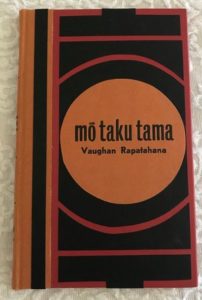
mō taku tama is a handsome book, a robust hardback, taller than most Kilmog publications; in its dimensions resembling the coffin in which the dead son lay, mentioned several times in the poems: Vaughan’s last sight of Blake. On the cover it has the title and the author’s name in black inside an appliqued ochre circle which looks like a sun; abstract, black shapes are glued down over the red boards in such a way as to make that sun resemble an eye, perhaps in a gate or on a door; there is also the visual pun: son / sun. The end papers are pale green, the unused leaves, front and back, have been cut large and left, like unlived years; and the type, as in all Kilmog books, is clear and unambiguous. On the title page, in a single decorative flourish, the author’s name appears in red below the black lettering. This is a heart-breaking book; but it is also a manual of how to stare down the facts of life and death, and especially death by suicide. It is by keeping on talking to the dead, even when there isn’t anything to say: ‘kua heke haere ahau / ki tēnei tāruarua o te toikupu; / kāore aku mea kē atu.’ ― ‘I am reduced to / this anaphora: / I have nothing else.’

Links:
Vaughan Rapatahana reading:
https://www.nzepc.auckland.ac.nz/features/six-pack-sound/01/rapatahana.asp

Erik Kennedy’s review:
https://landfallreview.com/prating-in-alien-tongues/

Rapatana’s essays for Jacket 2:
https://jacket2.org/commentary/introductory

Best NZ Poems 2017:
https://www.bestnewzealandpoems.org.nz/past-issues/2017-contents/vaughan-rapatahana/

Mervyn McLean’s Music, Lapita, and the Problem of Polynesian Origins can be downloaded as a PDF here: http://polynesianorigins.org/

A dictionary of Te Reo:
https://maoridictionary.co.nz/

MARTIN EDMOND was born in Ohakune, New Zealand and lives in Sydney, Australia. He holdsa Doctorate of Creative Arts from Western Sydney University. His most recent books are Isinglass (UWA, 2019) and Timelights (Lasavia, 2020). A non-fiction work, Marlow’s Dream, on Joseph Conrad, is forthcoming.
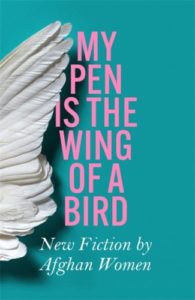
Zarlasht Sarwari reviews My Pen is the Wing of a Bird

My Pen is the Wing of a Bird: New Fiction by Afghan Women
Ed Catherine Boyle

MacLehose Press Quercus London

Hachette Australia

ISBN: 9781529422214

Reviewed by ZARLASHT SARWARI

My Pen is the Wing of a Bird, draws us into the lives of fictional characters in Afghanistan in an anthology of twenty three unrelated but deeply connected short stories. Written by 18 women authors in Dari and Pashto, the works are translated for an English speaking audience. The stories traverse multiple decades in Afghanistan’s recent history, from the communist ruled period of the 1980s to more recent representations of Afghanistan society during the American occupation. The political climate of Afghanistan is not the focus of these stories, though it is important to be cognisant of the different regimes, wars and occupying forces which form the backdrop of these vignettes. 

It is unfortunate, that we continue to learn of Afghanistan through the repeated narration of its affliction with war. A place devastated, cradling the broken hearts, maimed bodies and hungry stomachs of its people. The anthology illustrates how people are forced to endure life, amidst the manic conditions cumulative war and violence brings. As we read how the most basic of needs remain unmet for characters within these stories, we are forced to contemplate the banal and significant privileges we as readers, take for granted every single day. 

We come to know the women and men in these stories, inhabiting urban centres or remote villages across Afghanistan. We move with them through their day, speaking to loved ones overseas, cooking meals, going to work, childrearing, dealing with colleagues, cursing bad health – all seemingly mundane tasks that anyone across the world can relate to. But these stories are not mundane. They are intense and impactful. They feel unbearably real. We witness characters negotiating everyday needs and obstacles in the midst of extreme poverty, injustice, want and violence. We witness so many contradictions and the convergence of so many unfortunate and unimaginable factors that weigh down on human existence. In between, we also witness acts of quiet kindness, unexpected wins and persistence in actualising personal agency. 

Whether based on imagination or seeds of truth, these fleeting instances of hope within the stories, gives us the oxygen we need to continue reading. Even so, they compound the sad reality for how ephemeral hope has come to be for so many of the characters and by extension the men and women of Afghanistan. On the unimaginable complexity described within some of these stories, one can only surmise that in a society at war for more than forty years and plagued by foreign occupation, the authors may well have witnessed such things and laid them bare for us to also witness. It is this fortitude in storytelling, that brings hope and understanding in the midst of so much hopelessness.

The book is the outcome of a project led by Untold, a British organisation describing itself as  a ‘development program for writers marginalised by communities and conflict’(1).  The project was the culmination of two years work between writers in Afghanistan and translators and editors abroad. The anthology was published in 2022, following the shocking and chaotic withdrawal of US forces after 20 years of occupation.  

The opening story gently invites us to witness the life of an elderly mother who stayed behind in Kabul after having sent all her children abroad. It is set during the post 2001 era of the US occupation and infers the myriad of geopolitical and transnational influences which plays out in her life. The lonely melancholy is obvious in her movement; pouring tea, turning on the television to connect with the outside world and forlornly looking at photos of her children and grandchildren living abroad. These images depict a familiar experience of separation among so many families and offers details that many readers who form the Afghanistan diaspora would recognise (tea with dried mulberries and walnuts, photo of a child posing in their traditional dress next to a large vase, a cloth draped over the television to avoid dust). These are the details that speak to the practices of home making and cultural maintenance replicated by many women of Afghanistan diaspora communities across the world. 

We become anchored in the social and political reality of the protagonist, Nuria when we learn of the latest news bulletin about a violent attack targeting and killing staff at the Moby Media Group (MMG). As one of the many privately owned media companies which emerged in post 2001, the company was often targeted by the Taliban as it was a symbol of western influence and excess. MMG led the dynamic media landscape which was forming in the country with free market conditions and freedom of speech laws. The Afghan Australian owner of the company, Saad Mohseni is often referred to as the Rupert Murdoch of Afghanistan. Nuria switches the news off as soon as she turns it on, suggesting fatigue by the violence, another experience common among the war weary people of Afghanistan. We witness her life through the series of photos she glances upon, marked by decades of war and regime change, social connection and loss, and her family’s migration to safety. She accepts solitude as part of her maternal obligation and derives satisfaction in keeping her children and their future safe. She does not fear living in solitude, but the realisation that she may die in solitude leaves her unsettled and distressed. This opening story sets the sombre mood and opens the door for us to walk in deeper to further explore the other more confronting stories to come. 

Each story beautifully captures details, intimate perspectives and dynamic relationships. Each story allows us to come to know the characters closely in short, sharp scenarios. Though each story is concise, they are not an easy read. There is a need for pause, to breathe and reflect as one moves through this anthology. Despite some of the universally familiar scenarios, there are many aspects reflecting unique aspects of Afghanistan culture and everyday practice. The throwing of water behind the steps of a traveller to bless them a safe journey, the customary way of how guests are received, drinking tea with ghor – an unrefined sugar product common in South and Central Asia. There are also many depictions that represent negative and violent attitudes and treatment towards women, ethnic and sexual minorities. To an outsider it may reinforce the negative tropes routinely applied to Afghanistan as a backward country. However, it is a harsh reality that in a four decade climate of war, poverty and illiteracy, many aspects of human behaviour decline and become further perverted. For those with heritage from Afghanistan or familiar with the culture there, they may well be able to distinguish how problematic or difficult practices have become further corrupted or amplified.  It is difficult and jarring to face these realities as they are presented to us throughout these stories.

The anthology opens windows to worlds and characters during different eras in the past four decades of Afghanistan, where we are able to enter the homes and communities of the people who inhabit the stories. The collection provides an overview of very diverse experiences from Afghanistan not commonly available to an English speaking audience. A positive and empowering move would have seen the stories published in the language they were written (Dari or Pashto) alongside English, rather than in English alone. English speaking audiences would of course read the translation but for those literate in Dari and Pashto within Afghanistan (whose speakers number over 60 million (2)) and those living within the estimated 7 million strong Afghan diaspora across the world, could have had the opportunity to read these stories in their mother tongue.  It would have offered a fitting tribute to honour these works and encapsulate as part of the important body of literature documenting the complexity of life in Afghanistan, a region which has had a strong literary culture dating back to the era of the Samanid empire in the 9th and 10th centuries. 

It was from the region which Afghanistan now occupies that many classic and contemporary artists and literary masters have emerged. Afghanistan was the birthplace of the great Islamic scholar, poet and master of Sufi mysticism, Jalāl ad-Dīn Muhammad Balkhī (known also as Rumi) born in the early 13th century, who produced the epic Masnavi – a six book poem comprising 50 000 lines. Rumi’s work has had significant international influence until this day (3). Other writers of cultural significance who made major contributions to the Dari literary canon and who came three centuries before Rumi include Rabia Balkhi, a poetess renowned for her ‘major contribution to the foundation of the Persianate literary canon’ and Abu ‘Abd Allah Ja‘far ibn Muhammad Rudaki of Bukhara, a poet laureate of the Samanid court (4). Rudaki was the first poet of note to compose poetry in the New Persian script and is hailed as the father of Persian poetry. The significance of his contributions are felt in the wider Persianate world including what is now Afghanistan, Tajikistan and Iran. Though the nature of society and life has changed dramatically since the time of these literary greats, the trajectory of Dari and Pashto literature remains ever connected and forms the root of everyday literary practice loved and valued across Afghanistan and beyond. For a society still plagued with remarkably high illiteracy rates, literary works are often transmitted via musical arrangement. Poetry and prose are transformed with musical composition allowing those literate and illiterate to tap into the cultural assets of the literary realm through different generations of popular culture (5). 

In reading the anthology, My Pen is the Wing of a Bird, one is reminded of a heartbreaking song which captures the sad sentiment of the experience of the people of Afghanistan. 

Sarzamine man (My Homeland) performed by respected artist Dawood Sarkhoosh (1998), and written by Amir Jan Saboori, laments the ongoing suffering of a people forcefully displaced from their homeland. The song laments the pain of separation and the ongoing and cumulative trauma and dispossession rained upon the people of Afghanistan by external forces. 

“My homeland, in uncurable pain, who composed your grief?,
My homeland, who opened your door… who stole your treasures?
My homeland, everyone has damaged and broken you, each taking turns”. (6)

It is this collective grief, captured through song and literature, that is detailed and given colour in My Pen is the Wing of a Bird. The stories are not only about war, they are of course about how people, families and communities live in spite of it. How justice and fairness are perverted, how basic needs are desperately met and how some women hold onto hope in the most unlikeliest of ways. How long standing cultural values are eroded by regime changes, and how betrayal and injustice is endured but cannot cause delay from picking up a child on time from preschool. The title of the anthology evokes the desire to transcend the physical and material hardships of life in Afghanistan. It is only upon completion of the anthology, where we feel the depth and extent of this desire, the reason for it and the necessity of it. 
 

Notes

1. Untold Website, see http://untold-stories.org/
2. Unknown author, 2011, “The view from within: an introduction to new Afghan literature”,
Words Without Borders, see https://wordswithoutborders.org/read/article/2011-05/the-view-from-within-an-introduction-to-new-afghan-literature/
3. Ali, R. 2017, “The Erasure of Islam from the Poetry of Rumi”, The New Yorker, see https://www.newyorker.com/books/page-turner/the-erasure-of-islam-from-the-poetry-of-rumi
4. Ebtikar, 2021, “The story of Rabia Balkhi, Afghanistan’s most famous female poet”, Ajam Media Collective, see https://ajammc.com/2021/08/16/rabia-balkhi-afghanistan-poet/
5. Massoumi, M. (2022), “Soundwaves of Dissent: Resistance Through Persianate Cultural Production in Afghanistan”, Iranian Studies, 55, 697–718.
6.  For an audio recording of the song Sarzamine man and credits, see https://www.youtube.com/watch?v=ZdQP8-gHjxg.


ZARLASHT SARWARI
is a researcher, writer and PhD candidate at Western Sydney University. Her research examines identity construction and belonging among Afghanistan diaspora communities in Australia.  Her work considers what it means to be from Afghanistan in the context of a homeland, both real and imagined, which has become increasingly out of reach and under threat. Zarlasht has produced written works for Southerly Journal, ABC radio, Sydney Writers Festival, Parramatta Laneways Festival and Fairfield City Museum and Gallery. 


Joshua Klarica reviews Nostalgia has ruined my Life by Zarah Butcher-McGunnigle

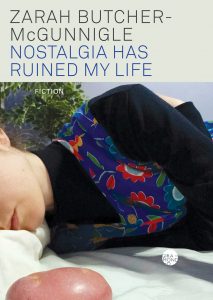
Nostalgia Has Ruined My Life

Zarah Butcher-McGunnigle

Giramondo 

ISBN 9781925818772

Reviewed by JOSHUA KLARICA


A technique commonly employed by poets is the announcing of the setting or theme of the piece in its title. Consider T. S Eliot’s poem ‘In a Station of the Metro’, whose title functions as a covert, preliminary line that allows the poem to maintain its effective couplet form. This device eliminates exposition in the work, and plants the reader in the thick of it immediately. Zarah Butcher-McGunnigle, the New Zealand writer whose first book Autobiography of a Marguerite takes the long poem form, utilises this same tactic in the title of her second work. Before we encounter the first words of Nostalgia Has Ruined My Life, the thesis has already been rambunctiously stated. Butcher-McGunnigle, it seems, insists that we view the impending labours of the unnamed protagonist through this prism, managing our expectations – ensuring we understand – before we read and, inevitably, pass judgment.

At once a dark, meandering comedy, at once a documentary of the stultified millennial, Butcher-McGunnigle’s second work follows the deadpan joys and luckless U-turns of a young woman navigating the trials and illusions of youth in an age where ennui seems a rite of passage. She idles time on dating apps, reads online horoscopes, and attempts to apply for jobs before reaching the cover letter and thinking “I can’t be bothered, I don’t care about this at all”. (p25) Any successes are swiftly undone, while any misfortune is short-lived: this is the recipe for getting by. 

While the denouement of the text revolves around securing an administration job at a bakery through a short-lived ménage à trois, the source proper lies amid a series of events not particularly concerned with forming a narrative at all. The text consists of short bursts of commentary, noting moods, whims, and events, usually little more than a paragraph in length, although on rare occasion these break onto a second page. This book of vignettes, although this is a loose term here, might be an exercise mandated by her therapist. They chart, comment, and record the events of a life waiting to get going. 

It is initially challenging to determine whether this is boredom palpable, or rather a languishing attributable to the rising challenges of mental health. There is dry pathos here: “I’m still experiencing cognitive dissonance regarding the heater I bought” (p8). This same humour is bundled into a cry for help: “I’m trying to stop sleeping with a towering pile of clothes on my bed so now I’m sleeping with a towering pile of clothes on the floor instead”(p48). As the notes pile up, the narrator reports suffering from depersonalisation disorder and depression, the intense feelings of being outside of one’s body: watching instead of driving. This recasts any initial suspicions that this was an entitled, bored millennial moping and milling, but still, dealing only in sharp statements, Butcher-McGunnigle never truly invites the reader to know the subject.

Instead, the collages of text become confessions of one simultaneously trying to appraise and make sense of a situation. Not many can say with confidence that they “want to pick blackberries on a farm and then die”(p8), or that they want, this moment, to have scabs on one’s knees(p39). Yet for all their darkly droll commentary, these confessions give way to more sincere, and serious, realities. If having scabs is proof that we have lived, the gaining of that experience is another case altogether. Later, during an interview, our protagonist suddenly “can’t concentrate on anything” because her intrusive thoughts have inexplicably fixated upon her “ankles (being) gnawed open and bleeding, bones exposed”(p44). There is bravado in these lines, but it gives way easily. 

If one joy of the reading experience can be found in plugging the gaps and discerning what happens outside of the story presented, then there is an entire world that carries on beyond these short monologues, making the task of the literary synapse jump a rather difficult one. This isn’t to say that such a limitation necessarily works against Butcher-McGunnigle here. While the fragmentary, oscillating nature of narration might not appear particularly cohesive, the blunt imagery claiming the protagonist’s days is thoughtful. Late one night, for example, while fending off the internal machines that question what she is doing with her life, she is struck by an ad for a mop. Later, she feels compelled to mop up a mess herself, or sweep dust into a pile. It might seem ridiculous, like wanting to walk down a very long driveway, but at least it is something to counteract, through any means possible, the feeling of uselessness. Throughout the text, Butcher-McGunnigle is deftly at work arguing that almost anything can have purpose, so why is it that we can struggle so much to find it?

Another equally dark and unnamed heroine suffering a similar anxiety can be found in Otessa Moshfegh’s much appreciated 2018 novel My Year of Rest and Relaxation. Only, where Moshfegh’s protagonist ends up losing a year, Butcher-McGunnigle’s is so helplessly aware of each ridiculing second as it takes an age to pass. This is a take on modern anxiety that exceeds Moshfegh’s effort, in part (and noting that the heroines are separated by two decades), because Butcher-McGunnigle makes it clear that life, irresistibly, goes on elsewhere. One of the great strengths of Butcher-McGunnigle’s subtlety is the way the external cast – a host of nostalgic-laden folks including ex-boyfriends, high school bullies and siblings – become osculating matter in the protagonist’s orbit, whose episodic appearances work to chastise her own effort at getting on with it, while reinforcing the absurdity of doing just that. Butcher-McGunnigle unveils the hilariously twisted idiosyncrasies employed to handle the increasingly native experience of lackadaisy, like scamming Airbnb or securing one’s place in an elusive pyramid scheme.

This mode of commentary is calculated, refined so it reflects a persona under siege of review and hyperaware of its own subjectivity. It is life in the internet age – bite-sized content that excels at the entertaining and the forgettable. In an endemic example, our protagonist is ovulating, and laments that

[n]o one’s giving me any attention so I make an apple pie at midnight. I spray multi-purpose cleaner on the pie and it shines and then it gets soggy. Last week I had sex with an orphan. But we fell out before I could give him his birthday gift. (p38)

Beyond the jocular and the intimate, for better or for worse, this is how she wants to be seen. Reading these episodes becomes an exhibition, and so hints at the works compelling theme: in what spaces do we exist, and what dictates them? Horoscopes, Tarot readings, Myers-Briggs personality tests, and a litany of online chats informs Butcher-McGunnigle’s protagonist of a particular sense of self, and how she and others view it. 

There is much space between these episodes to which we are not privy, meaning these episodes, their scarcity, their intensity, is highly selective. As a result, Butcher-McGunnigle’s work tussles over the roles we should be performing, but not necessarily those that we do. Sure, there are the more obvious episodes Butcher-McGunnigle wants us to note on the matter: “When he’s fucking me I am thinking about what would be an easy but nutritious lunch option for him” (p15). Then there other, subtler evidences of her poor, somehow inaccurate performances of being, like when the Mystery Shopper she is sleeping with insists they can’t both be INFP’s, or the interviewer for a teaching role suggests they instead brainstorm some other vocations for which she might be suited. Yet our heroine has all the attributes that suggest she should be, or at least can be, successful. A writing career, even though it has stalled here; pregnancy, though not seen through; a deep and very mixed bag of suitors that find her attractive and endearing but succumb themselves to obnoxity and online currency; her own intelligence, in spades that can’t find the matching outlet – she is sharp and useful as a blade kept behind inch-thick display glass. So, it isn’t so much a matter of finding someone to say I love you to, but rather in finding a way to value the act itself. 

Before we begin Zarah Butcher-McGunnigle’s second work, we are asked to assume that nostalgia has to some effect shaped the story that follows. Be it warm liminality or useless retreat, we are immediately called upon to approach the text with our prejudices for or against nostalgia in hand. But by works end, this initial outpost seems rather ham-fisted, for nostalgia in these pages cannot simply reference halcyon throwbacks. Rather, it reflects a time when we were unencumbered by the dictates of our performance. 

Nostalgia emerges when we look back. It is difficult to unsee. “I just want to be in a ball pit in a McDonald’s playground,”(p80)admits the young-but-too-old female in the closing passages. Yet the way is shut, and now even the longing for this kind of easier, familiar passage becomes its own performance. But everything is fleeting, we know this much, which has both a kind of crestfallen truth and surprising optimism to it: this too shall pass.


JOSHUA KLARICA is a writer who lives and works in Sydney’s Inner West. He has a first class honors in English Literature from The University of Sydney, and has been published in Backstory Journal and Bluebottle Journal, among others.

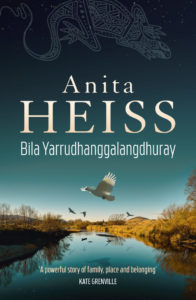
Brenda Saunders reviews Bila Yarrudhanggalangdhuray by Anita Heiss

Bila Yarrudhanggalangdhuray

by Anita Heiss

Simon and Schuster     

Reviewed by BRENDA SAUNDERS


In the ‘Prologue’, to her novel, Heiss introduces us to Aboriginal tribal life at the onset of colonial expnsion in southern NSW. This is Gundagai in 1838. She provides the historical setting for the action and events to follow. At this time Wagadhaany, the central Aboriginal character in this novel, is a small child living with her family along the Marrambidja Bila (Murrumbidgee River). She hears the adults complaining about the changes, the loss of their land, the clearing of their hunting grounds. They don’t understand why the settlers won’t listen to their advice. Heiss introduces the reader to Wiradjuri words and names, which give greater authenticity to her description of the river people and their culture. There is a glossary of Wiradjuri words and reference notes included at the end of the book.

The novel opens and ends with two dramatic events, two tragedies caused by the great river. In 1853, Wagadhaany is now a young woman working as a domestic for the Bradley family. She is allowed to visit her family camp on Sundays, where she joins in celebrations by the river, speaking her own language freely. In English her name means ‘dancer’ and she readily joins in camp celebrations. The river becomes a metaphor for the power of the natural environment: respected by the local clans, misunderstood by the white settlers, it is both a danger and an essential element for survival.

In the first chapter, Heiss takes us to the historic great flood, when the small trading town of Gundagai and low-lying properties were completely inundated by rising river currents. Many people drowned, but several were rescued by the bravery of local Aboriginal men.

Wagadhaany and two Bradley brothers are saved by her father Yarri during the flood, but their parents and siblings are lost. During the town celebration, when Jacky Jacky and Yarri are given breast plates in recognition of their bravery, she wonders:

‘why… don’t they give the people on the river some more blankets and food. The breastplates will not keep them warm from the frost that continues to settle each night and early morning…hunting does not always bring enough for the entire camp.’

After the tragic flood the younger son James, becomes infatuated with a young widow, Louisa, a Quaker with strong views about women’s emancipation and Aboriginal dispossession. After their marriage, she is kind to her young servant and the two become unlikely friends. Unfortunately, she has no capacity to see the devastating effects on Wagadhaany when she is forced to leave her Wiradjuri family when the Bradleys move to a new property near Wagga Wagga.

Although a work of fiction the story of Wagadhaary is told in a narrative style, following the results of historic events due to the expansion of the pastoral industry in NSW. Heiss has brought into focus the struggles and the dignity of this Aboriginal woman, trying to survive between two cultures. Her character is intelligent and lively, her observations on the White community both wise and at times amusing.

She has become increasingly aware that White people live very separate lives to each other, and even simple sharing of food among families is not common.

Away from the problems at the cold Bradley homestead, Heiss shows us a different world at the Wiradjuri camps along the Murrumbidya, at Gundagai and Wagga Wagga; camps with many children, old aunties, cousins and a warm sense of belonging.

The introduction of Louisa’s character into this story serves to highlight the great dichotomy between the two cultures; between white middle class values and traditional Aboriginal customs. This lack of understanding, of listening is the grit of the novel. Louisa seems unaware of the social mores of the town, who regard Aboriginal people as uncivilized. Rather, she imposes her own high ideals of racial equality on her own terms. One example is the scene at the river when Louisa demands a visit to the river to see the children, suggesting they learn to read the bible!

Wangadhaany is the observer, registering the gradual changes, the conflicts and domestic violence in Louisa’s marriage. Louisa however does not observe the changes in her friend. She is unaware of her relationship with the successful drover Yindy, from the local river people. So when she becomes pregnant, Louisa is devastated, as she herself is childless.

Louisa drops the cup she is holding and it smashes on the hard floor. Pregnant? How can you be pregnant? You and Yindyamarra aren’t married!

For many years Wagadhaany has been grieving to return to her Wiradjuri people, so she tries to flee her situation. The NSW law gave the settlers complete control over the Aboriginal clans along the river, who were bound to them for life, as stockmen or domestics (The Master and Servant Act, 1848). Despite this, Yindy, Wagadhaany and their three small children decide to travel along the river to her own ‘miiyagan’.

But the journey ends in tragedy. While they are enjoying the freedom of river life, their baby daughter Miimi drowns on the strong current. Once more the Bila Yarrudhanggalangdhuray has become a Bila Mayilgan, a river of death.

BRENDA SAUNDERS is a prize winning Wiradjuri writer and artist. Her third poetry collection, Inland Sea was published in 2021 (Ginninderra Press) and her poetry and reviews appear regularly in anthologies and journals both on-line and in print, including Australian Poetry, Plumwood Mountain, Overland, Westerly, Best Australian Prose Poems 2020 (Melbourne University Press) and Best Australian Science Writing 2020 (NSW Publishing). Her prose poems and microfiction have featured as short films, (Voices of Women 2021) and audio projects such as ‘Sonic City’ (Spineless Wonders 2022). Brenda is Convenor of Round Table Poets at Writing NSW.  

Sophie Cunningham launches Daisy and Woolf by Michelle Cahill

Daisy and Woolf

by Michelle Cahill

Hachette

ISBN: 9780733645211

Launched by SOPHIE CUNNINGHAM

I felt some trepidation when I heard that Michelle Cahill had written a novel about the Woolfs because I’ve been researching a book about Leonard Woolf, but, inevitably, about Virginia and other Bloomsbury sorts, for more than 15 years. I, like Michelle, began my novel because I’m interested in postcolonialism, in race, but over the years of writing had come to realise that unlike Michelle, the experience of, the story of, the colonised body was not mine to tell. And that her book, Daisy & Woolf, is not ‘about’ the Woolfs. It’s about Daisy Simmons, an Anglo-Indian woman, one of the ‘silly, pretty, flimsy, nimcompoops’ with whom Peter Walsh spent time with while in India, and in the case of this particular women, had fallen in love with. Her name, unless I’m mistaken, is first mentioned as an aside, in brackets. Michelle has undertaken the task of giving Daisy Simmons a voice and body. Retrieved her from erasure.

My trepidation disappeared as I read Daisy & Woolf and got to revel in the glories of its language, its confidence and control. None of us can write a story which considers all angles, which gives voice to all experience. Yet none of the stories we tell are whole if there is not a body — that word again — of work that, collectively, gives voice to the experiences of those that have, historically speaking, been written out of history. Virginia Woolf ’s racism, and, frankly, the racism of the British in general, cannot be allowed to stand unchallenged. Being brilliant with words does not excuse Woolf. In fact, it makes one even angrier — that a woman, so intelligent, so extraordinary with words, was uninterested in even attempting to release Daisy from the brackets that imprison her.

My delight — perhaps counter-intuitively — grew as I began to read Daisy & Woolf and, in its opening pages, read Mina’s description of her mother. (Mina is the contemporary narrator, of sorts, of the novel. She’s wonderful). ‘She [the mother] was like some ancient still-breathing artefact locked in a long glass cubicle in a dusty room in the British Museum – before it became corporatised, before they added the café and the souvenir shop –‘ (p14 ) Mina’s creative journey and her personal journeys dodge each other, weave together, they blur, sometimes in the same sentence, always in the same paragraph, with research, with stories of Virginia Woolf ’s writing. For Mina, for Michelle, are not just connected to Daisy through heritage but to Virginia Woolf herself. They share a writer’s heritage. Woolf can be cruel and dismissive. Mina interrogates herself for similar qualities. She talks of history waiting to fault her for writing Daisy’s story. I understand that here Michelle is describing is a specific experience — that women, that women of colour, — have to tread more warily when taking risks, when being audacious. That they are more likely to be attacked (literally, as Mina is, but also using words) but in that phrase, and indeed in Michelle’s description of the writing and creative process Daisy & Woolf is just wonderful at capturing the complicated narcissism and ruthlessness of creative process, a process that sits alongside a requirement that the writer erase the self, their selves if they are to succeed. . .

Mina pursues narrative and the cost is high (a loss of relationship with her son, the loss of her job, the guilt of not being there for her mother at the end). Daisy is attempting to make her mark on the world by pursuing love. By insisting on herself as a romantic and sexual being as well as a mother, and a wife/servant. The losses that Daisy endures in this pursuit are profound and the description of her voyage from India to England is harrowing. The loss of her daughter takes us deep into grief. Showing us the poetic power, the control that Michelle, always a poet, has over her writing in this novel. This is the quality, indeed that a poet can bring to a novel.

This can be harder to read because we know that Peter Walsh, the man she loves, doesn’t just love another (Clarissa Dalloway) but does not, in fact, register her being with much more interest than Dalloway, or Woolf do. Daisy’s attentions irritate him. He follows women randomly on the street. Walsh’s shrugging off of the relationship in Daisy & Woolf is masterful: Daisy has lost her children, her old life, to work as a governess.

I loved Daisy and in Daisy’s yearning and longing and optimism I could feel my much younger self. Of course Daisy’s future would be far more constrained than mine will ever be.

Daisy also has a self-awareness; a presence of mind, that makes her heroic. Her chaste acceptance of the attentions of men on the voyage over speak not to fecklessness but to wisdom. An understanding that she will need a protector. An intuition that Peter Walsh cannot be trusted. Daisy is no fool. Michelle, Mina, make it clear that Daisy’s story— including its trauma and tragedy — does not belong to Mina and most certainly not to Virginia Woolf . We lose sight of Daisy towards the end of the novel because she belongs to herself and will, bravely and boldly, wrestle her fate to the ground.

‘A meditation on art, race and class in a postcolonial world, Daisy and Woolf is a masterpiece of postmodern fiction to rival The Hours or Wide Sargasso Sea. Powerfully reentering those in the margins of Anglo-centric histories and fictions, its exquisite telling demands we listen.’ The comparison with Wide Sargasso Sea is not a stretch. The language in this novel is extraordinary: the art of a poet between the covers of a novel.

Another comparison that came to mind — Pachinko. What becomes of stateless brown women.

I’m so pleased that Michelle Cahill wrote Daisy & Woolf, that she generously gave me the chance to read it, and that she did me the honour of asking me to launch Daisy & Woolf. I look forward too, for the conversations we’ll have about our books. About the way they speak to the other, and the ways in which they pursue agendas. And our shared interest in, and passion for the writer’s life.


SOPHIE CUNNINGHAM’S latest novel, This Devastating Fever, is forthcoming in September 2022 with Ultimo Press. She is the author of seven books, across multiple fiction and nonfiction, children and adults and include City of Trees – Essays on life, death and the need for a forest, and Melbourne. She is also editor of the collection Fire, Flood, Plague: Australian writers respond to 2020. Sophie’s former roles include as a book publisher and editor, chair of the Literature Board of the Australia Council, editor of the literary journal Meanjin, and co-founder of The Stella Prize celebrating women’s writing. She is now an adjunct professor at RMIT University’s non/fiction Lab. In 2019, Sophie was made a Member of the Order of Australia for her contributions to literature.
Fernanda Dahlstrom reviews Nothing to See by Pip Adam

Fernanda Dahlstrom reviews Nothing to See by Pip Adam

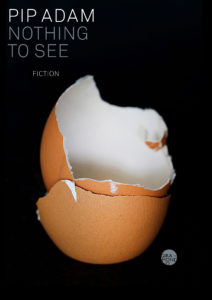
Nothing to See

by Pip Adam

Giramondo

ISBN 9781925818680

Reviewed by FERNANDA DAHLSTROM


Pip Adam’s third novel, Nothing To See, deals with female identity, addiction, digitization and impending climate disaster. Penny and Greta sleep in the same room in a shared flat. They reflect on sobriety, share clothes, receive help from the Salvation Army and get into the occasional fight. In many ways, they operate as a single entity and their flatmates, Heidi and Dell, who they met in rehab, operate similarly. It is some time before this twinning is

=================================

Continue reading for only $5 per month

Subscribe for full access to Mascara Literary Review or login

Continue reading

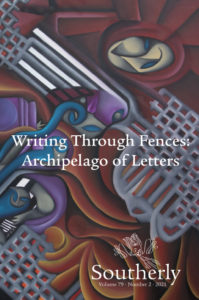
Matthew da Silva reviews Southerly

Writing Through Fences: Archipelago of Letters
Southerly 79.2

Brandl & Schlesinger 

Reviewed by MATTHEW da SILVA


It was while reading this issue of Southerly 7.2 Writing Through Fences— Archipelago of Letters that news emerged of the Australian government’s decision to allow some refugees in its care to resettle in New Zealand and for others to be released from a Melbourne hotel. It was as though the entire country gave a sigh of relief, attacks on the government coming thick and fast. Then the question of why it hadn’t happened sooner was overshadowed by Britain’s government announcing that it would establish an offshore processing regime with Rwanda as the linchpin. The problem of inequality had raised its head once more as another country tried to come to terms with its own attractiveness. It seems like the flow of migrants is unstoppable. Politicians’ job is to deal with it. 

But they have help from the community, who are the ones, in the final result, who put them where they can make a difference. While lives – like those of the people featured in this issue of Southerly – had been damaged, the damage to Australia’s reputation remains unequal to the task of dimming its allure. 

On social media, people have become hardened around talking points. Emotions are raw and feeling runs high with every indication that it will continue to do so. But is art the same thing as politics? I often wonder these days because the lines seem to blur and I worry that we’ll forget the reasons why we need art.

A Slate tweet of 21 March (7.04am) contained a headline and a comment: “200 Priceless Paintings That Belong to Russia Are Stranded in Paris. Will France Give Them Back? Art isn’t politics, but what if Putin wrote the preface to the exhibition’s catalog?”

Art isn’t politics, indeed.

Or Jay Rafferty’s tweet at 6.31am the same morning that went, “Bukowski affected my work a lot when I was younger, I think “The Laughing Heart” was one of my formative poems. But I, as many of us, have wised up. No hesitation in saying he was a dickhead with a few good poems and that’s probably the best compliment I can give him.”

Poor Charles, removed from his pedestal after all these years.

Can you still be a poet without being Virtue’s exemplar? Can you implement policies designed to stop drownings at sea and still stay friends with half the electorate? And what do we really want from art? Don’t we want it to answer questions for which conventional responses cannot serve? Questions that journalism, for example, cannot answer. What sorts of questions? Questions about that thing we easily label as the “soul” or those about the less easily described characteristics of a universe, the nature of which appears intent on releasing its last secrets slowly? Where, to posit the biggest one of all, did it all start?

Are poets to be limited, like 18th century’s Alexander Pope, to things pertaining to humanity, or do we risk considering other possibilities? Pope, for his part, didn’t accurately anticipate the liberation that sat on his doorstep but we seem to think we can see the future.

On the other hand I think about the possibility that Southerly’s appearance at this time (issue 79.2 came out last year) presumed a change of policy by Morrison and his colleagues. Are the publication and the refugee resettlement announcement somehow linked? When you read in this magazine accompanying material that illustrates the depth of the problem facing the government you come across evidence why their switch might be advised. A passion from such a deep reserve coming so close to the surface – printed on paper and distributed by mail to thousands of letterboxes – must give the authorities pause. 

Discussions about Aboriginal sovereignty stand as a rebuke to politicians of most stripes. While the works featured in this issue of Southerly are not all of equal quality, this reviewer welcomes conversations, even those which are subversive. Hatred cannot be allowed to overcome collegiality, otherwise we’d all be invading others’ households without even knocking on the door, putting our feet up on the coffee table and asking rent for what isn’t ours. Like some son of the Vikings. 

We have to respect diversity and its rules. Diversity is in fact a strength, and the ability to entertain multiple solutions to pressing problems is a hallmark of pluralistic democracy. The mainstream must always tolerate the margins.

Each of us has a voice. The voices you hear if you read this issue of Southerly are however normally silenced, and this is part of the beauty of this issue, curated by former detainees Hani Abdile, Behrouz Boochani, translator Omid Tofighian and refugee activist Janet Galbraith. Even the editorial voice is worth reading, though it’s (hopefully) not the reason why you’d buy the magazine. Editors must be wary of attempting to train reluctant voices into a chorus or of conscripting a contributor to approve a view they didn’t themselves hold. Melissa Lucashenko walks this balance valiantly.     

I found pleasure in reading Hani Abdile’s ‘Oooh Old Friends’ though I couldn’t work out who the “friend” was, the poem skirting round the outside of names playfully. I think it was this aspect of the poem, which is regardless quite short, that drew me to it. Also short and elliptical is Mohamad Haghighi’s ‘Rainbow’ where the thing or person the poem is addressed to slips out of the reader’s view like a dream upon waking.

Sabaa’s ‘When?’ sits on more familiar territory (“When will I be free from detention? When will I see life outside the fence?”) but pinpoints the essential problem faced by legislators and advocates alike (“When will my country become a better place to live?”). There are occasional glimpses of the same ideas elsewhere, as in M.D. Imran’s ‘Lifelines’, which contains anecdotal evidence of the kinds of mistreatment causing refugees to go overseas to live. Imran is originally from Myanmar but now lives in Chicago, in the United States, following a period in exile in detention funded by the Australian taxpayer. 

The depth of feeling that animates his journalism finds echoes elsewhere in the volume, for example in Sad Proof’s ‘I Love You’ where the country known as Australia (which the editors are careful to characterise as stolen land) is posited as finding its lover in the refugee (“I want to tell you I love you, Australia”) who will fight for its rights “and not give a chance to make [it] poor like my country”. Reading poems like this person’s made me think of the way that deaths at sea have played out in the media, especially on television, which brings me to considering the ways that politicians on both sides have sought to formulate refugee policy. 

But there is little acknowledgement of these issues in the collection. Taking a leaf out of the playbook of more progressive elements of the commentariat, ‘Which Way to Go Back?’ asks Farhad Shah, and reading his poem you can understand a little more of the refugee experience. Less aggressive than some of the work in the book, ‘Which Way to Go Back?’ contains worlds and presents the comfortable reader – the sort of person who buys Southerly, who even bothers with poetry in the first place – with additional puzzles. 

Its way of creating a dialogue made resonances with other poems, as though it were a familiar trope. It would be refreshing to think that the book was able to set up a dialogue, and perhaps this stage has already been reached.

The best poems in this book, like Abdul Samad Haidiri’s ‘Home – Where Else to Go?’ contain more than just a complaint, though always there is the bitterness of the outsider to flavour the work. In such poems you get to see something essential about the species, for having a home is an essential part of being human, in fact not only animals but even plants favour certain types of habitat over others, or even can only survive under certain conditions.

Adaptation is part of the refugee’s game plan however, as we see in Mabsud Masan’s ‘To Corrupt the System Is to Have Compassion’ which uses elements of Pidgin in a creole designed to give a taste of life on Manus Island. It’s a bit rebarbative but entirely comprehensible, our discomfort – it would be strange to eliminate all traces of the voyage – enhancing the experience of reading the journalism. A short piece by notable advocate Behrouz Boochani demonstrates this writer’s ability to pack a punch into a smaller space.

Farhad Bandesh (with Melita Luck) uses poetic language that draws heavily on the natural world to create a picture of the refugee experience that adds lustre to the whole. It’s as though because the desire for the goal is so complete there are few ways to communicate the depth of feeling that constitutes reality for someone in his position. Absolute joy, complete abandon. Hatred, fear. Like in a Hollywood gangster movie, or some rich concoction where the fate of civilisation rests in the hands on a renegade hero, and the only way to secure it is through extreme violence, we’re able with these poems to get down to essentials. But the experience is no less rich for the simplification that takes place. As in Shiharan Ganeshan’s gentle story (short fiction rare in the book) titled ‘Flute’, which is a kind of fable about class, art, meaning, and fate that is laced, as in an old Arabian-night story, with magic and with its own brand of suppressed yearning. 

I wish that every person who wanted to come to this country had easy passage, and in fact on a blog years ago suggested opening up a refugee processing centre in Jakarta. Unfortunately I probably lack requisite experience and insight and can only write meagre reviews of wonderful books of poetry and prose – with a few delightful artworks added for good measure – but if I can encourage one person to read this issue of Southerly I’ll be happy.


MATTHEW da SILVA was born in Brighton, Victoria, and grew up in Sydney. He has Bachelor of Arts and Master of Media Practice degrees from the University of Sydney and lived for just under a decade in Tokyo. He has two adult children and lives in Sydney.


Winnie Dunn reviews The Kindness of Birds by Merlinda Bobis

The Pigeons Are Taking Over: The Kindness of Birds
by Merlinda Bobis

ISBN 9781925950304

Spinifex Press

Reviewed by WINNIE DUNN


Ibis

The beloved bin chicken is always feeding off scraps of bread whenever I walk to Fairfield station. Because it is a sin to throw away the sacredness of bread, those leftovers become a well-meaning gesture shared by members of the south-west Sydney community. I clutched my copy of The Kindness of Birds (Spinifex, 2021), a short story collection by Merlinda Bobis, as I watched the ibises peck peacefully between pigeons for crumbs. 

Short stories are like ibises. Ibises are displaced from their homes due to global warming yet they still choose to stay in large groups and consistently work towards common goals. Likewise, short stories are in themselves self-contained. But when interconnected, their morals, moments and memories take over time and space in a deliberate way for the reader. Short stories aggregate like a flock (Bobis’ collection has 14 individual stories) and yet are shunted to the margins when one thinks of books (short story collections are the least sold or noticed in our industry). 

It is the image of the ibises gathering together which I carried into my reading of Bobis’ latest work. Her collection is a series of small gestures, revelation of cultures and feathered symbolism that make up the book’s overall theme – kindness and its many forms in the face of adversity. 


Pigeon

The title of this review takes inspiration from Vietnamese-Australian writer, Shirley Le. It was her narrator’s opening line in our co-written play, Sex, Drugs & Pork Rolls (UTP, 2021). Used as a symbol for British colonialism, the pigeons flock at the narrator’s Yagoona home window, leaving  dirty marks on the glass. Yet, the pigeon is remarked by the narrator’s mother as “much nicer” than the native magpie – the magpie in this sense being used as a symbol for First Nations people’s sovereignty, which was never ceded. As migrant settlers who are writers, it is a constant privilege to know how best to respect this sovereignty, when and where to tell our own stories, and when we are taking up too much space. 

In this way, Bobis acknowledged and paid respect to First Nations people’s sovereignty throughout her collection. The stories ‘Candido’s Revolution’ and ‘My Tender Tender’ especially speak to the complex history of colonialism, migration and sovereignty on this continent. 

It is the singing of a folksong, reimagined by a Filipinx poet named Remy, that stays with me as I read ‘Candido’s Revolution’. An infamous Manilaman pearl diver hums from atop a tree, “Dandansoy bayaan ta icao” (p54), capturing the attention of Mary (1893 Australia would simply refer to her as “a native woman”). Without a shared language between them besides the complimentary phrase, “Can-do good song” (p55) they still look at each other through the trees. The initial allure they shared is eventually cut short by racist laws and the call for a revolution in the Philippines. For The Kindness of Birds, this interaction marks the historical beginning of inter-cultural dialogue between First Nations people and Filipinx migrants – a connection that is often left unrecognised. 

This connection continues in the short story, ‘My Tender Tender’. One of the main characters Uncle Freddy Corpus, swears on the Bible when he tells Nenita of their shared Asian ancestry – she Filipina and he Filipino and Yuwuru. After telling stories to Nenita of miraculous feats of diving to survive the perils of colonialism, Uncle Freddy Corpus eventually “takes out various memorabilia from [a] satchel. He opens one: it’s a copy of a marriage certificate of his Filipino grandfather Servo Corpus Felipe and Yawuru grandmother Maria Emma Ngobing. She’s speechless, honoured […] touched by this gesture affirming their Philippine connection.” (p82) In this way, Uncle Freddy and Nenita’s intercultural dialogue shows how us settlers should act as we walk on stolen lands – nothing but intent listeners, sharing only when asked and only when it will foster healing. 

Colonialism would have us all believe that there are only pigeons at the centre of history, Bobis’ writing shows us how wrong that is. 


Common mynah

In Tongan culture, an omen of death arrives in the form of a bird entering our houses. One summer, a common mynah flew into the open doors of the top-storey balcony and flittered in circles on the living room ceiling. Even with the doors wide open, the petite brown blur still struggled to find the exit again. ‘Shoo-shoo-shoo!’ my aunty Lahi pleaded, her doughy belly rolling as she battered a straw broom above her head, hitting the plastic chandelier as she did so. ‘Fuck!’ Lahi swore, sweat dripping from her short strands of brown-black hair and into her freckled and frumpled face. Hearing someone swear, (that someone being technically my mother in Tongan culture), made me stifle a giggle. The mynah gave a series of squeaks before finally finding the open balcony. I watched as its fluffed mass disappeared over the streets of Mt Druitt. 

Within the short story ‘When the Crow Turns White’, a half-dead bird is carried into parliament injured from the hailstorm raging outside. Two cleaners of Filipinx heritage, Orla and Corazon, wrap the crow in white cloth remarking, “Climate change is scary.” (p14) Throughout their debates in the empty chamber rooms about legislations, the constant arguing of old white men and the winds of change with the first Aboriginal woman elected into the house of representatives, Corazon holds a secret. She is a descendant of crows, a unique culture connection that makes her a born healer. From acts of miracles long ago, she still has memorised the chant, “Ilayog, ilayog ang ilo sa bagà. Ilayog, ilayog ang sakit ni padabà. Fly, fly away the poison in the lungs. Fly, fly away the pain of the beloved!” (p20)

So what happened when the mynah visited us? My grandmother died a week later from a heart attack. 

And what happened when the crow flew up in a bundle of white cloth within our parliament? A series of “bipartisan”, “polite” and “caring” (p25) MPs across the political spectrum seemingly overnight. 

Why? Only the birds know.


Bat

The mammal (not a bird) that started COVID (racists love to use this as an excuse to call east and south-east Asian people “dirty”). The pandemic is threaded throughout Bobis’ short story collection – a grandmother and grandson are quarantining in an apartment together after returning from a trip to the Philippines (‘Grandma Owl’), a lover’s well-meaning yet blasé attitude towards mask-wearing (‘My Love, My Nerūsē’) and a nurse holding a pained patient’s hand even as it went against protocol (‘Angels’). It is these small gestures, hidden between dialogue, that readers should pay close attention to when reading The Kindness of Birds. Bobis’ work on the subject reveals it was not COVID that reshaped our society but rather all the small acts of kindness individuals chose in order to look after each other. 


Pelican

The only school assignment my father ever helped me with was a cardboard presentation about pelicans I did in Year 2. We printed out blurry Google images of the impossibly large white birds and glued them (using a mixture of flour and water) onto purple cardboard we bought at the Plumpton Newsagency for two bucks. 

My favourite story in Bobis’ collection is ‘My Father’s Australia’. Nenita (a recurring character), stares at the tailored suit she had once bought for her father. The suit, a pasalubong (homecoming gift), was given to her father with the intention that he would wear it when he took his first steps in Australia. In its navy hues, Nenita remembers how her father lived “on tilted earth” (p91) at the base of volcano in Legazpi, fixing people’s aircons in order to provide a better future for his children. In the suit, Nenita hears the memory of her father reciting in English, “To Oz, to Oz”(p92) for a trip that would never eventuate. 

The love between Nenita and her dad reminds me of the only time in my childhood when my father was not existing in survival mode (being a Tongan man with eight children would do that). When we spoke of pelicans, he seemingly had all the time in the world for me as we took our first steps in my education together. ‘To uni, to uni,’ my father, who dropped out of Year 12, would remind me after each school year ended. 

In this way, ‘My Father’s Australia’ is the standout of the collection. 


Blue-and-gold macaw

It was only when I moved to Fairfield in south-west Sydney that I saw the native parrot of South America. The suburb is home to a small yet strong Latinx Australian community. But it still didn’t make sense to me how the blue-feathered bird the size of a small television was caged away in a dilapidated second-storey balcony. 

What I found the most striking about Bobis’ writing, was how effortlessly she was able to reflect the true diversity of Australia without it ever feeling like it was forced or there simply for the sake of it. A woman Nenita passes by when swimming at the beach yells out “Jidoo!” (p222), Grandma Lou’s Chilean neighbour Matilda is the only person that calls Lou by her real name “Luningning” and reminds readers that as people of colour we’re always being interrogated for our skin, our accent and our names (p174). Nenita with her Latvian partner, who is always leaving her sweet notes like, “Gone walking. ♥” (p138) – a gesture that makes all the difference when choosing to grow old with someone. All realistic depictions of the inter-cultural connections we all share with neighbours, friends and even family. 

Halfway through my reading, I took a break and went outside onto my own second-storey balcony. I stared at the yellow underside of the parrot. Still wondering why on Earth a giant South American bird was flapping its wings with the sound echoing off the brick and concrete of endless rundown apartments. Laughing as I realised I was standing beside my own cultural marker – a potted frangipani tree.  


Rainbow lorikeet 

To me, the lorikeet is the kindest bird there is. Eternally squawking in bushes as if laughing. Eating with such fever and frenzy because they’re so cheerful that they hardly notice what is in their beaks. Darting in pairs across busy streets. Flocking in the afternoon sky so fast they become little black spots, dotting the daytime like stars. From Orla and Corazon, Lou and Matilda, Ella and Nenita and finally Remy and Belen – it was the sacred sisterhood of the women characters Bobis’ paired together that carried this collection. Remy put it perfectly in ‘The Air of The Times’ when she penned in poem: 

“So enter, sister,
without gun or armour,
still magnificent.” (p52) 

If the ibis is what I took into my reading of The Kindness of Birds, the Rainbow lorikeet is what I took away from it, long after I had turned the last page.


WINNIE DUNN is the General Manager of Western Sydney based literacy movement, Sweatshop. She is a writer of Tongan descent from Mount Druitt and holds a Bachelor of Arts from Western Sydney University. Winnie’s work has been published in the Sydney Review of Books, Griffith Review, Meanjin, SBS Voices, The Guardian, Huffington Post, Red Room Poetry and Cordite. She is the editor of several critically acclaimed anthologies, and currently working on her debut novel as the recipient of a CAL Ignite grant.

Claire Qu reviews Love & Virtue by Diana Reid

Claire Qu reviews Love & Virtue by Diana Reid

Love & Virtue

By Diana Reid

ISBN 9781761150111

Ultimo Press

Reviewed by CLAIRE QU

The prim and vaguely Austenian title of Diana Reid’s debut novel offers a tongue-in-cheek self-description consistent with the book’s plentiful irony. Many labels could be applied to it: campus novel, bildungsroman, #MeToo novel, story of contemporary female friendship. Perhaps that is why it is so constantly self-aware, so unremitting in its parody of all the stock characters – the insecure freshmen, urbane professors, greasy suitors, and smugly ‘liberated’ women – that people these genres.

=================================

Continue reading for only $5 per month

Subscribe for full access to Mascara Literary Review or login

Continue reading

Dave Clark reviews Born Into This by Adam Thompson

Born Into This

by Adam Thompson

ISBN 9780702263118

UQP

Reviewed by DAVE CLARK


As a technique pioneered and refined over the past hundred years, keyhole surgery involves a surgeon making small incisions in the skin, so tiny that at times it is hard to tell afterwards that something significant has taken place beneath the surface of the patient. It is a method used to diagnose health conditions, as well as to begin treating them.

From the first short story in Born Into This by Adam Thompson[i], I felt that I was in seasoned, steady hands. As the stories unfolded, each one was a penned incision, surgical and precise, cutting beneath the surface, diagnosing the ongoing impacts of colonisation/invasion. The writing within these sixteen short stories deftly slides beyond the synapses and impacts the heart.

I was surprised to learn that this was Thompson’s debut book. I was not surprised to see that this collection was shortlisted for multiple awards, including the Queensland Literary Awards 2021, the Age Fiction Book of the Year 2021 and the USQ Steele Rudd Award for a Short Story Collection. If his name isn’t familiar in your writing and reading circles, that will change once you get hold of his work.

Adam Thompson is an Aboriginal (pakana) writer from Launceston. He has worked for almost twenty years in roles caring for Lutruwita (Tasmania) Country and preserving culture and heritage. His passion for these endeavours clearly influences his writing and themes. His writing career has been gathering momentum over the last five years, with some of his short stories being recognised with writers’ festival awards. Born Into This is his first full collection of short fiction.

The sixteen stories in this book traverse across Tasmania, taking place on tiny islands, beaches, the streets of Launceston, in forests, at a funeral, in a school and a pub and suburban houses. Tasmania is a part of Australia not often captured in contemporary fiction. It is a refreshing insight into an often-overlooked region.

The characters within his book are blistering and humorous, compassionately created. Many of the characters are engaging enough to justify an entire book. The stories are fierce and political, leading to a collection that sizzles. It confronts. It takes tropes and myths and shreds them in an accomplished manner. It mixes world-class writing with his unique take on each character’s inner world. This is contemporary Australian fiction at its most impacting, sitting comfortably alongside the works of Tara June Winch, Melissa Lucashenko and the poetry of Evelyn Araluen.

Thematically, Thompson looks intently into the ongoing impacts of colonisation in current day Tasmania. As Noongar author Claire G. Coleman writes about in her recent book, Lies Damned Lies, colonisation/invasion in Australia was not an event. It’s ongoing.[ii] Any current writing about it needs to acknowledge this and challenge the power, privilege, and the very Anglo understandings of history. Thompson doesn’t tiptoe around this. The elephants in the room are pointed at and prodded. He does it with clever turns of narrative that lead the reader to see the world in personal ways that whiter parts of Australia can often turn a blind eye to.

For example, the second story, ‘Honey,’ looks at the commodification of language and how Aboriginal culture matters only to some when it can generate them a buck. The fourth story ‘Invasion Day’ takes places during a protest and has the line,

‘Looming above, like a love sonnet to colonisation, stood the sandstone monstrosity of Parliament House’ (p49).

Stories like ‘Jack’s Island,’ ‘Black Eye’ and ‘Time and Tide’ stride into the devastating, way-of-life-altering impact that climate change is having on the characters’ connection to Country. ‘Descendent’ wrestles with who gets to decide Indigenous identity and the persistent myth that Indigenous people in Tasmania died out with Truganini. The story seems to be saying that we were invaded, but not erased. Still here.

The experience of characters as minorities in their region often see them facing racism. As someone who has lived in Alice Springs (Mparntwe) for twelve years, I see and hear many acts of racism towards Arrernte people most days. Some of the acts are personal. Some are in way they are policed and treated in court or in the local shops, the societal structures that continue to try to kick them down to the bottom rung. It’s horrible to witness people and their families being targeted, based solely on their skin colour and culture. Those of us who are privileged will never fully understand what it is like and just how resilient people are living in the face of such ongoing injustice.

Acts of racism – the ‘in your face’ versions, the far-reaching political decisions, the removal of agency and the subtler, pervasive microaggressions – are shown and felt in many of the characters’ stories of Thompson’s book. The story ‘Sonny,’ about a white man who yells out ‘Run, Darky, run,’ (p101) to his friend on the footy field, sat heavy in my gut for days, sounding all-too familiar to instances around town.

It is deeply confronting – and necessarily so – to see how explicit and implicit forms of racism are still so prevalent. If, as a white reader of this book, we don’t feel sick and embarrassed and angry by Australia’s past and present, then we aren’t hearing the beating heart of this collection.

Tokenistic and paternalistic responses to colonisation/invasion are on display in these stories. ‘The Blackfellas From Here’ bitingly looks at the shallowness of acknowledgement of whose land it is, with Kat challenging James to hand over the deed to his house. It asks the question of what a deep acknowledgement of the past and present would look like. It shows that current political responses are still largely like acknowledging that someone has a flat tyre, but then just walking on by and doing nothing about it. Acknowledgement must be more than a cursory nod towards someone’s experience.

As a whole collection, there are many standout stories, including ‘Kite’ and ‘Born Into This’ to go with the ones already mentioned. On both the first and second readings of the collection, I felt however that the power of the book drops away in two of the final stories. As their own entities, ‘Time and Tide’ and ‘Morpork’ would find happy homes in many publications. In contributing to the overall theme though, it felt that these lingered in comparison to the crackling nature of the rest of it.

One subject that crops up regularly in the book is around survival. An example of this is the character Kara, secretly planting young eucalypt trees in areas that have been hacked away by forestry and mining companies. She contemplates this as she tends to the trees,

‘Natural survivors, like her own family, born into a hostile world and expected to thrive’ (p40).

Plants survive Tasmania’s climate as well as the brutality and the upheaval of exploitative human damage. These delicate pictures of flora and fauna are placed in many of Thompson’s stories, alongside their human equivalents. They are beautiful and telling reminders of people and culture that are deep-rooted, living and breathing in the present. Finding ways to survive, and thrive, even amidst significant change, Thompson weaves in his theme of hope. The reader is not left depressed, but more so, impressed upon: that there is horror in this country. And there is hope.

Several websites and interviews refer to Adam Thompson as an emerging writer. With a book this good, with prose and dialogue this splendid, ’emerging’ seems to be a misguided stamp. With Born Into This, he has well-and-truly added his works to the strongest writers in Australian contemporary fiction. To tackle content as heavy as the themes of racism and survival, and to do so elegantly and originally, is a remarkable achievement.

Notes:

[i] Thompson, Adam 2021, Born Into This, University of Queensland Press, Australia.
[ii] Coleman, Claire G 2021, Lies Damned Lies, Ultimo Press, NSW.


DAVE CLARK is a writer-poet with CFS who lives in Mparntwe (Alice Springs). He works as a counsellor and enjoys reading, photography and giving voice to quieter stories. His works have been published in Mascara, Imprint, Pure Slush Books, Adelaide Lit, Quillopia, Slippage Lit, Melbourne Culture Corner and Right Now. Twitter @DaveClarkWriter