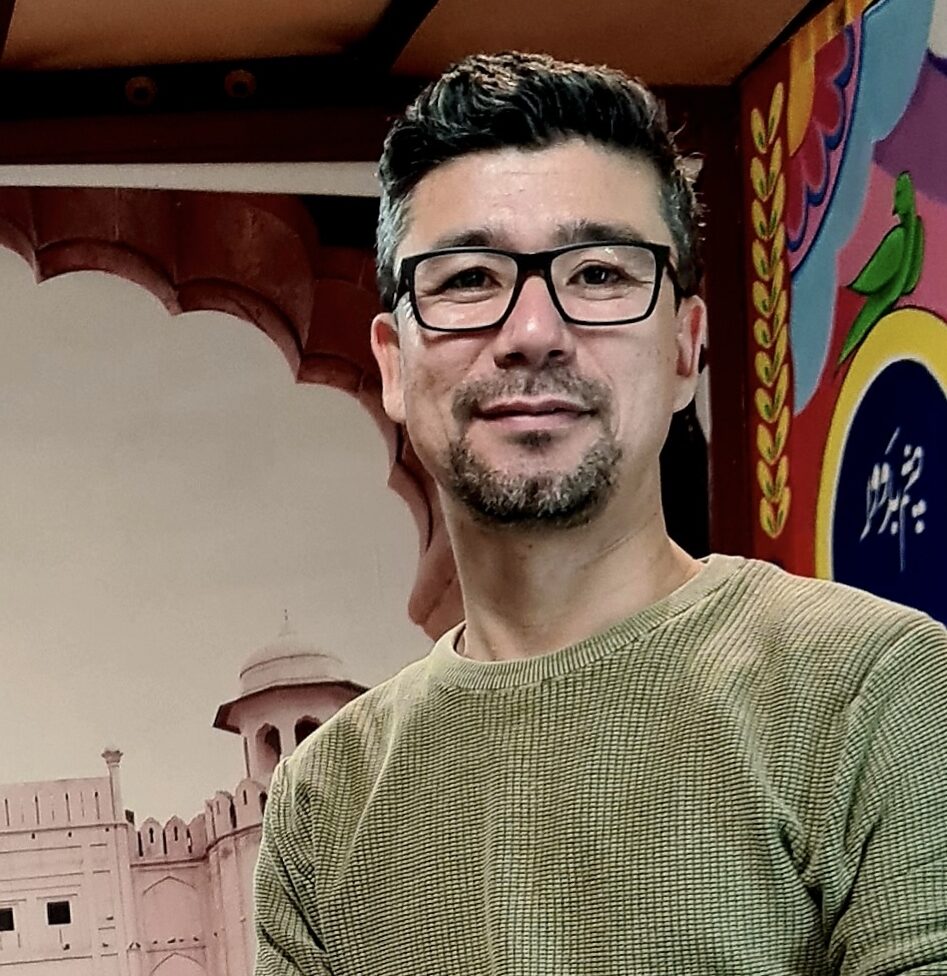
 Talib Dostizada is a Hazara writer originally from Quetta, Pakistan. He writes about displacement, memory, migration, belonging and the ordinary lives shaped by political violence and borders. He lives and writes on Boonwurrung Country in Naarm (Melbourne).
Only the Wind Remains
He awoke to the sound of a camel coughing.
The sand outside the tent still held the day’s heat. Inside, the tent had not cooled. The air smelled of canvas and of sweat that had dried and been slept in. Lal Chand Meghwar slipped out quietly, careful not to wake Marvi or the twins. The boys’ breathing was uneven. One of them murmured for water. Marvi’s hand reached in the dark and hushed him.
Outside, the desert stretched in every direction. The moon hung like a dim coin. Barbed fences cut the near distance. He lit a beedi. The match flared, then died. Dust lined the folds around his eyes. His lips were cracked. His body was wiry from labour.
A week ago his phone had buzzed. The screen was cracked, the battery swollen. It was about Meena, his cousin. Gone now. Married off in a mosque she had never entered before. Converted, they said. Willingly. The man was forty-five, they said, with a rusted motorcycle and five children. A maulana gave her a new name. The police had given her no choice.
He remembered her as a child, clutching the tiny silver locket, Jhulelal embossed on its lid, swearing she would never take it off. They made her take it off.
Her face returned to him again and again, not the grown woman led into a marriage she had not chosen, but the girl who once pressed a stolen guava into his palm and whispered, “Don’t tell.”
He flicked ash into the sand and watched it vanish.
In Barmer, a long way from Chachro, he worked with bricks. He had been told he was too old for the kiln, so he laid them instead, building walls of buildings he was never allowed to enter. Once he helped build a bank and was later refused entry when he tried to open an account. His Aadhaar card listed his address as Temporary Tent, Sector 5, Dry Nullah.
Every morning he carried his trowel to the site. The walk took twenty minutes across open sand that later in the day would burn the soles of thinner shoes. The foreman barked in Marwari. Lal Chand obeyed without reply. The other men kept to their own languages, Sindhi, Parkari, a little broken Hindi. Conversation was brief and mostly about the heat or the quality of the mortar. Sometimes he was paid. Sometimes he was not. The money, when it came, was folded small and pushed into his hand as if the act itself were slightly shameful.
One afternoon the sun sat directly overhead. He laid a brick, then another, until his hands stopped. He had not eaten since the previous night’s thin dal. He sat beside a puddle left by a burst pipe and stared into it. The water was cloudy with cement dust. His reflection did not appear. After a while he cupped some of the water and rinsed his mouth, then spat it out. The taste of lime stayed with him the rest of the day.
At the camp, rumours moved from tent to tent. A neighbour claimed her son had received his citizenship certificate and had even held the paper in his hands before it was taken back for verification. Another said the office had lost her entire file, including the only photograph she possessed of her dead husband. Lal Chand no longer believed in rescue. Belief required energy he preferred to spend on the next day’s bricks.
But Marvi did. She would come home from the water line and whisper, “I heard they’re sending officers next month.” Or, “Someone in the city said the courts will intervene.” Once she brought a torn newspaper page that mentioned long-pending cases of displaced persons. She smoothed it carefully and kept it under the sleeping mat. He loved her for that.
Sometimes he also wished she would stop. The thought arrived cleanly while he watched her fold the paper again. It lasted only a few seconds. Then it passed, and he was left with the familiar fear that her hope made the waiting sharper.
He spent evenings at the edge of the colony, where the sand met the rusting fence. Beyond the wire the desert continued without interruption, the same colour as the tents after a dust storm. Shankar joined him sometimes, a former factory worker from Karachi whose fingers were still blackened by dye. His nails were blue years after he had last touched fabric. They rarely spoke. They smoked and watched the horizon.
“I had a dream,” Shankar said one night. “I was a horse. I was pulling a cart made of glass. Inside it was god. I couldn’t see his face.”
Lal Chand nodded. “And?”
“We went in circles. Every time I looked up, same sand, same wind, same sound.”
“Did he speak?”
“No. He just wept.”
They sat with that for a while. Somewhere behind them a generator coughed and died. A woman shouted at a child. The usual sounds.
“In Karachi,” Shankar said after a long silence, “the dye never came out. Not even with the strongest soap. My wife used to scrub my hands until the skin cracked. Still blue.” He looked at his fingers in the dim light. “At least here the sand is the same colour as everything else. Harder to see what stains.”
They did not discuss the dream again.
When a local politician visited the colony, shaking hands and making promises, Lal Chand stood at the back. The man’s shoes were too clean for the dust. Aides followed with clipboards and cameras. A child asked if they would get electricity.
“The file is with the department,” the man said. “A survey has been approved.”
Another asked about schools. He nodded as if the question itself were progress. “Names are being taken. You will hear.”
People clapped. Some out of duty, some out of a thin thread of hope. Lal Chand did not clap. He watched the cameras move from face to face, lingering on the children, then packing up as soon as the speech ended. The man left in a cloud of fine dust that settled slowly back onto the tents.
That night a fire broke out in the kitchen tent. It began, someone later said, with a kerosene stove left unattended for only a moment. The kitchen tent stood close to the others. Once its canvas caught, the wind carried the flames from one tent to another. Children screamed. Men shouted for buckets. Women clawed at the sand and threw it by the handful.
No one died, but the fire took several tents and everything people had kept inside them.
When it subsided, the ground was black and soft underfoot. A girl stood sobbing near the ruins, clutching a melted comb, its teeth curled like dried petals. Lal Chand paused. He held out his hand. She hesitated, then placed the comb in his palm.
Near the blackened ground, a man was arguing with his wife in a low, rapid voice. She had found a half-burnt ration card and was trying to smooth it. He snatched it from her and tore what remained into smaller pieces, then threw them into the ash. She did not cry out. She simply sat down where she was and began sifting with her hands again. No one intervened.
Lal Chand walked past them, past the sleeping tents, back to the fence.
He sat there a long time. The comb was still warm against his fingers. Around him the colony smelled of wet ash and scorched plastic. People moved slowly, sorting what little could be saved.
He stayed by the fence until the horizon shifted from black to grey. The wind softened. The sand grew cool. From the tents came the sound of stirring, children waking, women banging pots, the first coughs of men who would soon lift bricks. A few figures were already sifting through the ash with sticks, looking for anything that might still be used.
Lal Chand rose. His knees ached. His back resisted. He put the comb in his pocket and walked back.
When he entered the tent, Marvi was already awake, eyes swollen from smoke. The twins pressed against her. She looked at him as if searching for news.
“Did you sleep?” she asked.
He shook his head. “The wind kept me awake.”
Her thumb stopped on the rim of the tin cup. She looked at his face a moment longer. Then she handed him the water.
He drank. The comb sat against his thigh. The coolness lasted only a moment. The twins crawled into his lap. Their hair still smelled of ash. One of them asked if the fire would come back. He put a hand on their heads and said, “Not today.”
Marvi leaned her forehead against his shoulder. They stayed like that for a while, the four of them in the dim space of canvas and smoke. Outside, voices rose and fell, arguments about where to rebuild the kitchen, who had lost the most, whether the authorities would send anything. Inside the tent the sounds were smaller: the twins’ breathing, the soft scrape of Marvi’s thumb against the rim of the empty cup.
The sun rose over the colony, hard and merciless. He stepped out. For a brief moment the wind touched his face. Then the heat returned.