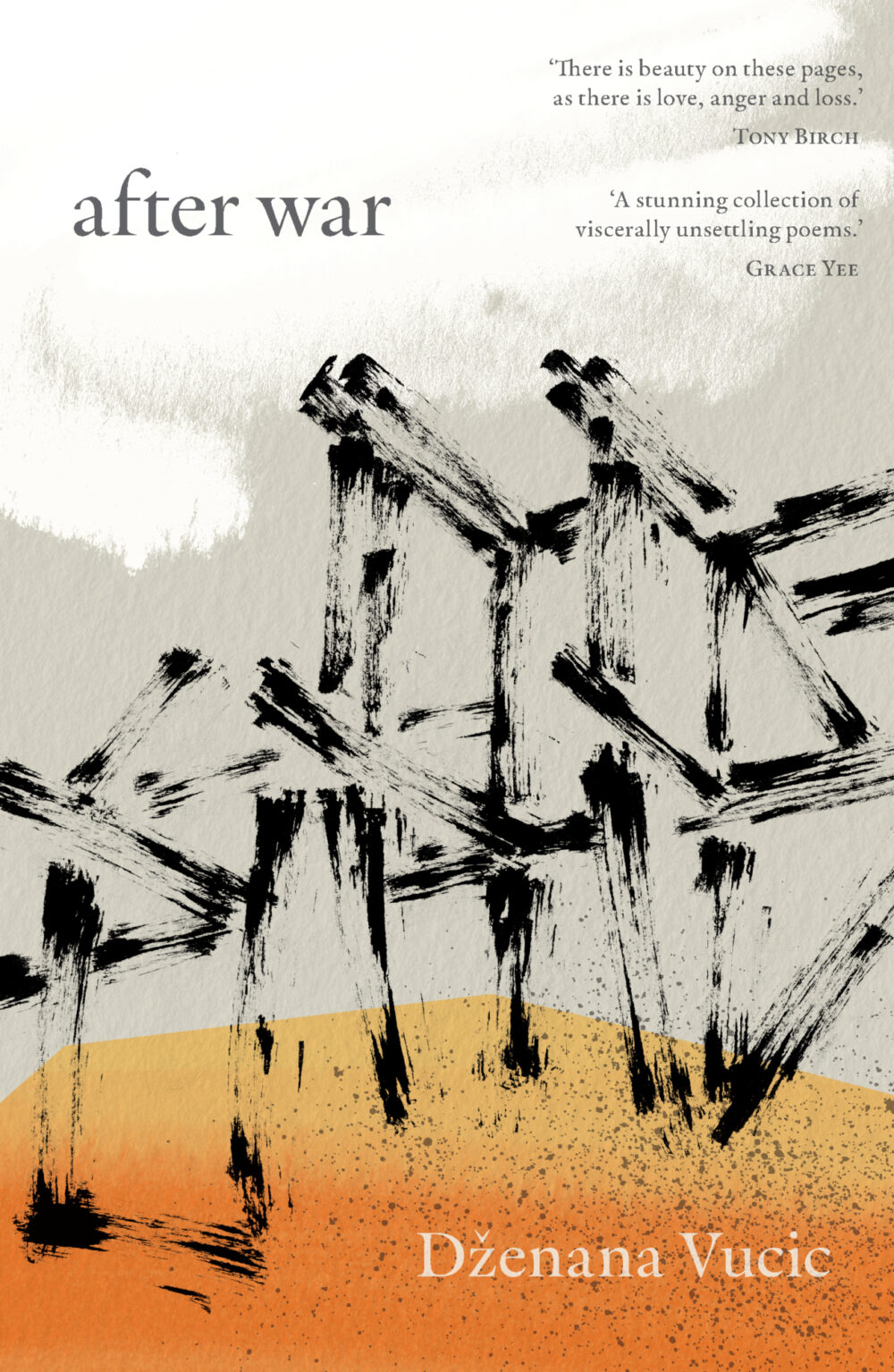
 after war
by Dženana Vucic
ISBN: 9780702271120
Reviewed by Ajla DIZDAREVIĆ
This is how we learned to love. Gouging
flesh, gripping knives. Calling things by other names
A memoir in poetic fragments, after war renders the realities of Bosnian War victims grappling with the trauma of what they survived decades later. Refusing to censor how war results in imperfect survivors, Dženana Vucic’s debut collection of poetry contextualizes the violence that occurred throughout Bosnia in the 1990s while focusing on how this violence continues to exist in the minds and bodies of survivors, no matter how much time has passed. Vucic writes of the shellings, the rapes, and the deaths experienced by people in Bosnia, establishing a foundation of horrors from which her poems emerge. This foundation also informs the premise that pulses in each poem: everyone knows how harrowing war is, even those who haven’t lived through it. But only those who have lived through such violence understand how the war never really ends; it lives on in its survivors.
Indeed, the majority of after war lingers in the present, not the past, fixating on moments that come after the dust has settled, during the time “of fracture, of still” that survivors encounter in the diaspora. The characters in Vucic’s poems escape Bosnia for refuge in Australia, where it’s made clear that, although the physical threat of war has ceased for these survivors, the violence they experienced is still alive in their minds. By ascribing a temporal omniscience to war in poems like “First Year After War,” Vucic depicts how war continues to wrack the psyche and weaken the bodies of survivors no matter how far away they are from the war geographically and temporally:
I will not remember
if I see the body or if it is a thing frankensteined
from shrapnel and exit wounds,
superimposed onto this idyllic suburban street […]
(p.9)
Further, after war goes beyond expected, one-dimensional renderings of survivors that are meant to evoke shallow sympathy from readers; instead, Vucic takes a significant but fruitful risk with poems that refuse to censor the ugliest parts of people who are trying to make sense of what the war did to them. Throughout the collection, Vucic’s characters struggle with mental instability, at times becoming hysterical, raging as they hurt themselves in a desperate attempt to make sense of the pain they carry. The violence that characters inflict upon themselves echoes the violence externally imposed upon them during the war, most notably in “girl,” where the speaker’s sister views her own body as evidence of all that has transpired. In turn, she seeks to shrink her corporeal form as a way to shrink the impact of the war, intentionally starving herself to lose weight:
[…] can you shed the past like kilos
or is trying to a kind of looking away. can you look away. […]
I am watching her slice off her excess which is flesh yes
but joy too […] and I am thinking it is a marvel that a girl can lose so
much and remain […]
(p.16)
The characters in after war often hurt those they love most, usually inadvertently. Friends and family become collateral damage in the struggle to externalize and address one’s own pain. Vucic frequently utilizes body horror in her image systems to depict such strained relationships. In “it repeats / we repeat,” the speaker laments how her sister “was a little girl once” before the war exposed them to hunger, giving them “sharpened stomachs.” The speaker goes on to admit the extent to which the war has altered the family member she once knew, how the sister’s traumas are so sharp, the speaker can cut herself on them:
[…] now my sister
is broken glass, jangling. the clack of her teeth begs & shards fall
to the ground & pierce our soles […]
(p.14)
Here, and throughout the book, the refugee’s physical body is both proof of survival, of endurance, and evidence of crime, of the subjugation and suffering inflicted upon it. after war underscores how the Bosnian Muslim (Bosniak) refugee identity is inherently contradictory, with refugees viewed as both clean and dirty because of their affiliation with Islam—a faith that is both a source of hope and a red target on her characters’ backs. Vucic explores the strained relationship Bosniaks can have with their Islamic ethnicity, particularly in context of the Bosnian Genocide, during which Serbian forces called the slaughter of Bosniaks an ethnic cleansing.
This concept of cleanliness, of what is worthy of being polished and saved versus trashed and destroyed, permeates after war. In “it repeats / we repeat,” the speaker describes her mother as “scrupulously clean” and her family being “a family / of compulsion & anti-bacterial spray.” Then, the speaker supplants us with a heartbreaking explanation for her family’s fixation on hygiene:
[…] it is because we are
dirty. we have always been dirty. we bring the dirt with us,
between our skin & our hijabs, hoarded under the tiles of our
mosques […] we bring the dirt with us until we are cleansed & we
have been cleansed & our country has been cleansed of us.
(p.13)
With this poem, Vucic perfectly encapsulates the contradictory parameters that Bosniaks have been told pen the boundaries of our existence: we are both Bosnian and Muslim, both clean and dirty, taking our shoes off in a home we are told “is not yours,” told that we are always “in need of ablution” no matter how well we are “keeping clean hands.” Vucic establishes such dichotomies to provide a scaffolding needed to help readers understand the torment of after war’s characters—and the torment of all genocide survivors ethnically cleansed from their own homes.
Along with being a shining example of Bosnian diaspora writing and war poetry in general, after war is an excellent poetic primer on the Bosnian War. Vucic concludes her collection with pages of notes that extensively describe the Bosnian War, provide context for historical references, and define the bilingual utterances scattered throughout her poems. In doing so, Vucic extends a hand to Western and Anglophone readers, inviting them into a seemingly impenetrable, foreign world and making it accessible and familiar.
AJLA DIZDAREVIĆ has worked as an editor and educator in the United States and Europe. A graduate of Vanderbilt University’s MFA in creative writing program, Dizdarević is the author of What I Learned About Dogs in the Village (Carnegie Mellon University Press, 2027). Her individual poems have been published in Southword, The Hopkins Review, Conduit, RHINO, and North American Review. Her translations of Serbo-Croatian (BCS) poetry have been published in Asymptote Journal, Exchanges, and Versopolis. She is the recipient of a scholarship from the Department of Cultural Affairs, a Fulbright grant, a David Hamilton Prize, and support from the Bread Loaf Translators’ Conference.