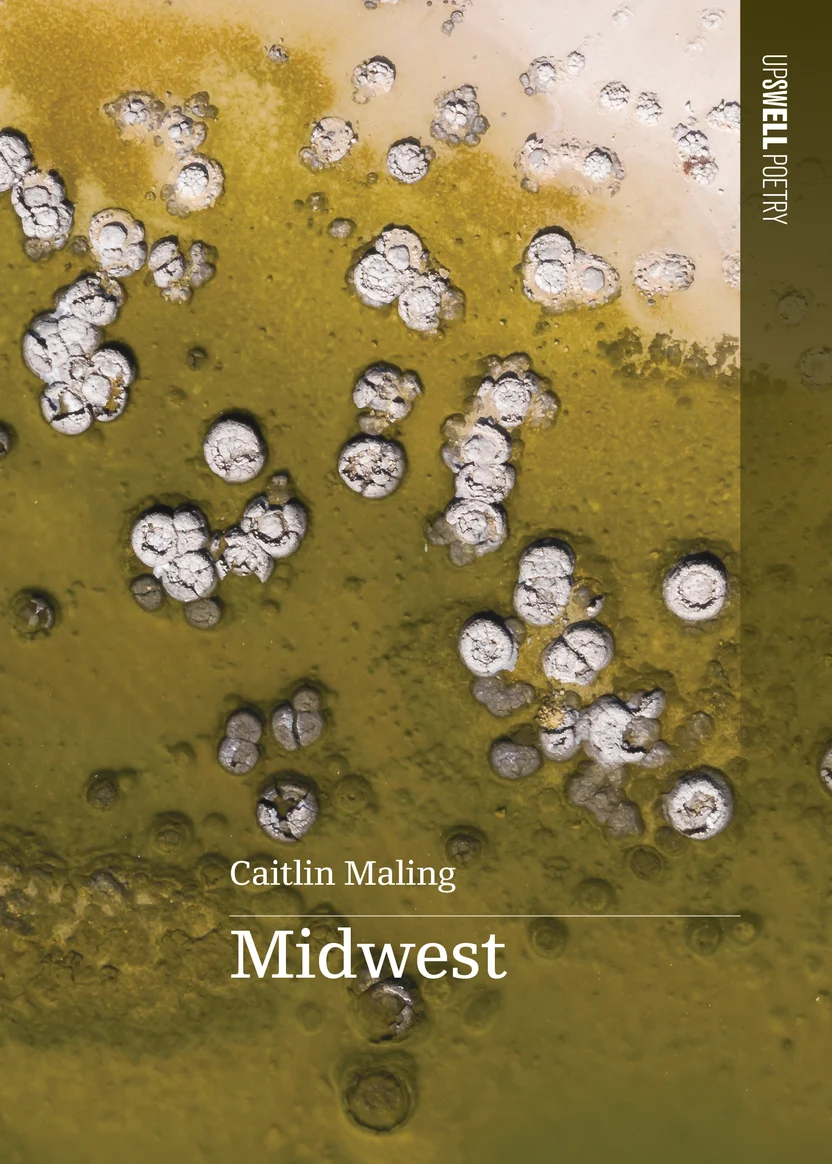
 Midwest
by Caitlin Maling
ISBN: 978-1-7642397-2-1
Reviewed by PAUL SCULLY
Strange as the admixture may sound, Caitlin Maling’s Midwest reads as a junction and interweaving of a new motherhood journal and a survey of sorts, both geographical and emotional-responsive, of the mid-Western-Australian coastline, its near environs and aspects of its history, written into poems of observation, investigation and reflection.(1) Read as such, the poems suggest that, while the poet might leave the region in the living of her wider life, the region never leaves her, indeed has never left her since her youthful exposures to it.
Alternatively, the collection reads as a cumulus grown from Randolph’s Stow’s poetry, his being “a shadowed view of the land and the sea that Western Australia writers inherit”. (This sense informs lines such as “& wonder if the shadow is/ cloud, sail or ghost”−‘ “Her husband Pelsaert learned, had died while she was voyaging to join him” ‘, p54). A dozen or so poems acknowledge such provenance, as pointed out by Maling herself in a 2024 article, and a half-dozen others appear to share the lineage. In the article, Maling positions her Stow poems, and perhaps her wider catalogue, “in an almost eclogic method I’ve previously termed called resinging”. (2) This article enriches the reading of these poems, especially and oddly the pacing of my reading, and signposts the full collection. Maling also reports a sense of self-recognition on first reading Stow.
There are, of course, individual poems that resist these architectures and command their places by their own logic, just as my capstone themes do not exhaust the collection’s breadth and depth.
The sections of the book are named geographically and move north from Perth along the Indian Ocean Drive, ending in Exmouth. Inspiration is taken in several places from Western Australian writers, John Kinsella and Stow, though her complete reference range is broader and more diverse. (3)
The first section, ‘a long Indian Ocean Drive’, positions us at the start of the journey northward and for the birth of the poet’s baby, though time in the section is not linear and an older child and memories of earlier years and events intrude in several places. There are poems that pair sea eagles− “…When eagles mate, one minds the nest/ the eggs, the young. The other swoops for fish. / To sustain another life you must first sustain your own” (‘What can the juvenile sea eagle gain’, p13) −metaphorise cicadas and fish stocks and spawning, while others test paint swatches in Bunnings and write lists in preparation for a baby shower. The most obvious journey poems are ‘Prepping for the Drive’ and ‘Prose Poem about Leaving’ (pp14&26) and the first town comes into view in ‘Cervantes’, which Maling reports as the location of her first encounter with Stow’s poetry. The last poem (‘Crustacea’, pp29-32) points directly to Stow via reference to the shipwrecked, Batavia. These canvases allow a slant-attuned mind to reflect on ars poetica, liken a glass-bottomed boat to a vicarious window into the lives of others, feel humidity on the skin “like gecko’s feet/ like I could stick to the ceiling, bug-eyed” (‘Cervantes, 2022’, p27) and “ask the women from the islands/ if the islands remember Batavia” (‘Crustacea’, p29), women being doubly victimised in the brutal aftermath of the wreckage on Abrolhos Island and at risk of being “imprinted” (my inverted commas) with male violence more generally.
The ‘Shipwreck Coast’ section is Stowian heartland and he is cited in seven of the ten Lucretia poems. Lucretia Jansz was a threefold victim of the Batavia shipwreck, being forced into concubinage for her survival by the commander of the survivors who remained on Beacon Island, Jeronimus Cornelisz, while Batavia’s captain set forth in a longboat to effect a rescue, and she was tried and convicted subsequently for instigating the whole gruesome episode, which is steeped in a Lord of the Flies savagery, by the implied reason of her very femaleness. Maling’s article notes that most accounts of the affair have been written by men and she wants to ensure a woman writes Lucretia’s voice, if imaginatively, “as a corrective into the historical record”.
The poems themselves use Stow’s mythological and literary allusions for their titles but proclaim their independence in arresting language that reflects on nature while mindful of the prisoner expectations and events have made Lucretia, and charts her desolate inner sea:
The day is grey,
sky flecked with tendrils
of sand that graze.
Across the horizon
islands bruise like a stranglehold.
(‘Lucretia’, p45)
… My whole life
I watched you wander, you angered
to be home, hungered to sail again.
What else had I to do
but join you?
(‘Lucretia as Enkidu’, p51)
In some other life, I called my daughter home and fund she was an island. She came towing an anchor of sand nested in reefs that spread out from her like cracks of ice after a stone has been dropped … No man is an island but women have tides, winds, move and are moved by sun and earth”
(‘Lucretia as Demeter’, p52)
The island is a recurrent motif, again deriving from Stow, but wholly apt for a person whose testimony is more presence than assertion and for whom self-isolation is survival. The self-island’s natural truthfulness contrasts with her experience of the physical island−”But this island is faithless/ conjures no gods, men scurry/ and knock against the dreams I use as threads./ My own god-like patience fraying”.
The collection moves north again to the well-known regions of ‘Shark Bay’ and ‘Ningaloo’ with their dolphins, whale sharks, manta rays and stromatolites. These are augmented by humpbacks, leopard sharks, wobbegongs, dugongs and octopuses. Some poems and some poem titles have a scientific awareness and flavour that enhances Maling’s naturally observant eye for poetic detail and there is a more buoyant tone than in the previous section that admits more of the personal.
She notes wryly, ‘Corvids come into town when it’s hot and dry/in July, just like people from Perth” (‘The museum has fake grass just out front’, p60); expresses her frustration with parently mundanity, “ … I want to tear up/ the sky so often in the mornings/ part the fronds of darkness/ make it be light in the humdrum/ breakfast room , baby shouting for bananas/ their perfect yellow exponential selves/ cut swift by a logarithm/ making it flat, one-dimensional/ I had to ask my husband how to do this” (‘ “Pain is nothing more than data” ’, p62); senses the danger that sometimes lurks behind nature’s masquerade, “The edges of pectoral fins gliding/ leaving ragged shadows like kites” (‘ “Snakes measure danger depending on predator density” ’, p65); injects the process of her poetry writing into the narrative, “To write the poem, I must take off my glasses./ To watch the film, keep them” and “ … I am working/ on a poem about a bay where stromatolites lie/ reliant on sea level regression” (‘Surface Reading of “Ten Thousand Waves” ’, p71); she remembers and grieves, “Before he died/ Dad and Mum holidayed here./ I can’t go to Shell Beach/ because they loved it./ Grief is simple/ gratitude thornier/ easy to forget” (‘At Hamelin Pool’, pp78-9); and shepherds her child, “ … We used to walk our sone outside/ in his pram every night before bed. It is new to us/ to have given it up, but he frightened when the seasons/ showed him darkness, the streetlights: shadows” (‘Should I Tell You Then of My Grief’, p88). Nearly every poem has something to recount.
Midwest is a coming-to-grips with past and current “knowns” in its many dimensions−rediscovery, remembering, refamiliarisation, enlargement, the emergence of new insights, unforeseen tangents. These make for a collection that adds to Maling’s personal lore and poetic lore more generally, though she is perhaps is not finished with her subject matter and hints at her broader ecological concerns in the final poem, ‘CODA’ (p108), when she returns to her island motif, “Perhaps I’m not done with the mess/ of the world, the way the ocean/ swirls plastics to it, makes islands/ out of lost rubber ducks”. After all, “It’s [no more than] the skeletons of our lives reassembled/ gargantuan”.
NOTES
1. This appears to be third the poet’s third book with a marine theme, the others being Fish Work and Fish Song.
2. Caitlin Maling, ‘Lucretia on the Island: Revisiting Randolph Stow’s Masked Poem, Journal of the Association of
the Study of Australian Literature, Vol. 24, No. 1 (2024), openjournals.library.sydney.edu.au/ASAL/article/view/20457. The quotation in the first sentence of this paragraph is attributed to Sam Carmody in this article.
3. Kinsella has been an anthologist of Stow’s poetry, the less examined and lauded part of Stow’s oeuvre.
PAUL SCULLY is a Sydney-based poet with four published collections, the latest being The Literary Detective and Other Crimes published by Bonfire Press in 2025. He holds a Doctor of Arts from Sydney University. His work has been commended and shortlisted in major Australian poetry prizes and published in print and online journals in Australia, Ireland, the UK and USA. His website is http://paulscullypoet.com.au/.