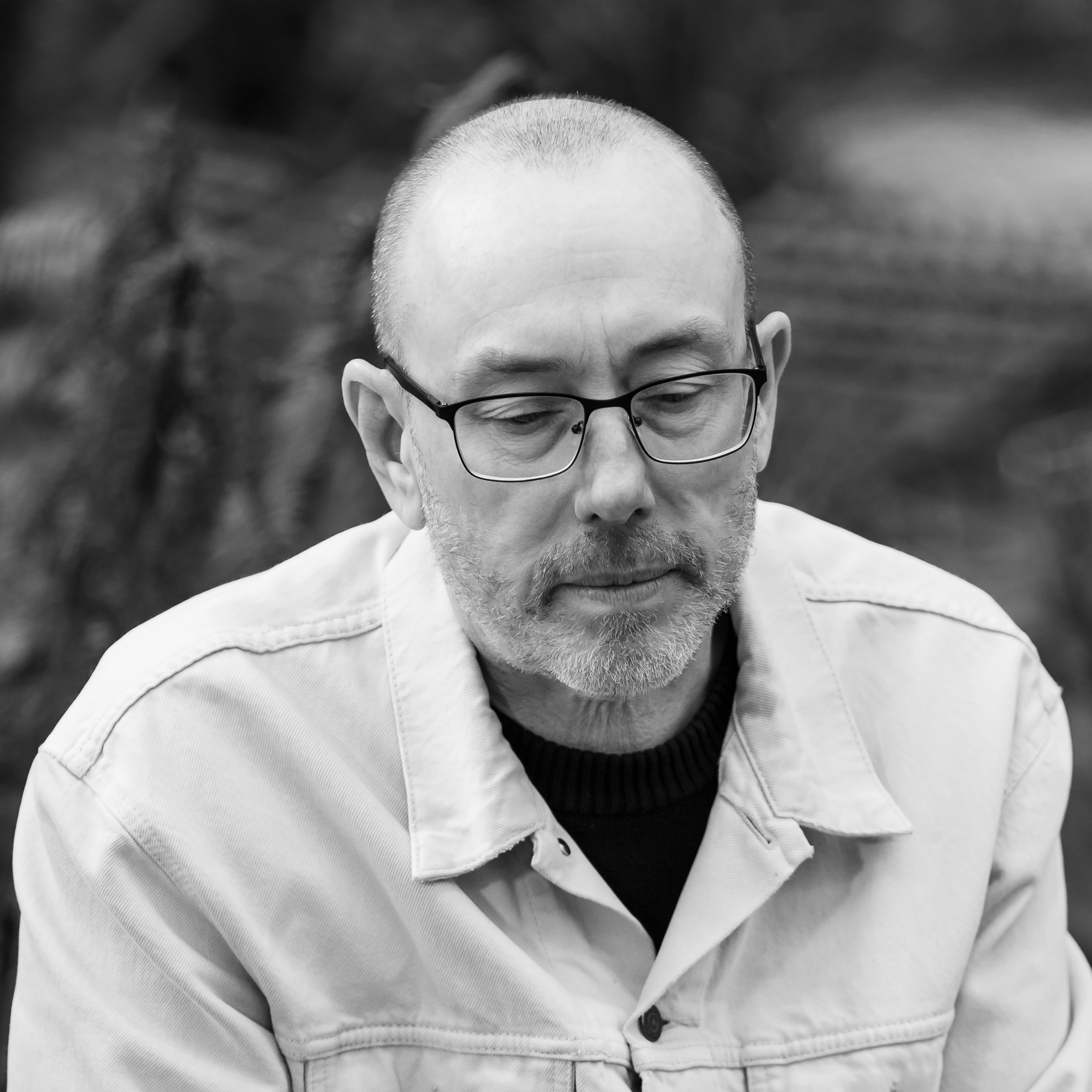
 Nigel Featherstone is a queer writer for the page, stage, and music. His most recent major work is The Story of the Oars, a play with spoken songs, which had its world premiere at The Street Theatre, Canberra, in 2025. Nigel’s novels include Bodies of Men (Hachette) was longlisted for the ARA Historical Novel Prize, runner-up for the ACT Book of the Year, and shortlisted in the Queensland Literary Awards. Recently he has been shortlisted for the ACU Prize for Poetry and the Newcastle Poetry Prize. Nigel is also the founder of Hell Herons, a spokenword+music collective that released its debut album, The Wreck Event, in 2024 (with Melinda Smith, Stuart Barnes, and CJ Bowerbird). In 2014 he was commissioned to write the libretto for a highly regarded song cycle, The Weight of Light, which had its world premiere at The Street Theatre in 2018. His short works – prose and poetry – have appeared in Guardian Australia, Sydney Morning Herald, Meanjin, Lantana, Griffith Review, Oystercatcher, Rabbit, Locative, Kill Your Darlings, The Millions, ANARKISS (UK), Horseshoe Literary Magazine (Canada), Chicago Quarterly Review, and AC | DC: Journal for the Bent (USA), among other outlets. A former ACT Artist of the Year, Nigel lives with Gandangara, Ngunnawal and Ngambri Country (regional NSW and ACT).
THE SHOEBOX
After my mother drew her final breath I inherited a shoebox, one I found
among the shadows of her wardrobe. Two shades of faded purple. Printed
on the lid FOOTREST: FASHION THAT FITS, but also, written in her
distinctive hand, SCHOOL CAPS, PENNANT, TIE. Mementoes. But of
what? In the stillness of my loungeroom I sit and slip off the lid. One by
one I touch what Mum collected, kept, yes, caps, those that protected –
labelled, defined – the lives of three boys, brothers. On the pennant,
inscribed in dramatic type, a single word implying the rules about how
words work, shapeshift, form whole worlds, then a motto, large and loud:
LAUS DEO. We were moved from that school to another, though really it
was the same except four suburbs away and hacked out of bushland’s last
stand. Remaining on the couch, I run my fingertips across the length of the
tie, the one I wore for six years, from the time of child to the time of not-
child. Two red pin-stripes on a blue background that’s almost black. Every
weekday morning, over a crisp white shirt – praise be to god – I tied that
thinning snake of a thing around my neck, tightened it, and straightened it
too; in terms of the latter there was an uphill battle being waged in my
body, waged outside it as well. Putting my palm to the stiff material,
which, I see, is silvery in the mid-morning sun, it’s so bright, I recall the
boy I was. On the bus, on the train, in the playground – quadrangle: one
must use the right words. Bubbler, toilet block, steps and stairs. In the
gymnasium’s changeroom, a flick of that lightweight weapon on skin, then –
praise be to god – it becomes a bandana as worn by Rocky the Mafia
enforcer (as if any of us could have empathised with him); that sort of lark
was lost on me, who always leant towards serious. In a blackboard
classroom, worn by the boy sitting behind the desk beside me, the tie forms
an arrow that flies between neck and belt-buckle. Praise be to god! Let me
whisper in my own ear: reach out, run a finger from knot to wideness, let
fear not get the better of you, or him, whoever he is, he’s an amalgam, for
there was more than one, in my chest, that’s where they liked to live.
Returning the tie to the box so it can rest again – praise be to god – with
the pennant and caps, I wonder what my mother wanted from me, wanted
from the world, the world she railed against, ‘fought tooth and nail’. The
power was elsewhere. Praise be to god. I remember how, in her last days,
when, for an unfathomable reason, all she managed to carry in her
diminishing chest were numbers – ‘seven, nine, seven, nine, seven, nine,
seven, nine, nine, nine, nine’– and colours – ‘yellow, green, yellow, green,
yellow, yellow, yellow, yellow’ (no red, no blue) because of the plaque in
her brain and the decay everywhere else. At the end of our last call, she
broke out – I shouldn’t have been surprised – and she said, ‘I love you with
every fibre of my being’. The fibres now lost, except the ones I keep in a
shoebox, in the silence, in the dust, among the shadows of my wardrobe.