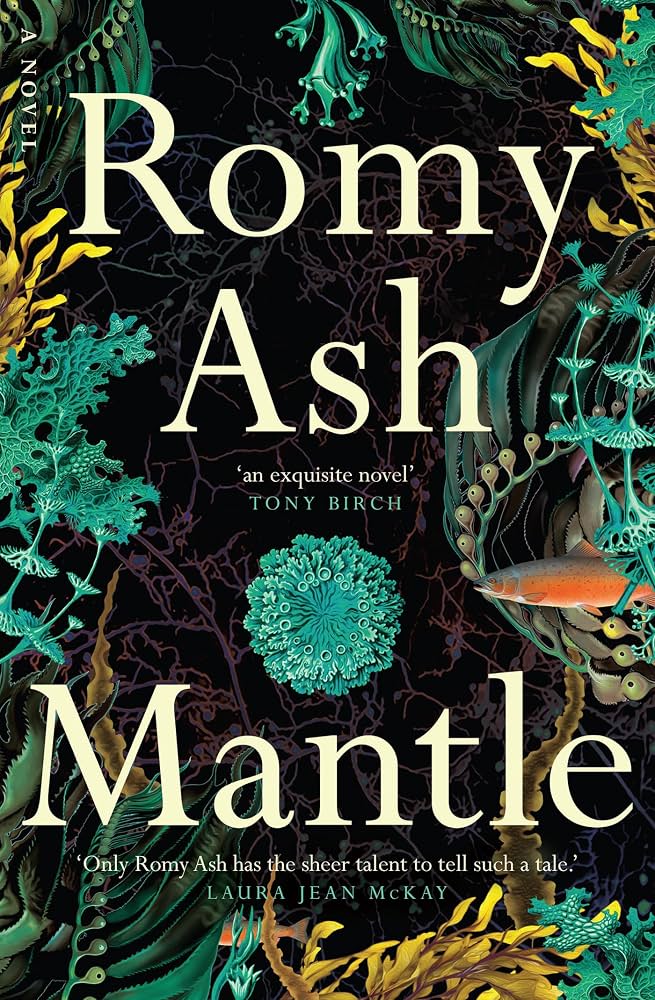
 Mantle
By Romy Ash
ISBN 9781761154768
Reviewed by GUS GOSWELL
Crust/Core. Attraction/Revulsion. Human/Non-human. Romy Ash’s second novel Mantle digs into liminal spaces to unearth a near-future narrative that erodes the boundary between the fate of humanity and that of the natural world we are indivisibly entangled with. In doing so, Mantle challenges us to confront what record we will leave behind in the strata.
Mantle’s first-person narrator is Ursula, a jaded, 50-year-old university geoscientist who studies rock and sediment layers to read the Earth’s history. Ursula has moved to lutruwita/Tasmania from the mainland to be with her mother Delores, who is dying. Delores is ‘a skin bag of bones’ (p.5). She lives in a house on a cliff overlooking some of the state’s industrial salmon farms. She believes bushfire smoke has done something sinister to her lungs. Ursula thinks it’s cancer from the cigarettes. A shared history of grief has marred the relationship between mother and daughter, but there’s still a tenderness. Ursula watches a nurse listen to Delores’ heartbeat with a stethoscope, and desires to do the same. ‘I want to hear the rush of blood, the beat of her heart. The inside of her, my first sounds’ (pp.16-17). The novel’s fascination with the body as a site of knowledge is established early.
Soon Ursula has the same red marks on her skin that she noticed on her mother’s. She goes to the doctor. He calls it ‘the rash’ and prescribes an antifungal cream. The pharmacist who dispenses it to Ursula has the rash as well, as do many other residents of the small town community. As Delores’ health declines, Ursula sits with her, holding her hand; ‘On my own palm, I feel fine strands, like fur has grown between us. I scrape at it with my fingernails, absent-minded, and it’s soft, insubstantial. It comes away from the skin’ (p.52). But as the geological meaning of the novel’s title suggests, the rash – like so much else in this story – is more than a surface phenomenon. ‘It doesn’t seem to stay in one place but instead rises behind an ear, and then under the toenails, and across one calf and then vanishes. There doesn’t seem to be a way to get a hold of it. I rub the cream in one place, and then another. But it is like it’s living beneath the skin, not atop it’ (pp.52-53).
By the time Delores asks to go to hospital, concern is spreading publicly that the rash is viral, airborne and deadly. The paramedics who take Delores away wear hazmat suits. When Ursula reaches the hospital, Delores has already died and Ursula is orphaned. In coming days grief arrives in waves, mooring Ursula to Delores’ home. With state borders closing, she couldn’t go back to her old life and career even if she wanted to.
Toby, a younger man who catches Ursula’s eye at the local pub, begins to fill the empty spaces in her days. He works as a diver at the fish farm Ursula despises for its polluting light and noise and environmental harm. Despite the difference in their ages and life experiences, Ursula and Toby fit well together, engrossed in each other’s bodies, cooking meals for one another. But more is growing between them than familiarity. ‘I look down at my breast, cupped by his hand as we slept. There’s a soft fluff all over the areola and the blue-veined sides. The fluff looks like cobwebs, old lady’s long hair, roots. The tendrils are so fine, they’re a whisper. “What is this?” he says, looking at his hand’ (p.76). As days become weeks the growths take the form of mushrooms. While Toby is disgusted, Ursula is captivated by what she finds growing on their skin. The hyphae are densest where their bodies press together. The mushrooms can be shaved or plucked off, but more will erupt. Realism/surrealism/magical realism; more borders artfully blurred.
In recent decades science has begun to reveal the extraordinary way fungi communicate through expansive mycelium networks. As the mushrooms bloom, Ursula appears to be tapping into something similar through her own fungal filaments, not only smelling, hearing, touching, seeing and tasting the life forms around her, but experiencing a heightened sense of communion with the natural world whose beauty and vulnerability she’s increasingly immersed in while the pandemic burgeons.
Exploring the curved beach of a bay, Ursula finds she is walking on fossils. ‘I chip away at the 250-million-year-old rock…I split it and can see another layer, layers upon layers compacted together…I imagine all our bodies, layers of them, laminated in sedimentary rock’ (p.116). She recalls something she heard on the radio about what followed the mass extinction of the dinosaurs. ‘There was this whole fungi age no one ever speaks about. When the earth was covered in the immense rotting bodies of those big beasts, and the fungi, okay with the darkness, thriving actually in the darkness, had its way with those bodies, doing its work, breaking things down, and transforming that matter into something else that resembled life’ (p.117).
Later, back at the pub, a conversation between Ursula and a local character at the bar also turns to transformation, in a way that illuminates another, atmospheric, layer of meaning embedded in the novel’s title. ‘“You know,” he says, “twilight happens in reverse at the other end of the day. The morning…There’s always that, you know, after the night”’(p.184).
While Mantle provides Ash with the storytelling scope to explore symbolism and metaphor on such vast geological and celestial scales, it also demonstrates again how skilled she is at grounding narratives in place through the accumulation of small and unquestionably true details on a human scale. In her 2012 debut novel Floundering, a baking hot car and sweat sliding across skin made two young boys’ coming-of-age experiences in a coastal caravan park a felt-more-than-read reality. In Mantle, it’s the fireplace, the wood pile, the composting toilet, slippers by the back door and kitchen knives in need of sharpening that usher us into Ursula’s life.
But where Floundering achieved its narrative power through the precision of its portrayal of siblings navigating the threats of a sweltering summer, Mantle’s narrative weight accrues through the interiority of Ursula’s grappling with decay and loss at simultaneously planetary and personal levels. Temperatures are rising, extinction is spreading, and Ursula’s world is no longer post-pandemic, or comfortably pre-collapse. And yet, Mantle remains a book of sly humour and gothic whimsy that revels in the pleasures of good food made by hand, of sex, firewarmth, a solid cast iron pan, moments shared with birds, and oceanic submersion. As Ursula’s world is unmade, these pleasures remain, not as a means of escape but as welcome anchors of her inheritance and responsibilities within the human and more-than-human worlds. When Mantle moves to its coda, a bold act of industrial sabotage by Ursula and Toby expresses that shared ecology.
Resignation/Resistance. Despair/Defiance. In writing Mantle, Romy Ash, through Ursula, has refused to look away from the Anthropocene’s accelerated reckoning. But in this bewitching novel there’s a hint of that mirrored, ascending scale Ursula learnt about earlier at the bar, a glimmer from a twilight that while it is falling promises that it will also rise.
—
GUS GOSWELL is a freelance writer, reviewer and journalist specialising in nature and climate stories. He has also reviewed fiction and non-fiction for Australian Book Review, The Saturday Paper and The Age/The Sydney Morning Herald.