 The Northern Tomb
By Isabelle Li
ISBN 9781923099821
Reviewed by RAIDAH SHAH IDIL
The Northern Tomb explores three years of the Covid pandemic in Shenyang, a capital city in Northeast China, through the compelling first-person perspectives of Mr Zhao, an elderly widower and retired army official who came from a privileged background, Sister Fu, his widowed middle-aged carer who grew up in poverty, has lived with abuse and chose a more independent life, and Junior, Mr Zhao’s son, who was abused by his father and had been imprisoned under the Severe Strike Campaign in the Great North Prison in 1983. This story follows Sister Fu’s decision to leave her job as a hospital cleaner and work privately for Mr Zhao for better pay, their healing companionship with one another, and the intimate glimpse into Mr Zhao’s interactions with his family: his two daughters live abroad and his son and twin grandchildren are nearby. Sister Fu has far more patience and compassion with Mr Zhao than his son, revealing the cracks in Mr Zhao’s family, especially in the aftermath of his wife’s death. We later learn that Mr Zhao did not care for his wife as her health deteriorated, and his son has not forgiven him for his neglect, nor has he forgiven his father for beating him as a child. Isabelle Li’s debut novel is remarkably self-assured and brings historical events into dialogue with personal stories.
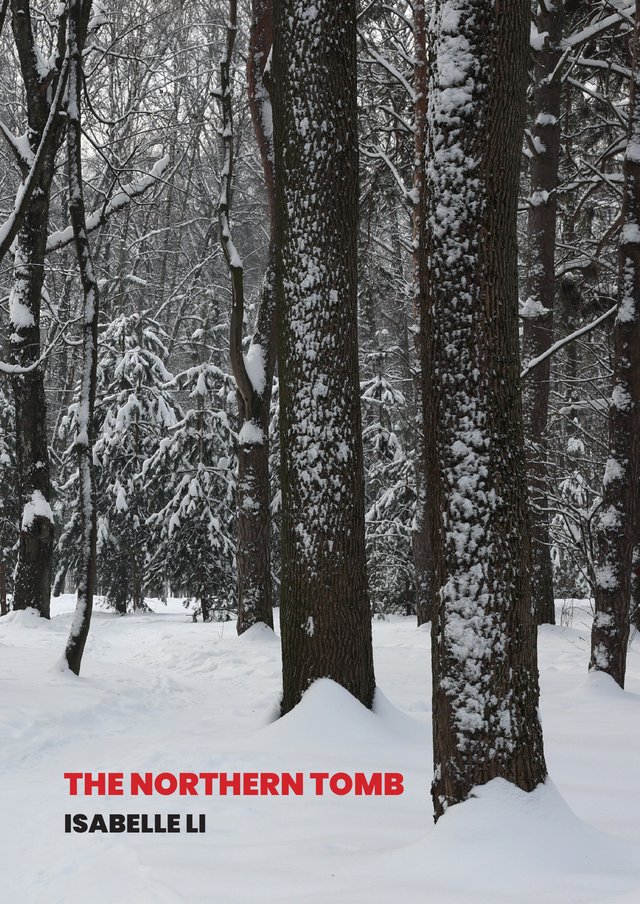
The first thing that struck me was how light and unassuming the book was. It took two weeks to arrive at my Malaysian address, posted from Sydney, the city I used to call home. The book cover itself is of frosted trees and snow (cover design by Miranda Douglas), and the title, ominous: The Northern Tomb. It looked almost like a psychological suspense story – and in some ways, it was; a deft, evocative, haunting exploration of what it means to be human. However, there are also many political and cultural questions the novel raises , or omits entirely – which is a statement in and of itself.
This book follows two decades of tremendous change – the Great Leap Forward to the Cultural Revolution was a time of rapid industrialization, communes and social upheaval, censorship, closure of schools and universities, military presence and punishment and death for up to 2 million people. This is the tumultuous backdrop that underpins the experiences of our three protagonists.
The Northern Tomb does not touch on the experience of the Chinese diaspora, but rather focuses on exploring themes of illness, care and under the specific context of a complex cultural history and national tensions. This book’s specificity only strengthens its emotional impact.
Powerful, poignant themes permeate The Northern Tomb: loss, redemption, regret, familial love and abuse. What was most confronting to me was the indignities that come with aging, and losing bodily autonomy.
Even the title itself is a heavy one: it comes from The Northern Tomb (Beijing) – officially known as the Zhaoling Tomb, this UNESCO World Heritage site is the burial place of Hong Taiji (the founder of the Qing dynasty) and his empress. Additionally, the novel alludes to the Great North Prison (the northeast) where many writers and intellectuals were sent to labour camps during Mao’s time. There is no reference in this novella that over one million Uyghurs and other mostly Muslim minorities have been detained without trial in the northwest of China.
It is difficult to be overtly critical of the Chinese government, especially when it comes to human rights abuses, but the skilful characterisation of Sister Fu with her lower-class background, mud hut origins, abusive childhood experiences while living on the border of Russia shows that it is possible to expand the experience of what it means to be a Chinese citizen. Not referencing the detainment of Ughyurs and other minorities may risk romanticizing detention as something that belongs in the historical past, instead of a brutal current reality; it may uncritically sustain the narratives of Chinese progress. Yet, the consequences of wards and prisons are deeply evident in each of these characters’ lives.
And, despite the heavy themes, Li tempers these bleak reflections with moments of pure hilarity, such as arises from impairment and medical jargon:
Another time soon after his medical check-up his daughter asked, ‘How’s your atrial fibrillation? Is it under control with medication?’
He replied warmly, ‘Daddy’s constipation is a chronic affliction no medication can cure.’ He assumed that a topic of such paramount interest to him would be of the same interest to his children.
I couldn’t help laughing and interjected, ‘Not constipation! Atrial fibrillation!’
He laughed too. ‘My eras have become artifices purely for decorative purposes.’
(p176)
These moments of levity are sprinkled throughout the novel, giving readers some much-needed respite. In addition to the deterioration of aging, the all-too familiar caregiver frustration with stubborn elders shines strongly through Li’s prose. On page 186, we see this through the viewpoint of Sister Fu, alarmed by Junior’s anger at his father’s decision to leave their bunker, only to catch COVID:
Junior visited everyday, bringing more ibuprofen, food and endless criticisms of his father’s paranoia, arrogance, and egocentrism. Mr Zhao endured the onslaught with only a nod or a chuckle, and not one word to rebut. His mellowed attitude finally rang the alarm bell. ‘What’s wrong with him?’ Junior ruminated in the kitchen, putting down a bag of beef buns he’d brought from a Muslim market near the Little West Gate.
For once I agreed with him. Something had gone seriously astray, deviating from the usual upward trajectory of a recovery. Mr Zhao had always been demanding, of others, and of himself. Now he simply stopped caring.
(p188)
Despite Junior being abrasive and bull-headed with his own father because he was beaten by him as a child, Junior is at his most human when he is with his twin children. This is a tender glimpse into the formerly incarcerated young man:
I’d drifted back to sleep again and was woken by a massive sneeze of my own, rousing mischievous laughter. Little Poplar had used her hair to tickle my nose, the two of them on either side of my head, looking at my face as though it belonged to an oversized dog. I was short of sleep and wanted to scold them for disturbing me. Then I thought: who else in this breathing world would be interested in my hairy nostrils? And soon they’d grow out of childhood, finding me boring and old. Little Poplar would be the first, being more discerning…….They settled their soft bodies into the folds of my arms, and I was overwhelmed like a brooding hen by the immense pleasure.
(p 173)
Through Junior’s perspective, we read about the vast contrast between father and son’s parenting styles:
My father used to say, ‘Life is a struggle’, which was supposed to explain all failures and heartaches. But why should it be? Must we earn our right to happiness? Couldn’t we make life, as short as it is, a joyride, a feast, a party? The last thing I wanted was for my children to struggle. I’d tasted so much bitterness and pledged to spare them of such hardship.
(p156)
Junior’s relationship with his dying mother brought me close to tears and made me wonder about my own husband and his mother; my mother and her sons; and my own relationship with my young son. Junior reflects on his mother’s ill health after his release from prison:
By the time I came home her deterioration had started. Over the years her mind continued to disintegrate, gathering speed until it became an avalanche……Slowly she started to lose control of her body. My father was useless when it came to personal care. She was more comfortable having me wash her after the occasional mishaps. There was no embarrassment between us – her body was where I came from, and she’d cleaned and cared for mine…..I despised him for not seeking effective treatment for my mother and blamed him for her loneliness. He even wanted to send her to a nursing home to be looked after by strangers. I didn’t argue – nobody could persuade a heartless man on moral issues. I just said, ‘Do what you want. She’s your wife.’ What I didn’t say was, ‘Just you wait. You’ll be next.’
(p137)
Every perspective reveals deeper layers behind the four character, and Li’s dramatic skill in creating narrative tensions and intensities generates so much empathy. I wished each could inhabit the other’s memories and experiences, to grant them more patience and empathy. Mr Zhao describes the bodily perils of old age with painful vulnerability:
‘In my old age, aches and pains had colonised my body: sharp pain in my right knee, aches in my shoulders, cramps in the right side of my abdomen. But the worst afflictions were constipation and insomnia’ (p77)
His love for his children, despite their distance, shone through Li’s haunting prose.
She was my legacy. One day her voice would become music, songs without words, ringing infinitely sweet. Even in deafness I’d be ever so happy to listen to her. (Page 78)
I was moved. For many years I’d given up hope for grandchildren who’d bear the family name. But without giving birth to more books, my son had produced twins in his fifties, and surprised everyone with his natural ability in looking after them, a consolation in my old age (p95)
Even though the novel does not end with a clear sense of closure, I trust in Sister Fu’s compassion, Mr Zhao’s regret, and Junior’s determination. I have so much hope for Little Poplar and Little Pine. Even though Junior was being unduly harsh to his father in his old age – a natural consequence of being beaten by him as a child – I hope that because he broke the cycle of abuse with his own children, perhaps one day, in the far away future, his children will hold him with far more gentleness and love. The Northern Tomb‘s focus on healing, caring and parenting is an astute and eloquent narrative study of what social cohesion might look like for the intimate family circle, and for the spaces beyond.
RAIDAH SHAH IDIL is a Malay Australian author born in Singapore, raised in Sydney and based in Petaling Jaya, Malaysia. Her debut middle grade novel, How To Free A Jinn (Allen & Unwin) won the Readings Children’s Prize in 2025 and was Highly Commended by the Victorian Premier Literary Awards. Her book made it to the Vibrant Voices list in New York Public Library, establishing her as one of the top 50 BIPOC emerging voices in 2026. Raidah loves jungle trekking with her husband and kids. She misses kebabs, enjoys noodle soup, ginger tea, and dreams of uninterrupted sleep.