Author: mascara
Maya Khosla: Red-Tailed Hawk
.jpg) Maya Khosla was raised in India, England, Algeria, Burma, Bhutan, and Bangladesh. Those cultures as well as her background in biology strongly shaped her writing. As an independent wildlife biologist, Maya is comfortable wandering through oak woodlands or waist-deep in silty waters (wearing chest waders). Her books include “Keel Bone,” (poetry from Bear Star Press; 2003 Dorothy Brunsman Award), “Web of Water: Life in Redwood Creek,” (nonfiction from Golden Gate National Park Conservancy Press, 1997) and “Heart of the Tearing,” (poetry from Red Dust Press 1995). Performing, teaching and writing have earned her awards from the Headlands Center for the Arts, Poets and Writers Inc., and the Ludvig Vogelstein Foundation.
Maya Khosla was raised in India, England, Algeria, Burma, Bhutan, and Bangladesh. Those cultures as well as her background in biology strongly shaped her writing. As an independent wildlife biologist, Maya is comfortable wandering through oak woodlands or waist-deep in silty waters (wearing chest waders). Her books include “Keel Bone,” (poetry from Bear Star Press; 2003 Dorothy Brunsman Award), “Web of Water: Life in Redwood Creek,” (nonfiction from Golden Gate National Park Conservancy Press, 1997) and “Heart of the Tearing,” (poetry from Red Dust Press 1995). Performing, teaching and writing have earned her awards from the Headlands Center for the Arts, Poets and Writers Inc., and the Ludvig Vogelstein Foundation.
Red-Tailed Hawk
The flowers you give
are my maps. If I am ever lost
their petals’ scent will pull me
toward your musk again.
January 1, 2008
It’s a cloud-lidded morning. Thoroughly soaked, the fenceposts lining my little backyard are stained so dark the lichen growing on them looks fluorescent green by comparison. Rain is a mark of auspicious beginnings, though Michael just walked out of my condo with his spare motorcycle helmet and running clothes.
“I’m moving to the Philippines, Tash,” he declared before leaving. “It’s home.”
He has often mused about emigrating. But the emphasis on home gave his announcement a ring of conviction I haven’t heard before. We were standing in my condo hallway next to the stairs going up to my bedroom, where we shared New Years resolutions last night. I searched the olive-green flecks mixed into the browns of his pupils that drew me in from the moment of our first date, years ago, when he lifted me into the air in spite of a sore left shoulder.
But this morning his eyes were too dark to see the greens. He sank to the edge of my second stair to tie his shoelaces.
Michael was raised in the Philippines. His Dominican mother, siblings and the online game company he works for are all based there. I’ve visited Manila, Kanlubang, and Makiling with him. I too have most of my family overseas, in India. So I sympathize with his sense of home in a distant country of seven thousand-plus islands. It’s the warmth, the ability to buy a single cigarette, to figure out ways to return home from office for an afternoon nap. It’s the tropical air that can get so heated and heavy with moisture that when it breaks into drizzle, it’s hard to notice the difference.
He stood again, filling my condo hallway.
“Give me a hug? I won’t be seeing you again.” He leaned forward, arms reaching, the fingers of his square hands spread. His lips were in a pout, his eyes focused, intent.
I shook my head. As if yielding meant he would leave my place, California, the country. As if leaving without that hug meant he would have to reconsider.
When he turned to fumble with the front door locks and pick up the helmet, his right hand came within inches of me. I felt an urge to grab and shake it vigorously. He slipped out and I held the door open, breathing in the scent of post-drizzle moisture.
Sun behind veils, salts of loss on the tongue. An Anna’s hummingbird dashed past in a streak of shiny vermilion, wings beating about eighty times a minute, like a pulse racing over words held down. Its speed emphasized its ground level opposite, a two-legged trapped as if in torpor, unable to rush out and beckon her partner back.
It’s quiet here; guilt deadbolts me in. I made him leave. My hallway looks whole shades dingier. The dining table and its contents, two freshly drained tea mugs, a persimmon and a sliver of leftover fruit loaf, shrink-wrapped in plastic, hold the weight of a recent conclusion. Upstairs, my unmade bed is too tousled to allow for a quick smoothing over. It needs to be stripped and redone.
The blooms he brought me yesterday are louder in his absence—red so saturated it looks wet. They are a reminder. We had planned a morning hike. The remainder of today was supposed to form neatly around the crystal of its there-and-back symmetry, the sweet scents and rush of blood and breath.
Last week’s storms have filled the North Bay’s soils and streams and enriched its forests and meadows with every color except this drained gray of sky. I have spent twelve winters here working out in the wild, so I know. Coho salmon are torpedoing up towards their deaths against the flow of swollen creeks. Frogs are emitting creaky calls from under umbrellas of dripping ferns. Bulb-bright highlights of new growth are re-greening every limb-tip of every bishop pine, redwood and fir. When a hawk alights, the branch gripped in its circlets of claws will shake and sway and splash. Winter wrens and varied thrushes in the vicinity will fall silent.
I haven’t the energy to emerge.
Michael is driving south to his home in Novato. Inside his car, he will switch the air vent back to ‘cold’ since I’m not with him. He will brush his hair impatiently with his left hand, the dark curls springing back after each stroke as if in protest. His eyes will be locked ahead as he waits for a chance to enter the right lane, glide past the slower car and swing back across highway dots and dashes.
The New Years resolutions we bantered about seem utterly irrelevant. Mine included accomplishing symbolic nuggets of what I hope to achieve within the next three hundred and sixty four days. “First thing’s first: begin it feeling new,” my mother used to launch forth. “Wear pressed clothes without a trace of past perfumes. Take six deep breaths at an open window. Make modest wishes…”
I do. Today they were good food and exercise, fresh air and water, a respectable chunk of work and a search for bobcats, raptors and frogs. These were the seeds I wanted to set, the emblems of my intentions for 2109.
Moving to the window, I twist the angle of the faux bamboo blinds and put my face close. A cold smell is all. A few weeks ago Michael gripped my battery-powered drill in both hands and worked on each fitting with single-minded diligence, asking me to hand him a nail here, a bracket or a blind there, stepping back to view it before moving on to the next one. Hours later he had installed them in all my windows. We whispered our verdict in unison.
“Wow!”
He drew down the new blind, placed my drill inside its blue box on the coffee table and closed the distance between us. When we kissed, a slight leak in his right nostril wet my upper lip. I moved to wipe myself and he drew back to clean his nose with a quick apology. He was just as quick to advance again. The thudding in my ears blended with the salts and frictions of touch and the nose-drip was forgotten — until we parted to climb the stairs and the same wet spot chilled with evaporation.
When I get the angle correct, cloud-light glances off the blinds’ buttery hue and lights up the red and yellow cushions scattered across two futons that frame one corner of my living room. On the shelf in my downstairs closet is the new brocade sweatshirt I planned to throw on before leaving. Next to it a blank space where Michael’s white motorcycle helmet was stored. The sight propels me upstairs. On the top shelf of my bedroom closet, his running tea shirt and shorts were kept folded next to my field shirts that have clung to their mud-and algae-stains through wash cycles. He’s neater than I am. He’s meticulous. Even the absence of clothes looks rectangular.
I can’t bring myself to move my shirts and woolen shawls over to fill the empty space. Leaving it empty falls in the same category as refusing him the goodbye-hug. It’s a safeguard that could protect against an absence so complete it’s irreversible. Against losing my grip on those arms that looked weighty with rest just hours ago in this room.
The dishes, counters, and tabletop are clean, the bed made. I pressed the persimmon from its ends so the flesh gave, easily, two halves of a whole. The orange flesh had the consistency of an overripe mango but was sweeter, chalkier, full of rich sugars and salts. It was comfort food.
I threw away the fruit loaf that began our quarrel. I had taken it out of the freezer and warmed it in lieu of my homemade date-oatmeal bars, which I had run out of.
Michael eyed the density of fruit and nut between bites.
“Who’s been here? You had a whole loaf a couple of days ago.”
“This? It’s been sitting in the freezer,” I argued.
Still chewing, he scanned my living room and shook his head.
“I don’t think so. Look at those two cushions lying by the fireplace. You’ve had company. Recently.”
I tried to remember when my friends Susan, Mella, and Sally had been over, whether they’d eaten much of the loaf. We had met sometime before Christmas, probably two weeks ago. Then I realized it didn’t matter what I said.
Michael was chuckling, shaking his head. “Tash, it’s obvious someone’s been here. Cozy evening with him?”
“You know what, Michael? Enough.”
He stared at his empty tea mug as though making a calculation. Then he sprang up. “You know what? It’s obvious you’re involved with someone. I’ll do the same.”
“I think you need to leave,” I heard myself say. He responded with the wide-eyed gaze of a frightened child. Then he went around the corner and I listened to the thump-thump of his feet up the stairs.
It’s 1:44 p.m. When I get online, Michael is there too.
“I am completely devasted and cant even breath,” he begins his chat.
He’s back. Except the misspellings reveal a carelessness rare for him.
He types, “I just can’t imagine being without the love of my life and yet I bring us so much pain and turmoil.”
It’s a shot of lucid light searing the gloom. Perhaps we’ll get through this. He writes that even his divorce was easier than losing me.
“You are not losing me!” I reply.
“It’s this seroquel,” he writes. “It’s making me crazy.” Seroquel is his latest antidepressant.
Two hundred and ten emoticons of a face in tears arrive on my screen. I have never understood how he does that so fast. I want to reach through the electronic windows separating us and cover the hands that type unfiltered fears and push the return button with the urgency of one who is trying to check his fall in a dream.
He does not mention the fruit loaf or cushions.
It’s a little over a mile to the cement-lined ponds and greens of Sonoma State University. I’ve worn my new sweatshirt for ritual’s sake, and a rain jacket over it. There are footprints ahead, but no one else is walking the Copeland Creek Trail now. No one is playing in the football field south of my path. The creek is invisible behind a riparian world that has risen like fire; swaths of green and nubs of new leaves-to-be are pointing skyward like a multitude of hopes. Their savings account, groundwater, is rich and gurgles underground like a secret.
There is a slap and suck to each step through muddy softness. Crossing a puddle the brown of soil-flour, I think of the hike we missed this morning. The same eight miles through Point Reyes National Seashore along Bear Valley Creek became a habit for us long before Michael’s counselor began giving him prescriptions for antidepressants. We stuck with the eight: Bear Valley Trail to Meadow, Meadow to Sky, Sky to Mt. Whittenberg and back down to Bear Valley. Is there some significance to our missing out on the first of the year? Was it best, asking him to leave when I did?
A white-crowned sparrow clings to a spindle-thin twig among a perfusion of bare branches. Its gold beak is an ember opening to release a series of plaintive trills. I watch with binoculars. It catches sight of me and dips into the creek-side tangle.
A red-tailed hawk circles on the air thermals above. Its tail swivels and I catch a glimpse the red dorsal feathers. My binoculars magnify the down-turned head, shifting slightly from side to side as it scans the football field. Hunting is a swift dream, mired in instinct but crisp with the single-minded focus of pursuit.
In a breath, it bunches up its wings, extends its claws and plunges fieldward. A predator’s drive looks so sure, yet it is in the dark about itself. The wings unfurl as claws touch grass. Now it’s hopping, now still. Apparently it has missed its target.
A few seasons ago I encountered a fallen red-tail. That too was a cloud-wrapped day. I was surveying for burrowing owls in rolling grasslands close to Altamont Pass, where wind turbines cover the ridge-tops for miles. The raptor must have collided with the turbine roaring above us.
“If you throw a large cloth over it,” a woman at the nearest wildlife rehabilitation center explained when I called, “it will calm down. If you don’t have one, back off or you’ll risk having your wrists lacerated.”
I shed my fleece jacket and spread it wide, measuring. It was no large cloth. I made a split-second decision and advanced in terror. The bird stood regal, head rising, hooked beak bared, crest feathers standing. They looked damp—rain or sweat? Every inch of its foot and a half tall body was designed to intimidate.
Still, I advanced closer. It took one hop away. The left wing was dragging in a pathetic antithesis of the poise that was using up so much of its body’s meager energy savings. It raised the talons of one leg at me with a predator’s regal fury. The beak was still bared. I couldn’t afford to hesitate. Let instant darkness calm it.
I had been given good rules over the phone; I had sat through training classes in Golden Gate Raptor Observatory before that. But when the moment closed in, adrenalin-fired fear eclipsed all thought.
I dropped my fleece on the bird and all was very quiet. I bent double and gathered up the raptor in my jacket. It had calmed down— immediately. It sat still, trapped, light as held breath.
Walking uphill with arms outstretched, I was panting soon. My car was parked under the wind turbine and its wails grew and grew as I neared the ridgeline. Inside my jacket, all was so still that there were moments when I was convinced the red-tail had slipped out. I turned back once, but the capture spot was already out of view.
Was it comfortable inside? Would it heal, hover in the updrafts again to decipher—the way no human eye can—the day-glow ultraviolet ribbons of mouse urine, the twitching, racing maneuvers that must look utterly futile from a bird’s eye view?
And most important, had I folded the broken wing correctly, given it enough breathing room?
I didn’t dare check. Awareness of a human face would have caused more stress to the bird. The questions were torture, though. They haven’t left me, though I now know one of the answers.
Andy Quan Reviews Equal To The Earth by Jee Leong Koh
Continue reading for only $5 per month
Subscribe for full access to Mascara Literary Review or login
Ashley Capes Reviews Readings From Wheeling Motel by Franz Wright, Music by Michael Rozon, Daniel Ahearn
.jpg) Readings from Wheeling Motel
Readings from Wheeling Motel
by Franz Wright
Produced by Daniel Ahearn, Chris Ahearn
Music by Michael Rozon, with Daniel Ahearn
Riparian Records 2009
Recorded by arrangement with Alfred A. Knopf, an imprint of Knopf Doubleday Publishing Group, a division of Random House, Inc.
http://readingsfromwheelingmotel.bandcamp.com/
Reviewed by ASHLEY CAPES
A musical collaboration between the US poet Franz Wright and Los Angeles musicians/producers Daniel Ahearn (Ill Lit) and Michael Rozon (Brazzaville, Melvins).
When I received Readings from Wheeling Motel, by Pulitzer Prize winning American poet, Franz Wright, I was immediately struck by how convincing Wright was as a reader. He does not rush a single moment, and brings a sense of assuredness to the recording, with his willingness to leave space where space is needed. Having Ahearn travel to the poet’s home in Waltham, MA to record the readings may have added to this, as the studio can be a demanding place, where budgets and schedules often hang over a performer.
The publisher notes that the original music, recorded by Ahearn and Rozon in Los Angeles, “creates a dreamy counterpoint to Wright’s delicate, deliberate lines” and “offers the rare opportunity to experience this world-class poet in a uniquely personal and direct manner.”
I agree. It is a highly personal experience, at times an unnerving one too, both musically and thematically. An extensively self-referential collection of pieces, conviction comes from a willingness to both examine and criticise the self. Even to run across the bruises at times, as in the mercenary tradition of much poetry, Wright tears through his own life and ends up sharing stunning material. “Night Flight Turbulence” is a perfect example of a personal moment becoming shared, through both its interaction with the music and the listener. The recording builds a tight space around the narrator, enhanced by heavy, reverb-drenched atmosphere, courtesy of the piano’s legato phrasing and reversed guitar. Wright’s expression of confinement is made more tangible with a word choice that is both conversational and abstract:
In the greenly-lit restroom,
I looked pretty ill, like
a vampire locked in
a confessional;
the drug had no effect
whatsoever, maybe
slightly more arctic and fearful.
I looked pretty ill, like
a vampire locked in
a confessional;
the drug had no effect
whatsoever, maybe
slightly more arctic and fearful.
Here and throughout, Wright’s voice is like an anchor, holding everything in place. The music moves around and beneath his raspy tone, never intruding, but instead supporting his imagery and deft use of metaphor and simile. At times the music almost sounds like it chills him, despite being recorded after his reading.
Dennis Wilson’s Pacific Ocean Blue seems comparable. Both recordings are musically cool and reflective, often pensive, or simply dark. And both voices are deep, raspy and weathered, but clear (though more so in the case of Wright). And it’s that clarity of voice that’s so frequently mirrored in his poems – “At 54” is a wonderful moment of revelation, where ‘place’ becomes everything:
And I can’t wait
to return to this chair
in which I am sitting, this
world, the one where
each object stands
for nothing at all but
its own inexplicable existence.
Listening to Wright read his poetry, I found myself at his mercy; I experienced each piece like a movie – knowing so little about what was coming next. It kept me involved in a way that was different to the page. In fact, one of the greatest challenges in writing about Readings from Wheeling Motel, is that I can only show you the words, I can’t let you hear them. And it’s important to feel the way in which the intensity of the poetry is counter-balanced by Wright’s calm, measured reading, the open, unobtrusive music. Now, when I re-read sections of the poems here, the intensity is stronger than the calm. Wright, who has battled alcoholism, addiction and psychiatric illness, is biting when it comes to the limitations of prescription therapy, as with “Paediatric Suicide”, which begins with the line:
Being who you are is not a disorder.
Being unloved is not psychiatric disorder.
This launches an attack, going well beyond defiance:
And seeing a psychiatrist for 15 minutes per month
some subdoormat psychiatrist, writing for just what you
need lots more drugs
to pay his mortgage Lexus lease and child’s future tuition
while pondering which wine to have for
dinner is not effective
treatment for friendless and permanent sadness.
Child your sick smile is the border of sleep.
The poem is one of the most beautiful and heart-rending of the collection. For as much as it is haunting, brooding and bleak, there is beauty, defiance and strength. Wright’s mix of tenderness and harsh realism weaves its way through so many poems, like “Waltham Catholic Cemetery” or one of the longer pieces, “With a Child”:
And the words
for these things are so terribly small;
and the world of those words
only slightly less mortal
than this instant of taking your hand,
of taking care to look both ways,
not to squeeze too hard, or be too aware
that no such mercy will be proffered
by a world that has no need
of words, or us.
At times it sounds like Wright is searching for and finding the right words, as if he does this ‘live’ as he reads. This space is used to great effect, such as in the list-like poem “Intake Interview,” where each line is given the room to stand alone:
Would you compare your education to a disease so rare no one
else has ever had it, or the deliberate extermination
of indigenous populations?
The entire recording is sequenced with space in mind. During the poems and between them, there is enough time to feel or think, between one poem and the next. The music, at times quite dramatic, though usually so understated, is transitional between pieces, but also allows the listener room to absorb the poem themselves.
The impressionistic sketches and musical fragments (arranged by a big supporting cast) comprise at the least, piano, pedal steel, nylon acoustic (on the delicate “Out of Delusion,”) electric guitar, wordless vocals. During “Day One”, a simple, hard drumbeat underscores the humour in the piece:
Good morning, class. Today
we’re going to be discussing
the deplorable adventures
of Franz Wright and his gory flute.
Just kidding.
One of the more dissonant pieces of music in the recording is from “Abuse,” which brings a silent film or saloon to mind, with an off-kilter feel, one that is a surprising but not unwelcome contrast with the rest of the collection.
“Bumming a Cigarette” follows and returns to a slow, marching tone, for one of the most harrowing moments as Wright seems to accuse himself of becoming his father, who also suffered with alcoholism and who eventually died after being diagnosed with cancer of the tongue:
And you can only armour yourself in death-wish for so long, the
blows are not muffled, it will save you from nothing;
and the idiot drive to go on, and actually be glad to go on,
keeps breaking through, ruining everything, even
this last chance for some sort of peace.
The collection does have the feel, at times, of a startling eulogy. Death features large in the collection, both its inevitability and, perhaps, its inability to be explained away by religion (“Everyone, Lord who wakes up in a cell./Everyone Lord who wakes up in the cancer bed.” from “No Answer No Why”). I came to the closing track looking for something tender, more hopeful, and “Wheeling Motel” delivers this. Settling on a reflective moment, it is framed beautifully by piano and a wordless vocal with a gospel, Amazing Grace/Great Gig in the Sky-feel, where Wright closes with an echo, subverting the famous American Civil War poem and personalising the conflict by referencing himself and his father, suggesting an ability to reconcile, to forgive:
Then the moon will rise
like the word reconciliation,
like Walt Whitman examining the tear on a dead face.
It’s a privilege to be introduced to Wright’s work in this manner. Hearing a recording is an experience that many of us will never have. There are poets from the past whose readings are impossible to record. Contemporary poets may be prohibited, or lack the opportunity. There are so many stumbling blocks between poet and listener. But here, Ahearn, Rozon and Wright tear them down and present the poetry in a way that brings the reader, in Ahearn’s words “disorientation, transcendence, a strange peace.”
Tim Wright Reviews Pam Brown’s True Thoughts
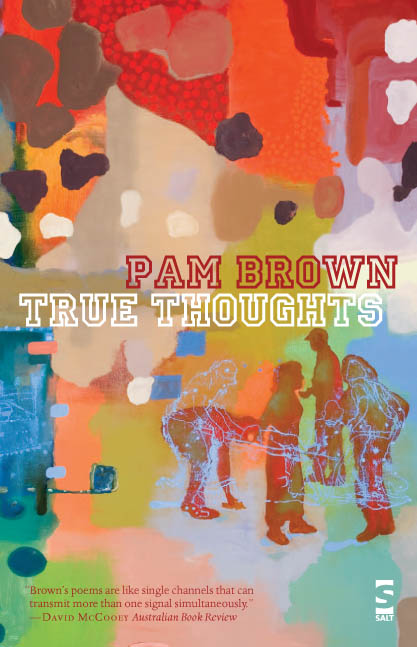 Drinking Water in a Suburb Called Zetland: Notes on Memory and the City in Some Poems by Pam Brown
True Thoughts
by Pam Brown
Salt Publishing, 2008
ISBN: 9781844715152
Reviewed by TIM WRIGHT
In a recent discussion of the lyric in Australian poetry on her blog[i], Pam Brown wrote of her poetics that she was interested in ‘the occurrence of ‘the current’’. The current here could be both ‘the contemporary’ or ‘the present moment’, the moment of writing. In her latest collection True Thoughts this interest in the current merges with an ongoing interests in memory and place (particularly the local). The past and present appears often as a duality in the collection, along with others: stillness and movement, inside and outside, this way or that way, here or there. The poems’ mode is kinetic, they proceed by indirection[ii].
Brown’s noted critical take on the everyday – and sometimes hyper (and anxious) self-reflexivity – is integrated into the practices and habits around work, leisure, friendships, travel, reading, and writing. The title is plural: ‘thoughts’ as in products; not ‘thought’ as process. The poems are less about the kind of thinking exemplified by Rodin’s Thinker, an absorbed stillness; instead thoughts occur, one after another, amidst and in response to movement, radio, traffic, mobile phones. Thinking takes place in a city, and so the possibilities or potentialities latent within it become part of the thinking process. Subject and object are often captured on the move, going somewhere else. Glimpses of the poet appear – catching a train to work or sitting at a desk to read – alongside and simultaneous with records of various kinds of mental action: observing and noticing, worrying, hesitating, remembering or speculating on conversations with other writers and friends, making a decision.
The poems don’t lend themselves to scholarly close reading; they wriggle out from under the microscope; they don’t seem to me to be coded or contained in the way that that method, at some level, implies. They share concerns of memory, and a responsibility to continue thinking politically and humorously in an increasingly fragmented contemporary. About half of the poems are more than three pages long, and move by branching, link-and-node formations: shape mimics thought. I read the poems as a book length work; not quite a sequence, but a collection in which chronology is important. I suspect that a way of reading (or listening) to the poems is required that is more open to distraction – a state the poems themselves are written through – one which could skip across the poems, read them glancingly and let them go out of focus as much as reading lines and words in a sharply focussed way. In a sense this is simply to read in the spirit of the poems themselves. They are not, I think, written as contained aesthetic objects to be regarded. The poems (and their ‘speaker’) proceed by way of indirection, and this is realised in the heightened attention and care given to line breaks – those points of the from which it could ‘go anywhere’ (as one poem says). The anywhere is not fantastic – an escape – but a state of (distracted) openness to possibility which the poems want to maintain, to keep in the air. It is productive to think of them, for a moment, alongside the ‘talk poems’ of the contemporary American poet David Antin. Antin has explained that his style of poem comes from wanting ‘to think about things that are worth thinking about that lead to more thinking[iii]‘.
The two opening poems, ‘Existence’ and ‘Amnesiac Recoveries’ are responses to the US war in Afghanistan, and the Iraq war as it proceeded from dreaded possibility to reality in the summer of 2003. JS Harry’s ‘Peter Henry Lepus in ‘Iraq, 2003” (from Not finding Wittgenstein, 2007) and Jennifer Maiden’s George Jeffreys sequence (from Friendly Fire, 2005) are important reference points, being the major Australian poems I know of written in response to the second Iraq war. Where Harry and Maiden use fictional characters to imagine Baghdad, Brown’s response is autobiographical, remaining ‘herself’, in Sydney. In this context the description of a swim in harbour that opens the poem ‘Amnesiac Recoveries[iv]‘, seems luminous, a luxury, when posed against the knowledge of the distant war:
2002
I get away
from the academy
and after breakfast
dip in the green harbour
under sprinkling rain.
I know the war continues.
on tv
in the background of the frame
the investigator yawns.
The speaker is both part of, and separated from the unnamed war by a screen. She is, after all (as I am), Australian, a citizen of one of the countries involved in the war, and so, in an obscure sense, involved. I borrow the word from the last lines of John Forbes’ ‘Love Poem’, perhaps the most subtle Australian poem to do with the first Gulf War[v]. The final lines of Forbes’ poem have its speaker watching the televised bombing during the Gulf war of 1991, knowing, ‘ … obscurely, as I go to bed / all this is being staged for me’. Brown’s poem also ‘knows’ the war mediated by a TV screen, but doesn’t stage the same moment of laconic epistemology; it sets the image, moves on to something else.
The poem is noteworthy for how it plots different points across the city, passing through three different environments, from the desiccated university to breakfast to the green harbour in three lines. The searching and questioning provoked in Australia by the wars – about what it meant to be a citizen as well as a writer, an artist, or a poet – are explicit in the poem, and haunt the collection. There’s an awareness that there is possibly more at stake now than then, but also that the ideals and lifestyles of the seventies and eighties have largely disappeared, and that certainties about politics and political affiliations have become more complicated and more fragmented. Ken Bolton has noted of this collection that ‘[t]here is a lot of lying down, small rests, boredom defeated—but also, to a degree, a withdrawal from the game, beyond maintaining solidarity with others’ humanity . . .[vi]‘ . Simultaneously, there is a will to continue, and to continue thinking in the face of what often feels overwhelming; this is apparent in the plural title (‘Amnesiac Recoveries’) which suggests a series of shocks that each bring about a return to awareness (of history, of politics) from a state of amnesia. The poem continues:
that empty-to-the stomach feeling
as I enter the building
to begin
my twelfth year of toil
I know how to fix everything
but, obstinate in my resolve,
withdraw.
who here
would phone Interflora
for your funeral
There is clearly a self-conscious eye observing the poet’s gloominess in these lines. While moods such as these reoccur in the collection, they’re rarely entirely dark. As much as in earlier collections, Brown’s poems are humorous, and anxious–the James Schuyler quote ‘I order you: RELAX’ is a favourite–as they record the attempts of a person to make sense of the new decade, and a new, disappointing, age brought about by those wars. The poems attempt to register that disappointment, but also to try and unlock keyholes to counter it. At the end of the title poem from his 2003 collection, Kieran Carroll made a distinction between decades when he noted the change from the 80s to the ‘slicker, mentally tougher 90s[vii]‘. These two poems and others in the collection seem to be an attempt to do something similar, to find a word for the first decade of the 2000s, to try to understand what is and what was unique about it. By staying close to the body, by not protecting the poems from the grotty everyday and the ephemeral (the ‘tangled crepe-paper streamers,/napkins, plastic plates/& other picnic junk’ left after Australia Day), and also by stubbornly resisting, most of the time, to ‘get metaphysical’, the poems feel out an attitude for existing politically now, one that is as subject to distraction, mood, and change as a mind and a body are.
The first poem in the collection, ‘Existence’ shares many of the concerns of ‘Amnesiac Recoveries’, and could be read as a companion poem. It begins:
from here on in
if I follow
the girl in the
‘your tv
hates you’
sweatshirt as her motorcyclist
warms his darkly bubbling engine
ready to blur
into a field of speed
it’s probably
one less path
to torpor
for me
a dishwasher whirrs above me
a slab separates us – water restrictions
mean nothing
war
is
imminent,
Sydney goes sailing
The imminence of war suggests that both poems were written at around the same time: a Sydney summer with its rain, heat and frangipanis smeared on the footpath. Both poems, too, juxtapose the luxuriance and privilege of water (sailing, sparkling waves, the ‘Rose Bay Afloat’) with the obscured, but still dimly apparent, ‘rest of the world’ that the water separates Australia from. As with most poems in the book, other lives appear only as strangers observed, emails, the trace of a life through the whirr of a neighbour’s dishwasher. As an opening poem it flags some of these themes of the book: Sydney, war, memory, and finding ways to continue.
The anti-war poems are followed by five written during a residency in the Trastevere in Rome. Most of the rest–about two thirds of the collection–seem to take place in or around contemporary Sydney. Memory and the city emerge explicitly as themes in ‘Saxe Blue Sky’ and ‘Train Train’, which detail two Sydney train journeys, one from the leafy eastern suburbs into the city, the other down from the Blue Mountains and past the sprawl of the western suburbs. ‘Saxe Blue Sky’ begins with a train journey to work. One of the things I like about this poem is the particular stretch of train journey it describes. As the train comes out of Kings Cross tunnel the passenger seems to float for a few hundred metres, about half a minute, over a zone of the city which is a crammed mix of the old and the hypermodern. It passes over the housing commission terraces and luxury apartments of Woolloomooloo, the towers along William Street in the distance, the Cahill Expressway, and for a moment beside the Art Gallery and the Domain. Bookended by two tunnels—one into Kings Cross and the other into Martin Place—the experience is highly cinematic down to the jumpcut beginning and the sudden fade to black as the train hits the tunnel. Local landmarks are registered: Brett Whiteley’s ‘burnt match/live match’ sculpture outside the Art Gallery of NSW, a bronze frieze on the gallery wall. Soon the speaker looks away from the train window, down to a set of catalogue cards she will need to go through once she gets to work:
cards detailed with
pencilled handwriting,
traces of old colleagues
now moved on.
The process of recording information onto a card by impression becomes analogous here to how memory can become “impressed” in material things, and here patina becomes important to thought over surface smoothness. What stays the same in a city over time? The poem details those things which persist: icons (the Harbour Bridge), identities (Brett Whiteley), official histories (plaques). Yet there is a frustrating weakness of visual memory, and the way it plays out in the experience of living in the city:
I remember most of them,
more, I remember their memos,
circulated notes—
our names listed,
stapled to a corner,
memo read, name ticked, then passed along
to the next name—
pre-email
The scripts of these old colleagues produce an encounter that’s placed parallel to those official histories embedded in the city, which flash past but leave little impression. One of the questions asked throughout the book is how to remember while avoiding the stillness, or endless replay of nostalgia (which in this case might be the colonial architecture of The Rocks). Cities change, taking memories with them, and so actively remembering former iterations (taking notes, documenting in some personal, experiential way) is a method of resisting what in ‘Amnesiac Recoveries’ is termed ‘memoricide’ – the bombed Baghdad library. Brown’s poems stay close to the built environment, and pay attention to inscription in all its forms (shops signs, old notes, memos…). Rather than history, it might be more useful to think of Brown’s concern with the materiality of memory in terms of heritage. Heritage as ‘that which we’ve inherited’, or ‘that which we are heir to’, allows a connection to history at the interface with the built environment. The political question then becomes, How is it decided what gets kept? In the poem, the sifting, sorting, chucking-out process that will shortly take place with the old cards could be the architectural model version of an answer: personal archivism.
The poem, ‘Today there is much more heritage than there used to be’, develops this concern while addressing a friend in hospital. The poem moves between several views, the ‘in situ’ view of the speaker, imagined views onto the Harbour, either from Brereton’s house or hospital, to a less inspiring view of a tv from her hospital bed. The poem begins,
built between the wars,
acts of social optimism,
our anachronistic homes—
but, or, even, so
we live in them,
sought after charm emblems.
in the block next to mine
a gang of workmen
is hurling the walls
and the tea break
and the lunch
out the windows,
bricks and door frames
plastic forks and curry packs,
like storm debris,
hurtling
like broken twigs
across the car park
a lightning flash
interrupts computing—
I imagine your stormy view
over Elizabeth Bay, beautiful
night-dark, night-light,
small boats tossing and slicing
through the bay
(how
do such tiny blinkings
guide them?)
towards Clark Island
or heading back
to the illuminated city
The poem transitions between contrasting scenes (day and night, land and water), blending interior and exterior with the lines ‘a lightning flash / interrupts computing’. It suggests a kind of noir city imaginary that the poems work out of. The poem ends comically, with the poet on her knees waxing the bathroom tiles, and the realisation that ‘a resemblance of heritage’ is ‘as near as we’ll get’.
Brown’s poetry might be usefully thought of both in terms of the flâneuse and of the bricoleur, but also of the rag-gatherer, that other nineteenth century Parisian character, collector of what the city dwellers considered of little value. In The Arcades Project, Walter Benjamin quotes Laforgue of Baudelaire, ‘He was the first to write about himself in a moderate confessional manner, and leave off the inspired tone.’ The description is reminiscent of the self-deprecating voice of many of Brown’s poems. The quote continues:
He was the first to speak of Paris from the point of view of one of her daily damned (the lighted gas jets flickering with the wind of prostitution, the restaurants, and their air vents, the hospitals, the gambling, the logs resounding as they are sawn and then dropped on the paved courtyards, and the chimney corner, and the cats, beds, stockings, drunkards, and modern perfumes) – all in a noble, remote and superior fashion . . . The first also who accuses himself rather than appearing triumphant, who shows his wounds, his laziness, his bored uselessness at the heart of this dedicated workaday century, its strange decor: the sad alcove . . . and to take pleasure in doing so[viii]
The ‘Haussmannization’ of old Paris in the nineteenth century, the period when Baudelaire was writing, might be the ‘Meritonization[ix]‘ of Sydney in the twenty-first. There are less smells to encounter, and not so many logs-being-sawn-and-then-dropped to listen to, but a pleasurable ‘bored uselessness’, certainly evident in Brown’s poetry, might be as effective a strategy as it was for Baudelaire. For Brown, the city is a grid for making sense of experience, as well as a mnemonic. The poems map the movement of thought as it occurs in a city space. The spare, pared back lines span outwards seeming to collect details. And while she is attentive to the world outside, she seems to be happy to not let it cohere: questions are permitted to stay unanswered, odd irregularities are often placed in the poem as readymades.
Rather than the smoothly flowing motion of the car or bike, the poems move at walking pace, and with the memory of its rhythm, are able to turn around and backtrack. Brian Massumi’s appealing idea of walking as ‘controlled falling’ is a reminder that walking is as much a product of resistance, each step being the arrest of a potential fall, as it is volition. Brown’s writing proceeds, it seems to me, with this necessary resistance, by cutting lines short. One step, then another; one thought, then another. The distractions of a city street are rendered in the short lines and variations in spacing across the page. Brown celebrates the pleasures of distraction, of being able to go ‘in any direction’. At times this distraction resolves into crystalline moments of attention. The first two short poems are from ‘Zennish’, a series of short poems from the earlier collection, 50/50, the third from Little Droppings, a chapbook of out-takes from the collection This World, This Place:
thirty shades
of mirrored
sunglasses —
I
like the look
of a lucozadey amber
~
ah,
the little dose
of gamma radiation
I
was given
at the clinic
~
Drinking water
in a suburb called
Zetland
There is a singular state of attention present in these poems. Duchamp’s concept of the inframince, or the ‘ultrathin’, provides a useful context for these poems. Some of the well-known examples Duchamp gives are the sound of corduroy pants rubbing against each other, the difference in volume between a freshly washed shirt and a shirt worn for one day, the taste of one’s mouth lingering in exhaled smoke. It is these attenuated feelings, Brown’s poems suggest, that make up an everyday plane of affective experience. There is a resistance to explanation in the three line ‘Zetland’ poem, a trust in language to do the work. We are not told who is in Zetland, or why, or indeed what Zetland is: the name could be a 1920s version of a future city, with its ribbon-like freeway overpasses and hovercrafts. In fact, the name derives from the former name for the Shetland Islands – I discovered this by punching it into Google. It is a suburb in an inner but slightly hidden-away, often overlooked, part of Sydney; rapidly gentrifying.
True Thoughts is populated by screens, junk technology, litter, buildings, freeways and cars, public transport, water (the harbour, the beach, the dishwasher), brand names, and now and then, glimpses or traces (archival, memory traces) of other lives. The poems often alternate between exterior and interior spaces (the interior of a train carriage and the view through the window; the flash of lightning illuminating a study desk sitting at the computer) and this is paralleled to the constantly changing relationship between thought and the outside environment. Brown’s poems, her forms, are ‘true thoughts’, at the level of the nagging ethical worries, as well as the jingle reverberating in a mind interrupting more serious thought, or the overheard conversation. They attempt to remain open to experience in an age of (that potentially optimistic phrase) ‘late capitalism’.
[i] [http://thedeletions.blogspot.com]
[ii] The phrase is from Edward S. Casey’s chapter title ‘Proceeding to Place by Indirection’ from the book The Fate of
Place: A Philosophical History, University of California Press, Berkeley, 1997/98
[iii] ‘A Conversation with David Antin, with host Charles Bernstein and questions from Penn students’, University of Pennsylvania – March 16, 2004 [http://writing.upenn.edu/pennsound/x/Antin.php]. A fuller quote reads: ‘I have a distaste for the jewel-like work, which I don’t tend to do very often as you can probably agree. I also don’t like it. That is in some sense I’d like to produce an object that’s an action. And it’s an action that leads to actions by others: mental actions or human actions. And on the other hand I don’t want it to be simply talk .. In a certain sense, simple talk that isn’t engaged with trying to figure something out or think something through, dissipates too rapidly for what I want to do, I want to think about things that are worth thinking about that lead to more thinking. I want to do thinking that leads to thinking.’
[iv] Taken from a longer collaboration with Susan Schultz, housed in the Department of Dislocated Memory, at the
International Corporation of Lost Structures [http://www.icols.org/pages/PB&SS/PB&SS.html]
[v] I refer to the final poem in Forbes New and Selected Poems (1992), not the poem of the same name from Damaged Glamour (1998).
[vi] Ken Bolton, from a review of True Thoughts unpublished at the time of writing
[vii] ‘ The Night I saw Terry Alderman Dancing to Nick Cave at Chasers’, from the collection of the same name, Ginninderra Press, 2003
[viii] Convolute J, ‘Baudelaire’, The Arcades Project (1999) Harvard University Press, Cambridge, p. 246
[ix] Meriton is a large construction firm, responsible for many apartment block developments in Sydney.
Natalie Owen-Jones Reviews Storm and Honey by Judith Beveridge
Storm and Honey
by Judith Beveridge
Giramondo Press, 2009
ISBN 9781920882563
http://www.giramondopublishing.com/storm-and-honey
Reviewed by NATALIE OWEN-JONES
Storm and Honey is Judith Beveridge’s fourth major volume of poetry. Her first two, The Domesticity of Giraffes, and Accidental Grace, established her as one of the finest voices in Australian poetry, and her third, Wolf Notes, gave this status an enigmatic depth and lustre. In many ways Storm and Honey reminds us of what an important book Wolf Notes is. Within this more recent work continues a quality of breath and line and a confidence with subtle states of mind that was first given to us in those poems. More specifically, the idea of writing a sequence through the lens of a fisherman and documenting life on a working trawler continues an interesting theme in her writing. In ‘From the Palace to the Bodhi Tree’ in Wolf Notes, and the ‘Buddha Cycle’ in Accidental Grace, Beveridge also writes from within character. The poetic speaker in the Bodhi Tree cycle is the Bodhisattva, the sequence imaginatively following his journey, physical and mental, from his life as a prince to the moment when his search for enlightenment is about to be fulfilled. In ‘Buddha Cycle’ it is the monks and laypeople surrounding the Buddha’s life – many of whose stories are drawn from the Pali cannon itself – who speak the poems, representing the Buddha himself as an effective absence, shining at the centre of their experiences.
Yet despite the sequence, on first glance, ‘Driftgrounds: Three Fisherman’, marks an abrupt turn in Beveridge’s poetic. Moving a long way from the non-violence and search for ultimate peace of the Buddha cycles, these poems do not temper the brutality of fishing – the suffering, the stench and death that are a part of that life. Her language revels in the harsh, visceral opportunities offered through the exploration of the fishermen’s lives. Its beautiful meditations, however – ‘Morning, up river’, ‘At the Inlet’, for example – do represent fishing’s other side, the contemplative moments offered by a life on water. Driving both of these, at least outwardly very different themes in her work, is the importance of experience and the acknowledgement of the reality of suffering to Beveridge’s poetry. The importance of bodily experience to the life of the mind finds its own expression in poetry and she invites us, in this volume, to think of this expression as refiguring and bringing into focus far away worlds: the fishing life, sea creatures, the minds of others.
Experience has a hold on this volume’s poems, in the way its words feel on the tongue and to the eye and this animates more than the violence of trawler life. Her poems range wildly across language through sound and ingenious simile and her playfulness – more acute in this volume than in others – acts in a similar way to the creation of her fisherman and her portraits of other men of the sea. It offers a lens through which to view this other, and ultimately our own, world. The opening poem announces the volume’s fascination with sound as it describes the awful scene of a child’s body being removed from inside a shark:
We heard the creaking clutch of the crank
as they drew it up by cable and wheel
and hung it sleek as a hull from the roof.
The poem offers a glimpse of the nature of the sequence’s three main characters, the narrator, Davey and Grennan:
The limb’s
skin had already blanched, a sight none
of us could stomach, and we retched,
though Grennan, cool, began cutting off
the flesh in knots, slashing off the flesh
in strips; and then Davey, flensing and
flinching, opened up the stomach and
the steaming bowels.
Positioning the narrator as the more sensitive one, the writing moves from nauseating detail to cold fact. Speaking of the gulls overhead, ‘Still they taunt us with their cries’, he says, as ‘Grennan with a tool / took out what was left of the child’ (15).
This first poem sets a shadow of death across the volume. The next, ‘The Trawlers’, speaks more generally about the fishermen’s working life, and introduces writing, language, poetry itself, as another of the sequences most insistent themes:
The broken northern cliff face and tidal rips still
driving across the rocks. The lighthouse on the headland
like a valve that blew its incandescence decades ago.
The trawlers are slanting, moving across thick dossiers
of water, the wind dictating, urgent, demanding
a copybook hand. (16)
This is not the only time the speaker describes weather in writing metaphors, nor has a particular focus on time. Beveridge often uses intriguing and quite beautiful constructions where, for example, something is ‘still’ occurring, something else ended a long time ago, and ‘soon’ something else will arise. It is a persistent awareness in her poems that deserves more attention than I can give it here, and I suspect it is tied to her recurring figures of the moon and weather. It opens her poems to endless possibility. The language and poetry metaphors are more specific to this sequence (there are many playful references to Octopuses and their ink) and drive, I think, its intricate inner logic that points not so much to its being made up of poems about fisherman as painting portraits of fisherman-as-poets. The speaker says in ‘Inlet’:
I know my stroke will lose rhythm in the brown
waters of the cove, but now I make
curved passage across the bay where even Grennan
or Davey on the far-off jetty, their reels spinning
like a sudden volley of insects
cued by the dusk, might, just possibly – when
they come into the presence
of still waters – find something beautiful to say. (23)
And after this mention of beautiful speech, the next two poems speak of the other two fisherman, Davey first, then Grennan, in their own adventures towards poetry – in the case of Davey, a percussive adventure in sound:
…I like a reel to sound as if it ground shell grit,
I like it to bitch-box its hisses, I like the full
clack and brattle and not just have it chitter
like a sorry crab. (‘Tackle’ 24)
In ‘The Knot’, Grennan’s tying a knot is like ‘signing a run of verses, / or psalms in the deaf-dumb alphabet’, the narrator marvelling at how ‘hands [that] have felt the cold brutality of the sea / and lugged nets of killing across the shallows, can make / the tiny twists and turns and conjugate beauty’ (26). If these poems, or even the sequence itself, can be thought of as portraits of the fishermen as poets, it would not be surprising to realise that many of the sequence’s other poems, ‘Lingo’, ‘Delancy’, and ‘Weaver’, for example, are also portraits of the characters the fishermen come across at sea. ‘Capricorn’ is another, the final poem of the sequence and, I think, its finest. It reminds me that the book is dedicated to her son, and opens with the metaphor of a lens –something the sequence offers us pervasively, as I mentioned earlier, through its personas and its language:
Through the end of an old Coke bottle he tracks
the flight of a petrel until it is tattered by
sea wind and another blurred mintage of the sun.
Along the pier he hears the men with their
reels, with their currency of damp sand. His rod
quivers, weighted not with fish, but with
the names of storms: Harmattan, Vendavales,
turbid winds running the vanguard of
dangerous straits.
Do these lenses refigure reality or make it clearer? In tune with childhood, here, it becomes a portal for the imagination: ‘But now the bottle is a horn,’ the speaker says, ‘into / which he pours so much breath’. Closing the sequence with a lovely symmetry by recalling the child of the opening poem, these lines open into the free potential of the mind, where the first closed onto mortality:
Ah, but you know, if
you were to take this child’s hand; if you
were to keep his gaze in yours and wait for
each circulation of his breath; if you were
to watch the pirated scenes of daydreams
play out through a windfall of glass, then
you’d see the copper-coloured sun. You’d walk
this beach a long time with your thoughts
trading in weather and wind, the petrels keeping
pace with the rakish lines of dreams
sailing in with the clinker-built storms.
This freedom is a condition of a literary imagination, the poem goes on to say. It is its weapon to ward off death, although this manoeuvre reminds us of death’s ubiquity:
No, the world
would not be a wave repeating its collapse,
but whatever mintage of story a boy can find
among fish scales, sand and the common
issuance of wind; a boy who knows nothing
of the linkages between storms; nor of
the men, yet, who log weather’s quick decay
onto gauges of abuse; who knows nothing
about paying for that old voyage toward death. (60-61)
The last poems, collected under the heading ‘Water Sapphire’, are often rhapsodic, celebrating poetry’s ability to circle and illuminate a topic or thing or word. They are playful meditations on a word’s sound – as in ‘Apaloosa’, on cockatoos and the mosquito. One of this section’s most brilliant poems, ‘The Binoculars’, speaks again of the sea: of sea-birds, and the speaker’s father’s love of watching them and of his friend, Harvey, who fell to his death while doing it. Revisiting the cabinet in which her father locked Harvey’s binoculars, she
…levelled
them to the back of the room and saw what looked
to be the sky in mauve-grey, sea mist patterns
full of flecks like the birds I could never bring
to view.
She remembers then that once she
…saw him again clasping Harvey’s
binoculars between his knees, working the prisms
and the light-gathering lenses he’d removed back
into place – and slowly sealing into each intricate
chamber as much as he could of Harvey’s ashes. (76-7)
It is tempting to read this final image as an overarching metaphor for the volume, but I do not want to simplify its rich mystery. Beveridge’s poetry requires us to ask the question – which crystallises in this particular collection and, moreover, in its figure of the lens – is poetry essentially facing itself, addressing itself and mining the bright core of language to illuminate its hold on us? Or does it face outwards to the world, bring us the world and open our minds to realities we have not yet experienced? The glass of ‘The Aquarium’, the final poem of the book, might be seen as another type of lens, one through which the speaker views so many of those creatures that appeared in ‘Driftgrounds’ as dead, now with wonder at their alien lives:
The weirdest things are the tiny cuttlefish,
the ones whose translucent, gelatinous faces
are hung with the rippling curtains
of their feeding tentacles. Their locomotion-frills are wafting too,
fine as chiffon.
She pulls these creatures close to us and pushes them away with wonderful similes, making them at once familiar and deeply strange. After describing the virtuosic acrobatics of the octopus, with another gesture of symmetry her last image is the shark:
I go back to watch the octopus again whose arms now
seem to be conducting music to four distinct orchestras.
Then it plays with one of the small rings put there for its
amusement –
and in a flash
as though its were a length of voile or Dacca silk, it draws
all four meters of itself through the ring’s small hole
shape-shifting then tightening
its small face against the glass before it holds the rim
of the ring again, and it draws itself back through
as if into another portal, another hole in space.
But even after this, it’s that shark I can’t forget –
how it’s eyes keep staring, colder than time – how it never
stops swimming,
how it never closes its mouth. (86)
Perhaps speaking of poetry here, perhaps of the terror of death, it is a wonderful image to close a collection that holds the difficult tension between the two.
Beveridge’s is a poetry that keeps an exact and beautiful balance, as if she intuits a point of stillness where each line, each poem, comes to be complete. I often think that the heron, which appears so frequently in her work, is something of a symbolic totem bird. Her poems hold themselves open to the possibilities of time, of chance, of the ‘if only’ of the imagination, yet step with a similar delicate surety:
Near the pier another heron is holding its bill over the reeds
as purposeful as a seiner with a marlinspike, before it
jabs then returns to its wire-drawn stance, as if all it must
achieve now is to lift and pull itself into the distance
like sail twine.
…
And look! how they stand – at last – stilled to perfection. (‘Herons at Dusk’ 80)
Jenny Lewis
 Jenny Lewis is a poet, children’s author, playwright and song writer. Her last collection, Fathom, was published by Oxford Poets/ Carcanet in 2007. She has been commissioned by Pegasus Theatre, Oxford to write a verse drama, After Gilgamesh to be performed in March 2011. She is also working on a linked collection of poetry, Taking Mesopotamia, for which she has received a generous grant from Arts Council South East. She teaches poetry at Oxford University.
Photograph by Frances Kiernan
Maker
for Pedro Bosch
this is the place where broken
things come to rest from their brokenness
they can’t get the taste of terracotta
out of their mouths
they know they came from mud,
only yesterday
they were a substance
to be walked on
now their bridles, palms, trunks,
wings hold unexplained shadows
the moon
eyes the world from their jagged holes
above them, peacocks roost in the trees –
Neem, Arjuna and the Banyan
under which Krishna sat
scooping butter
the bark’s twisted textures
are ropes going into the earth
resting before the spring burst
of growth, green after green
reaching for the sky with its
shattering light.
Silver Oak
Instead of heat and light
grey shrouds:
each morning a burial
we fight our way out of
grevillea robusta –
a sentinel of stillness
seen through muslin –
would look at home
snow-covered
among the tundra’s herds
and frozen, sea-lapped edges:
yet this is India too,
her private winter face
cleansed and secretive
in her dressing table mirror
with thoughts of spring
a world turned away from –
the make-up and saris,
the razzmatazz of blossom.
Aseem Kaul
 Born in New Delhi, Aseem Kaul now lives in Minneapolis, where he is Assistant Professor of Strategy at the University of Minnesota. Aseem’s poems have appeared in The Cortland Review, nthposition, Rhino and Softblow, among others, and a collection of his short fiction, titled études, was published in 2009.
Ghalib
Tonight, you recite Ghalib from memory;
because poetry, like blood, must come from the heart.
Taking a sip from your glass after every couplet,
the scotch rhyming perfectly the melancholy on your tongue.
You cling to nostalgia like an empty mirror,
to the scent of this language that withers like flowers.
You gather pain the way the sky gathers,
pinprick by slow pinprick, the stars.
Somewhere between question and answer
the feeling dissolves. The need to sing becomes
the struggle not to fall. And you arrange
your ruins into one last gesture,
knowing the Beloved will not heed your call,
knowing she will prove false, like God, or the Moon.
***
You write to me from Delhi,
speak of summer blackouts,
of how, disconnected from the machines,
you thought of Ghalib –
the bomb blast of his grief
leaving the city in ruins –
and how the history of loss
could be written on a feather.
When the power returned
you turned the lights off,
lit a candle to see
the darkness a little better,
and still the shadows
were not the same.
***
“Madness”, Ghalib writes, “is never without its reasons;
surely there is something that the veil is meant to protect”
And I think of all the years we have spent
listening to these ghazals, the verses
falling from our lips like pieces of exquisite glass
from broken window frames;
shaping our mouths to his sadness,
unbuttoning our collars to let his words stain
the rubbed language of our songs.
What have we been hiding from,
my friend? What longing is this inside us
that we disguise in a dead man’s clothes?
Autumn Cannibalism
It’s a painting about war:
about civil war and the way
hatred makes us all family,
the way two wrongs will feed
on each other till they both
taste about the same.
So it has to be wrong
that it reminds me of us
eating ice cream in the park
that October, reminds
me how you pressed
your lips to mine
for one squeezed instant,
how your tongue curled
cold in my mouth,
how I pulled away surprised;
and how, in that moment,
spoon still in hand,
you looked good enough to eat.
Static
There are nights beyond voices;
nights when all you listen to
is the static on the radio,
its sound of in-betweens;
haunted by disturbance,
by the endless galaxy
of daydream whose pipes and whistles
remind you how long it’s been
since you danced with a stranger,
or stayed up till dawn
nursing heartbreak
with the volume turned down low.
You wanted something more –
a song you knew the words to,
the sound of human speech –
but are content to sit
by this fire of crackling frequencies,
the hiss of its sympathy
like the echo of some long-ago
Babel, a clamour of stations
that murmurs the air; displacements
you prefer to the silence
they inhabit, if only for the sense
that there is someone else out there.
Kim Cheng Boey Reviews Aria by Sarah Holland-Batt
Continue reading for only $5 per month
Subscribe for full access to Mascara Literary Review or login
Indran Amirthanayagam
Continue reading for only $5 per month
Subscribe for full access to Mascara Literary Review or login
Ouyang Yu: To Be(long) or Not to Be(long): Issues Of Belonging In A Post-multicultural Australia
Ouyang Yu: To Be(long) or Not to Be(long): Issues Of Belonging In A Post-multicultural Australia
.jpg)
Belonging is longing, a longing. For migrants to live in a land they have chosen to settle themselves in, to be(long) or not to be(long) is a crucial question. It depends on what they long for: Is it a temporary abode for short-term benefits before packing up and going home, a permanent enclave on its own or a (second) home where they feel they truly belong or want to be long in?
=================================Continue reading for only $5 per month
Subscribe for full access to Mascara Literary Review or login
Carol Chan
Continue reading for only $5 per month
Subscribe for full access to Mascara Literary Review or login
Greg McLaren
Continue reading for only $5 per month
Subscribe for full access to Mascara Literary Review or login
Benjamin Dodds
.jpg) Benjamin Dodds is a Sydney-based poet whose work has recently appeared in the pages of Southerly, Etchings, Cordite, Harvest and at the brilliantly named Chickenpinata.com. He maintains a weblog at http://benjamindodds.blogspot.com/
Benjamin Dodds is a Sydney-based poet whose work has recently appeared in the pages of Southerly, Etchings, Cordite, Harvest and at the brilliantly named Chickenpinata.com. He maintains a weblog at http://benjamindodds.blogspot.com/
Pig
There’s a pig in the grass
and broken bricks
and caked pads of sawdust
piled up behind the gun club’s rifle range.
It’s only slightly buried beneath it all.
The punk-rock haircut of subversive green
is healthier than any lawn in town,
and the white smiling teeth,
top set only—the lower ones lie in soil,
could sell Colgate on TV.
After its rest, it will stand
and shake the turf
and building rubble
from its lightly downed back
and prance down the mound
on pretty, pointed trotters
or so I tell my nephew
who reaches to prod
the balloon of belly
with a bent, spent welding rod.
Wrested
Splayed out like Vitruvian boys
on the concrete cap
of the raised water tank,
they draw a day of hoarded heat
through buttocks and backs.
The rude, familiar honk of an approaching car
and a wholesome hello launched
through the kitchen window below
shatter their world completely.
Screaming drifts of galahs,
as pink and grey as the sky that holds them,
signal the death of this hot-blooded day.
One last protracted clasp of hands,
and two monkeys skim
down the parchment-smooth skin
of a convenient branch.
On the anaemic lawn, two country mothers
smile over a quick cup of tea
at the reluctant arrival
of their perfectly normal sons.
Subcutaneous
since it happened
I have been waiting
for this other event
for the crust to form
for the thin weeping to slow
and for you to move within me
I have seen it in my head
your white fingers fumble
with curve-pointed scissors
as you slip one blade under
and snip the thread at a point
beside the precise black knot
I feel a sudden slackening
just beneath the surface of my flesh
and the anticipated slide
of scrupulous slicing nylon
at a depth whose nerves lie dormant
all times but this
I sit ready tonight
and see you sense a mood in me
that seems incongruous to you
B N Oakman
Continue reading for only $5 per month
Subscribe for full access to Mascara Literary Review or login
Judith Beveridge
.jpg) Judith Beveridge has published four books of poetry: The Domesticity of Giraffes (Black Lightning Press, 1987), Accidental Grace (UQP, 1996), Wolf Notes (Giramondo Publishing 2003), Storm and Honey (Giramondo Publishing 2009). She has won many awards for her poetry including the NSW Premier’s Award, The Victorian Premier’s Award and the Judith Wright Calanthe Award. In 2005 she was awarded the Philip Hodgins Memorial Medal for excellence in literature. She is currently the poetry editor for Meanjin and teaches poetry writing at postgraduate level at the University of Sydney.
Judith Beveridge has published four books of poetry: The Domesticity of Giraffes (Black Lightning Press, 1987), Accidental Grace (UQP, 1996), Wolf Notes (Giramondo Publishing 2003), Storm and Honey (Giramondo Publishing 2009). She has won many awards for her poetry including the NSW Premier’s Award, The Victorian Premier’s Award and the Judith Wright Calanthe Award. In 2005 she was awarded the Philip Hodgins Memorial Medal for excellence in literature. She is currently the poetry editor for Meanjin and teaches poetry writing at postgraduate level at the University of Sydney.
The Herons
Then the path wound down
to a browner place, to a river
where rain-grey herons slender as rushes
drifted off like camp-smoke.
I’ve only seen their colour
in a few opals baked deep in clay country.
When they stared, it was as if
their eyes carried on
through emanations.
One stood so peacefully
as if it saw and heard the single
far off, crystal note;
slender, rag-thin bird we called
blue Gotama. We crumbled a mushroom—
all we could call
sacred, yet common:
but they looked past all hungers.
So we trod quietly back,
left them sitting above the long
brown earthworm of the river
and our pile of useless
vegetable soil. They were
beautiful as blue veins in the wrists of monks
fasting for perfection.
The Caterpillars
On the headland to the lighthouse,
a brown detour of caterpillars
crimped end-to-end across the road.
Poke away the pilot and the line
would break up, rioting,
fingering for the scent.
Put him back, they’d straighten.
You could imagine them humming
their queue numbers.
I’ve only seen such blind following
in the patient, dull dole queues,
or old photos of the Doukhobors,
the world’s first march of naked people.
I watched over the line for hours
warding off birds whose wings, getting close,
were like the beating of spoons
in deep bowls. I put a finger to the ground
and soft prickles pushed over,
a warm chain of hair.
This strange sect, wrapped in the sun
like their one benefit blanket
marched in brotherhood and exile.
Later, a group of boys
(their junta-minds set on torture)
picked off the leader.
Each creature contorted,
shut into its tight burr.
I could only stand like a quiet picket
and watch the rough panic.
I remember them, those caterpillars,
pacifists following their vegetable passion—
lying down in the road and dying
when they could no longer touch each other.
Occasions of Snails
1
They slide out of the light
leave a chrome stain through shade on the brickpath.
Their excreta are milled like censer ash
as they wander aisles, scented paths,
crawl over ageing grasses,
bask in warm mud like the terribly poor.
They wander the earth
as if looking for St Francis of Assisi.
2
So many anonymous buds—
a bucketful from the lettuces and roses.
The colour of autumn’s loose litter—
they are aimless, evicted,
itinerant for the velvet luxury
of the orchid and lily.
3
The evening is cool, a cricket’s call
fills the ground like a slow cistern.
I bend close to the earth, watch a tiny snail
rock in the crib of a leaf.
A trail just visible where spiders are tooling lace.
It works the abrupt edge.
It is a couturier cutting away.
It will quickly feather this leaf.
4
As a child I squinted for their script.
I searched the vast twin prayeryards
of sunshine and wind.
I watched for their headlines
as if they were notices for the arrivals
and departures of angels;
as if they were the proof—
beautiful and brief—of anonymous flights
scrawled across the house-walls, down ditches,
on uncut grasses, on a splintery fence;
as if they were the tinsels of a local moon.
5
Now I am a gardener.
I make their landscapes deadly.
I make Golgothas in the garden.
And I have laid my poisons—
the mockery of diced stems.
6
I have pressed them to the earth.
I have trowelled them into the soil.
I have riveted their pastel to the bricks.
I have denied them soft altars, plush roads,
these trackers of unattainable softness,
these evacuees of needle-thin tracks
who never look back on their painstaking silver.
7
But look how they go—
beseeching the deities Gloss
and Lightheadedness; how they stroll
amongst mucilage and essences
as if in mystical consortium
with nasturtium and rose—
how they find the sane bewilderment
of a child wandering in her garden
with a rose in her head.
She curses her brothers
who drop them on cactuses,
turn them into sludge
and laugh them into sad weak bubbles.
Still, she remembers the hiss
of so many tossed into the ash.
Those winkled from their sockets by twigs.
8
Sometimes, when I hold them,
when they are immured
and smelling of lavender;
when they turn their dibbled heads
from my palms, I remember
those soldered paths
and this world’s exotic itinerary.
Again, I track their rubbled passages
(to the roses, to the compost).
They have crawled into eggshells
as if into temples, as if into light.
How to Love Bats
Begin in a cave.
Listen to the floor boil with rodents, insects.
Weep for the pups that have fallen. Later,
you’ll fly the narrow passages of those bones, but for now—
open your mouth, out will fly names
like Pipistrelle, Desmodus, Tadarida. Then,
listen for a frequency
lower than the seep of water, higher
than an ice planet hibernating
beyond a glacier of Time.
Visit op shops. Hide in their closets.
Breathe in the scales and dust
of clothes left hanging. To the underwear
and to the crumpled black silks—well,
give them your imagination
and plenty of line, also a night of gentle wind.
By now your fingers should have
touched petals open. You should have been dreaming
each night of anthers and of giving
to their furred beauty
your nectar-loving tongue. But also,
your tongue should have been practising the cold
of a slippery, frog-filled pond.
Go down on your elbows and knees.
You’ll need a speleologist’s desire for rebirth
and a miner’s paranoia of gases—
but try to find within yourself
the scent of a bat-loving flower.
Read books on pogroms. Never trust an owl.
Its face is the biography of propaganda.
Never trust a hawk. See its solutions
in the fur and bones of regurgitated pellets.
And have you considered the smoke
Yet from a moving train? You can start
half an hour before sunset,
but make sure the journey is long, uninterrupted
and that you never discover
the faces of those trans-Siberian exiles.
Spend time in the folds of curtains.
Seek out boarding-school cloakrooms.
Practise the gymnastics of wet umbrellas.
Are you
floating yet, thought-light,
without a keel on your breastbone?
Then, meditate on your bones as piccolos,
on mastering the thermals
beyond the tremolo; reverberations
beyond the lexical.
Become adept
at describing the spectacles of the echo—
but don’t watch dark clouds
passing across the moon. This may lead you
to fetishes and cults that worship false gods
by lapping up bowls of blood from a tomb.
Practise echo-locating aerodromes,
stamens. Send out rippling octaves
into the fossils of dank caves—
then edit these soundtracks
with a metronome of dripping rocks, heartbeats
and with a continuous, high-scaled wondering
about the evolution of your own mind.
But look, I must tell you—these instructions
are no manual. Months of practice
may still only win you appreciation
of the acoustical moth,
hatred of the hawk and owl. You may need
to observe further the floating black host
through the hills.
Death
Something’s dead in that stand of trees.
Vultures circle and swoop.
Flies fresh from the herds
hum around my head.
I watch the maggots rise, cooking up.
Ants in tiny rows keep convoying
skin, tissue.
Even the moon can’t keep itself clean:
soap soiled by a dung-collector’s hands.
The carcass is a spotted deer’s.
Only yesterday, perhaps,
it was grazing among the trees,
its hide so much the colour of the trunks,
it would seem to be hardly there.
How many years have I journeyed?
Time. So much its own colour.
Death in every stand of trees.
In the Forest
So long in this forest—I hardly remember
my home. Though sometimes when I see
the pink reach of lotuses—I remember
the underside of my mother’s hands.
And sometimes, when I see a scorpion
jack up the green stinger of its tail,
do I think of my father’s lithe thumb,
gesturing. Sometimes the wing of an
insect, weighing no more than two
layers of lacquer, will make me count
how often I saw Yasodhara’s face
under the sky’s veneer. I’ve seen so
many lives born outside of reason; little
antennas poking through their cocoons.
Now, a praying mantis strokes the air
with a casual feeler, then tenses its legs
against the weather. How long will it sit
folded in upon itself, brave petitioner?
All day I bow to these creatures—
those who wait their cycles out more
devoutly than moons. But sometimes,
watching a butterfly emerge, I sense
my own eyelids flutter in the strange
puparium of a dream. O, I don’t know
if I’ll ever wake, changed, transformed,
able to lift on viridescent wings.
But as I watch, I feel my mind enter
a vast space in which everything
connects; and a grasshopper on a blade
of grass listens intently with its knees.
The Lake
At dusk she walks to the lake. On shore
a few egrets are pinpointing themselves
in the mud. Swallows gather the insect lint
off the velvet reed-heads and fly up through
the drapery of willows. It is still hot.
Those clouds look like drawn-out lengths
of wool untwilled by clippers. The egrets
are poised now—moons just off the wane—
and she thinks, too, how their necks are
curved like fingernails held out for manicure.
She walks the track that’s a draft of the lake
and gazes at where light nurses the wounded
capillaries of a scribbly gum. A heron on one leg
has the settled look of a compass, though soon,
in flight, it will have the gracility of silk
when it’s wound away. She has always loved
the walks here, the egrets stepping from
the lute music of their composure, the mallards
shaking their tails into the chiffon wakes,
the herons fletching their beaks with moths
or grasshoppers, the ibis scything the rushes
or poking at their ash-soft tail feathers.
Soon the pelicans will sail in, fill and filter
the pink. Far off, she can see where tannin
has seeped from the melaleucas, a burgundy
stain slow as her days spent amongst tiles and
formica. She’s glad now she’s watching water
shift into the orange-tipped branches of a
she-oak, a wren flick its notes towards the wand
of another’s twitching tail. There’s an oriole
trilling at the sun, a coveted berry, a few
cicadas still rattling their castanets. She loves
those casuarinas, far off, combed and groomed,
trailing their branches: a troupe of orang-utans
with all that loping, russet hair; and when
the wind gets into them, there’s a sound as if
seeds were being sorted, or feet shuffled amongst
the quiet gusts of maracas. Soon the lights on
the opposite shore will come on like little
electric fig seeds and she will walk back
listening to frogs croak in the rushes, the bush
fill with the slow cisterns of crickets, her head
with the quiet amplitude of—Keats perhaps,
or a breeze consigning ripples to the bank;
the sun, an emblazoned lifebuoy, still afloat.
The Shark
We heard the creaking clutch of the crank
as they drew it up by cable and wheel
and hung it sleek as a hull from the roof.
Grennan jammed open the great jaws
and we saw how the upper jaw hung from
the skull. We flinched at the stench of blood
that dripped on the fishhouse floor, and
even Davey – when Grennan reached in
past the scowl and the steel prop for the
stump – just about passed out. The limb’s
skin had already blanched, a sight none
of us could stomach, and we retched
though Grennan, cool, began cutting off
the flesh in knots, slashing off the flesh
in strips; and then Davey, flensing and
flanching, opened up the stomach and
the steaming bowels. Gulls circled like
ghouls. Still they taunt us with their cries
and our hearts still burn inside us when
we remember, how Grennan with a tool
took out what was left of the child.
Hooks
I’m sorting out the hooks in Grennan’s big old tackle box.
I pick one from the box. It has a sliced
shank, a rolled-in sports point, a wide gape and long bite.
I like the ones too whose points lie offset from their shanks
and those with sinkers like fisheyes
moulded onto them. This hook with a corroded point
and rusting suicide barb I name wild-beaked bait-giver.
This hook looks like the neck
of a little egret when the wind lifts a wisp of feathers
from its nape. This hook has a kinked shank and sickle
curve, so I call it ibis leaning
over the shallows. These two forged-silver, light-wired
bait-holders brazed together beautifully I call greenshanks
in flight. I know Grennan and Davey
would think I’m silly naming these old hooks, but what
else is there to do when you’re stuck in a boathouse, no fish
running, when the hooks’ real names
Sproat, Sneck, Big Bend, Model 20R are just not poetry.
Appaloosa
I have always loved the word guitar
David St. John
I have never been bumped in a saddle as a horse springs
from one diagonal to another,
a two-beat gait light and balanced
as the four-beats per stride become the hair-blowing,
wind-in-the-face, grass-rippling,
muscle-loosening, forward-leaning
exhilaration of the gallop.
And I have never counted the slow four-beat pace
of distinct, successive hoofbeats
in such an order as to be called The Walk.
Or learned capriole, piaffe, croupade in a riding school,
nor heard the lingo of outback cattle-cutters
spat out with their whip-ends and phlegm.
I have never stepped my hands over the flanks
of a spotted mare, nor ridden a Cleveland Bay
carriage horse, or a Yorkshire coach horse,
a French Percheron with its musical snicker,
or a little Connemara, its face buried
in broomcorn, or in a bin of Wexford apples.
I have never called a horse Dancer, Seabiscuit, Ned,
Nellie, Trigger or Chester, or made clicking noises
with my tongue during the fifty kilometres
to town with a baulking gelding and a green
quartertop buggy. Nor stood in a field while
an old nag worked every acre
only stopping to release difficult knobs of manure
and swat flies with her tail. And though I have
waited for jockeys at the backs of stables
in the mist and rain, for the soft feel of their riding silks
and saddles, for the cool smoke of their growth-stunting
cigarettes, for the names of the yearlings
and mares they whisper along with the names
of horse-owning millionaires – ah, more, more even
than them – I have always loved the word appaloosa.