Author: mascara
Ali Jane Smith
Ali Jane Smith’s first poetry collection, Gala was published in 2006 as part of the Five Islands Press New Poets Program. Her work has appeared in journals such as Southerly, Cordite, and Famous Reporter. She has recorded readings for audio Cd and performed in schools, universities, pubs, cafes, shopping malls and festivals. She is the Director of the South Coast Writers Centre.
Poems as Dolly Parton: A real live Dolly
Up close you can see
the texture of my skin.
The smile that was always mine
the eyes full of thoughts
of you and the other people
I care for. Of the world
and what can be done.
If you take my hand it will be
the hand that you know.
The touch that you have grown
used to and never grown used to.
The voice most of all
shows the things that change
and never change
like a long, long love affair.
It’s easy to hear what’s been lost:
the range, the clarity, but
in my voice now you’ll hear
all the joyous moments
inspired thoughts, desolate
hours, true griefs, and loving gestures
you have known.
Poems as Dolly Parton: Only Dolly Parton album you’ll ever need
I know you love
the dirt-poor dreaming girl
who lets you forget
the hours and pains in
writing, singing, playing, looking pretty.
The show that lets you forget the business.
I know you like the stories.
You like my heartbroken women.
My happy singing women. My ruined
but still hopeful
lost and longing never despairing
picked up and dusted off
women who know the cold truth and carry it
alongside warm hopefulness.
You look at me as I
smile out at you from your tv
a photograph or the stage
when I sing and laugh and let you see
a glistening tear that doesn’t spill.
You want me to mend
your hurts and forgive.
To see the good in you, but
the pain and cruelty as well.
To know
and still love you.
Nicholas YB Wong
Continue reading for only $5 per month
Subscribe for full access to Mascara Literary Review or login
Martin Edmond Reviews Vicki Viidikas’ New and Rediscovered
Martin Edmond Reviews Vicki Viidikas’ New and Rediscovered
 New and Rediscovered
by Vicki Viidikas
May 2010
ISBN: 9780980571769
Reviewed by MARTIN EDMOND
That Incorrigible Weapon: Vicki Viidikas, New and Rediscovered
A few years ago a friend who lives in Queensland asked me if I would mind having a look around the second-hand bookshops in Sydney for the only one of Vicki Viidikas’ four books he didn’t own a copy of: Knabel, her third, published by Wild & Woolley in 1978. One very hot January day I stopped in at Gould’s in King Street, Newtown and spent an irritable half hour or so looking
Continue reading for only $5 per month
Subscribe for full access to Mascara Literary Review or login
Anna Ryan-Punch reviews Porch Music by Cameron Lowe
Continue reading for only $5 per month
Subscribe for full access to Mascara Literary Review or login
Rae Dee Jones reviews The Circus by Ken Bolton
Continue reading for only $5 per month
Subscribe for full access to Mascara Literary Review or login
Andrew Carruthers reviews The Domestic Sublime by Chris Wallace-Crabbe
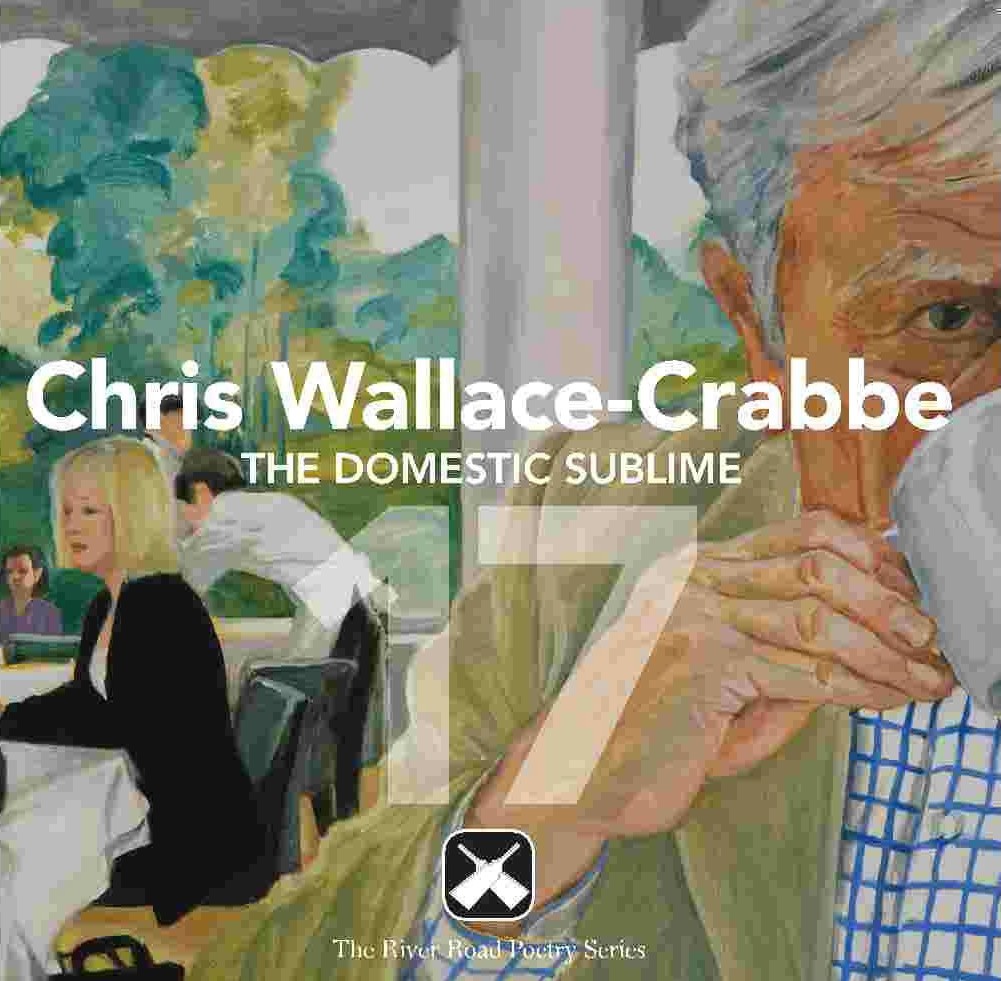 The Domestic Sublime
by Chris Wallace-Crabbe
Audio CD Nov 2009
REVIEWED BY ANDREW CARRUTHERS
George Orwell’s defense of broadcasted poetry in his essay “Poetry and the Microphone” (1945) was, amongst the efforts of Marinetti and Khlebnikov and Kruchenykh (founders of Zaum), one of the more impassioned cases for shifting the balance from printed to oral forms in poetry in the first half of the Twentieth Century. In this convincing essay, Orwell was not claiming that the movement from literacy to orality was a backwards movement — some kind of necessary step back into a primitive world before literacy in order to solve its problems — but simply that the advantages of broadcast at that moment were too alluring to be dismissed. For Orwell: “By being set down at a microphone, especially if this happens at all regularly, the poet is brought into a new relationship with his work, not otherwise attainable in our time and country.” Given the circumstances (particularly the trials and fortunes of his BBC program Voice) Orwell’s radical argument in favour of spoken word poetry was not to view print as doomed or inferior, nor did he want to risk again mounting the “phonotext” (to use Garrett Stewart’s terminology) on the tyrant’s pedestal (he cites Doctor Goebbels as one lasting impediment to public approval of broadcasted poetry). Rather, sounded poetry sets up a paradox concerning the listener and broadcaster: “In broadcasting your audience is conjectural, but it is an audience of ONE. Millions may be listening, but each is listening alone, or as a member of a small group, and each has (or ought to have) the feeling that you are speaking to him individually.” On the paradoxical nature of the one and the many in broadcasting Orwell could not have been more percipient: spoken-word poetry brings to the relationship between the listener and the word a certain intimacy, an intimacy perhaps unmatched by print.
The River Road Press, started up by Carol Jenkins in 2007, is responsible for a series of releases of contemporary Australian recorded poetry, and Chris Wallace-Crabbe’s CD of recorded works The Domestic Sublime (River Road Press, 2009) is another in the series. Wallace-Crabbe has recorded his poetry before, and collaborated with composer Damien Ricketson (A Line Has Two, 2004). In The Domestic Sublime, the cadences of his voice move with measured rhythms and a becalming timbre, revealing a new intimacy to known words. Though we are not strictly in the domain of broadcasting here, the nature of the Compact Disc format is no different to other recorded/microphonic artefacts in that the conjectural audience is an audience of both many and one, and in this sense both a “domestic” and a “sublime” audience.
The disc’s title poem “The Domestic Sublime” (a suite of five poems) is in a way a coating as much as centrepiece. Neither at the extremes of psychopathology nor critique, the form everyday objects take here seem closest to that which the last line of Philip Larkin’s poem “Home Is So Sad” exhibits with regard to the poet’s deictic placement: “The music in the piano stool. That vase.” (Collected Poems, Faber, 2003). In Larkin’s line, the object speaks for the word, or like an object, the word stays still while the poet’s eye/ear is cast from object to object: the said deixis of the that. Similarly, in the suite “The Domestic Sublime,” the sound poem “Saucer” (and you will recognise it as a generic “sound poem” once you hear it) is littered with like-objects, whose chordal arrangement of “cup”/“mug,” and “plate”/”saucer” (spliced with “slip,” “splash,” “drip,” “slop” “tip” and other deictic/domestic indices) resembles a Wittgensteinian language-game. “Sad without a cup,” as the last line sounds, leaves the word trailing behind its object, the saucer without its cup, reading-out the meaning from the language that holds and contains it, turning the word from its object. If the cup and saucer can be transposed to the binary of word and sound, what we witness here is a turning and tuning of the word and its domestic object-associations to its pure, “sublime” sound. “Who first spotted the lack,” the slip between cup and lip, a slippage of meaning (or the lack in signification itself) is the kind of first line that almost has to be heard to be understood.
What of the reading itself? To varying degrees the text remains a base for interpretation, a score to be read. A recording by a poet is still an interpretation of the text. In “Wanting to be a Sculptor”, the last line is modified (or de-gentrified) from “that would be the shot” (as it appeared in Whirling [1998]), to “that’d be the shot”, and the effect is that the shift to the colloquial recasts the lines retroactively set before it. Before, there was the call:
to invent a ceramic language
to encourage silver and brass to dance
articulating air
As a kind of material/iconic optics of desire, these lines are recast in the sense that the possibility of (mis)hearing the emphasis as “that would be the shot,” is eliminated, rendering the idiom more consciously vernacular than privately desirous of a material, ceramic language. Is such distanciation any surprise when one is being scrupulously listened to? Or is this a curiosity peculiar to subjectivity itself? Similarly, the last line of “The Bush” (originally in For Crying Out Loud [1990] “fluted with scalloping surf/and every step a joke.”) finds its variant where “joke” is replaced by “quip”, again foregrounding the vernacular, the spoken, and in particular retaining the plosive consonance of step/quip. Modifying last lines is not sacrosanct in Wallace-Crabbe’s book.
My personal favourite is Wallace-Crabbe’s reading of “An Die Musik”. The rhotic trill of “vib[r]ating” brings to the word a sonic immediacy. A sonic immediacy especially given that the word’s referential circuit onomatopoeically draws the listener into the world of the “phonotext” as if it were something not reducible to inscription (or that, if it was, the immediacy as such of the performed word outdid its predecessor in the stakes of performance). With the line “There’s always pathos to our comedy” Wallace-Crabbe voices an audible, knowing smile. It is worth reprinting the last stanza:
Listen. A texture delicate as lace
Repeats the long-gone master’s melody.
These ringing notes are all we know of grace
But repetition has its lovely place.
Tact, texture, text. Texture, here, is afflated, exhaled, delivered in refrain. An echo of death is audible too, recalling the line that read “riding the breath of death” from “The Speech of Birds” fifteen tracks earlier. Qualified earlier by the line “You can’t get back to the lawns of infancy”, repeating the wise advice of psychotheoretical systems, Wallace-Crabbe delivers tact by reassuring us in the refrain that to resist going “back to the lawns of infancy” ought not stricto sensu cancel out the place of repetition in poetry. For poetry’s relation to repetition — and in particular the psychoanalytic resonances of that relation — reflexively enter Crabbe’s poetic thinking. Thinking in the purest sense, for in a curious reversal of ekphrastic trajectory, what “one is often tempted to say” (from “Mozart On The Road”) enters the frame of its own saying. “Travel narrows the mind, one is often tempted to say,” as the phrase goes, thinks its phraseology. Or, the problem of the self, of subjectivity — surely familiar and yet always foreign territory to Wallace-Crabbe — are here conjured up as poetic sound-bites that put thinking and saying/poeticity together, while simultaneously drawing them apart. Indeed the issue of subjectivity, as Wallace-Crabbe puts it in his book Falling into Language (1990), involves an estrangement from self, an attempt to get outside the self to look at it:
One rides within oneself. Sometimes, too, one stands outside for a while, leans aside or flies aloft, trying to get a look at that self (112).
Intimacy for Wallace-Crabbe, then, is double-sided. To be “oneself” is to look at that self from outside, from the standpoint of the other, as in a mirror, to be at once inside and outside. Meaning, rather than being something that one finds ‘within oneself’ is, in the poem “We Being Ghosts Cannot Catch Hold Of Things”, personified as a “blind god/who limps through the actual world/seeking any attachment,/looking for good company.” Meaning resembles an outsider seeking contact, contract, company. And in “Stardust”:
Meaning is only a bundle of signs
That parallel and light the real,
But would they then be in the real?
[…]
Then signs are double wise at once,
Being inside and outside what they picture
If one follows the line that the real is that which cannot be symbolized, signified, assigned meaning, then the relation between meaning and the real is one of both insolubility and dependability. Reduced to a bundle of signs, meaning is both external and internal, of the real and external to the real. Considering the audition of words, meaning is both external and internal to the sounds words make. Transliteration would be the word. Elsewhere there is the sense that landscape, what lies outside the domestic, is something of an echo of the transliteration occurring between speech-act and sign, sound and sense. Such echoes can be heard in “Grasses,” where the Whitmanian trope of leaves (or Shelleyan apropos of “Ode to the West Wind”) makes its appearance alongside the “common urban transliteration of landscape” which, read within this context of recorded voice, puts the playing of language into a broadly metonymical embodiment of landscape as the text waiting to be sounded, read out, broadcast:
Sternly avoiding the asphalt, treading on grass
I pick my pernickety way across
this common urban transliteration of landscape,
the oddly broadcast parks and median-strips,
saluting the god of grass with the rub of my feet
What Wallace-Crabbe calls the “thought-voice” in “Mozart On The Road” may be something like an “inner voice,” the voice privy to the self, but also the voice of the other, the stranger who is writing, perhaps waiting to broadcast the self. Being before a microphone, being set down, prepared, perhaps even with the lines of a text-score set out before the poet, is to speak to or towards another archive of recordings. Another archive of course in the sense that the double bind of written and spoken literature, a bind that goes way back, perhaps before the self (“Before the self fully was, there were texts” [Falling into Language]), may reveal the self’s origins in writing. As the pre-symbolic subject speaks to an imaginary audience of one, and enters the world of spoken texts via a transliteration of sorts, as the poet broadcasts the parks and median-strips of an urban sublime, the Whitmanian troping of grass touches, as it were, Wallace-Crabbe’s poetic feet.
To broadcast one’s voice out as a poet is to draw words, language, in toward a sonic immediacy, and as a consequence toward poetic intimacy. However “oddly broadcast” poetic space becomes under the jurisdiction of voice, certainly there is a case for taking up Orwell’s challenge to the poets — to open up their voices to a listening public — without inhibition. With projects like PennSound putting the sound back into poetry, the field is open for more poets to do the same. Correspondingly, the River Road Poetry Series is a copacetic venture that will give more listeners more of the voices in Australian poetry.
The Irregular Self: Debbie Lim reviews Andy Jackson’s Among the regulars
 Among the regulars
by Andy Jackson
March 2010
ISBN 9780980769500
REVIEWED BY DEBBIE LIM
An online piece by the Academy of American Poets suggests that poems about the body ‘are often poems of celebration and awe, poems that delight in the body’s mysteries, its “dream of flesh”’.1
In Andy Jackson’s ‘Among the Regulars’ the body is far from romanticised. Instead, the body – specifically the ‘irregular’ or ‘different’ body – is viewed as a battle zone that divides the self. In ‘A Passing Thought’, the poet concludes: ‘This body / is no sanctuary – it is here the war is fought and won, / before I can even decide which side I’d rather be on.’
Jackson, who has Marfan syndrome, takes the body (sometimes his own, sometimes those of others) as his immediate subject in this powerful first full-length collection. However, this is essentially a book about marginalisation and its impact on the experiencing of self. It is both personal and political, employing subjective experience to question the status quo. While the poems are often introspective they cast an equally acute look back at the world.
Often the speaker is placed within a specific social situation. In ‘No Shelter’, for example, the poet describes being targeted by hooligans while walking home:
Floating home from a poetry reading, fog and who I am
closing in as I walk forward, I am still visible.
A mostly full stubbie of beer, VB I suspect,
thrown from a slow car, swoops over my shoulder.
Typical of the collection, the language is beautifully cadenced yet grounded by a conversational tone and everyday details. The poems play out within unremarkable settings: backyards, pubs, hospital rooms, parties, swimming pools. But in Jackson’s poetry, the real drama takes place internally. He has a particular skill for capturing the crucial detail that belies deeper social tensions. For example: ‘a hairline crack dives across a wall’, ‘a Study Bible’s width away from my wife’, ‘a nurse’s ‘uniform opens an inch, / briefly exposing a hint of the sensitive flesh / of our different positions, how cold it can be.’
‘Among the Regulars’ contains three numbered sections. The first and third comprise a substantial number of poems presumably based on events from the poet’s life. In the second section, many poems are dedicated to or inspired by real-life people, most of them unconventional by way of their bodies. These include someone born with androgen insensitivity syndrome, a Melbourne video performance artist, and Justin Fashanu (Britain’s first black footballer to be paid a million pounds and who later came out as gay).
These poems inspired by others are fascinating portraits. However, ultimately I felt more often moved during the first and third sections, and felt these sections also contained the strongest individual poems. Nevertheless, I enjoyed these people-poems for their reach and shift of perspective
One such poem was ‘All is Not as it Seems’, dedicated to Ilizane Broks, born with androgen insensitivity syndrome. The condition means genetic males have outwardly female physical characteristics. However, often it’s not until puberty that the syndrome is diagnosed:
It’s too soon to ask you which box you’d tick,
which cubicle you’d rather use. Now, the mind
is a humming stillness, the body ambiguous.
[…]
Your soft wings hide the outline of wings.
At the verge of thirteen, your toes grip the edge.
Beneath your feet, a wind you dare not predict.
I also enjoyed the territory of ‘Strange Friendship’, a poem about the awkward and unspoken boundaries of male friendship:
The clinking of pool balls is an ambient sound,
the crack and sigh of another crude attempt.
I want to tell you how strange this friendship seems,
to ask you where your grief is, as if in your composure
you are being dishonest, but I fear this might be
the stone thrown into the clear face we’ve made.
Friendship between young Australian males is not a typical poetic subject. Taking place on a couch in a pub ‘where a certain absence / of intimacy’s the done thing’, the narrator yearns for a more honest connection with his friend. The final line undercuts the open-hearted disclosure with a comic ironic twist, as the narrator suggests: ‘I reckon I’ll get another. You want one?’
But for me, Jackson shows his strengths best in poems such as, ‘Nothing Personal’, ‘Quasimodo’, ‘Hairline’, ‘The Embrace’ and ‘Labourers’, from the first section, and ‘Secessionist’, ‘Breath’, ‘Metaphor’ and ‘The Embalmer’s Art’ from the third. These display a compelling voice that is incisive, complex and affecting.
Emotionally, it is a confronting collection. As I read, I felt admiration for its accomplishment while simultaneously cringing. The poems conjure those painful experiences of non-belonging that everyone has had and (mostly) buries as deep down as possible. Not so Jackson whose poems replay such events in aching close-up. In ‘Hairline’, for example, the poet recounts a childhood incident with his brother:
In the wake of what you said as if I wasn’t here,
it is so quiet I can hear my chest swell with breath
then shrink. A hairline crack dives across a wall.
Cobwebs wave in the breeze and paint flakes fall.
Mum attempts to patch the gap with diplomatic talk,
but the air won’t go back outside. So that’s it –
you want to know if this pain of yours is a sign
your spine will curve like a treeless leaf,
turn into mine. […]
Sometimes poems with a polished style can seem emotionally distant, as though the original impetus has been refined away. The poems in this collection, however, retain an immediacy that pushes under your skin. Perhaps this is partly generated by the intense focus on the physical; the reader is riveted into the poem like a self into its body. At times, the close perspective felt almost claustrophobic. Jackson uses William Carlos Williams’s adage ‘No ideas but in things’ to great effect. He also knows that attending to ‘things’ can be a powerfully subtle way of conveying emotion.
A handful of poems verged into prosiness and as a result felt flat or strained. ‘Beneath the Surface’, ‘Severance’ and ‘Opening Night’ were examples of those that, for me, did not quite lift off the page. Also, ‘Comfortable’ and ‘Cells, Dying’ seemed to lack the richness of characterisation and detail needed to make these poems fully convincing.
But these criticisms seem petty cast against the book’s strengths. The best poems go beyond being technically successful works on the page; they also reach out with a complex humanity. This is a poetry in which seemingly contradictory attributes are embodied. Lyric beauty combines with an unflinching gaze, self-assuredness with vulnerability, awareness of minute bodily gesture with existentialist questionings.
The vivid sensual image is a signature feature of Jackson’s poetry. Here are a few examples: ‘that patch of schoolyard asphalt / freckled with blood like the breaking of rain.’, ‘The thin white frames of schoolgirls rise like lighthouses.’, ‘A million things are hidden in this bass clef shape’, ‘the vehicle / that will make a jigsaw puzzle of your face’. Such phrases are visually arresting but also have an effortless music and are rich with psychological implication.
If the poems in the first section establish the poet’s entrapment in his body, and those in the second extend to the experience of others, then the poems in the final section seem connected by the notion of the self’s separation. Many of these are about death, division, or a crucial life-segmenting moment.
‘Secessionist’ (which won the Rosemary Dobson Prize in 2008) is one such poem. Perhaps my favourite of the collection, it is visceral and masterfully controlled, combining a sense of the surreal with an almost savage economy. In it, the speaker describes the hellish existence of living with his estranged twin, who shares his body (seemingly like the famous Siamese twins Chang and Eng):
I feel a breath at my neck and wake. A dream
only a stranger’s brain could make jolts me back
into my body. Who else roams these bones?
The morning sun cannot melt him away.
He throws back the sheets as I reach for the snooze,
my brain a dead leg he drags through the day.
Tautly paced, the poem culminates with the speaker plotting to kill his other half: ‘And tonight, as he slips / into sleep, a molecular frequency keeps me awake, / sharpening this knife.’ The ending gains greater pathos from the implicit knowledge that murdering the twin also entails suicide. The question being asked might be: How far will we go to escape the pain of our (bodily) selves?
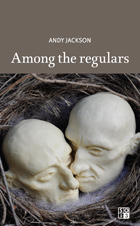
The image of conjoined twins – two identities vying within one body – seems a fitting metaphor for Jackson’s vision of the self. It’s an image of the self in conflict, its dual (duelling?) entities: self versus body, self versus society, and ultimately, self versus itself. Perhaps even the self in time (past battling future) is yet another conflict. But while it’s essentially a portrait of division and alienation, it’s also one that asks us to consider the multiplicity of identity. Interestingly, this twin imagery is reflected in the book’s cover artwork: two white resin heads sculpted in the poet’s likeness sit nestled together in a bird nest.
Another central recurring image is that of gaps (and cracks, silences, holes and vents). In ‘The Direction of Vents’, a woman walks up to an old tree in a park and wraps her arms around it: ‘…perhaps she has opened / a vent in her skin, wider than the nib of this pen / that lets things out, not in.’ The vent seems to represent a means of personal release.
But perhaps it is the final poem that offers the clearest insight to the significance of gaps in the collection. ‘The Embalmer’s Art’ is an unsettling elegy spoken by an embalmer who takes us behind the scenes of his vocation. Here are the last three stanzas:
Every line looks how the family expects –
precise, seamless, unremarkably human. Yet
the gaps are beyond repair and leak. Under
each clean surface, tiny lives swarm and feed.
I evoke a face with the eyes shut, the frozen
unknowable dream. This is our recurring theme,
that in grieving there are some curtains
we don’t want thrown open, this skin
a net composed of yearning, and of holes.
Here, the gaps suggest the irreparable distance between the self and others – a space through which emotional pain flows to the surface. They are the holes in the body’s theatre curtain that expose the vulnerable authentic self.
One of the most memorable poems for me in the collection was ‘Breath’. Dedicated to the poet’s partner, it reads as one of those seemingly effortless works conceived when life’s chaotic points momentarily align. Here it is in full:
BREATH
For Rachael
I ache to speak without a mouth, make the page
a pale limb dotted with life’s subtle buds.
The world and its molecules turn without this strife.
I have thought myself into knots, my intensity-twin.
There is a language of body, a grammar of gaps.
That day bowed down with the weight of our tongues,
your room a womb for the selves we’ll become.
And now, adrift in the silence of Pärt, an absence
both Rothkos know, I think of you and weep
with joy, even though the continent is shrinking.
My skin is a map of welts from pinching myself.
Go to our room! You say, as the streetlight blinks,
and take that brace of language off, your heron-ness –
for a while, I will cushion your mind with my breath.
Perhaps breath – of the self yet unbounded by it – is one way of spanning those gaps, and transcending the body, albeit briefly. This is a radiant sonnet which forms a rare still point in the book.
Among the Regulars is a distinctive, impressive and thought-provoking collection. By asking the reader to step into the body of another, it challenges us to consider the impact of assumptions of ‘normality’ on the individual. Ultimately though, it is the presence of Jackson himself breathing through the lines which makes this such a moving work.
1. Academy of American Poets. www.poets.org/viewmedia.php/prmMID/18999
Continue reading for only $5 per month
Subscribe for full access to Mascara Literary Review or login
Fiona Scotney reviews Net Needle by Robert Adamson
 Net Needle
by Robert Adamson
ISBN 9781863957311
Reviewed by FIONA SCOTNEY
In many ways the collection Net Needle is a logical continuation of Adamson’s recurring themes of love, loss, birds and the Hawkesbury region. It is very Adamson. It has the traits readers have perhaps come to expect and admire from his last few collections. It is dedicated to his partner Juno, his ‘heart’s needle, soul’s compass’, it opens with a poem about birds and the title comes from a poem about fishermen. What could be more Adamson? Yet there is nothing staid about this collection. He returns to familiar subjects and makes us look again and in doing so we gain a new understanding and a new level of appreciation. This is Adamson doing what Adamson does best.
This poetic craft is most evident when reading ‘Net Makers’, a poem which balances the delicacy of memory and weaving with the immediacy of tobacco stained fingers and fish guts. The poem contrasts the hardness of the men with the softness of their bent bodies and practiced movements. There is a sense of boyhood wonderment and admiration in their craft of mending and at the same time their ability to ‘cut the heart clean/ from a fish with a swipe of a fillet knife.’ The weaving of the nets in the poem is mundane, pragmatic and performative,
They stitched their lives into my days,
Blue Point fishermen, with a smoke
stuck to their bottom lips, bodies bent
forward, inspecting a haul-net’s wing
draped from a clothes line. Their hands
darting through mesh, holding bone
net needles, maybe a special half-needle
carved from tortoise shell. Their fingers,
browned by clusters of freckles
and tobacco tar, slippery with speed –
We are invited into an intimate space of memory, reflection and repetition as ‘they wove everything they knew/ into the mesh, along with the love they had,// or had lost, or maybe not needed.’ This is men’s work located in a domestic sphere; the backyard by the clothes line of Adamson’s childhood home. In the poem there are the subtle tones of the tortoise shell needles, freckles and tobacco tar set against the action of stitching, inspecting, draping, darting and mending.
As in The Goldfinches of Baghdad and other collections, Adamson has drawn on Mallarme’s idea of a book as a ‘living composition’, where each page becomes a stanza in the poem of the whole book. In this collection there is a four part structure which brings cohesion. The poems are grouped by observation, recollection, homage and finally death and transformation. Part one is characterised by observation, by poems that turn our attention to the otherwise unseen miracles in the mundane, as in ‘Net Makers’ and ‘Via Negativa, The Divine Dark’:
On the table a cicada, flecked with flour,
opening its dry cellophane wings.
The cat flies across polished space illuminated by the
Kitchen’s energy-saving light bulb,
A Philips “Genie.”
Here the divine dark is lit by stars and an eco-light blub. The via negativa, a way of describing God by negation, takes form in the tree-ferns, mist and banana trees, as well as breezes, watermarks and stars. It is not Wordsworth’s pantheism, but rather Spinoza’s recognition that all things are God.
Morning turns its back on the sun;
gradually, night arrives. In the skylight,
stars appear through the smokescreen from burn-off,
brilliant pinholes.
Stars are clustered tress, hung in the night sky.
Here and in other poems in part one of this collection, observation mingles with metaphor and personification to create interesting juxtapositions. In ‘Garden Poem’ for Juno where Adamson writes, ‘At midday/ the weather, with bushfire breath, walks about// talking to itself’ and ‘a breeze clatters in the green bamboo and shakes// its lank hair.’ These simple yet beautiful lines when considered become profound and masterful. In the first example he combines the observation of midday with the metaphor of ‘bushfire breath’, with personification the weather which ‘walks about// talking to itself’. Such lines show the complexity of Adamson’s craft.
Part two of Net Needle is comprised of redrafted poems from Shark-net Seahorses of Balmoral: A Harbor Memoir (2012), a collaboration with artist Peter Kingston which produced a hand printed limited edition artist book,. These poems are based on recollection and tell stories about Sydney, the harbor and the rivers. They are not simply nostalgic reminiscing, but rather poetry as memoir, as Adamson looks back over moments of his life that span his childhood to his time spent in Long Bay prison. In this section a focus on narrative tends to replace the more image-driven poetry of the first part of the collection. I wonder if this is in response to the collaborative process of creating the artist book, which responds to Adamson and Kingston’s shared memories of Sydney, albeit at opposite sides of the harbor, Kingston at Vaucluse in the east and Adamson at Neutral Bay in the north. Both were born in 1943 and the art book chronicles some of the history of the area, as well as Adamson’s personal history.
Sometimes there is an emotional distance in these poems, as in ‘The Long Bay Debating Society’ which begins with the dispassionate line, ‘I spent my twenty-first in Long Bay Penitentiary.’ The poem recalls the pacing in the prison yard through the day and his reading of novels and poetry at night. It records Adamson’s early ambition to be a poet,
Sometimes an education officer
Would turn up and ask
What are you going to do with your future?
I’d tell him I wanted to be a poet
He would shake his head
And comment that I was being insolent
After weeks I convinced him
We wanted to start a debating team
The poem takes an unexpected turn from Adamson reading and wanting to be a poet, to convincing the officer about his desire to start a debating team. As it moves from the general to the specific, the poem shifts to the subject of the poem, the debating society. ‘It took a month to convince the Governor/ Finally the authorities agreed/ We could form a debating society’. This new freedom is still bound by the control of the authorities, as the ‘crims’ read and research in the prison library and organise an outside team to debate with, they are undermined by the Governor’s choice of topic, ‘(it was the summer of 1964) our topic/ “Is the Sydney Opera House Really Necessary?”’
Other memories are captured with a mix of facts and observations, as in ‘The Green Flash’ where Adamson recalls walking across the Sydney Harbour Bridge with his mother, and going to the ‘Pylon Lookout’, ‘There was the café, where mum bought/ my first Devonshire tea.’ The South West Pylon lookout was open to the public at weekends from 1932 -1981. ‘This was the spot my father took/ my mother on their first date; he always/ knew how to impress people.’ The strength of these poems is in their ability to record personal and public history and memory with location.
Part three acts as homage to other writers, the poems reference or are dedicated to other poets and writers including early influences on his writing including Francis Webb, Percy Bysshe Shelley, and his friend Michael Dransfield. These poems provide a reminder of the sociability of poetry. The act of naming other poets creates textual relationships, the names become tropes, poetic devices that can represent a mode, or style of working, or gesture to interpersonal connections or relationships. These poems also speak of the longevity of Adamson’s vocation as a poet. Since the publication of his first collection in 1970, Adamson has published over 20 books of poetry. He has devoted much of his life to poetry, not only as a poet, but also an editor, mentor and teacher.
Adamson is one of a number of Sydney and Melbourne poets who emerged in the late 1960s and have been seen as part of a loose school or generation of poets characterised by their explicit break with existing poetic practice, their adaptation of American models, and their shared opposition to the Vietnam War. John Tranter’s anthology, The New Australian Poetry (Makar, 1979), announced this new generation, the ‘generation of ‘68’, and presented the twenty-four poets included as representing a ‘commitment to the overhauling of poetic method and function’ and a ‘serious attempt to revitalise a moribund poetic culture.’ Adamson, like Dransfield, was included in the anthology and they are often referred to as key figures of the “generation of 68.”
Part four of the collection can be characterised by themes of death and transformation. ‘Death of a Goshawk’ is a haiku with an untraditional syllable count which reaches its dénouement in the last line facilitated by its title,
White goshawk
Hovering on sunlight and air –
A boy’s trigger finger.
Other poems about death include ‘A Proper Burial’ about the death of a pair of tawny frogmouths beside a highway, ‘The Whiting’ where the poet is visited by the shadow of a fish he has killed and ‘The Great Auk’ for Charles Buckmaster, a poem which references another ‘generation of ‘68’ poet and friend of Adamson’s who died aged 21 in 1972. Not quite elegy, this poem recalls fondly Buckmaster’s poetry magazine The Great Auk and his contribution to the Sydney and Melbourne poetry scenes.
Charles spoke of auk bones
discovered in Massachusetts, fragments put
together by the archaeologist of morning, kingfisher
of poets. Charles wrote for the lost forest
and opened new pages as he
walked the streets of Melbourne,
writing back the great auks, speaking branches
to sing from; as the growth rings
thickened our lives, he stretched himself imagining
pilchards in massive schools
turning oceans silver with auk food –
auks returning in poems, swimming from the heads
of poets, into the tides of our words.
The final poem in the collection is ‘The Kingfisher’s Soul’ for Juno. It is a redemptive poem, where the ‘you’ in the poem, presumably Juno, brings new knowledge and discoveries to the first person speaker, ‘Your breath blew a thicket of smoke from my eyes’, ‘You taught me how to weigh the harvest of light’, and ‘You brought along new light to live in’. The poem ends with a final transformation, ‘I preferred the cover of night, yet here, I stepped/ into the day by following your gaze.’
Net Needle sees Adamson return to recognisable themes and influences in a way that is at once familiar and rewarding. For this reason, it is also a wonderful introduction to his work for new readers.
FIONA SCOTNEY recently completed her PhD at the University of Queensland titled ‘The New Australian Poets: Networks and the Generation of 68’. She has previously been published in Cordite, The Australian Poetry Journal and Southerly.