J.C. Masters reviews Change Machine by Jaya Savige
Subscriber Only Access
Sorry you must be logged in and a current subscriber to view this content.
Please login and/or purchase a subscription.
Accessibility Tools
Sorry you must be logged in and a current subscriber to view this content.
Please login and/or purchase a subscription.
Sorry you must be logged in and a current subscriber to view this content.
Please login and/or purchase a subscription.

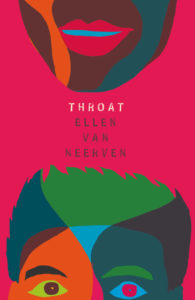 Throat
By Ellen Van Neerven
Reviewed by DANIEL SLEIMAN
In reading poetry, we look for those rare moments where a creative sequence of words thoroughly subjects our thinking, our feeling and our knowledge to a momentary realisation of reinterpreted or interrupted truth. There are many of those moments one finds while reading Ellen Van Neerven’s poetry collection Throat (2020). Take these three lines appearing in different poems.
Take me to the back of your throat, I’ll stay
(p123)
Language is empty without ceremony
(p128)
Climate is our only bank
(p33)
Neerven can say so much with so little. In fact, that’s poetry’s appeal and the/ir craft in writing reflects the tightness and complexity of its form. They display a matured economy of expression but are as comfortable writing longer narrative-driven verse.
One of my favourite pieces in Throat is only ten words long and finds its place in the section called ‘Whiteness is always approaching’. It is a title, which based on the section’s themes, could have easily worked as ‘Whiteness is always encroaching’.
I was a perfect GF but sometimes I was black.
(p42-43)
These words are presented on two full pages, the otherwise emptiness or silence gives them so much more meaning. One is tempted to even continue the writing with their own insecure reflected prepositions in the empty space. There is so much more to be said, and those thoughts are instinctively taking place in the reader’s cognitive play.
The conscious stylistic choices are also replete throughout the collection. The use of the Aboriginal flag along with text in ‘Logonliveon’ serves as a punctuating reminder, self-identification and reconstructed meaning to fit the changing moment of technology and living. A treaty is drafted and presented to the reader questioning the/ir relationship with the production of the book but also of white Australia—a status quo, often neglectful of Aboriginal voices on the question of sovereignty. Australia of course remains the only Commonwealth country without a treaty with its Indigenous population.
‘Treaty’ presents the reader with so many questions to unpack. And Neerven does that poignantly. Hard truths demand hard questions. Neerven takes up the role not only of a poet but as an educator. The book comes with a reading list for ‘Whiteness is always approaching’. It includes writers like Ghassan Hage, Toni Morrison and Vivek Shraya. The white reader is undoubtedly urged to spend some time in this section.
‘Expert‘ and ‘White Excellence‘ are two poems that really hit the nail when it comes to white presumptions, white language and the critique of Black Excellence centred around the white gaze.
Think I got
a non-Indigenous girlfriend
who thinks she’s an expert
don’t know how she got her expertise
(45)
There have been too many white ‘experts’ on what matters to Black people. This was especially noted during the #BLM movement where Australian TV panels got a lot of flak for not inviting any Black speakers on issues that directly affected them.
‘White Excellence’ comes in many forms but my favourites are the ones who cook for me. Listen, make space. Buy black books, buy black music. Never assume to know what we think or what we want.
(56)
T.S Eliot once wrote that poetry is ‘the common pursuit of true judgment’. There is a measured concern in Neerven’s writing, whether it’s the devaluing of Indigenous languages, connection to land and water or gendering. It is a judgment both in critique and insight, but one that opens conversation rather than shutting it down. Whilst subtlety has always been the measure of art, there is nothing wrong with calling a spade a spade, and Neerven even titles one of their poems ‘Call a spade a spade’ where they take issue with the mealy mouthed semantics in our everyday political discourse. Don’t say ‘no worries’ say ‘I worry’.
In ‘Four Truths and a Treaty’ they write:
We gotta talk about sexism, homophobia, and transphobia in the community. No point pretendin it don’t exist.
(58)
Blunt.
As a queer Black writer, Neerven explores the sometimes-knotty intersection of sex and race politics. It is a lived experience, and it comes through in their words both genuinely, and in exploratory ways giving no defining answers but retaining our attention nonetheless vividly and honestly. In the section titled ‘I can’t wait to meet my future genders’ their poem ‘Body Flow’ imparts a resounding expectation or even resignation in describing their body.
I guess it would be fitting to describe my body here.
Spidery
Flowy
nothing to hide
hips in the wrong place
unambitious arms
(67)
Neerven’s writing however is anything but unambitious, with Throat being her third published work following on from Heat and Light and Comfort Food. It is a work that tackles familiar themes, but one that is done with a uniquely sustained style and an undeniably fresh voice; a voice that one can return to on the page and in recitation and find added nuance and meaning and a reason to care. One cannot help but to find a certain affinity with the poems, and the writer, as one reads and rereads Throat. It feels like a crush.
In ‘Crushed‘ Ellen writes:
All my crushes
have been books
(98)
What a wonderful way to think about our relationship with books. With a red, sinuously coloured cover featuring lips, eyes, and with an evocative title in Throat many readers will feel attuned to Neerven’s latest work.
Notes
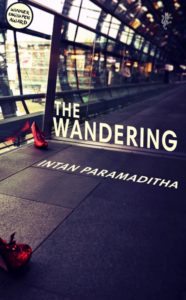 The Wandering
by Intan Paramaditha
ISBN
Reviewed by GABRIELA BOURKE
Reading Intan Paramaditha’s The Wandering during a global pandemic and in a time where all but essential travel within state borders is forbidden is a strange experience. In the author’s acknowledgement included at the end of this book, Paramaditha writes that the novel was ‘…conceived in New York, published in Jakarta and written over the course of nine years as I moved across continents…’. The imposed stasis in which I read this book though forced a contemplation of some of the most pressing themes of the novel: how do power, position and privilege determine where you’re allowed to go, and perhaps even more importantly, where you’re allowed to stay? Paramaditha’s ‘choose-your-own-adventure’, second-person narrative invites you to jet-set, from Jakarta to New York to Berlin and beyond, the impetus of the story depending on the choices you make and those choices formed by your own desires, ambitions and longings. The Wandering considers what freedom means, in a world where a yearning for elsewhere underpins so many of our encounters, and where travel is borne of boredom for some, but terrible desperation for others.
Jonathan Safran Foer’s line ‘Sometimes I can hear my bones straining under the weight of all the lives I’m not living’ occurred to me more than once while reading this novel. A create-your-own adventure story imparts a responsibility: of choosing right, making choices that will carry you to a satisfactory ending. In fact, the decision fatigue I was already feeling as a result of moving house in corona-times was exacerbated by the requirement of choosing a path through the narrative, and by my desire to ‘choose right’. My first foray brought me to an end all too quickly – an ending that did not bring me the satisfaction for which I yearned. Retracing my fictive footsteps and finding a new way resulted in a relationship with an old, white man who seemed to have an obsession with young, Asian women. How did I get here? I wondered, despairing, moving backwards again, hoping there was a better way, and then again, backwards and forwards, realising as I did so that usually a novel, like life, won’t give second chances. In life, death signifies the end of one’s story on earth, whereas The Wandering gifts its reader that fantasy of acting on hindsight. Unhappy with reaching an untimely demise, I return to the point where I can salvage my life. Unfulfilled by a relationship, I travel back, choose someone else, carry on once more.
So who has the freedom to make mistakes? This is the fundamental idea on which The Wandering is built. Who has, as Tiffany Tsao puts it on the back of the book, the freedom to wander the earth? Not Fernando, with whom the narrator flees the US upon Trump’s election in 2016. Not Meena, the narrator’s friend and neighbour whose freedoms are curtailed by geographic and financial borders. What about the narrator herself, who has agreed to a lifetime of wandering, denied forever the opportunity to return home? Paramaditha’s commentary on the nature of globalisation and neo-liberal consumer-capitalism is both thoughtful and provocative. The realisation that the ‘you’ of the story and the ‘you’ who is me reading the text are chasms apart in terms of the restrictions placed on our passports is discomforting. The Faustian pact on which the story is premised forces a consideration of other real-life pacts made by people bargaining for their freedom as borders are erected and both the freedom to move and the freedom to stay is forbidden to all but a privileged few.
The Wandering poses questions, rather than providing answers. The encounters between people and places may bring home the sad realities of life for many, but somehow Paramaditha retains a sense of playfulness and spontaneity that makes this novel fantastically readable. For a novel premised on a Faustian pact and peppered with allusions to Greek mythology and Indian philosophy, sections like the blow imbue liveliness into references that otherwise might be slightly stuffy.
‘How will I be able to reach you when you’re travelling?’ asks Demon Lover. He looks despondent.
You stare at him, stupefied.
‘For God’s sake! Stop snivelling. Since when does a devil need a visa?’(6)
The Qur’an quoting, Cerberean-chihuahua toting Hecate is another good example of this novel’s light-hearted reimaginings of well-known myths and symbols, which provide a necessary counterpoint to the grimmer elements of the story.
In leafing through the book in readiness to write this review, some names and places leapt out at me that I did not encounter on my first reading. This is surprising, as I was diligent in my attempts to locate and travel along all of the offered narratives. I’m interested by these stories I’ve not read, and interested to consider why I’ve not reached them. Are some strains of the narrative too far out of my comfort zone that I subconsciously avoided them? Is not reaching these stories indicative of some truth about my own identity, about the limitations of myself and where I’m willing to go, what opportunities I’m willing to run with?
Paramaditha’s novel allows for a uniquely individual experience, and one which might be borne from the reader’s cultural, financial, generational or other background. An individual’s experience of this book is likely to be as diverse as one’s experience of the world – an admirable feat, and one in which it’s worth immersing oneself. The Wandering may have had some teething issues, but it’s strong enough, creative enough, joyful enough and certainly ambitious enough that I’m already looking forward to Paramaditha’s next book.
GABRIELA BOURKE is a sessional academic and doctoral candidate at the University of Sydney. Her work explores the representation of nonhuman animals in contemporary literature. Her work appears in Southerly and Mascara Literary Review.
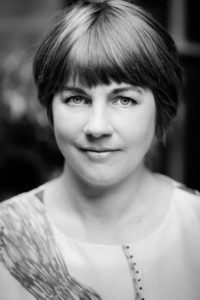 Petra White lives in London. At the time of publication her most recent book is Reading for a Quiet Morning (Gloria SMH 2017). She is shortlisted in the 2025 Prime Minister’s Literary Award for That Galloping Horse.
The Visit
Because I was permitted to
I waded through water.
Eyelashes still as the tiniest fronds.
The pond pure sleep,
a demon thrust down into the dark,
the nestling of elm roots.
Then the slow drip of colour
in the mind, a friend
for the seconds the light held.
I walked out into new darkness,
where I was permitted to go,
the moon waiting for me
like a piece of enchantment
I was taught to resist.
The moon, with its grey blotches,
splintery daylight,
white as as my father’s face.
The Typist
The typist home at teatime, clears her breakfast, lights
Her stove, and lays out food in tins.
T.S. Eliot, The Waste Land
1
Unseasonable as a warm winter, pale on an utterly rainbow afternoon.
Not begging to be heard, not begging at all.
Here, everywhere, outside the window, on the streets and in the parks
danced men with twig like women in their ravenous arms, a dance
like that of creation, half terror, half the terror of love.
I fumbled into my small
red revolting car that smelt of rain and clattered with dirty coffee cups.
In traffic waited like a stumped parrot on a rod.
Then windows wide, the brashest air gushing in.
Fleeing melancholy,
I drove and drove and never ran out of fuel.
And the road did not run out, the world turning in the sun’s glimpse.
Unbearably fresh the yellow flower fields
blazing in the heat
like crowded slabs of hell
the yellow flowers
blazing like tomorrow,
when I land and weep
the yellow flowers blazing like my skin
behind a hot windscreen,
pounding me into the here, the trickle of sweat.
When body becomes body,
nothing more
only the flowers seem to sing.
2
See the muscular roos they leap above the nose-tickling weeds,
their flanks curved like machinery, paws bristling about the thin line
that is neither heaven nor hell but the tickly brush of the instant, barely tolerable.
Oh humans. Grainily composed of future and past,
who are, Rilke said, forever saying goodbye.
Suppose I got my teeth down into the instant, and lived there,
who would I know? The ‘open’, he called it.
How a spaniel enters a room and is instantly part of it,
how he knows just enough to get by,
fixing on a human like an apple grafted to a pear.
How a woman puts her head in her hands after a difficult conversation, how another says,
I am a tree planted halfway up a hill, I cannot spread my canopy to the top.
How the human hope sparkles everywhere.
3
Where is the chorus that wails around the car,
who sings the notes that make suffering true?
Melancholy silvers the tongue with ice,
freezes the self.
More light, more light.
Soul sits on a high shelf and eats breakfast,
the moon is a broken cabbage below her.
The god that created hell
and the hell that created god.
The strange joy of desiring nothing.
Wide sweep of road
and the waving spinifex know no minutes.
Only blank sunshine, desert.
The car carries nothingness,
empty seatbelts glinting in the light.
4
I stopped at a roadside diner and ordered chips, the only food, with ten different sauce bottles,
prepared in the bubbling silence and grubby neon light of the lonely diner
where nine people lived in the midst of vast planetary scrub and wind-bent trees,
feeding giant road-trains that arrived and left with a million lights dancing
each driven by one poor-postured man all day and night in solitude.
Colossal swathes of road like time, stretching before and after.
I sing the whole human package with its clutch of knowings,
the heart with its grappling of love, statistically half open a quarter of the time.
The body that travels like Ophelia into the estuary with hands outstretched
and nothing in them but reeds and echoes
of when the dust of the present washes off the fingertips entirely.
A journey unfolds of itself as the road unfolds beneath the tyres.
And then I turned toward death, my durian-scented hitch-hiker.
Life, he said, that reddish glow, it yet haunts your cheeks.
He spoke and as he spoke I could not choose but hear.
I stand like an animal with life and death intermingled in me, not unlike you
who have never felt more alive.
What if I offered to take you off your own hands now?
What would you say?
He said, like one who could not politely be refused.
The smell of chips ghosted the car.
The black road had gripped my soul.
I prayed for a stay of dawn.
And I clutched his thready arm.
Can we be friends instead? Will you visit me again?
Before long, he said, before long.
And vanished, leaving me with the long haul of life.
Always asking, what next, what now?
The formal voice that sings the formal notes.
 Case Notes
By David Stavanger
UWA Publishing
ISBN 978-1-76080-119-9
Reviewed by DAVE CLARK
I recently attended a training course that looked into depression. As I sat, sipping on an Earl Grey tea, the presenter went on an acronym spree, throwing them around like a farmer with an excess of seeds. I was beginning to feel lost with the terminology when a lady across the room called out.
‘None of this will help the people I work with.’
We all paused in wonder. The presenter, flustered by what they felt was an unnecessary interruption, ploughed ahead with the phrasing that he knew, continuing to lock many of us out of the discussion. The lady threw her hands up in the air and called out again.
‘This isn’t how people describe their experience of mental illness.’
Sweat pooling on his brow, the presenter was now the one who seemed lost.
‘Well, um, you’ll have to find ways of explaining it to them,’ before reverting back to jargon that put the barriers back up.
Working in the field of mental health as a counsellor, I have seen for many years how the language used around mental health can block people out of their own experience. It constrains them, shames them. People can be reduced to a number, a label, a stereotype, a problem, an illness. Their find themselves on the other side of the door, locked out of their own story.
David Stavanger’s latest collection of poetry, Case Notes (UWA Publishing, 2020), picks up a crowbar at the outset and pries open the door for more than a peek inside. As the poems unfold, there are times where his works cut open a hole in the wall and leads the reader through, bypassing dehumanising phraseology and into an intimate, raw and illuminating insight of lived experience with mental illness.
The book of thirty-seven poems steps immediately into the impact of bi-polar depression, suicide, medication and electroconvulsive therapy, revealing them with wording that puts skin and bones back onto mental health. About medication, he writes,
‘They taste like a mixture of chalk and talk shows’
(p23)
About the complexity of depression, we see that ‘he wants guarantees that can’t be given’ (p12) and that ‘Certainty is the strangest thing’ (p23).
No hard-and-fast words that package it up neatly. Instead, Stavanger steps beyond bland phrasing and poignantly describes an intricate world of ambiguity. His poem, ‘Electric Journal’, which was shortlisted for the 2016 Newcastle Poetry Prize, sees the writer trying to keep hold of his mind. Stavanger is able to breathe words into corners of mental illness that are usually, at best, misunderstood, and often, disregarded.
Halfway through the book is a poem called ‘P is for Power,’ listing roles starting with ‘P’ who hold influence. Patient is not one of them, and Stavanger uses his writing to claim some of his power back, and in doing so, giving some to the reader. This is a compelling skill and one that I was moved by throughout the collection.
The works not only deal with mental illness. They pivot into balding, bingo, fading relationships with fathers and being a father to his son. And yes, dogs. Dogs are mentioned over fifty times in Case Notes, including a discussion between the writer and his dog in ‘Dog Minding.’ Who’s the writer and who’s the dog is up in the air and adds to the enjoyment of the piece.
I found a trilogy of poems about his relationship with his Dad especially touching. The lines
‘…but sometimes
there’s no way
to resurrect the living’
(p69)
will surely strike home for anyone who has found it difficult to relate with a parent and the regret over what has been, and what continues to be, when looking at those figures that raised us. There is a tenderness expressed in these writings, lamenting that it is possible to have a pulse and yet still not be fully alive.
Another topic to explore in his works is the one around toxic masculinity. ‘How to be an Alpha Male’ highlights the destructive façade of the social script fed to many of us men over the years. It is an area that needs to continue to be discussed and pulled apart, and I would be interested to hear more of it from Stavanger’s satirical perspective.
Not only is there clever pivoting of topics throughout the collection, Stavanger uses an array of forms – free verse, lyric, cut-and-creatively-paste from discussion forums, poetic memoir, prose – to keep the reader’s interest up. And throughout is a playful, wonderfully absurd use of language. At no point did I find the humour degrading his experience of mental illness. Rather, the black humour and flat-out whimsy provided a clever counterbalance to the weight of what he addressed and left me laughing at regular intervals.
In the poem ‘Mental Health Week,’ he writes:
‘If you tell them such things
they will tie you to the nearest chemist.’
(p61)
There’s this outstanding line in ‘Male Patterns:’
‘In the savannah of middle-class suburbs
you seldom see a bald man lose a street fight
with a wheelie bin’
(p81)
And also this cracker – ‘I got into $ for the art’ (p76).
These turns of phrase occur at a pleasing rate and caught me off guard every time. I dare anyone to read his glossary of terms at the back of the book and not burst into a blazing smile.
Each line in this book is well-crafted, bumping you further along a path you didn’t know you were walking down, but glad you did traverse. In a recent interview with Jackie Smith (Smith 2020), David spoke about how he wrote some poems as an unreliable narrator. To my reading, this cleverly reflected the variability we find in our own minds, regardless of the state of our mental health, sometimes stumbling along to who-knows-where. Case Notes does this with deliberate vulnerability and incisive wit.
I agree with Ali Whitelock’s (Rochford Street Review 2020) assessment of the book, that it gets inside you and reminds you of your humanity. In a world where stigma and acronyms and labels predominantly fill up the experience around mental illness, this work pushes that aside to reveal a beating heart and a mind fighting hard to get itself back. It brings clarity and gives an approachable language to complexity. That is a welcomed feat. And while he says in interviews that he does not write for awards or his peers, it is no surprise that four of the poems in this collection have been shortlisted for prizes over the years. Unsought-for but worthy recognition for one of Australia’s finest contemporary poets.
The final three poems in the collection release some of the pressure built up from a tightly coiled selection, showing us an author finding hope, recovering in the waters of the ocean and a sauna. He remarks at the start of the final poem, ‘New Age,’
‘We dream, we heal, we are reborn’
(p112)
To capture in poetic form the struggle of mental illness and the steps towards healing is an achievement. To capture it in a way that leaves the reader wanting more of it is a sign of a collection worth reading, recommending and reflecting upon. And whether it was Stavanger’s intention or not, this work provides one more key to the doors that usually lock people out of their own experience when it comes to mental health. Thanks to the poems in Case Notes, the barriers of stigma and acronym-filled-labels are one step closer to being undone.
Notes
Rochford Street Review, 2020, Reaching inside you: Ali Whitelock reviews ‘Case Notes’ by David Stavanger, https://rochfordstreetreview.com/2020/09/03/ali-whitelock-reviews-case-notes-by-david-stavanger/. Accessed 2/10/20
Smith, Jackie 2020, Exploring ‘Case Notes’: an Interview with David Stavanger, https://jackiesmithwrites.wordpress.com/2020/05/16/exploring-case-notes-an-interview-with-david-stavanger/. Accessed 2/10/20
Stavanger, David 2020, Case Notes, UWA Publishing, Australia.
DAVE CLARK in an emerging writer-poet who does his living and breathing in Alice Springs. He works as a counsellor and enjoys reading, photography and giving voice to silenced stories. His works have appeared in Verdant, Adelaide, Glow and read on 8CCC and ABC Radio.
Twitter: @DaveClarkWriter
Sorry you must be logged in and a current subscriber to view this content.
Please login and/or purchase a subscription.
 Yumna Kassab is a writer from Western Sydney. She studied medical science and neuroscience at university. Her first book of short stories, The House of Youssef, has been listed for prizes including the Victorian Premier’s Literary Award, Queensland Literary Award and The Stella Prize. Her writing can be found online at Kill Your Darlings, Sydney Review of Books, Peril Magazine, Meanjin, The Sydney Morning Herald and now Mascara Literary Review.
Woman // Her Words
Alexis, 37, 1994
You can bring the horse to water but you can’t make it drink. You try to help people: you give them things, you teach them, and what do you get for your efforts? Nothing, absolutely nothing.
Sorry you must be logged in and a current subscriber to view the rest of this content.
Please login and/or purchase a subscription.

 Nicole Smede is a musician, poet and educator of Worimi and European heritage, exploring a reclamation and reconnection to ancestry through language, poetry and song. Her work has been broadcast on national and international radio, published in anthologies and journals and features on ferries, in visual art and sound art works. Nicole is grateful to live, learn and create on Dharawal country. https://nicolesmede.com
Baraya
I hear voices of ancestors
crossing this country
spirit awake
with an anxious energy
I tread carefully
amongst old Lore
Yii
batjigan barray
gulawyn
bikan*
old grandmother trees
usher me
to ancient summits
where songs ebb
and flow with the wind
passing through
open palms
they travel
the songlines of my body
stirring the spirit within.
*this (is)
dingo country
koala
platypus in Gatthang
Cicadas
The landscape vibrates loud
bending branches
beaming brightly from boulders
an intense hum of wings
where fearless thrill seekers
deep sea divers
dropping downward
abandon
rocky shelves overhead
trembling under our feet
stoney shoals set
slippery steps
balancing
immersed in cool silence
we tread tranquil waters
arcadian
arching apex
achilles
toward the embankment
we tread water
and the soundtrack rings loud
in our ears.
Rosemary’s Rocks
Yellow blossoms –
like bright shards of light
disrupt this green and grey landscape
they’re early this year.
Damp moss softens
underfoot moulded steps
trail behind
and I ascend this rocky slope
does it, like the trees
recall my last visit?
Resting here
senses sharpen
birds in syncopated song
cut through crisp air
and mist
suspended
between ridges
clings
like the cold to the tip
of my nose
all is alive
in freshness
in an awakening spring.
Sorry you must be logged in and a current subscriber to view this content.
Please login and/or purchase a subscription.
Sorry you must be logged in and a current subscriber to view this content.
Please login and/or purchase a subscription.
Sorry you must be logged in and a current subscriber to view this content.
Please login and/or purchase a subscription.
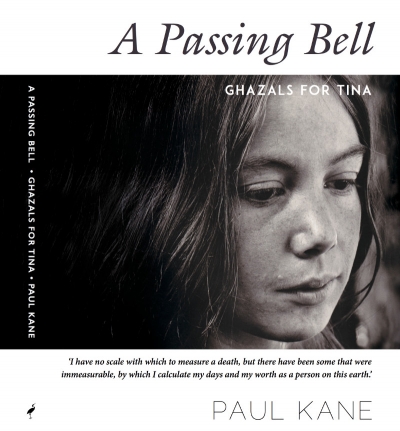 A Passing Bell: Ghazals for Tina
By Paul Kane
White Crane Books
ISBN 978-0-648337-11-9
Reviewed by PAUL SCULLY
“Paul Kane is a poet, critic, scholar and librettist” who splits his time between Australia (principally rural Victoria) and the USA and is well-known in the former as a driving force in the Mildura Writers Festival, along with Tina Kane, a textile artist and conservator who “has published numerous essays, translations and reviews” in both countries. “Tina died in Australia on 25 July 2015” after a two-year battle with motor neurone disease.
“The road I walk is one of sadness/ …. /Every time my step falls upon the road, I admit my bondage.” (Ghazal 72)
“Our love was always a response to the anguish of this world/ … / How could our anguish not be beautiful?” (Ghazal 73)
Paul Kane’s A Passing Bell abounds in phrases that could be extracted as summaries of the work. I chose the above to capture the tones of litany, compulsion and grief that pervade it, and the striving for some species of beauty that is part of all poets’ motivation.
A Passing Bell is book-ended by a Prologue in the voice of a third person commentator, witness or presence – a God or a God-substitute, the unnamed Master (perhaps Hafiz ), the spirit of love – that frames the ghazals that follow as involuntary exercises shaped by “a loss so fundamental he is shocked to be alive.” There is also an Epilogue, which is in Tina’s voice and which acknowledges her role in leading him out of his “underworld” “of cavernous grief” at her death to a point where he can turn his Orpheus away from her Eurydice.
Tina was (remains?) Kane’s wife and collaborator in the 2014 translation and illustration of twelve Hafiz ghazals, so the choice of the ghazal form within the Sufic remit seems natural and even an extension of that earlier work. (Kane mentions Hafiz by name in Ghazal 8, though he does not venture equivalence between himself and the great poet in any way). It might even be viewed as another joint project of his words and her animating spirit. This may speak of a deeper affiliation, it may hark back to collaboration, or it may be the product of aptness to themes. There are signs suggestive of the former– the work’s character as a verbal pilgrimage of sorts, the congruence of earthly and spiritual love, the marriage of truth and love, the invocation of a Master presence, the implication of stages in the grieving process (à la Kübler-Ross) and/or stations of enlightenment, e.g. “Passing” in the title, and references to an afterlife.
The ghazal’s last bayt (couplet) usually mentions the poet or narrator by name or requires a reversion to him or her in some way, whereas this occurs only in the Prologue, and then in the voice of the third person. All the ghazals in the body of the work revert to Tina and the Epilogue reverts to them both. This variation is consistent with the work’s inferred joint authorship, and its devotional and Sufic compass – the lover becomes the beloved and both manifest love itself.
While I am not overly familiar with Kane’s other poetry, internet samplings (Cordite, Snorkel, for example) make clear that A Passing Bell is a conscious, if natural, departure from all but the Hafiz translations. These samplings are quite different in construction and tone, and more modernistic, though there is a not infrequent correspondence in themes. Kane’s career demonstrates both a deep and broad interest in collaboration and cross-cultural forms, such as his and John Kinsella’s Renga: 100 Poems; and it is worth noting that Ouyang Yu has translated Kane’s poetry into Chinese.
There is a concept in the Qu’ran known as tawhid that signifies the uniqueness of God as creator and sustainer of the universe and is sometimes interpreted in Sufism as making us all part of God – in Attar’s A Conference of the Birds, for example, the birds resolve their pilgrimage to find their king, Simorgh, by peering into a mirror.
These comments are not intended as a religious or form-centred reduction of A Passing Bell. It so pulses with emotion and both light and dark humanity, and so alternates between the dirge-song and the lyric that it can be savoured without religious overtones and resonates beyond the form’s strictures. Nor do I want to stray into arguments of appropriation. The poetry is too organic to sustain such an accusation. Despite its deeply personal content, there is no sense of voyeurism in reading this book, though readers will naturally reach out to their own experiences and that is perhaps intended.
By the publication of A Passing Bell, Kane reasserts his faith in poetry – he is no Laura Riding – despite the traumatic disjuncture of Tina’s death. Meaning is neither necessarily singular nor requires certitude. Poetry is living by “words whose purpose is to say what cannot be said” (Ghazal 8), though “poetry” is itself “merely a word”. Poems are “like newborns shocked by the harsh alien air” of utterance and “part of a larger life which includes death, naturally,/ but only because, for them, death is another kind of life”, a life to be treasured “for it has touched you, Tina, and I cannot let it go” (Ghazal 46). In any event, “I wrote everything for you and waited like a child for notice” and this long poem is “at most a hint, perhaps an invitation or petition” for an acknowledgement in absentia and thus a “prayer” (Ghazal 130).
We all might be warmed by a prayer said by or for us, be it religious, secular or a simple contemplation of nature. Paul Kane has been brave and caring enough to share his and Tina’s.
PAUL SCULLY is a Sydney-based writer. His second collection, Suture Lines, was published in December, 2016 by Guillotine Press. His work has been published in print and online journals in Australia and the USA.
Sorry you must be logged in and a current subscriber to view this content.
Please login and/or purchase a subscription.
Sorry you must be logged in and a current subscriber to view this content.
Please login and/or purchase a subscription.
Sorry you must be logged in and a current subscriber to view this content.
Please login and/or purchase a subscription.

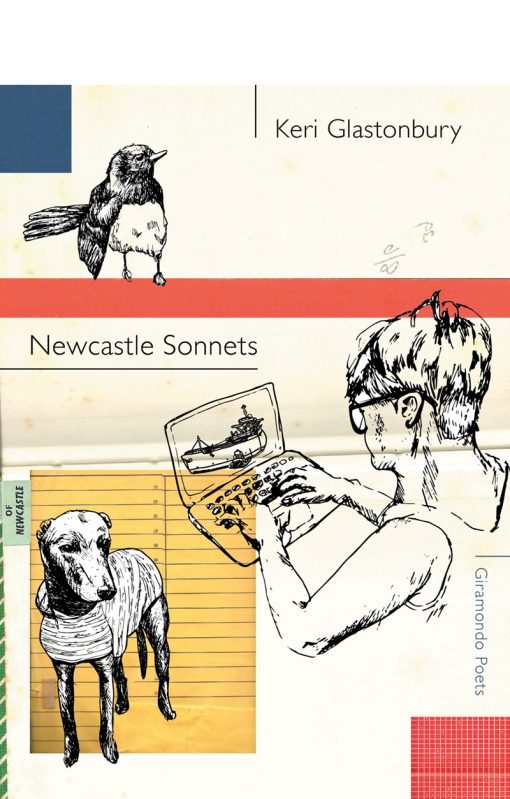 Newcastle Sonnets
By Keri Glastonbury
Giramondo
ISBN 978-1-925336-89-4
Reviewed by ERIN MCFADYEN
Keri Glastonbury’s Newcastle Sonnets are at their most mimetic when firing off their dazzling one-liners. The collection is interested in the processes of de- and re-composition that make up, continually, the post-industrial suburbanscape of Newcastle. Taking the city as a kind of monkey-bars apparatus for throwing together and for tumbling apart, the Sonnets treat language the same way as the landscape. They revel in the (re)generative potential of double-meanings, puns, and hyper-specific referentiality, but also, in the end, searing take-downs of local teens and late capitalism alike, delivered with a glimmer to the gut.
The weirdly quick, mercurial march of gentrification is right at the centre of Glastonbury’s target. There’s certainly a pleasure in the poet’s sharp wit, if not an entirely easy one for readers complicit in enjoying her knowing ivory tower in-jokes. Glastonbury might, for example, follow the humour of recognition, in passages like
There are still flashers at bus stops
but now the grapevine is virtual
& kids have Fjällräven Kanken backpacks
in candy colours
with wonderful pastiche puns:
The unbearable lightness
of rail (34)
These lightnesses, slightly unbearable though our delight in them may be, are fast hits of readerly reward. Often several times over in each sonnet, we’re given viscerally indulgent lines like ‘What is Batman’s guilty pleasure? / Clive Palmer’s soft, shitty body,’ (35) or ‘the thick oatmeal / of Sandliands’ face’ (8). We can smile, satisfied, at jokes overlaying the literary and the local — ‘Tess of the Erskinevilles’ (7) — and at speculative questioning with one foot in the university and the other in the clouds: ‘what if John Forbes had lived / to live tweet during Q&A?’ (6).
These moments offer us something like shining hard lollies of poetry, sugar hits immediately delicious on the tongue. It’s tempting to suggest that they puncture, redirect, or interrupt what Glastonbury elsewhere describes as a Novocastrian ‘ambient attention’ (4). We can consider that they give us all of our reward at once, a high-energy hit; the laugh, the immediate vision of reference points coming together. Conversely, we can also think of them as spilling our attention outwards, simultaneously in all the directions of the poet’s many gestures: across landscapes, across literary history, across registers and experiences both haptic and intellectual. In both ways, these joyfully — and, yet, not uncritically — hilarious poems lean into the kind of attention deficit that Glastonbury describes in ‘2 Hours South’:
A farrago of ways to be jealous, ways to be vicarious
ways to suffer, swiped away like old screens (71).
And, yet, to pin these poems as insufficiently attentive would be misrepresentative. Indeed, there’s a way in which they’re exactly the opposite; Glastonbury’s investment in the particularities of the ‘little big smoke’ of Newcastle signals a poet invested in deep attentiveness. Indeed, Glastonbury is critical of views of regional life which deal in broad strokes, in cliché, or in snobbish selectivity. In ‘The White Bird,’ for example, she’s unimpressed that
The metropolitan critic comes to town
& goes only to the regional gallery
— a poetry of complaint, misses the authenticity
of the drying paint. The blacks,
the Prussian Blues (72).
There is certainly a will to recenter the regional in this attitude and in the poems which enact it, positioning Newcastle the minor metropole not simply as secondary or merely aspirational, but as real and affecting and deserving of references that Melbournians might have to Google to get.
Attentiveness to these kinds of details, these minutiae, might be a kind of love. This would be fitting, perhaps, given the nominally generic form of the pieces here — I mean, given that these poems refer to a history of, and are, sonnets. The most obvious point of reference here might be Ted Berrigan’s The Sonnets, which Glastonbury mines and mimes in poems like ‘Just Quietly Babe.’ Glastonbury’s opening line here — ‘Dear Hamish, hello. It is 5.15am. / Guess we’re more West Coast…’ (29)— walks behind the eminently East Coast Berrigan, whose second sonnet begins ‘Dear Margie, hello. It is 5:15 a.m’ [1]. Equally explicit, though less exegetical, is Glastonbury’s gesture to Shakespeare in ‘The Pink Flamingo (of Trespass).’ In this instance, ‘the Tromp family’s psychedelic road trip / unfolds like a Netflix folie a deux / as Shakespeare’s Sonnet 127 is read in Noongar’ (67). Sonnet 127 is the first of Shakespeare’s ‘Dark Lady’ sequence. Here, double meanings help to figure an ostensibly unconventional object of love:
In the old age black was not counted fair,
Or if it were, it bore not beauty’s name;
But now is black beauty’s successive heir,
And beauty is slandered with a bastard shame:
For since each hand hath put on Nature’s power,
Fairing the foul with Art’s false borrowed face,
Sweet beauty hath no name, no holy bower,
But is profaned, if not lives in disgrace.
Therefore my mistress’ eyes are raven black,
Her eyes so suited, and they mourners seem
At such who, not born fair, no beauty lack,
Sland’ring creation with a false esteem:
Yet so they mourn becoming of their woe,
That every tongue says beauty should look so. [2]
If ‘beauty’ comes apart from ‘fairness,’ (as in lightness) here, and attaches itself instead to the raven black of the apostrophised woman’s eyes, ‘fairness’ becomes a truly polyvalent term. Both beautiful and opposed to beauty — because it is the opposite of darkness — fairness’s ambivalence is its foundational feature.
Glastonbury’s gesture to doubleness fits her approach to the sonnet form itself. Even with her clear references to the sonnet in its various historical guises, she’s interested in challenging precisely what this form can do, and what it can reasonably ask poets to do. We might configure her use of the form using Berrigan’s phrase, imagining these works as ‘Poem(s) in the Modern Manner’ [3]. The poems in Newcastle Sonnets are 14 lines long, getting us over the line for formally recognisable Elizabethan sonnets, but rhythmically and in rhyme (as well as in geography, in topography, in politics) we are a long way from London. Her treatment of the sonnet shortens and stretches out the lines, swings the rhythm. So considered, Glastonbury can be seen as, at times, crafting an exposed-brick iteration of this historical form, drawing attention to its structural foundations if only to ironically distance herself, and the aesthetic she ends up with, from them. In this, she makes the sonnet something exciting and relevant for the kinds of readers she might teach in her ‘cushy lecturing job in a regional town’ at the University of Newcastle:
…an anthroposcenester, the full cast
of Girls in every class, like every town
has a Kurt Cobain… (77)
Yet, exposed brick doesn’t always signal the fresh, the new, or the thrilling for Glastonbury, who also sees ‘the pebblecrete poles of the East End / speaking to an historicist melancholy’ (11). Indeed, in ‘The Sea Folding of Harri Jones,’ Glastonbury pictures stone not so much as reconstruction, but as ruin:
Someone’s doing parkour on the military ruins,
no one is washing up in Shepherds Hill cottage,
the ghost of artist-in-residence past… (56)
Looking back and documenting decay — as well an enacting it formally, in protracted blank space and grammatical cul-de-sacs — is always at the centre, then, of Glastonbury’s vision of the gentrifying city, and the new sonnet that she writes it in. For this reason, I want to offer the possibility of reading Gastonbury’s attention to Newcastle not only as ‘ambient,’ but also as meaningfully ambivalent. These aren’t poems written by a ‘metropolitan critic,’ but nor are they really poems of home. Glastonbury, indeed, has commented publicly on her arrival in Newcastle as an adult, and her dual senses of intrigue and distance from it at this time [4]. Hers are poems which register decay and hold gentrification in contempt, while still revelling in the vibrancy of locality, sparkling with gleefully specific references, in a voice that might almost sound proud. Perhaps Glastonbury formulates her own attitude most aptly: Newcastle Sonnets feels ‘post-celebratory’ (71), deflating the glamour of new money and construction, but also finding reparative feeling in the forgotten corners of a city living in the shadow of its historical self:
From below the bridge the neon reflections could be koi,
everyday rewards glimmering in karmic glissando (41).
Notes
1. Ted Berrigan, ‘II,’ in The Collected Poems of Ted Berrigan, by Alice Notley, with Anselm Berrigan, and Edmund Berrigan (Berkley: University of California Press, 2005), p. 3.
2. Colin Burrow (ed.), The Complete Sonnets and Poems (New York: Oxford University Press, 2002), p. 635
3. Berrigan, ‘Poem in the Modern Manner,’ in Collected Poems, 6.
4. Jim Kellar, ‘Newcastle poet minces no words capturing a city in transition,’ Newcastle Herald, 19 August 2018.
 Amanda Lucas-Frith lives on Wangal land in Sydney’s inner west with her partner and two children. She’s a communications and publishing consultant, and is currently completing the final subjects of a Master of Strategic Communication at UTS. She attended the 2019 Bread Loaf Writers’ Conference and is a member of Youngstreet Poets. Her poems have appeared in Snorkel and Cordite Poetry Review.
Border Protection
My life in lockdown looks
the same as it did before—
I search for my daughters’
hats, make snacks and play-
dough, and lavish colour
on each letter of the alphabet
just to tickle my tongue
to yellow, lilac, vermillion.
So many ways to make
bright things brighter
now the days close
and open like paper
fortune tellers. I write
to silence the chatterbox
to a single answer
and in this imaginary,
wage my Machiavellian
war against the diminutive
queens that surround me,
nesting between bathroom
walls or fortified around
the cubby house. The pest
control company kept
its social distance and said
they only use natural
chemicals, but at this stage
of the pandemic, I’ve lost
my organic moral advantage
and crave the kind of
annihilation only pesticide
can give. In the face
of diminishing freedom,
it’s curious how much
I desire to tame the dissenting
rattle, to be listened to
and obeyed as the single
absolute power of my
house, not minding at all
the cognitive dissonance
of wanting my daughters to
only do as I say, and never
as I do.
A Bright Room
When you arrived, I snapped
open like a purse and the surgeon
lifted you out, one sleek penny
at a time. He held you
level to his gaze and assessed
you like a rare coin, while a wake
of midwives pressed their fingers
to your mauve flesh.
Your father cut the cord
connecting us and we waited
for your cry in the bright room,
under the theatre light, where nobody
had mouths and every pair of eyes
held mine. I looked up to see,
reflected in the light’s mirror,
a kaleidoscope of myself
separate to my body—a ruby smile
from hip to hip—not mended
but altered by a blanket stitch.
Born again in a sea of sedatives,
I saw you there first: pools of black
gusting the surface to glass.
You arrived as a southerly wind
howling to the bright room,
your squalling cry cooling to my
touch, as I held you skin to skin.
Sorry you must be logged in and a current subscriber to view this content.
Please login and/or purchase a subscription.
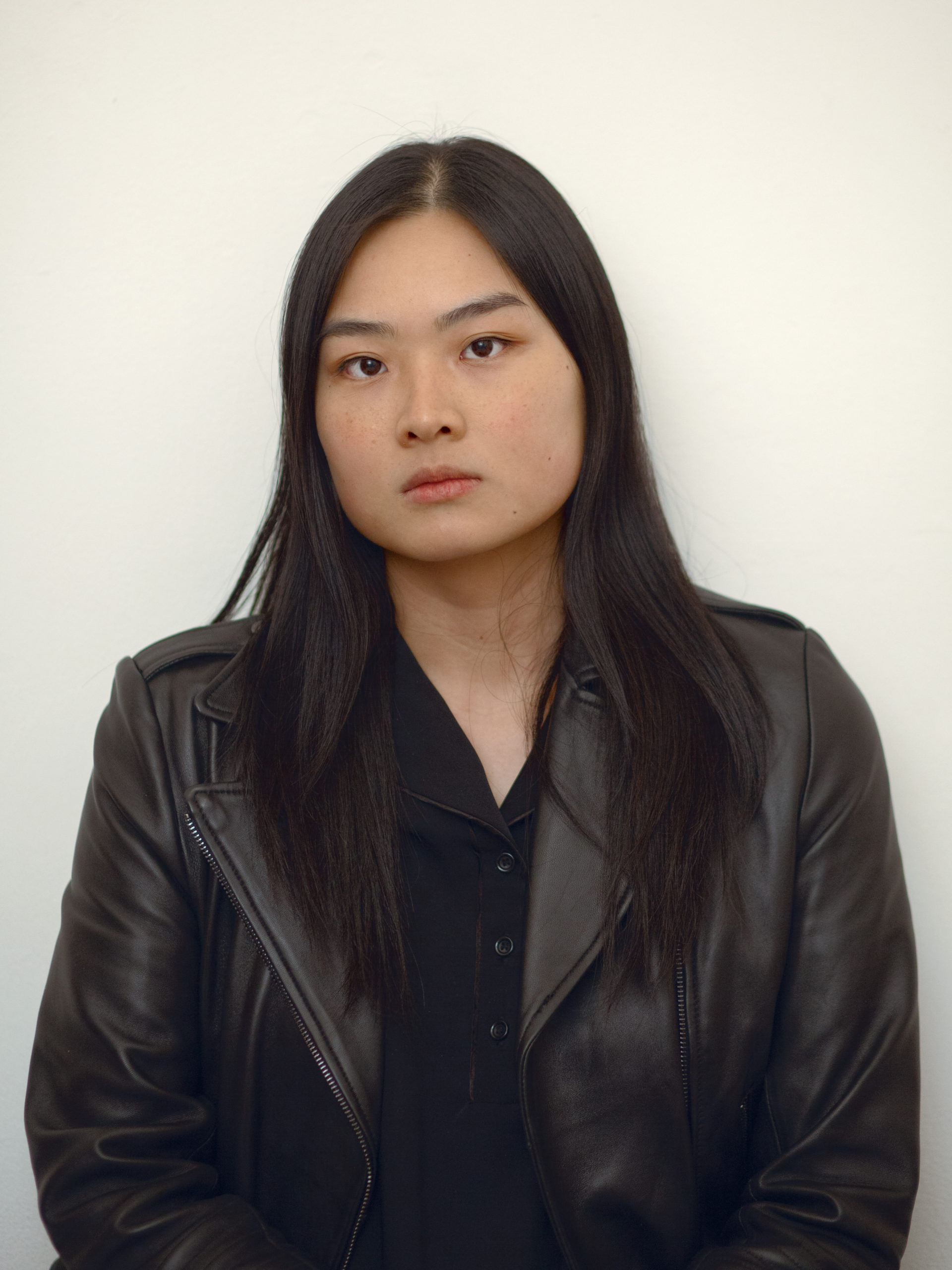 Janette Chen is a Chinese-Australian writer from Lidcombe. She is a member of Sweatshop: Western Sydney Literacy Movement and the 2019 winner of the Deborah Cass Prize.
Wall of Men
Every time mum starts the car, Teresa Teng starts singing. Mum’s 80s Chinese pop ballads blare from the stereo as we pull out of the driveway. Mum is driving me to Lidcombe train station so I can trek it to Veina’s house in Turrella. Outside it’s so hot the heat makes the fibro walls our house look wobbly. I put the windows all the way down because we never use the air con. Teresa Teng’s voice drifts down the street from our car. She sounds so sweet even when she’s accusing her lover of lying to her. As we drive, Mum asks me if Veina has a boyfriend yet. Mum’s face looks dry and red from the heat. She has so many red hairs now, which are white hairs dyed with henna she bought from the Arab shops in Auburn. She glances at me as we slow at a red light and turns off the music. Since I finished high school two months ago, Mum has asked me four times already if there will be any boys when I go out.
‘No, Ma,’ I sigh as we start moving again. It was technically true. As far as I knew, Veina is texting a guy called Andre and hanging out with some guy called Jason but she’s never called either of them her boyfriend.
‘Do you have a boyfriend?’ she asks in Cantonese.
‘Noooo, Ma,’ I groan. Mum flicks her black eyes at me and then back at the road.
‘I was the same age as you are now when I first got married,’ she says. ‘Your Ba is not my first husband.’
I hold my breath. This is the first time Mum has told me about her first marriage but I already know. I overheard her talking to Dad in the kitchen once about a fortune teller she saw back in Guangzhou when she was 17. ‘He told me I would be married twice and he was right about that,’ I had heard her say. In traffic, we inch past an empty lot of weeds and rubble that is fenced off with a glossy sign advertising new apartment blocks. ‘I was so in love with my first husband,’ Mum says. ‘But one day he started locking doors. He started swearing at me. When he slapped me, I thought it would only be one time.’
My muscles tense up when I imagine Mum being hit. We pass the Korean BBQ restaurants on the turn into the station and Mum parks crookedly in the drop-off zone. She keeps talking, her words spilling out like water. ‘He dragged me across our bedroom and strangled me until I realised that if this man loved me he would kill me with his love.’ I put my hand on Mum’s shoulder. I don’t know what else to do with this information. Mum brings her hand to mine and holds it tightly. ‘I know you’re a smart girl. But just be careful. The man you choose is the life you choose.’
Some dickhead in a white ute blasts his horn and cuts Mum off at the end of the sentence. I grab the plastic bag of cherries I’m bringing to Veina’s and tell Mum that I won’t be home for dinner.
On the train to Turrella, I sit in a three-seater behind a young Nepalese couple. The woman’s head is nestled in the space between the man’s shoulder and his brown ear. I think about how I used to see my parent’s wedding photo all the time as a kid. It was propped on the dresser in my parents’ bedroom. The man in the photo was my dad. The woman in the photo had skin as pale as the moon. Yi yi, I had called her, which means Auntie. I couldn’t believe it was my mum. This is because in real life, mum’s skin is the colour of wholemeal bread with lots of seeds in it. In real life, her lips are more brown than red. I knew so little about this other life she had before that photo was even taken.
I get off at Central and change platforms for the airport line. I had never heard of the suburb of Turrella until Veina moved there. Veina is my only high school friend who moved out of home immediately after graduating. Now she lives with four housemates and they all share one tiny bathroom. ‘Fun fact: The Streets ice cream factory used to be in Turrella,’ Veina said when she first told me she was moving. I believed the fun fact, I just couldn’t believe she was moving so far from Lidcombe, away from me. The afternoon heat wraps around me like a blanket when I step off the train. I am the only person standing on the platform. The plastic bag of cherries sweats in my hand.
Veina’s house is a long pink rectangle on a concrete block with a brown roof. When I arrive at the house, I’m sweating from my pits. I tap on the window of Veina’s room but when I get to the front door, it’s her housemate Peter who opens it.
‘Hello,’ he nods. Peter’s tiny head at odds with his massive shoulders. He steps back and holds the door for me. The thin white t-shirt he is wearing is stretched out around the collar and the skin around his neck is pale and pink. All I know about Peter is that he’s a backpacker from Slovakia. And he’s a prawn. He has a body good enough to eat and a head you can throw away. I realise Peter’s holding a big plastic rubbish bag and quickly step inside as he steps out.
The front door of the Turrella house opens straight into the living room with all its random old furniture, plus the sleek black chair Veina and I carried straight out of the new food court in Town Hall one time. I take off my sandals at the door. The pale blue tiles are cool beneath my feet but I know they’re dirty. I can see the dust and hair and dried boogers on the floor. The living room extends into the kitchen on the right, both overlooking the backyard where the laundry is still flapping on the lop-sided Hills Hoist.
Veina’s in the kitchen wearing a big faded black t-shirt with her hair is all over the place. She looks as if she only woke up a couple of hours ago and hasn’t gotten changed yet. Her kitchen is made up of custard coloured plastic laminate cupboards and drawers with golden brown trimmings. Veina gets me started on cutting up onions for our dinner: slut spaghetti. We started calling it that in Year 8 Food Tech because boiling pasta is easy. As I’m tossing onions into the hot pan, Veina tells me about the date Peter brought to the house the night before.
‘He was cooking chicken for this tiny Asian chick and was getting her a chair and everything. But it was like, all so he could fuck her,’ Veina says dryly. When she’s not wearing makeup, Veina looks like she’s fourteen but when she opens her mouth, her voice sounds like she’s smoked a pack a day for as long as she’s been alive. Today, Veina has a thick line of black gel eyeliner painted over her eyelids.
As I pour the contents of a jar of pasta sauce into a saucepan, Veina dumps a handful of oregano and the good bits of a green capsicum we found going soft in the fridge. ‘I always see him looking Asian chicks up and down and up and down,’ Veina says.
‘I would be looking him up and down and up and down if I lived here,’ I confess. But then, I imagine making out with him with his big nose sticking into the side of my face. His mouth would be dry and floury and his pale, slippery body would be squirming on top of mine, crushing me under a mattress of muscle. The thought of it makes my throat tighten.
Peter comes into the kitchen wearing only a pair of baggy track pants. The t-shirt he was wearing earlier is gone. I wonder if he just heard what I said and if all this skin is an invitation. I decline by only looking at him above the neck. His face is long and small in proportion to his wide shoulders and thick neck. His nose sticks out like an arrow. But then he goes to grab a Coke from the fridge and the long line of his back smooths and stretches.
‘Time to eat out this slut spaghetti,’ Veina says after putting the final touch: chilli flakes. In addition to being easy, slut spaghetti needs to be hot. Veina uses chopsticks to put the pasta into two bowls for us and we take them to eat outside.
I have one foot out the front door when it sounds like Peter is saying, ‘Hey, Jen, Jen, Jen, come back.’ His voice is deep and nasally. I turn around. Peter is standing right in front of me. His collarbones are at my eye level and they look like small, featherless wings that spread beneath his skin.
‘You forgot this,’ he says and hands me a fork.
‘Thanks,’ I say to the fork and hurry out the door after Veina.
The front yard is a concrete slab with an old single mattress on the floor. I brush off the dirt and dried leaves and sit down on the mattress next to Veina, leaning my back on the pink stucco exterior of the house. The air around us is starting to cool but the wall is warm against my back. Veina hands me a pair of chopsticks and starts slurping at her spaghetti, her head of black hair bobbing over her bowl. I put Peter’s fork on the floor beside the mattress.
A pair of lanky teenage boys walking a St Bernard are the only people out on the empty suburban streets. The long, pale arm holding the leash looks like a noodle stretching with every step the dog takes. Veina swallows her spaghetti and whistles at the boys. One of them turns around to look at us. He has dark eyes and hair and his skin looks warm and buttery. He might be Eurasian or it might just be the way he looks in the sunset.
‘You shouldn’t do that,’ I tell her.
‘They’re cute,’ Veina says, holding up her hand in greeting. She turns and grins at me. The liner around her eyes makes them look like black crescents with eyelashes.
‘Don’t worry, I know you’ve got it in you,’ Veina says. ‘You just need to be pushed out of the nest. Then you’ll fly like the skank bird you truly are.’
I roll my eyes and watch the boys walk away. In high school, Veina and I cut out all the pictures of cute boys from university brochures and stuck them on the wall in our Year Twelve common room. ‘So Many Opportunities at University’, the caption read. It was Veina’s idea. We called it the Wall of Men, and it was opposite the Wall of Ramen where we pinned up empty instant noodle packets. During our free periods, Veina smoked out the windows of the spare music rooms and I did maths practice papers next to the Wall of Men. The boys in those pictures all had smooth, white skin and were smiling straight at me.
Veina and I went to Sydney Girls High School, an uppity institution for Asian overachievers. Our school motto was ‘Labor Omnia Vincit’, which is Latin for ‘Homework Always Pays’. It was the motto of my mum and the mums of one thousand black-haired teenage girls pressing textbooks to their chests. The ATAR we got was the life we got. I stared back at the boys on the Wall of Men and wondered if they would still be smiling when I beat the living shit out of them at the HSC.
Now that we finished school, me and Veina are melting into lazy flesh bags in the summer. We move from the dirty mattress when the mosquitoes start to bite. Back in the house, the last light is coming through the kitchen window. I wash the cherries I had brought and inspect them under running water. They’re plump and brown and cold from the fridge. A lot of them are scarred or bruised or overripe. Dad had bought a big box of cherries for ten dollars at Flemington markets and my family has been eating cherries at home every night. I pick out a dodgy one, bite out its open sore and put the rest of the cherry in my mouth. It’s so sweet and so cold.
In the living room, Veina turns on the TV to watch If You Are the One on SBS. It’s starting to get dark now, but no one has bothered to turn on the lights. I join her on the lumpy brown couch. A new male contestant steps out of the single-man cylinder that lowers Chinese bachelors to the stage like a love delivery chute. He’s buff with tanned skin. Beijing Beefcake.
Veina and I give the male contestants a score from one to ten depending on how likely we would go on a date with them. We have different selection criteria to the female contestants date to get married. The women on the show want to know if the man has an apartment, a car and a high-paying job. The men want to know what the women look like without any makeup on. Veina and I heckle the television when the contestants talk that shit, which is every episode. We’re going to get our own apartments, cars and high-paying jobs. We don’t do maths practice papers because we like maths.
On screen, Beijing Beefcake smiles and waves at the audience as he walks out of the man capsule and on to the stage. The fabric of his white shirt strains against his pecs.
The back door opens with the broken flyscreen flapping around and Peter steps inside, hulking a basket of laundry against his bare chest. Veina offers him some cherries and Peter puts down his laundry and slides down the armrest of the couch. Now I’m sandwiched between him and Veina. I shift in my seat so we’re not sitting so close. My body thinks it wants one thing but my mind is in control. Don’t throw away the head for a prawn.
We all watch Beijing Beefcake’s pre-recorded video of his life as a personal trainer. I pick out a handful of super soft cherries with wide, open sores dried into dark scabs. I’m feeling stiff from sitting next to Peter. His abs look like skinless chicken nuggets set into two neat rows. They cuddle and curl against each other as Peter leans forward to spit a pip into the bowl. I look away when something starts buzzing beneath me. It’s Veina’s phone, half submerged in the crumby gap between the sections of the couch, vibrating deeper into the fold. I slip my fingers between the couch cushions and grab the phone.
‘Ugh, sorry,’ Veina says. ‘Mum calls every day to check on me.’ She answers the phone with a, ‘Wei’ as she walks off towards her room.
I move over to where Veina had just been sitting so there’s more space between me and Peter. He sneezes. His hands go from covering his nose to stretching across the back of the couch, bridging the distance I had just created between us. It’s cooling down. He needs to put a shirt on. On If You Are The One, Beijing Beefcake is sitting in his living room in a white singlet. I would give him a 6.8. Maybe 8 if he looked a little less inflated. He could be a 9 if he talked about something besides his muscles.
‘My big muscles give me big responsibilities,’ the yellow subtitles at the bottom of the screen translate as Beijing Beefcake nods at me through the television. ‘I swear to the whole nation I would never hit a woman. I can look after her and protect her,’ Beijing Beefcake says. He flexes one bare, bulging brown arm after the other. ‘She can kiss my biceps every day.’
Next to me, Peter shifts in his seat. I hope Veina will come out of her room soon so I don’t have to be alone with Peter. I stuff my mouth with three cherries and sink back into the sofa and stare at the TV. What would it feel like for his strong arms to hold me gently? As I imagine the tenderness of resting my head against his chest, a sharp pain shoots through my mouth. I hold my cheek with my head turned away like I had just been slapped. It feels like someone had cut the right side of my cheek with a pair of scissors. I lean forward and let the contents of my mouth drop into my other hand. The living room lights turn on.
‘Fuck your dad,’ I curse. ‘Oww.’
‘Are you okay?’ Peter says, putting his big, warm hand on my shoulder. It feels heavy there. I look up and see Veina walking across the room.
‘My dad says that when you bite yourself it’s because you’re not eating enough meat,’ she says. ‘Your mouth wants meat in it,’ Veina wiggles her eyebrows suggestively.
‘Ugh, well fuck your dad too,’ I say. I look down at the half-chewed cherries in my open palm. The wet, red flesh glistens like mashed and bloody brains.