Author: mascara
Megan Cheong reviews Mother of Pearl by Angela Savage
Megan Cheong reviews Mother of Pearl by Angela Savage
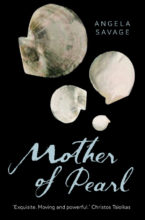 Mother of Pearl
by Angela Savage
ISBN 978-1-925760-35-4
Reviewed by MEGAN CHEONG
Mother of Pearl: Perspectives on exploitation
When I open a book by a white writer and am confronted by the point of view of a person of colour, my body tenses as if in anticipation of a blow. Rather than reading, I pick nervously at the writing in search of cliché and oversimplification. Because the source of the tension I feel in relation to point of view is less a question of who has a right to whose story than it is one of craft. As Rankine and Loffreda point out in their introduction to The Racial Imaginary, “our imaginations are creatures as limited as we ourselves are” and therefore susceptible to the same preconceptions under which we labour as the products of an entire history of racist culture, politics and violence. The first-principle question is not therefore: “can I write from another’s point of view?”, but instead: “why and what for?”
=================================Continue reading for only $5 per month
Subscribe for full access to Mascara Literary Review or login
Victoria Nugent reviews Blueberries by Ellena Savage
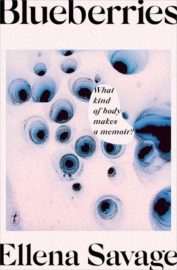 Blueberries
by Ellena Savage
Reviewed by VICTORIA NUGENT
Memoir, poetry, probing essay-style musings and competing inner voices exist side-by-side in Ellena Savage’s Blueberries, a bold and incisive collection of experimental non-fiction.
While Blueberries is Savage’s debut essay collection, she has been widely published, with her works appearing in literary journals, daily publications and various collections. Many of Blueberries’ offerings have appeared in various publications previously, in differing forms and have now been stitched together to form a well-flowing collection that explores big topics like class, colonialism, feminism, reproductive rights, sex and trauma.
In her sharp and intimate prose Savage’s essays probe into what it means to be a woman, a feminist, a writer, a modern Australian and a product of a colonial society. While she never shies away from important issues, Savage imbues her work with a warmth and expressiveness that adds levity when needed.
Keystone work, “Yellow City”, which was last year published in chapbook form, kicks off the collection strongly, taking the form of diary entries tracing Savage’s steps through Lisbon in 2017, a city that she has returned after being a victim of a sex crime there some 11 years earlier. “Yellow City” is haunted by that past incident and by questions about the reliability of memory.
“—‘My first memory.’
—Is buttressed by recalling it.
—‘My first memory.’ A fiction fixed to the linear self.” (8)
Savage lays herself bare in this piece, scraping back the layers to show how the trauma had shaped her in the intervening years since the “encounter during which my flesh remembered the possibility of a violent death. When my body understood for a second that corpses are dismembered to cover-up crimes.” (6)
The second essay, the titular “Blueberries”, explores the learnings that Savage takes from an elite writing workshop she attends the USA, delving into questions of privilege, gender, what it means to be a woman and a writer and what associated obstacles come with those two roles.
The essay had a cadence all of its own, coming back to the phrase “I was in America at a very expensive writers’ workshop” (41) or variations of it to drive home each new stanza. Dropped commas make the prose flow with a heightened sense of urgency, a sort of feverish enthusiasm that somehow sounds more like the dialogue might have with an impassioned friend, eager to convey the import of the issue weighing upon their mind.
The intersection between gender and the creation of art is a key theme of the work, with Savage delving into the role gender played in the dynamics of the workshop and how that mirrored inequality between the sexes in wider society and in the arts.
In many ways, Blueberries could be seen as modern day response to Virginia Woolf’s A Room of One’s Own, delving into these inequalities, even while acknowledging the “thud of guilt knowing that someone, like, I don’t know, my own mother, would have wrung her neck to have been given the opportunity to attend her art’s version of the workshop I was at;” (57)
Savage’s musings hold an echo of Woolf’s own thoughts on women writers, brought into a modern era. Woolf wrote that “it would be a thousand pities if women wrote like men, or lived like men, or looked like men, for if two sexes are quite inadequate, considering the vastness and variety of the world, how should we manage with one only?” (Woolf, 87). I found echoes of Woolf’s frustration in Savage’s own thoughts on the writers’ workshop, where she “was disappointed not for the first time that ‘excellence’ was turning out to be mediocrity dressed up in money and maybe masculinity too, not the masculinity that is visible to us, brawny and street-smart, but real masculinity, which is reedy and tepid and well read and invisible.(42)
The piece also touches upon class and race but only in a relatively minor way. Savage recognises her privilege, pondering on the “kind of class mobility that I have because maybe my race is my class now” (45) and at the same notes that women writers made up “ninety per cent of the cohort, and most of them white” (54). Despite this acknowledgement though, white feminism remains the predominant lens for Savage’s analysis.
“Then one day me and my friend were at a big gallery and I looked at a wall of photographs of famous European artists, artists whose faces you’d recognise as those of famous European artists, and for some reason I saw it all at once laid out and the only thing I could say was ‘Where are all the women artists’, like I had only just noticed, which could as easily have been where are all the Aboriginal artists where are all the trans artists where are all the Asian artists, except that we’re talking about a group that constitutes fifty per cent of any otherwise marginalised population and any privileged one too.” (53)
This quote signifies (intentionally or not) that despite Savage engaging with ideas about how race might factor into marginalisation, her chief concern regarding representation still remains how much recognition women might receive in artistic spheres. With her argument about women constituting 50 per cent of the population, Savage subtly indicates a belief that the representation of female artists is of more important than that of the other groups she mentions. Women’s issues are thus given prominence over issues facing Asian and Aboriginal artists. Savage’s analysis stops short of unpacking how women of colour might face further struggles with representation as compared to white women.
Savage better acknowledges her own limitations in “Satellite”, a musing on her family’s Coburg background and the area’s gentrification, where she likens her roots to “an introduced grass species that thrives everywhere by choking its competitors, that avoids detection by passing for a native species, and this laboured metaphor is trying to say something about colonial figures like me who’d really like to not make things worse than they are, but who by simply accepting the yellow blotted sun through the pane of glass, by accepting the home built atop spirits silent and angry, have roots that are caught in the seams of rotten foundations.” (79)
Class and how cultural capital is linked to social mobility is another theme Savage takes an interest in. She puts forward the supposition in Blueberries that “the accumulation of cultural capital for the purpose of social mobility is a stone-cold fact of life” (57), but one that is seldom talked about. Savage links this pursuit of elitism to the willingness of writers to pay for courses of “expensive mediocrity” (46) in a liberal arts environment where a kind of morality is associated with eating locally sourced, organic food, stemming from “the entitlement of an elite class to impose its moral directives on the people whose labour allows them to be elite in some way or another” (50). In “You Dirty Phony Saint and Martyr”, Savage writes that she imagined some of her own accrued cultural capital would “morph into material capital, but it has not, yet and might never” (133), as part of an essay in which she touches lightly on “the nexus of power, privilege and prestige in literature” (130).
In “Unwed Teen Mum Mary”, Savage seamlessly transitions from recounting the process of seeking paid work into a contemplation of what the word choice means, specifically in the context of having the agency to make reproductive choices. It’s a powerful personal essay that both takes the readers into the intimacies of Savage’s own life and looks broadly at the cultural narratives surrounding abortion and how Christian tradition has shaped them.
“In my view, any effort to pair femininity with maternity with biological destiny with virgin births with earthy crystal-lovemaking is an effort to relegate the female form to a position of inferiority, to a state of constant need and gratitude and dependence.” (112)
Savage shows a firm grasp of a variety of styles throughout the collection, playing with form in creative and clever, and sometimes disconcerting ways. “Allan Ginsberg” (fittingly) takes a poetic form, while “Friendship Between Women” has a compelling, rambling, stream-of-consciousness feel, rich with poetic description. Another interesting piece is “Holidays with Men”, which juxtaposes two separate works on each page, effectively creating two pieces in one. The first of the two reflects on a series of vignettes Savage once published in a zine, the second is a form of that vignette series, though one anecdote recounted in the companion piece about an acquaintance recognising herself in a vignette indicates that this version of “Holidays with Men” is not the same one. The eye and the mind don’t know which narrative to follow first but once the reader detangles the two, the combined work is a rich exploration of our modern relationship with travel, as well as the effects of travel upon relationships.
“Travel, in the broadest sense possible,
encompasses the furthest
reaches of a culture. Networks
driven by survival, by desire,
by a twinning of the two, have
flung bodies and stories away
from homes for all of history,
and all of prehistory, too.” (125)
“The Museum of Rape” could also be read in multiple ways, thanks to its use of numbered paragraphs, with the references throughout the text making it possible to skip to other parts of the work for a non-linear experience.
“8.0
What I am saying is that I understand the total collapse of structured
memory.
I asked myself, what does it mean to anticipate the loss
of one’s rational function (7.0, 7.1, 7.2).” (67)
In the penultimate work in the collection, “Portrait of the Writer as Worker (after Dieter Lesage)”, Savage offers anecdotes of a writer’s life, a series of almost fragmented thoughts that strung together paint a vivid picture of how creation intersects with earning a living. Together with “Yellow City” and “Blueberries”, it can be seen as one of the collection’s key pieces.
“You are a writer, and you know what that means: you don’t do it for the money. You don’t do it for the money, which is a great reason people have to not pay you for your writing.” (211)
Savage’s works drip with references to other literature… Hemingway, Shakespeare, Elena Ferrante, Jamaica Kincaid, philosopher Theodor Adorno and the list goes on. By drawing from all these different source materials, Savage expands the scope of the work and imbues it with even more meaning.
As a debut collection, Blueberries is strong, sharply drawn, thought-provoking and easy to devour. Each individual piece earns its place in the collection, providing depth and insight across a broad range of topics and showcasing a rich toolbox of writing styles. Savage digs deep to scratch at the mysteries of self and of social structure in this personal, compelling work, which defies easy categorisation, revealing more with each subsequent reread.
References
Savage, Ellena. Blueberries. Text Publishing, 2020.
Woolf, Virginia. A Room of One’s Own. Penguin Classics, 2000.
VICTORIA NUGENT is a full-time journalist and part time fiction writer living in regional Queensland.
Matthew da Silva reviews Invisible Eye by Gayatri Chawla
Continue reading for only $5 per month
Subscribe for full access to Mascara Literary Review or login
H.C. Gildfind reviews A Constant Hum by Alice Bishop
Continue reading for only $5 per month
Subscribe for full access to Mascara Literary Review or login
Emily Yu Zong reviews Everything Changes Ed. Xianlin Song and Nicolas Jose
Emily Yu Zong reviews Everything Changes Ed. Xianlin Song and Nicolas Jose
 Everything Changes: Australian Writers and China, A Transcultural Anthology
Ed. Xianlin Song and Nicolas Jose
ISBN: 978-1-76080-112-0
Reviewed by EMILY ZONG
=================================Continue reading for only $5 per month
Subscribe for full access to Mascara Literary Review or login
Jean-Francois Vernay reviews The Pillars by Peter Polites
Continue reading for only $5 per month
Subscribe for full access to Mascara Literary Review or login
Amy Van Der Linden reviews We’ll Stand in that Place Ed. Michelle Cahill
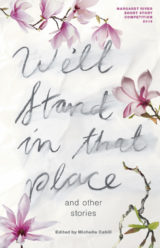 We’ll Stand in that Place and Other Stories
Edited by Michelle Cahill
Reviewed by AMY VAN DER LINDEN
‘In the short story form, a writer commits to a vivid and entire world; a world in which voice and dialogue matter exceedingly, sometimes tangentially, and every sentence is measured to carry structural and thematic weight.’
– Michelle Cahill. (vii)
We’ll Stand in that Place and other stories, is the latest anthology of the Margaret River Short Story Competition. The competition is an annual contest, open to authors of any age and nationality. Previous editors have been Ryan O’Neill, Ellen van Neerven, Laurie Steed and Estelle Tang. Nineteen short stories were selected out of over 240 entries. Michelle Cahill, who edited the 2019 edition has compiled a collection of stories covering a range of contemporary themes such as climate change, cultural inclusiveness, complex relationships and emotions, family and the need for queer spaces. Both emerging and established writers whose work highlight features of the short story form are included.
The winning story, titled ‘We’ll Stand in that Place’, by Kit Scriven is both an intense and intriguing story. Upon my first read, I was unsure of the exact events of the story, but was blown away by Scriven’s ability to both conceal and rearrange details. After the second read, it was clear that I had missed the overdose of Andy in the beginning. In her introduction, Cahill writes, “one needs to read attentively to learn that Andy has overdosed; that Baby’s grief is ritualised.” (ix) Scriven uses descriptive imagery and words that are full of deep emotions, both layered and symbolic, as the reader follows the protagonist dealing with the death of his first love. I agree with Cahill when she says Scriven’s craft produces something both “disturbing and unique.” He “marries the beautiful with the sordid.” (ix) As a reader, I was drawn to the character of Baby, because as his name suggests he isn’t your usual grown man. He sees things differently to other characters; he “wasn’t finished properly” and he doesn’t “belong.” (8) This story tells the experience of queer culture in the local and often dangerous streets of St Kilda and the experience of these non-binary and queer characters. The subject matter of this story made me excited for inclusivity in the genre of fiction. A distinctive feature of this story is the way it makes one feel both disoriented and connected. After reading this piece, I found that it continued to linger in my thoughts for a long time afterwards.
Catherine Noske’s ‘Thylacine’, awarded second place, narrates the story of a stay-at-home-wife and her experiences of being home alone during her early pregnancy. Her husband is a geologist who takes frequent field-trips to northern Western Australia as he discovers a rare fossil called the ‘thylacine’. Noske uses her story to fictionalise themes of absence and the hardships of marriage, whilst subtly commenting on the exploitation of Aboriginal land from causes relating to the mining industry and white settlement. Noske uses the finding of the fossil as the central framework of the narrative, and the subtle details of traditional gender norms, broken relationships and dependability soon follow. The wife fills the void between her husbands’ absences by washing his dirty clothes, whilst falling in and out of dream like sequences of happier memories when she and her husband were together. The small details of their absent relationship and wife’s dependency of her husband makes a comment on exposing traditional gender roles as she centres her day around waiting for him to get home from his trips. Whereas the husband uses his field-trips as an escape from his marriage and becomes so used to leaving that sometimes he “tells her it is field trips, but it isn’t. He finds things to do.” (16) Through the third person narration, Noske expresses the distance emotionally and physically between the husband and wife. Cahill comments in her introduction, that the story is “composed of numbered sections, each a possible prose poem”. (ix) This experimental style is exciting as it shines a light on the possibilities of the short story to break the boundaries of conventionality.
Rachel McEleney’s story ‘The Day the Rain Stopped Dancing’, was awarded the South West Prize. This story was one of my favourites because of its creativity and for its futuristic theme. McEleney addresses the two topical issues of climate change and veganism as the framework for her piece. She creates a world that is genetically modified by a US grain called ‘GentaCorp’s GM 21’ which cross-pollinates with other crops and mutates human cells. From naturalistic beginnings a strange, lonely world of climate change and animal extinctions quickly follows. Lily, mother of two and wife to husband ‘Jase’ is watching the news for updates and plans to keep her family safe from the mutating cell. Somewhere along her flashbacks to her childhood and long walks outside in the rain, the reader is aware that her loneliness has slowly driven her to insanity. The reason this story stood out to me was because it commented on a topical issue in an inventive and creative way and the ending was surprising. It creates a powerful message that anticipates a future dystopia that could happen if we fail to act on our environmental crisis today.
It is refreshing to see such a range of impressive stories that defy the conventions in narrative storytelling, especially when we are living in times in which literature is being produced and marketed for mainstream consumption. The collection shines a spotlight on new writers in the form of themes, character voices and the subject matter of the stories. Though no story is like the other, they all interpret the complexity of emotions that “we sometimes fail to honour in our daily lives and close relationships.” (Inroduction, viii.) Whether it is the masculine perspective and tough realism in Mark Smith’s ‘A Concreter’s Heart’, or the heartbreaking and layered emotions of Mirandi Riwoe’s story ‘Cinta Ku’, we see the idea of the complexity of emotions being both explored, discovered and lost.
In Jenni Mazaraki’s story ‘Somebody’s Baby’, K.W. George’s ‘Three Dog Night’ and K.A. Rees’ ‘Butterscotch’, the reader delves into the feelings of a sense of home, whilst also dealing with the complications of feeling lost. Both Justine Hyde’s story ‘Emotional Support’ and Darryl R. Dymock’s story ‘A Tough Little Bird’, both are stories about passengers in flight. Hyde’s use of humour contrasts cleverly with the grief and anxiety that is present in the character’s evident feelings of loss due to the passing of her partner. Whereas in Dymock’s short story, he uses an artificial conversation between two plane passengers, that slowly turns into a truthful and cathartic conversation to help the protagonist dealing with the stress of visiting her ill mother back home. Dymock demonstrates through his writing, how even in the most unexpected of times we can find a sense of hope to deal with our emotions and anxieties.
The nineteen short stories are eclectic in subject, making for a stimulating read. Each invites a discussion on themes from sexual awakenings to complex family relationships, cultural inclusivity and ecological dystopia. Characters are found talking to trees; or on a plane with a unique travelling companion. There’s even a monster in a lake, rendered with suspense and plausibility. The open theme of the competition means that readers are treated to an impressive range, while Cahill offers a neat summary of what makes a good short story. This collection doesn’t feel jolted or messy, but something that is much more than the sum of its parts.
AMY VAN DER LINDEN is a recent graduate of Swinburne University of Technology. She has graduated with a major in Professional Writing and Editing and a minor in Literature. She is eager to start a career in the literary industry and use the skills she has acquired from her studies in her work.
Sophie Baggott reviews Rethinking the Victim by Anne Brewster and Sue Kossew
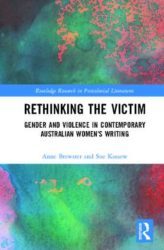 Rethinking the Victim: Gender and Violence in Contemporary Australian Women’s Writing
by Anne Brewster and Sue Kossew
ISBN: 978 1 138 09259 4
Reviewed by SOPHIE BAGGOTT
First of all, I owe readers a disclosure: if this book is an interrogation of power asymmetry and its potential to foster violence, then it’s disquieting that both its authors and reviewer embody a white middle-class lens on experiences largely rooted in less privileged positions across society.
Brewster and Kossew are acutely aware of this imbalance throughout their dense, often illuminating book, which explores writing about violence from women whom they identify as either majoritarian, Indigenous or minoritised. The theorists tussle with the tension between what they perceive as the need to open up a cross-cultural conversation with radical empathy and the need to avoid “perpetuat[ing] the invasion” (Nicholson, 2000). At several points, they account for their decision to engage with the works of Indigenous and minoritised writers by citing various authors’ own calls for their inclusion in the Australian literary canon. One example is Filipino-Australian writer Merlinda Bobis’s comment during an interview with Mascara Literary Review that her book, Fish-Hair Woman, professes “a reciprocal love between cultures” and her broader comments about the difficulties of “getting through the literary gate” in Australia (p.191 / Bobis 2015).
Rethinking the Victim is divided into four chapters with an overall integrative approach, though the academics focus on Aboriginal poetry in its own chapter (‘Violence against women and girls: Indigenous women’s activist poetry’); this perhaps speaks to the statistics and the specificity of violence against Aboriginal women. In Chapter 1 (‘Intimate violations: gothic and romance’), Brewster and Kossew reflect on wide-ranging texts such as the writing of Yugambeh writer Ellen Van Neerven and of Asian-Australian writer Chi Vu. In Chapter 3 (‘Broken families, vulnerable children’ and Chapter 4 (‘War and political violence’), analysis of CALD writers is again interwoven with reflections on texts by white middle class women.
While paying attention to their own embeddedness in power structures, Brewster and Kossew rightly suggest that cultures do not exist in a vacuum – all gender dynamics occur within the systemic inequality that extends worldwide. Global estimates indicate that one in three women will be subject to violence in her lifetime, and the bleak reality is that one woman is killed by her partner every week in Australia. Despite this horrific universality, representations of violence against women vary significantly. For instance, the theorists point out the “mediatised” way in which Aboriginal family violence is portrayed in the public sphere, with implications that it is distinct and “endemic” (p.94). In contrast, they observe the way in which “violence in the white middle-class home has traditionally been exceptionalised, hidden and relegated to the private sphere”, noting this cultural exceptionalism as a reason for broadening the dialogue around gender-based violence (p.17-18).
Here’s another disclosure: this latter observation was one that hit home, so to speak. It took a long time to face up to the fact that my (white middle-class) household was a place of violence, and that I know what it is to be and to see a girl/woman enduring many years of threats and assaults by a boy/man. I also knew, without instruction but through a hazy sense of loyalty and self-preservation, that the topic was absolutely taboo. Much of this book’s analysis therefore delved into familiar territory: a world of precariousness, futile attempts to ‘fix’ perpetrators, and the incremental ways in which women become trapped. Why am I sharing this? I suppose it’s in the book’s spirit of “reject[ing] the fear of stigma, shame and failure that often prevents white middle-class victims from breaking with notions of propriety” (a function which the theorists attach to novels such as Evie Wyld’s All the Birds, Singing, Emily Maguire’s An Isolated Incident and Anna George’s What Came Before) and in response to the appeal for solidarity that runs throughout Rethinking the Victim (p.18).
Since Rethinking the Victim forms part of the Routledge Research in Postcolonial Literatures, it is no surprise that both theorists’ research is strongly grounded in contemporary postcolonial literature. This passion comes across emphatically in their literary analysis, and they write extremely persuasively of the intersections between colonisation and violence (particularly in terms of Australia’s “national burial of a suppressed violent past”, p.50). I’d argue that this is occasionally to the detriment of the gender analysis – for instance, their seven-page exploration of Paula Abood’s ‘Stories from the Diaspora’ (2017) is a highly detailed study on race and violence, but barely touches on the aspect of gender (p.203-10). This is perhaps an insight into how gender may be the main issue for white women writers, while for women of colour (such as Abood) race and colonialism are such overpowering oppressions that there is less emphasis on the gendered perspectives.
Furthermore, to the best of my knowledge, the book omits any mention of the gender-based violence meted out to those who are trans or non-binary. According to Transgender Victoria, transgender and gender-diverse people experience physical assault, or threat of physical assault, at a rate of 25% – twelve times the rate of the general population. One example of a fascinating and necessary text that was missed is Australian-American Sarah Krasnostein’s The Trauma Cleaner, which won the Victorian Prize for Literature among other awards. This is a compelling story following the author’s acquaintance Sandra Pankhurst, a trans woman, throughout her life, which includes chronic violence – from a childhood of domestic abuse to the attacks that she endured in Melbourne’s drag scene and sex industry. It’s a book that interweaves closely with numerous strands of Brewster and Kossew’s analysis, and highlights the unreliability of trauma narratives.
Having said that, Rethinking the Victim is a remarkable feat and, notably, the very first book to examine gender and violence in Australian literature. How can it have taken this long? This is an important, intricate book which gathers together a wealth of literary analysis. The breadth of research and the depth of compassion is clear on every page. The astounding fact remains that this is only the first book to study gender violence in Australian literature – and there is much, much more work to be done.
NOTES
- Wadi Wadi writer Barbara Nicholson writes of how words can “perpetuate the invasion” in Reed-Gilbert, K. (2000) The Strength of Us As Women: Black Women Speak, p.28.
- Bobis, M (2015) ‘Interview with Emily Yu Zong’ in Mascara Literary Review
SOPHIE BAGGOTT is a Welsh writer and journalist in the human rights field, currently living in Melbourne and working at the International Women’s Development Agency.
Jean-François Vernay reviews On Shirley Hazzard by Michelle de Kretser
 On Shirley Hazzard
Black Inc, 2019
ISBN 9781760640194
Reviewed by JEAN-FRANCOIS VERNAY
“By right of admiration”
Following the publication of Nam Le’s On David Malouf, Black Inc has now released the sixth volume in the Writers on Writers Series. Fiction writer Michelle De Kretser, twice winner of the Miles Franklin Award, has been put to contribution to discuss the works and literary career of Shirley Hazzard. It is noteworthy that On Shirley Hazzard is her first published nonfiction book and chiefly comes across as a labour of love.
For Shirley Hazzard (1931-2016), the novel is an affair of the heart, of its vicissitudes and complexities throughout the world but rarely in Australia. Unsurprisingly, only a portion of her most remarkable novel of the period, The Transit of Venus (1980), takes place in Sydney. A post-World War II expat, Hazzard left Australia at the early age of 16. Her international lifestyle may not impress some fellow writers, like Gerald Murnane who never bothered venturing outside of Australia, but it nevertheless raises interesting questions.
Hazzard’s atypical life journey challenges the boundaries of what can be accurately defined as Australian literature. When Graham Huggan discussed this specific issue in his 2007 monograph (1), he may have thought of her, or else of Peter Carey, or of any other Australian-born writer who ended up building a literary career in the United States: “A more intriguing question is whether it is necessary for a writer to be Australian. Here, it seems reasonable to expect that an Australian passport should be the minimum requirement for eligibility as an Australian writer. However, there are some exceptions to the general rule, and numerous contested instances of dual or changing citizenship — raising the further intriguing question of whether it is possible, say, to be an Australian and a British writer, or an Australian then an American writer, or perhaps all of these at once.”
As a transnational novelist specialised in treating universal concerns, very few of her writings are set in Australia. And it is almost a mystery as to why The Great Fire (2003) was awarded the Miles Franklin Award in 2004, because ultimately even the Australian citizenship of Peter Exley and Helen Driscoll could not obliterate the pervasive international context of this novel set respectively in Asia (Japan, Hong Kong), England and New-Zealand.
Perhaps Shirley Hazzard found herself caught between the temptation to tap into her Australian heritage and the desire to broaden the choice of her subject-matter by colouring her plots with an international flavour — two polarities where every advantage has its disadvantage. Internationalist novelists like her who enjoy a larger readership and greater freedom of expression run the risk of alienating themselves from their fellow citizens by addressing transnational concerns, or in other words, by “look[ing] outwards, away from Australia” (3), as Michelle De Kretser elegantly puts it.
In a series of succinct chapters, readers are introduced to Hazzard’s literary preoccupations, sociological and metaphysical views, left-leaning politics (consistently siding with the subaltern), and innermost convictions which can sometimes be as tranchant as Patrick White’s most memorable caustic quips. She shares a taste for “irony and satire” (36) with the Sydney-based écrivain maudit who quickly gained the reputation of being “Australia’s Most Unreadable Novelist”(2) before he would win Australia’s only Nobel prize for Literature. De Kretser perceptively sees irony and satire as “antipodean weapons, the weapons of the outsider; a way of seeing that punctures and deflates” (37). She also shrewdly hypothesises in a chapter dedicated to The Transit of Venus that Hazzard’s literary hallmark, which was subtly espousing White’s, might have been the psychological cause for White’s rejection of her magnus opus: “He wrote to Hazzard: ‘What I see as your chief lack is exposure to everyday vulgarity and squalor’” (65).
Her poetic style, encapsulated in her use of quaint adjectives which adds a surrealistic touch to her pared-down prose, has a marked rhythm which De Kretser locates in various prosody effects (in her discussions of The Evening of Holiday and of The Transit of Venus) and in a distinctive phonological pattern: “She often ends a sentence with a stressed monosyllable” (20).
Michelle De Kretser astutely conveys her love for reading in the most infectious way, attesting to the lingering consequences of emotionally charged novels which manage to create a bonding intimacy of sorts with impassioned avid readers:
The greedy, gulping way I read The Bay of Noon — a child devouring sweets — returned me to childhood and whole days spent deep in fictional worlds. It was reading as a form of enchantment, a way of reading I continue to value and need. There are novels that, like beloved people, stand between us and the world. They do this by altering our relation to time. They pass through it. They render time irrelevant. (52-3)
The simple fact that “Hazzard had an unwavering belief in the power of art to transform, comfort, reveal”(15) goes a long way to show that she was intuitively aligning herself with what research in neuroaesthetics was later able to articulate at greater length: namely that art somewhat seems to enhance brain function and psychological well-being.
If the “specificity of our own species lies in our ability to represent the world and to share our ideas”, then great novelists like Shirley Hazzard and Michelle De Kretser who are particularly adept at manipulating syntax would be the shining ambassadors of our intelligence as literate animals.
NOTES
1.Graham Huggan, Australian Literature: Postcolonialism, Racism, Transnationalism (Oxford: OUP, 2007), 11.
2.This reputation was confirmed in 1956 when “the great Panjandrum of Canberra” described White’s prose as “pretentious and illiterate verbal sludge.” For further particulars, see Jean-François Vernay, A Brief Take on the Australian Novel (Adelaide: Wakefield Press, 2016), 173-180.
JEAN-FRANCOIS VERNAY’S The Seduction of Fiction (New York: Palgrave) and A Brief Take on the Australian Novel (Adelaide: Wakefield Press) were both released in 2016. His latest book, La séduction de la fiction (Paris: Hermann, 2019), which deals with all the cognitive mechanisms underlying literary passion, is yet to be translated. His Palgrave book is currently being translated into Arabic.
“The new life”: Ella Jeffery on Beautiful Revolutionary by Laura Elizabeth Woollett
“The new life”: Ella Jeffery on Beautiful Revolutionary by Laura Elizabeth Woollett
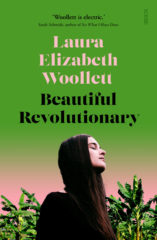 Beautiful Revolutionary
by Laura Elizabeth Woollett
Scribe
ISBN: 978192573039
Reviewed by ELLA JEFFERY
Laura Elizabeth Woollett’s first novel, Beautiful Revolutionary, takes the reader into the lives of several members of the Peoples Temple, the socialist church created by the charismatic, manipulative and controlling preacher Jim Jones in California in the 1960s. The novel follows the church’s expansion in America and eventual mass exodus to Guyana where Jones and his devoted followers established a community, named Jonestown, deep in the jungle.
Continue reading for only $5 per month
Subscribe for full access to Mascara Literary Review or login
Gareth Morgan reviews Ashbery Mode Ed by Michael Farrell
 Ashbery Mode
Ed. by Michael Farrell
Tinfish Press
ISBN 9781732928602
Reviewed by GARETH MORGAN
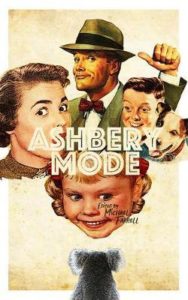
While the term ‘mode’ suggests something computerish, or mode as in moda, fashion, the poems in Ashbery Mode are less ‘coding’ or ‘trying on’ of style, more an absorption inside of a massive body of work. Ashbery’s poetry is a challenge for critics but great nourishment to poets. As the cover suggests, ‘we’ (koala) look up at these American heads, a cruel joke on the idea of Antipodes and perhaps a version of terra nullius from the American perspective. I am reminded of John Forbes’s ‘Antipodean Heads’, which starts: ‘I wish we could be nicer / like the Americans’, how we know so much of them, and keep looking up that way.

On Scars and Flying Horses: Lara Norgaard in Conversation with Linda Christanty
On Scars and Flying Horses:
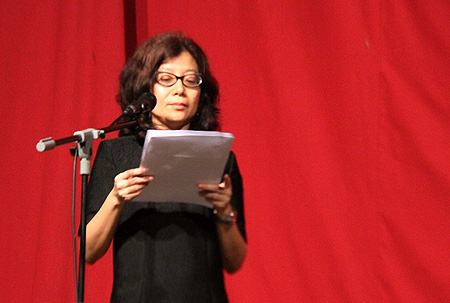 Linda Christanty is an Indonesian author and journalist. Her writing has been recognized by various awards including the national literary award in Indonesia (Khatulistiwa Literary Award 2004 and 2010), award from the Language Center of the Ministry of National Education (2010 and 2013), and The Best Short Stories version by Kompas daily (1989). Her essay “Militarism and Violence in East Timor” won a Human Rights Award for Best Essay in 1998. She has also written script for plays on conflict, disaster and peace transformation in Aceh. It was performed in the World P.E.N Forum (P.E.N Japan and P.E.N International Forum) in Tokyo, Japan (2008). She received the Southeast Asian writers award, S.E.A Write Award, in 2013.
Linda Christanty begins her short story “The Flying House of Maria Pinto” with a seemingly mundane encounter: an Indonesian soldier gets on a train, sits down next to a young woman reading a Stephen King novel, and tells her a story. The story he recounts is that of Maria Pinto:
“Maria Pinto was originally just an ordinary young girl who had once studied literature at a renowned university in Jakarta, and held out until the third semester before returning to the land of oranges and coffee. The people in that land died too early; they disappeared, committed suicide, went mad or plunged into the forest to unite the wild boar and the reindeer.”
Maria Pinto’s people give her ancient weapons and a flying horse, choosing her as their protector and commander.
“As of that moment, Maria Pinto had become the leader of treacherous troops, trapping the enemy in every zone, deterring those who only relied on tangible things; those who shunted aside fairytales and dreams.”
We as readers will not be able to set aside so easily the fairytale aspects of this short story; the soldier’s dreamlike narrative comes to overtake the rest of the plot. The woman on the train tries to ignore the overly chatty soldier, returning to her book until finally arriving at her destination. But after parting, the soldier is tasked with killing the enemy rebel target. He shoots at a figure on the street from a neighboring skyscraper and, when he goes to recover the body, discovers that this rebel is actually woman on the train who had listened to his story. Is the woman from the train the same enemy rebel from the soldier’s tale, Maria Pinto? That question remains unanswered, but what becomes clear is how political conflict finds its articulation in close, personal encounters and everyday stories.
Christanty is an Indonesian author known for approaching social and political issues in her writing. A student activist who participated in the movement that forced Indonesian dictator Suharto from power in 1998, Christanty has long dedicated her life to activism as well as the written word. After Indonesia’s return to democracy, she worked as a journalist and human rights advocate for women’s issues. For her activism, she was nominated for the N-Peace Award in 2012 in the Asia Pacific category and won the Kartini Award in 2014. Meanwhile, her fiction has won a range of national awards as well as Thailand’s prestigious Southeast Asian Writers Award in 2013.
According to the introduction to her collection, Final Party and Other Stories, in which the short story “The Flying Horse of Maria Pinto” was published in Debra Yatim’s English translation, “[Christanty’s] political activism is reflected in her prose . . . It is as if she feels the need to tell these things in order for us not to forget, and also maybe not to flinch when facing the demons of history.”
“The Flying Horse of Maria Pinto” is no exception. Though more implicit than her other stories in its political content, this narrative encodes questions of military violence and resistance. In fact, it is the inclusion of a second narrative plane–the mythical tale integrated into the direct encounter between the representative of the state (the soldier) and the representative of resistance (the woman)–that comes to command our attention and the progression of events itself. Indeed, the soldier’s story could be understood as a meta-narrative that reveals how this figure understands his own pursuit of this so-called “enemy.” The fascinating quality of “The Flying Horse of Maria Pinto,” and of Linda Christanty’s fiction more generally, lies not in literal depictions of conflict, but rather in the socially constructed narratives of conflict she interrogates through multiple layers of storytelling.
I spoke with Linda Christanty in Jakarta in 2019 as part of a series of interviews with contemporary Indonesian writers who represent Suharto’s New Order dictatorship in their work. The project is an effort to understand how authors construct counter-histories about an authoritarian past that the Indonesian state refuses to recognize for its brutality. As a U.S. American, I recognize the role my country played in supporting the anti-communist Suharto regime and turning a blind eye to the gross violations of human rights that took place. This traumatic past is not bounded by Indonesia’s nation-state boundaries; it is a history that incorporates global actors and that remains relevant beyond Indonesia. For foreigners, exploring how Indonesian writers revise and reconstruct narratives of the past can be a way to revisit questions of post-colonial, transnational leftism, which found its initial articulation through the 1955 Asia-Africa Conference in Bandung before the Suharto era ruptured bourgeoning international solidarity between recently independent nations.
Christanty is well positioned to reflect on politically committed writing in Indonesia, both in terms of her role in her generation and independently, as an author. As a key figure in a literary movement that used words first for liberation against an authoritarian regime and then for the project of reckoning with that authoritarian past, Christanty has witnessed marked shifts in Indonesia’s literary scene. And, in her own short fiction, the question of how characters invent narratives to understand their own experiences of social upheaval remains central, whether in “The Wild-cherry Tree,” where we find ourselves immersed in the imaginative perspective of a young girl processing assault, or in “The Final Party,” where an informant who sent friends to prison copes with his choices while arranging his birthday party.
When Linda joined me in a bustling café in central Jakarta, we spoke about free expression under dictatorship, continuities in violence, literary categories, and the Western gaze on socially committed Southeast Asian fiction. Much in the line of “The Flying Horse of Maria Pinto,” the question that spanned each topic was narrative itself, and how the language we use to tell stories frames history.
*
Lara Norgaard (LN): The memory of Suharto’s New Order dictatorship is a near-constant feature of your short fiction. Almost all of your short stories in the English-language collection Final Party and Other Stories relate in some way to that period’s violence, though sometimes that connection is not immediately apparent. Some of the moments that I found especially interesting are ones in which this history is implied in language rather than made explicit. For example, in “The Final Party,” when a man who had worked as a state informant recounts how he explained his job to his daughter for her school project:
“One day, little Alma asked about his work.
‘What do you actually do, Papa?’
‘I’m a note-maker.’
‘Note-maker?’ Little Alma laughed.
‘Yes,’ he answered firmly.
But in his daughter’s report book, he wrote down: entrepreneur.”
On a level of language, how would you say Indonesian either contains the memory of Suharto-era state violence or actually obscures the history of that period?
Linda Christanty (LC): There are a few expressions that people would use in the Suharto era, and especially language used by Suharto’s government. For example, most people, including any member of the military or the police, would very rarely say, “that person was arrested” or “that person was taken to prison.” Instead, they would usually use the phrase, orang itu diamankan – “that person was secured.” As all of us who were alive in that era, secured means that someone was arrested. It immediately had that connotation, conjuring up an image of someone who confronted the state apparatus and had to be “secured.”
It was also unusual, or taboo, to use the word buruh in the Suharto era. Worker, working class, labor. The government preferred that people use the word – employee – so that power relations would disappear. As a result, there wouldn’t be any apparent power dynamic between higher-ups and subordinates, bosses and workers, or in fact any oppressive relationship at all. That’s because the term karyawan in Indonesian relates to the term berkarya, someone who creates, someone who says something in the world. Buruh, on the other hand, means laborer, someone who only has the power to work. That person does not have authority over anything else; for example, they do not control the means of production. In that sense, when we use the word labor, it means resistance, because it means that oppression is present. When Suharto was in power, if a person used the word buruh it meant that they were also radical. Buruh is a word that collects or contains radical social movements and a long history of struggle. That was erased. So you would use more neutral terms: karyawan, which means employee, and kerja, which means work or job.
Then there’s one more example from when I was little. One day, I was talking to my grandfather in our house on Bangka Island. A man passed by out front, the father of a friend of mine from elementary school. My grandfather told me that this person, my friend’s father, wouldn’t ever be able work again at his company because he was terlibat – involved. In the Indonesian of Suharto’s New Order, the word terlibat always connoted being involved with the Indonesian Communist Party. ‘That person was involved,’ and people immediately or automatically knew that they had connections to communism.
There were so many euphemisms back then, you would hear the word terlibat and diamankan, and then the word buruh was erased, it never appeared.
LN: After the Reformasi period in 1998, when Suharto was removed from power and Indonesia returned to democracy, did these euphemisms continue?
LC: When Reformasi took place, or even before Reformasi when social movements were growing stronger and labor strikes and student actions were more and more frequent, people did start using the term labor, buruh, again. For example, when they would talk about labor or factory movements. And progressive students, the ones concerned about labor, would also use the term. Indeed the intellectuals at the time became a kind of driving force for change, recuperating this language that had been banned.
LN: For you, specifically, how has this influenced your writing?
LC: I started writing fiction when the New Order regime was still in power. Back then, if you wanted to write something or send a short story to print media, like a newspaper, the government had established rules. You couldn’t break the rules, so your story couldn’t contain any elements related to politics, religion, race, or anything that was seen as going against Indonesian society. The point is, you couldn’t have critical thought in your stories. But you could package it with something other than what you meant.
In fact, in the early 1990s I was writing fiction and news stories about the lives of marginalized peoples. And I also wrote stories about factory life. Usually, I wouldn’t write those for mainstream media, but instead for student magazines. At the University of Indonesia, which was my university, and also at other schools in Solo or Yogya, a subset of the student body was involved in the student movement. And some students who were quite forward-thinking, brave, and critical would publish work more freely, allowing people to write relatively unfettered by censorship, at least in comparison to mainstream media.
LN: In an interview with the online publication Arsip Publik, you stated that you don’t like the term “Reformasi literature.”1 I see your argument that this label makes it seem as though no one was openly writing critical texts before the transition to democracy took place. At the same time, I imagine that the experience of writing was indeed different before, during, and after the transition from authoritarianism to democracy.
If you don’t like the term “Reformasi literature,” how would you reframe shifts in the Indonesian literary world since the early 1990s?
LC: There are differences, of course, especially in what I was telling you about how certain words changed in their use. I still remember how, before Reformasi, right around 1997, we would usually use the term wanita (lady) when talking about perempuan (woman). The word for lady was seen as carrying more respect than the word for woman, as though the term perempuan had a certain negative connotation. But then, the Indonesian women’s movement was active at that time, and I still remember how in one issue of the magazine Kalyanamitra, they began to use the word perempuan to bring awareness to readers, to define the concept of perempuan and how it could in fact be emancipatory. The word perempuan, or woman, has something that could be understood as equality, a kind of strength. And so they began to use that term.
Writing under Suharto’s New Order is like what I already described. If you wrote for mainstream media, you would worry that they wouldn’t publish certain things. That wasn’t just about specific terms but also about certain topics. For example, it would of course be difficult to write realistic stories about Timor-Leste or disappearances. So writers like Seno Gumira Ajidarma, when he wrote about Timor-Leste, had to make the incident occur somewhere else, and make the characters from somewhere else so readers could maybe imagine this had happened in Latin America, for example.
I felt some of that myself, but I usually sent my stories to student publications because I wrote critically and said what I thought without allowing sensors to limit my work.
For literature after Reformasi, what’s actually very interesting is how varied the subject matter became. So many authors chose to write openly about their bodies after Reformasi. In the period before Reformasi, women were not free to write about their bodies. There are some personal aspects to that, but it also relates to how women’s bodies were associated with the leftist women’s organization Gerwani. During the Lubang Buaya incident2, these women allegedly danced naked and cut off the generals’ genitals. So, women’s bodies under the New Order regime were always associated with something evil, something immoral, something violent. And as a result, women could not easily speak openly about sex or sexuality.
But men could write exotic stories under New Order regime. No woman writer could so easily discuss the sorts of things that men wrote when they described women’s bodies or sex so openly. While men wouldn’t get any social pushback, women felt like it might be incriminating if they wrote about the same things. So, later, Reformasi was also marked by the appearance of novels that were more explicit because women were free to talk about their bodies, to write about eroticism and other aspects of their own experiences.
Of course, it was also during Reformasi that stories from the Suharto era—stories that people had been too afraid to talk about– started to be told. That includes political issues, injustices, and human rights violations that people hadn’t been brave enough to discuss.
LN: How about in the present?
LC: Actually, these problems from the New Order continue today. That includes, for example, human rights violations and gendered violence, which have continued since the New Order. Over the course of 50 years, not much has changed. Take women’s issues. Rates of sexual assault are still very high, violence is still very common. In 2019, the National Commission on Violence Against Women (Komnas Perempuan) published a report3 stating that violence against women increased by 14% from 2018. It’s unclear if that’s actually because there are more victims or because survivors are more and more likely to come forward, but regardless, the rates are high and the numbers haven’t dropped. Now, in terms of human rights violations or the criminalization of environmental activism, those are things that happened during the New Order and that still happen today.
Today, when people defend their land, or defend land that companies want to seize from communities, or when they defend the environment and try to prevent heavy metals from destroying rivers and fish, that’s considered a political act. That’s taking a stand, not just against companies, but also against a sector of the elite within our government. During the Suharto era, a political act was understood only as speaking out against the state and the military. Now, activists who don’t want companies on their land are also taking a stance against the state. Environmental issues are very crucial, on the same level as other human rights issues.
I see myself, along with Leila Chudori and Ayu Utami, as writers who grew up under the New Order and who were already in our twenties when Reformasi began. So we were born into that regime and lived under it through our early adult lives. That means our way of thinking, our memory, is very tied to that period. We are motivated to write about things like the 1965 Tragedy4 because that period, or stories about that period, are so strong in our memories. We write about what took place a bit later on, too, like activism under Suharto. That’s a common narrative in our lived experience. When we write about these topics, we’re also writing as witnesses, or maybe as people who grew up hearing these stories, as people who knew about or who may have been affected by the disappearances.
After us, there is a group that is far more distant from these stories. For some, their writing does touch on themes from our generation. But a different group has already moved on to write about other topics, which are not any less interesting but that also don’t necessarily depict authoritarian regimes or imagined dystopias.
For instance, Ziggy Zezsyazeoviennazabrizkie is one writer from the current generation that’s very interesting, in my opinion. She writes about a completely different world, and politics come through in her selection of symbols. Her novel, Semua Ikan di Langit (All Fish in the Sky) really impressed me. It takes place in a huge trash heap. Her main character is the corpse of a little boy. Her other characters are a cockroach and some fish, and they all ride together in a broken city bus that had been dumped in the trash heap. It turns out that the corpse becomes a certain kind of god or idol for these strange creatures. So the bus is flying along in this universe of trash, and one day it stops and a little girl gets on. The girl, who is actually the boy’s sister, is a Holocaust survivor. In this sense, Zezsyazeoviennazabrizkie writes about an event from the past, but her approach is very different from the one that my generation takes when we talk about similar topics.
LN: I’d like to hear more about your own approach. You’re a journalist as well as an author of fiction, and a lot of your stories have direct connections to real political issues. Your writing is far less surreal than Zezsyazeoviennazabrizkie’s, for example. When you write fiction, are your stories grounded in the kinds of events you yourself witnessed or in reportage about specific events?
LC: Well, let’s look at one of my stories, “Fourth Grave”. It’s about a young girl who is disappeared. Actually, I never say that she is based on someone real because she and her family are not real at all. In the story, there is an old married couple of Chinese descent, and their daughter is involved in politics. Up to this point, it’s all fiction. But were the disappearances real? Yes, they were. So I imagined a situation in which the daughter is kidnapped, like what happened to so many people who really were disappeared.
The story is about what I don’t know, like how a family would react if their child is disappeared. How does that affect the relationship between husband and wife? How do they remember their daughter? What is most painful in day-to-day life? It turns out what hurts are the little things, like when the wife wants to cook fish, but then all of sudden the husband says, don’t, our daughter might have been thrown in the sea. Memories arise, and they imagine what it might be like if their daughter had ended up in the ocean and then was eaten by a shark. And then they saw the fish in a totally different light, and they can’t eat it again.
LN: There are readers who say your stories are very sad.
LC: That’s true.
LN: I agree that they’re dark, but at the same time you include some whimsical elements. “Fourth Grave” actually has a lot of fantastical references to comics like Kho Ping Hoo, and “The Flying Horse of Maria Pinto” involves a supernatural flying horse, for instance. Could you comment on these dimensions of your work that are less realistic? What role does whimsy and fantasy play in political storytelling for you?
LC: Perhaps these elements, which many people would label magical or fantastical, are actually very everyday aspects of Southeast Asian societies. People believe that in addition to what we see in this dimension, there are also creatures alive in a different dimension. In belief systems or cultures around Southeast Asia, these elements are understood as ghosts or creatures on the threshold.
For example, where I was born on Bangka Island, people believe in 20 different kinds of ghosts. There’s a ghost that appears just as a head, for instance, called Anton, like the name for a little boy. Another one is called Hantu Burung Kuak, or Kuak Ghost Bird. If that one releases a specific kind of noise, it means something bad will happen. The ghost Menjadin can tear people apart. Aside from those, there are ghosts from Java that are pretty well known, like Kuntilanak, which is also called Pontianak in areas near Kalimantan. That means that in Malaysia, it’s also not uncommon to also hear about a ghost called Pontianak. Then there’s a snake ghost named Paul, like a white man. And there’s one called Mawang, too.
People who live on Bangka Island, in Sumatra, and even in the eastern islands of Indonesia, like Maluku or the Nusantara region, they take it for granted that these creatures are a part of their everyday lives. So when someone writes a story set in a society like ours, non-human characters are just normal. They aren’t strange. They just describe what’s going on in that other dimension.
When I wrote “The Flying Horse of Maria Pinto”, for instance, it was inspired by a trip I took by train. It was just one very brief moment. While I was in the train, I met a soldier. And during the New Order I really didn’t like soldiers, you know. I thought, oh no, a soldier is sitting next to me, how should I act? This was maybe five years before the New Order ended. Since I didn’t want to talk to him, I started reading some novel, I don’t remember which one.
That soldier wouldn’t stop talking to me, and then I noticed that he had a scar. From there, I started to imagine what I would end up writing in the short story.
NOTES
1. Sastra Reformasi, or Reformasi literature, is a term used in Indonesian literature to refer to an outpouring of openly critical literary production in the wake of the country’s transition from authoritarianism to democracy in 1998. Linda Christanty’s argument as to how this literary category obscures the tradition of critical writing before Suharto’s fall from power can be found in her interview with Arsip Publik: http://arsippublik.blogspot.com/2015/01/wawancara-linda-christanty-2.html.
2. Lubang Buaya is an area on the outskirts of Jakarta where seven Indonesian generals were murdered in 1965 in an incident that came to be known as the 30 of September Movement. The incident became the justification for Suharto’s military coup d’état and the ensuing mass killings, imprisonment, and persecution of members of the Indonesian Communist Party (PKI) and affiliate organizations (including the Indonesian Women’s Movement (Gerwani) and the Institute for the People’s Culture (Lekra)), as well as people with any perceived connection to the aforementioned groups. For more information on Lubang Buaya and its role in the foundational myth of Suharto’s authoritarian regime, see John Roosa’s Pretext for Mass Murder: The September 30th Movement and Suharto’s Coup d’État in Indonesia (https://uwpress.wisc.edu/books/3938.htm).
3. The full annual report can be accessed online here: https://www.komnasperempuan.go.id/read-news-siaran-pers-catatan-tahunan-catahu-komnas-perempuan-2019%20.
4.The 1965 Tragedy refers to the mass killings of 1965-1966 that took place in the wake of Suharto’s coup d’état. Estimates on the number killed range from 500,000 to three million people, and researchers have made the argument that the killings should be considered genocide. For more, see The Killing Season: A History of the Indonesian Massacres by Geoffrey Robinson
and The Army and the Indonesian Genocide: Mechanics of Mass Murder by Jess Melvin (https://www.theguardian.com/books/2018/mar/15/killing-season-geoffrey-robinson-army-indonesian-genocide-jess-melvinreviews).
This interview, translated from the Indonesian by Lara Norgaard, was edited and condensed for clarity.
 Lara Norgaard is an editor, essayist, and literary translator from Colorado. After graduating from Princeton University in 2017, she served as Editor-at-Large for Brazil for Asymptote Journal and directed Artememoria, a free-access arts magazine focused on the memory of Brazil’s civil-military dictatorship. Her essays, literary criticism, and translations can be found in publications such as the Mekong Review, the Jakarta Post, Asymtptoe Journal, Peixe-elétrico, and Agência Pública. Currently, she is a Henry Luce Foundation Scholar at the Lontar Foundation in Jakarta, Indonesia and will begin her Ph.D. in comparative literature at Harvard University in September 2020.
Us Boys Made of Smoke by Scott-Patrick Mitchell
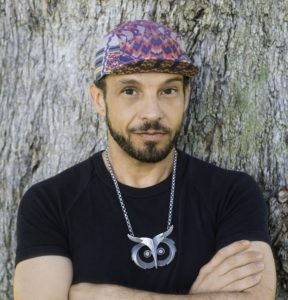 Scott-Patrick Mitchell (SPM) is a non-binary West Australian poet, writer and spoken word artist. SPM’s work appears in Contemporary Australian Poetry, The Fremantle Press Anthology of Western Australian Poetry, Solid Air, Stories of Perth and Going Postal. In 2015, SPM performed THE 24 HOUR PERFORMANCE POEM… which was exactly as it sounds. A mentor to many emerging West Australian poets and recipient of a 2019 KSP Writers Centre First Draft Fellowship, SPM is the coordinator for WA Poets Inc’s Emerging Poets Program.
Us Boys Made of Smoke
When we first kiss, I taste tobacco on your lips: rum-soaked ash, calling. For an ex-smoker, this kiss is dangerous. You are dangerous. But the sandpaper stubble of your chin smooths out the edges of my concerns. I sink into your tongue, lick the inside of my mouth. You turn my breath to smoke.
– Do you want a cigarette?
You ask this question after two months of dating. Two months of nicotine craving. These cravings are just as bad as the ones I have for you, for your kiss, for your nakedness heaving into my skin, into me.
– Yeah… ok. But you’re gonna have to roll it…
In time I learn your perfection of rolling a cigarette with hands too small to hold the volume of my lungs. My rollies are crooked, jagging yellow stains across the interior of the middle and index fingers. They are too tight at the tip, too loose at the base. The butts keep sticking to my lips. They aren’t as smooth as yours.
Like our cigarettes, we too are opposites. You: lithe slender man made of smoke, hair a caramel curl cupping collarbones, eyes so blue I am convinced you have stolen them from a work of art, or some long dead god. Me: scrappy, short, shoulders too broad, black stubble chin matching the buzz cut blackening my crown, eyes dark like a forest of hazel trees, squinting out the sun.
In bed, we are opposites again. My hands are confident. They turn your body into rollie papers succumbing to spit. Your hands have a nervous shake, as if desperate to light up, fumbling with how to keep a match aflame. My body is a flammable material so unfamiliar to you that it takes three months for you to learn how exactly to make me burn. I discover your trigger points in a matter of days, reduce you to sizzle. Then, embers.
Balance comes when you finally take the time to teach me how to roll a cigarette properly. In exchange, I show you the points on my body that ignite under tongue. We learn how to cup our physicality into the other. We are not spoons: we are the whole damn cutlery drawer. How we knife, fork, ladle love. Two cooks, our bed a broth. Smoking after sex.
– What do you mean you don’t know how to cook? you say, surprised at how barren my fridge is.
– I… just never learnt.
– So what do you eat?
– Take out. Cereal. Toast.
You try to teach me recipes you know, but all I learn is that meals are just a precursor to having another cigarette.
– You smoke too much, you say.
I just cough.
Somewhere, in the tendrils between us, an image settles into our lungs: black, sticky, uncomfortable. I want to jab a cigarette into our conversations, burn the skin of our speech, say you brought these back to me. But instead, I just exhale another plume into the room. The furniture is beginning to stink.
Outside of this house, smoking is more illicit, unacceptable. The bars in our town have gotten rid of designated smoking areas, so we smoke out on the street. We smoke in places less safe, more dangerous. Out the front of the bar on James Street is where it happens.
-Ya got a smoke?
The guy asking? He is trouble. Mr I’m-so-sketchy. Mr I-haven’t-had-a-decent-night-sleep-in-a-fortnight kinda trouble. His friend is all hollow cheekbones, rat-tail eyes skittering the sidewalk, looking for cigarette butts, opportunity.
These are the type of boys who would return home, hands blackened with ash, clothes stung with arson, only to tell their mother that no, they have no idea who started the bushfire over at the next farm.
You hand them your pouch of tobacco.
– Yeah thanks…!
The guys laugh. They begin to walk away, your pouch of tobacco in hand, their grins sinister, mocking. The f word is hurled from both their mouths – Molotov cocktails hitting piled sticks – jeered and jeered again at us. Scrappy flames flick up my skin. Anger kindles inside me.
– Oi, give it back! I yell, stomping toward them.
– Or what?! The one holding your pouch snarls, squaring up. What ya gonna do, you fucking faggot!?!
More slurs burn up from their throats – pooftas, cocksuckers, AIDS junkies – and are hurled at us. I allow myself to combust. You see, the rage is always there. Part of you learns to live a moment away from being lit up. These bigots just open the door, allow the fireball to come through, glorious. Consumptive.
I reach for your tobacco pouch. Their ashen hands push me back. I mimic their movement, push the ringleader, hard, then his mate, harder. The fire in their faces is furious. I don’t see their fists swing toward me. But I feel them. I hear them. Blood fills my mouth as my nose cracks. I spit the fluid out, not realising I’m spraying these thugs with my blood. They almost wail, beseech. More fists come.
I take them. Do not buckle.
You don’t come to pull me away. You don’t even shout out in protest. You just shrink inside yourself. Something extinguishes inside of me.
Encroaching sirens scare them off. They scuttle, scurry, run. Like rats. Like vermin.
This is when I buckle, slump to my knees. I can feel all eight punches. You rush toward me, but the blood covering my face, my clothes, it halts you, as though you’ve been conditioned to fear the very thing that makes us pump. Not even your hand reaches out to calm me.
I begin to sob.
The police arrive a minute later. You kneel beside me, put an arm around my shoulder. There is no comfort in this.
In the days that follow, I learn that bruises heal but a broken nose is for life. Especially if you’re on welfare. I flinch under your touch. You don’t meet my gaze. I jump when you enter the room. My anger, undiminished, makes me pull inside myself for warmth. One night, drunk, I extinguish a cigarette on myself while you watch.
– What the…!? You exclaim, panicking, slapping my hand away from doing myself harm.
I just grin. I want you to hit me, again.
In the days that follow, I purposefully antagonise you. You make excuses to stay away, stay at yours, stay on the other end of chat and telephone. You take longer and longer to respond. Our love turns to smoke.
I throw out my cigarettes, my ashtrays, all the paraphernalia of flame you helped me bring back into my life. The burn mark turns to scar. My broken nose becomes familiar. Everything we have created together is unlearned.
The cops never catch those two thugs.
Gabriela Bourke reviews Milk Teeth by Rae White
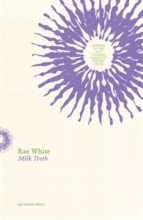 Milk Teeth
by Rae White
ISBN: 978 0 7022 6016 2
Reviewed by GABRIELA BOURKE
Rae White might be categorised as emerging, but their success as a poet is established. Winner of the 2017 Thomas Shapcott Poetry Prize, shortlisted for the 2019 Victorian Premier’s Prize for Poetry, placing second in the Judith Wright Poetry Prize for their poem ‘what even r u?’ and reviewed favourably in Westerly and Books and Publishing among many others, White’s reputation as a poet continues to ascend.
White’s first poetry collection Milk Teeth has been described as ‘an assured and original debut from a powerful new voice in Australian poetry’ (Culver, 2018). It’s interesting to me that White has chosen to precede their collection with a few lines from another poem, Alex Gallagher’s ‘vague body’, an excerpt which concludes ‘I’m tired of being broken by language/when it is the only safe place I’ve ever known.’ (Gallagher, 2017). This reference situates White’s collection in a tradition of non-binary poetry and at the same time indicates a preoccupation of the collection: that is, the way in which language fails to authentically represent transgender people. These lines provide a lens through which we can begin to approach White’s own poetry, which reconfigures modes of representation by offering an always-vivid, sometimes confronting series of poems which may cause discomfort, but in doing so deftly blast apart cisnormative understandings of gender and identity.
The first of White’s poems, ‘Mother’s Milk’, narrates a person taking a baby tooth from a box under a bed and eating it. The relish with which the tooth is stolen and the rapture with which it is swallowed is viscerally discomforting. ‘I roll it leisurely/with tongue, let it clink/like ice cubes in empty/glass. I swallow/feel it scrape & chafe/lodge in my throat.’ (3). The tooth then sets up residence in the narrator’s throat, resulting in ‘crackle quartz jutting from my neck./It glimmers & hums, my beautiful/crystalline baby/the only jewellery/I’ll ever wear.’ (4) This bodily transformation elicits a pain response from the reader as the molar scrapes and chafes and lodges, whereas the way in which the tooth takes up residence in not just a foreign place, the throat, but a foreign body altogether poses a challenge to the reader. Are we to assume the eating of the molar is a signifier for something else? Or did the narrator really eat the tooth? What does it mean, to eat the tooth? The slippage between the signifier and the signified – the tooth, signifying what – invites a poststructuralist reading for later poems, and decentres the role of language in delineating meaning. White takes a medium with which we are familiar, perhaps with which we even consider ourselves expert, and starts using it in a way unknown to us. In this way we have to be open to learning the language of the poet, to being open to understanding the language as they intend it, rather than as we have known it to be.
The next poem, ‘ambulance symptoms’, offers a brief reprieve with the soothing assonance of the first stanza: ‘july was flushed with winter/ promise: white water breezes/ & steeples of rain.’(5) Closer examination though reveals again that tendency toward brutal imagery: ‘my scarf/was a suspect in your/strangling.’ (5) In ‘Sabbatical’, the narrator of the poem goes fishing and, after hours of waiting, reels in the ‘putrid remains’ of a dead cat, ‘clumps of purple/fur clinging to pitted flesh. She’s not good/for eating.’(16) These poems assail the reader with the grotesque, in the form of violent death, rotting animal bodies or the consumption (or consideration of consumption) of something considered non-consumable. ‘Sabbatical’ concludes with the cat nudged back into the water with ‘…the toe of my pumps… (16); ‘go and gone follows’, concluding so similarly as to be almost identical, as the narrator encounters the dead body of a cormorant and uses the toe of their trainer to push the body into a lake (17). In an interview for Messenger’s Booker, White says, ‘I try to bring … conflicting duality … to my work: to engage the reader through casually unsettling their expectations, asking the reader why they might find something unsettling and why.’ (Messenger’s Booker, 2018)
We are unsettled by the unusual, by the taboo, by people, places and things with whom or which we are not familiar. The sequencing of White’s collection means that by the time we reach poems that are explicit in their commentary on the everyday life and struggles of a non-binary person, we can proceed with an openness, or perhaps willingness that we may have lacked upon first picking up the book. The poem ‘hook-up’ is forthright, unambiguous and unashamed.
picture us spooning
tangled entrails
dripping stink and
spittle. And six
months from now:
my vulva warm
untouched, my mouth dank and tacky. Your musty shirt
puckered on my floor.
In an article for The Guardian, Cat Fitzpatrick said
‘[Works by non-binary authors] go beyond the clichéd trans narrative which cisgender network executives and publishers have decided that “general audiences” want. As a result, they have much more to say, not just to trans people, but to everyone. They tell richer and stranger stories, ask deeper questions about gender, identity and injustice, and are written with the kind of brio, inventiveness and excitement that comes from desperately needing to say the things they are finally finding a way to write down.’ (Fitzpatrick, 2015)
The strangeness and inventiveness of White’s poems build and transform as the reader continues through the journey of the collection, so that by the final poem, ‘Feed your friends’, the funeral wake described opens itself to a range of interpretations, from the literal to the figurative.
It’s always reassuring to see a millennial writer achieving the kind of success White is currently enjoying, in the culture of funding cuts and the disparagement of creativity in which we now find ourselves. White’s poetry is fresh and defiant, and underlines the importance of writing and publishing in returning the space to communities who have previously been silenced.
Citation
1. Alison Gallagher, Parenthetical Bodies Subbed In, 2017
2. Tony Messenger interviews Rae White https://messybooker.wordpress.com/2018/09/17/milk-teeth-rae-white-plus-bonus-poet-interview/
3. Cat Fitzpatrick, ‘Beyond the cliches: how the trans poetry community is finding its voice’ The Guardian, 25 November, 2015. https://www.theguardian.com/books/2015/nov/25/trans-poetry-community-literature-writers (Accessed 14 February 2020)
GABRIELA BOURKE is a doctoral candidate at the University of Sydney. Gabriela is most interested in fictional representations of animal and human trauma, and the ways in which these intersect. Her work appears in Hermes and Southerly.
Paul Giffard-Foret reviews My Van Gogh by Chandani Lokuge
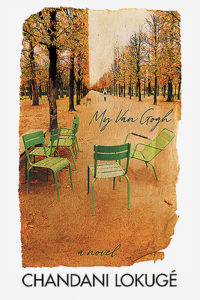 My Van Gogh
By Chandani Lokugé
Arden (2019)
ISBN 978-1-925984-17-0
by Paul Giffard-Foret
Chandani Lokugé’s fifth novel My Van Gogh takes the reader on a romantic and artistic journey across borders, from the rural farming lands of Victoria in Australia, where part of her characters’ family on their father’s side is from, to some of France’s touristic hotspots, including scenic areas of Le Loire Valley, the southeast region of Provence, or its capital city Paris. The metropolitan provenance of the novel is made evident by the design of the book cover. It shows a snapshot of what is reminiscent of the Tuileries Garden, which is located in the vicinity of Le Louvre Museum. This is despite the fact that Lokugé actually writes from the periphery of what constitutes her Sri Lankan Australian background. The terms of “periphery” and “metropolitan” are used here with a postcolonial agenda in mind, to refer to the ways in which the old structures of Empire and European colonialism still play out in our contemporary era. Lokugé is aware of such lingering structures insofar as her oeuvre as a novelist may easily fall under the loose category of “postcolonial fiction”. As an illustration, Lokugé’s second novel Turtle Nest, published in 2003, dealt with the issue of sex tourism and trafficking of local children for Western customers in a small fishing village in Sri Lanka.
We may wonder, then, what postcolonial elements there are in a novel in which the main characters are white and relatively privileged —symbolically at least, being endowed with cultural capital—and where a driving theme is the artistic legacy left by one of the most iconic Western painters and representatives of High Culture, namely Van Gogh? To revert to my earlier allusion to Turtle Nest, this novel shares with My Van Gogh a common concern with travel (and tourism) that itself recurs as a distinct motif in diasporic literatures of dispersal by migrant authors. Yet this time, the gaze happens to be reversed, for My Van Gogh, as its title suggests, does not so much speak of the master painter’s life as it heralds its appropriation by the margins. My Van Gogh’s central Australian-born character, Shannon, sets out on a quest for meaning by travelling to France in very much the same way that the West would journey to the Orient and the Far East in the hope of being “revealed” by the sheer Sublime of the place, by its spirituality, its history, art and craft. The tourist’s gaze operates a process of “museumification” which not only sublimates the real, as Jennifer Straus spelled out during her speech at Lokugé’s book launch, but it also flattens things out by silencing “accidents” of history.
So it is to Lokugé’s credit that the rippling echoes of those series of murderous terrorist attacks which have struck France since 2015 can be felt. These attacks carry along their trail of death haunting memories of a colonial era thought to have been long gone, since the last major terrorist attacks on French soil took place in the context of Algeria’s War of Independence and Algeria’s Civil War in the 1990s. The blight of terror is another common point with Lokugé’s homeland, Sri Lanka. As Shannon and Guy are walking along the promenade in Nice on Bastille Day, they must bear witness to “a ceremony to commemorate the lives lost” (55) on that very same spot and day in 2016, killing eighty-three. Shannon’s prolonged sojourn in France is meant as a way for him to reconnect with his French mother and brother Guy, both of whom are “exiled” in France away from the family farm in Australia, as well as with his great-grandfather Grand Pierre, who fought and died a hero during the Great War of 1914-1918. Yet their mother remains an “absent presence” throughout the novel, having cut off links with her family, while Guy, being now well established in his adopted country, and having started a new life in Paris as an art dealer, feels in some way estranged from Shannon. Grand Pierre’s military heroism, which is very much part of the family’s lore, gets somewhat dampened and overshadowed by the fact that his body remains are yet to be exhumed and identified after all these years.
Their scattering evokes the scattering, more broadly, of family relationships, friends and lovers, and in the final instance, of identity markers themselves, which is an aspect of our postmodern “liquid” selves that transpires in Lokugé’s novel. Put simply, identity relates to people and places, but the latter in My Van Gogh remain loosely connected and grounded. Lokugé highlights her characters’ difficulties to communicate with, and feel for, one another. Her characters, indeed, seem enveloped within a Hopperesque halo of solitude, like a carapace preventing them from facing and sharing with others those vagaries of life that otherwise fill the void of our existence. In this light, Lokugé’s choice of a happy ending sounds like a trompe l’oeil, especially with respect to the book cover. It shows empty chairs lying stranded and looking abandoned, and an individual’s silhouette walking away into the distance towards a vanishing point, being flanked on both sides by rows of tall, erect, autumnal trees. This image intimates that one’s personal journey is a lonely trail, as it must have been for the tormented, maddened Van Gogh.
In effect, the many touristic sites and scenic places (including Van Gogh’s temporary home in Arles), as well as churches and museums, though they are in part aimed at recalling her mother’s presence, all seem but a poor distraction and lack substance in the face of Shannon’s own pill-dependent depressive state. We are told that “for Shannon, also, it had become ordinary, a boring show staged for self-indulgent tourists. That quiet desperation, that unconscious despair that is concealed under the amusements of mankind, Shannon reflected, recalling the words of Thoreau.” (54) I am here reminded of award-winning French author Michel Houellebecq’s dystopian portrayal of France as a theme park for foreign visitors and local tourists in his novel, The Map and the Territory, whereby largely uninhabited town centres have been transformed into standardised temples of consumption and sanitised variations of the picturesque. As a review of the novel published in the New York Times concurred, “Houellebecq’s Paris exists in a state of flagrant social breakdown and the countryside has become an emptied theme park of itself.”
The parallel with Lokugé’s work can be further made here, since both authors have shown a deep, continuous interest in tourism as a powerful metaphor for our globalised era. As the New York Times review added, The Map and the Territory “deals with art and architecture, rather than sex tourism. It is set in galleries and villages rather than S-M clubs and massage parlors.” My Van Gogh similarly deals with the art market as a global form of currency. As earlier mentioned, Guy is a gallerist, and Shannon a student in art history. Shannon’s girlfriend Lilou, besides being a tour guide, is a musician and a painter herself, while Guy’s French lover Julie graduated in Fine Arts. Furthermore, the novel is peopled by references to mythical figures such as Proust, Beckett, Hemingway or Matisse, who at some point lived and worked in France, at a time—at least until World War Two— when Paris happened to be the world’s artistic hub and would attract artists from different nationalities, including Van Gogh himself. So at some point in the novel, Shannon for example goes to visit the southeastern village of Saint-Rémy-de-Provence, where Van Gogh was interned in an asylum for a year there, and where he achieved some of his most famous paintings.
In the same way that Houellebecq is, Lokugé is further concerned in her novel with those children belonging to the post-soixantehuitard (sixty-eight) generation, as they are dubbed in France, who grew up in the wake of the May 1968 Revolution. The upheaval, mostly student-led, entailed among other things a radical dismantling of the traditional family. Lilou, whom Shannon met during his meanderings across France, for instance is said to have parents who lived “wayward, hashish-filled lives—with a tribe somewhere in the Himalayas from what she’d seen in Facebook months ago.” (120) As Shannon tells her: “We are a lost generation—une génération perdue.” (121) This historical allusion to the devastation wrought by the Great War upon the youth in particular points to the existence of a crisis of a spiritual, metaphysical and civilisational nature at the heart of Western, and more specifically, French contemporary society, as Houellebecq himself exposed in The Map and the Territory, which won the Prix Goncourt (the equivalent of the Booker Prize) in 2010. This crisis would ripen to a full and explode in the form of the Yellow Vest protests by the end of 2018. The occupation of roundabouts by Yellow Vests across the French territory, in particular in deserted rural areas where the movement started, represented a desire to rebuild solidarity and cohesion in the face of a torn social fabric, as well as gain democratic sovereignty through this modern version of the Greek agora. Lokugé in her novel summons the imagery of the carrefour (not the hypermarket chain here, but its semantic meaning of a “crossroad” in French) to poetically express the random contingency and situatedness of cross-cultural love, which, as the reader is led to understand, can be undone as quickly as it can be struck. And this is precisely within the knots of this tension that lies the beauty and dramatic force of Lokugé’s prose. To quote from the novel:
Carrefour…
They lay entangled in each other. Her hand in his, a drowsy bird. The room was almost black, a shadow of light across the bed. He could faintly see her face raised beside his. They hardly knew one another. That was beautiful, he said. Thank you, she whispered. It’s a gift then. Whose voice, whose words? Didn’t matter. They were etched in him, deep inside. He kissed the fold of her elbow. Carrefour—he said—meeting place. He felt the texture—this word so foreign to him. Meeting place, she said, lieu de rencontre. (57)
A carrefour implies a certain level of reciprocity and a readiness to let go of one’s own cultural attributes to meet the Other on neutral, naked grounds. Travel narratives usually make for good romance precisely so because the characters in these narratives stand outside of their comfort zones. Standing outside or in-between cultures as do Guy the expatriate and Shannon the traveller make both brothers more easily vulnerable or susceptible to the possibility of yielding to the unknown of cross-cultural romance. As the French Iranian author, Abnousse Shalmani, reminds us, Guy and Shannon are “métèques” (a word originating from Greek and meaning whoever resides away from home). As such, métèques “do not have buried secrets within the attics of country cottages, no class prejudices, no embarrassment vis-à-vis History, culture, language; he or she has in effect left of this behind. The métèque goes beyond rules, common decency, social order.” (Shalmani 106; my own translation) France’s geography, located at the crossroads between six nations (which is why it is known as the hexagon), spans cultural realities as distinct as Provence’s Mediterranean Sea and the wine routes and forests of Alsace in the east. Alsace is probably the most métèque of all regions considering its historical ties in Germany, where Guy and Shannon’s great-grandfather Grand Pierre was killed. As a former imperial power and neo-colonial player, France has often proved unceremoniously unkind and unwelcoming to its métèques. Notwithstanding, My Van Gogh with its wanderings across some of France’s over-saturated historic sites operates a cosmopolitan itinerary worth following for the reader insofar as this scenic drift becomes a pretext for an inward exploration of the human condition itself.
Works Cited
Shalmani, Abnousse. Éloge du Métèque. Grasset, 2019.
Shulevitz, Judith. “Michel Houellebecq’s Version of the American Thriller.” New York Times, Jan. 13, 2012. <https://www.nytimes.com/2012/01/15/books/review/michel-houellebecqs-version-of-the-american-thriller.html> (Accessed 19 Dec. 2019)
———————
PAUL GIFFARD-FORET completed his Ph.D. on Australian women writers from Southeast Asia at Monash University’s Postcolonial Writing Centre in Melbourne, having completed his MA in Perth on Simone Lazaroo’s fiction. Paul’s research deals with gender studies, racial and cultural hybridity, migration, multiculturalism and related issues with a focus on postcolonial and diasporic Anglophone literatures from Australia, Southeast Asia and India. His academic work has appeared in various journals and magazines in the form of peer-reviewed articles and literary reviews.
Sophie Baggott reviews Rethinking the Victim by Anne Brewster and Sue Kossew
Rethinking the Victim: Gender and Violence in Contemporary Australian Women’s Writing
by Anne Brewster and Sue Kossew
ISBN: 978 1 138 09259 4
Reviewed by SOPHIE BAGGOTT
First of all, I owe readers a disclosure: if this book is an interrogation of power asymmetry and its potential to foster violence, then it’s disquieting that both its authors and reviewer embody a white middle-class lens on experiences largely rooted in less privileged positions across society.
Brewster and Kossew are acutely aware of this imbalance throughout their dense, often illuminating book, which explores writing about violence from women whom they identify as either majoritarian, Indigenous or minoritised. The theorists tussle with the tension between what they perceive as the need to open up a cross-cultural conversation with “radical empathy” and the need to avoid “perpetuat[ing] the invasion”. At several points, they account for their decision to engage with the works of Indigenous and minoritised writers by citing various authors’ own calls for their inclusion in the Australian literary canon. One example is Filipino-Australian writer Merlinda Bobis’s comment during an interview with Mascara Literary Review that her book, Fish-Hair Woman, professes “a reciprocal love between cultures” and her broader comments about the difficulties of “getting through the literary gate” in Australia.
While paying attention to their own embeddedness in power structures, Brewster and Kossew rightly suggest that cultures do not exist in a vacuum – all gender dynamics occur within the systemic inequality that extends worldwide. Global estimates indicate that 1 in 3 women will be subject to violence in her lifetime, and the bleak reality is that one woman is killed by her partner every week in Australia. Despite this horrific universality, representations of violence against women vary significantly. For instance, the theorists point out the “mediatised” way in which Aboriginal family violence is portrayed in the public sphere, with implications that it is distinct and “endemic”. In contrast, they observe the way in which “violence in the white middle-class home has traditionally been exceptionalised, hidden and relegated to the private sphere”, noting this cultural exceptionalism as a reason for broadening the dialogue around gender-based violence.
Here’s another disclosure: this latter observation was one that hit home, so to speak. It took a long time to face up to the fact that my (white middle-class) household was a place of violence, and that I know what it is to be and to see a girl/woman enduring many years of threats and assaults by a boy/man. I also knew, without instruction but through a hazy sense of loyalty and self-preservation, that the topic was absolutely taboo. Much of this book’s analysis therefore delved into familiar territory: a world of precariousness, futile attempts to ‘fix’ perpetrators, and the incremental ways in which women become trapped. Why am I sharing this? I suppose it’s in the book’s spirit of “reject[ing] the fear of stigma, shame and failure that often prevents white middle-class victims from breaking with notions of propriety” (a purpose which the theorists attach to multiple Australian novels) and in response to the appeal for solidarity that runs throughout Rethinking the Victim.
However, as much as Brewster and Kossew state their intentions to create a culture of inclusivity, I have to question why they then isolated Indigenous women’s activist poetry in its own chapter. Perhaps a more interesting and inclusive approach would have been to divide the chapters by the different forms that violence against women can take: physical, sexual, psychological and economic. In my view, this could have been an effective means of highlighting the myriad manifestations of gender-based violence and exposing its pervasive impact across society.
Since Rethinking the Victim forms part of the Routledge Research in Postcolonial Literatures, it is no surprise that both theorists’ research is strongly grounded in contemporary postcolonial literature. This passion comes across emphatically in their literary analysis, and they write extremely persuasively of the intersections between colonisation and violence (particularly in terms of Australia’s “national burial of a suppressed violent past”). I’d argue that this is occasionally to the detriment of the gender analysis – for instance, their seven-page exploration of Paula Abood’s Stories from the Diaspora (2017) is a highly detailed study on race and violence, but barely touches on the aspect of gender.
Furthermore, to the best of my knowledge, the book omits any mention of the gender-based violence meted out to those who are trans or non-binary. According to Transgender Victoria, transgender and gender-diverse people experience physical assault, or threat of physical assault, at a rate of 25% – twelve times the rate of the general population. One example of a fascinating and necessary text that was missed is Australian-American Sarah Krasnostein’s The Trauma Cleaner, which won the Victorian Prize for Literature among other awards. This is a compelling story following the author’s acquaintance, Sandra Pankhurst, a trans woman, throughout her life, which includes chronic violence – from a childhood of domestic abuse to the attacks that she endured in Melbourne’s drag scene and sex industry. It’s a book that interweaves closely with numerous strands of Brewster and Kossew’s analysis, not least of all the unreliability of trauma narratives.
Having said that, Rethinking the Victim is a remarkable feat and, notably, the very first book to examine gender and violence in Australian literature. How can it have taken this long? Towards the end, I admit I found myself wishing it had instead been titled Rethinking Victimhood. As Wiradjuri scholar Jeanine Leane wrote with regard to her family’s women survivors of sexual abuse:
They were indeed victims of something but they’re not perpetual victims––ultimately they were survivors.
While Brewster and Kossew make efforts to unknot the binarisation of victim/agent, instead framing women who endure violence as “agentic bearers of knowledge”, I’d argue that the potential transience (and transformative power) of victimhood could be better signified in the book’s first impressions.
This is an important, intricate book which gathers together a wealth of literary analysis. The breadth of research and the depth of compassion is clear on every page. The astounding fact remains that this is only the first book to study gender violence in Australian literature – and there is much, much more work to be done.
Notes
1. Wadi Wadi writer Barbara Nicholson, ‘Something there is…’ in Reed-Gilbert, K. (ed.) The Strength of Us As Women: Black Women Speak 27-30, 2000, p.28
2. Istanbul Convention
SOPHIE BAGGOTT is a Welsh writer and journalist in the human rights field, currently living in Melbourne and working at the International Women’s Development Agency.
The Making of Issue 24, Class Fetish …
Continue reading for only $5 per month
Subscribe for full access to Mascara Literary Review or login
On being a Working-Class Writer by Sarah Attfield
On Being a Working-Class Writer
How does a working-class girl from the council estate become a poet? And what’s class got to with it anyway? What does it mean to be a working-class writer? Can I still be a working-class writer now that I work in a university? What do working-class writers write about? Answering these questions requires a story.
I became a writer by accident. When I was at school I wanted to be an artist. I loved art – my brother and I were taken to London art galleries quite often when we were growing up. Bus fares were cheap then and the galleries were free. My Dad was always looking for places outside of Walthamstow to take us out at weekends and holidays because my Mum worked night shift and was the breadwinner. Dad was an autodidact – a working-class man who taught himself how to paint and draw. He worked (when he was employed), as a self-employed sign writer and our flat always smelt of paint and turps. Dad died when I was young and Mum was too busy trying to keep us fed and housed, so as soon as I was old enough, I took myself into central London and visited the galleries again.
They became my happy places. At school I studied art, but there was no chance that a kid from the council estate was going to become an artist. So I left school and worked in retail.
I had always been a reader. We had books in our flat (1) – Dad read spy novels and racy thrillers. Mum never had time to read when we were young, but she told me that when she was a child she loved to curl up with a book, but would get told off for being lazy by her father (a London Transport bus driver). No one in her household had spare hours for reading – everyone had to work. Mum’s schooling was interrupted by WWII, and despite her wish to continue at school and study to be a nurse, she had to leave at 15 and get a job. I didn’t see her read a book until I was in my teens (although she always did the newspaper crossword). She began reading again when a mobile library started visiting our estate. She liked historical romances, especially those set during WWII. Until her eyesight failed in her 80s, she always had a book on the go.
As a child I spent many hours in libraries. I’d read anything, which is typical of working-class readers. There was no sense of what might be ‘good’ or ‘worthy’ literature. Any book blurb that looked interesting was added to my pile. My local library had an excellent collection of Caribbean and South Asian literature and I worked my way through everything on the shelves. On a school excursion I saw Dub poet Linton Kwesi Johnson (2)
perform. His work showed me that I could write poems using my voice (I didn’t have to sound like Wordsworth or Tennyson – poets we read at school). This was a life-changing experience and the revelation that a non-posh voice could be valid stayed with me. At my working-class high school in the 1980s we had a visit from poet Carol Ann Duffy (3). None of us knew who she was, but a few from the English class went along to her workshop. This turned out to be another revelation. She knew how to talk to us working-class girls and she told us that our stories mattered. A poet from a poor neighbourhood like ours who understood our lives. It was clear to me from then that poetry was for everyone.
This love of poetry and of reading didn’t take me to university though. That was far from my reach. My dream of being an artist faded with the reality of leaving school and I started working full time at Hamley’s of Regent Street(4). I kept on reading (anything); I wrote poems in a notebook and created comical biographical poems for my co-workers between short snatches of time between customers on till roll). I carried on writing poems that I showed no one for years. After leaving Hamley’s to travel with a baby and partner in tow, I carried on writing but never considered publishing my poetry, although I gifted a few friends biographical poems about them. We travelled in our Kombi van around the UK and Europe and then left for Taiwan. I taught English in Taiwan with no qualifications (and likely was responsible for a cohort of Taiwanese kids with Cockney accented English).
Eventually I ended up in Australia with my Australian partner and child and we decided to ‘give uni a go’. When choosing what course to apply for I realised that the thing I’d actually always done consistently since I was a child was write poems and stories. My aspirations to be an artist gradually changed into wanting to be a writer, so I enrolled in a creative writing having little idea of what to expect. I’d never been on a university campus, and my understanding of tertiary education was formed through film and TV. I was required to submit a portfolio of writing with my application and I collected up all the things I’d written over the years and typed them up on a library computer (I couldn’t type – this process was excruciating. I was one of the only girls in my high school who didn’t take typing as an elective). I was called in for an interview at the university and told by the interviewer that my work had ‘potential’ – I had no idea what that meant.
I was accepted into the course and discovered that what I loved to write about was my experiences of being working class. Of my old home in London, my family, friends and the working-class community that I’d left so far behind in England.
My writing was well received by my tutors at uni and they were very encouraging and supportive. The first poems I started to get published in the late 1990s were centred on life on the council estate I grew up on, and by the end of my undergrad degree I had a collection in print (5). I incorporated Cockney songs into some of these early poems and enjoyed performing them to an Australian audience. I read at venues across Sydney and interstate. I even had a spot at at the Sydney Writers’ Festival in 2001. I was starting to make a bit of a name for myself but there were obstacles. I experienced dismissive and patronising comments from some well-established Australian poets. It was at this time that I realised that the gatekeepers of the Australian literary establishment were generally not interested in, or sympathetic towards, working-class poetry. So I started a PhD (6) investigating the lack of working-class representation in contemporary Australian poetry and discovered that working-class poets had been shut out of the literary mainstream. They found their work dismissed as simplistic or didactic. As sociological or overly political. Lacking in literary technique – not enough use of metaphor. Too focused on the everyday, the mundane. I saw it differently. Working-class poetry was full of life. It was about collective experience. There were poems that focused on hardship, poverty, trauma. Life living hand to mouth. Struggle was common. But there was also celebration of community, of working-class culture, and working-class diversity. The poems were often funny and the poets used humour as a survival tool. The language was simple, not simplistic. And metaphor might have been used sparingly, but that was because the poets wanted to represent the reality of their everyday lives – working class life often didn’t have time for metaphor.
The poets I talked to at the time had all found it very difficult to get published in mainstream literary journals. Many were very popular in their home towns, and drew large crowds to readings. Some self-published and sold many books on their own. Not many found their work reviewed in literary magazines, and they preferred to read at local events in pubs or worksites rather than literary festivals. Aside from a few notable exceptions, the Australian literary establishment gatekeepers were not interested in working class poetry. Or other working class writing. At this time (2000-2007), they were not interested in class at all, and this was a sentiment shared by academia too. As I started my academic career (as a casual academic for the first ten years), I began a battle with academics to recognise class as significant in Australia. I was told that class wasn’t a ‘thing’ in Australia, and I should leave my British class hang-ups behind. I was accused of having a class chip on my shoulder and asked when I was going to ‘get over the class schtick’.
But you can’t ‘get over’ being working class. It’s possible to hide a class background and learn to speak like middle/upper class people. An accumulation of educational and cultural capital can help with the passing. This means a rejection of family, friends, communities though. A class betrayal. Certainly not my intention. My working-class background has shaped me. I learnt how to survive hardship, to make the most of what you have. To always be ready to help others, to stand up for yourself and your community. My mother taught me these values. She kept us fed and clothed and kept the ‘social’ from the door. I watched her stand her ground in the DHSS office when they refused her emergency payments. She saw off bailiffs and loan sharks. She recognised who was at fault – the government, Thatcher in particular and later, all politicians who cared about making themselves richer. My mother looked after her neighbours and when she needed help, they looked after her. When I wrote my first collection of poetry, she was a big feature – a persona based on her was very important to the collection.
My working-class background is my old school, work friends, neighbours. It’s the council estate I grew up on, concrete playgrounds where I skinned my knees, the local newsagents where we bought sweets. Pubs I went to as a teenager, the street market, local caffs (cafes). Buses I rode, libraries I trawled. It’s everything. I’m proud of my working-class background. My university education and my academic job has not stopped me from being working class. I am a working-class academic. I am fortunate to now have a continuing position and earn a respectable salary, but that’s where my economic capital ends (no inheritance – my mother lived in a council flat until she died). I accumulated cultural capital as an autodidact before starting university as a mature age student. But I don’t have knowledge of the ‘classics’ like many of my middle-class colleagues. Middle-class pursuits are mostly not for me. If there is a working-class play being performed I might go see it, but I’m not interested in bourgeois theatre productions. Films are more my thing – and my love for independent, global art house cinema started off as a working-class teenager looking for cheap entertainment in central London after school (art house cinemas offered good concessions). If I go to a pub, I like one that sells Carlton Draught rather than micro-brewery craft beers. I resent paying more than $5 for a glass of wine that I don’t even like. I watch TV – lots of it. And I don’t have ‘guilty pleasures’. If I watch Love Island, it’s because I like it, not because I’m watching it ironically.
Things are changing. Not necessarily in the world of literary journals in Australia, but more widely. People are interested in class again (7). After all the years of working-class academics and writers ‘banging on’ about class, people are starting to listen. There is a growing volume of Australian fiction set in working-class communities. Books such as Peter Polities’ Down the Hume (2017), and The Pillars (2019) Luke Carman’s An Elegant Young Man (2013), Felicity Castagna’s The Incredible Here and Now (2013), Omar Musa’s Here Come the Dogs (2014), Michael Mohammed Ahmad’s The Lebs (2018), Tamar Chnorhokian’s The Diet Starts Monday (2014), Claire G. Coleman’s Terra Nullius (2016), Sue Williams’ Live and Let Fry: A Rusty Bore Mystery (2018) and Enza Gandolfo’s The Bridge (2018) show the ways in which class intersects with race, ethnicity, gender, sexuality and religion.
Melissa Lucashenko’s Too Much Lip won the 2019 Miles Franklin award. The 2020 Sydney Festival includes Anthem – a play centred on working class characters written by Christos Tsiolkas, Andrew Bovell, Patricia Cornelius and Melissa Reeves. And I have a contract from a publisher to write an academic book on Australian working-class literature.
It’s hard to crack the literary journals though and in Australia there still isn’t a lot of working-class poetry appearing. It isn’t clear why this is the case, and I’ll be investigating this as part of my new research project. The working-class poets I included in my PhD, have mostly stopped writing. Cathy Young, from South Australia had one book published in 2004, but nothing since. Her partner and fellow poet Martin R. Johnson published three collections, but also stopped publishing in 2004. One of the poets who was most prolific at the time was Geoff Goodfellow (also from SA). Goodfellow last published a book in 2014, with a self-curated collection of previously published poems. He hasn’t published any new works since 2012. While I haven’t had a chance to catch up with the poets yet to ask why, it is clear that they were rarely published in Australian literary journals. Young and Johnson concentrated their efforts into publishing locally, and Goodfellow focused on publishing collections with small sympathetic presses such as Vulgar Press (now defunct) and SA Wakefield Press. Most of the other poets in my PhD published sporadically and then disappeared.
A quick survey of 2019 issues of some Australian literary journals reveals some working class poetry. Mykaela Saunders in Cordite with ‘For Cops Who Stalk Children on Houso Estates’ (8). Her poem shows how class intersects with race and gender. In ‘Those Days in the Dirt’ (9) from the same issue of Cordite – Tom Lewin’s narrator reminisces about his days as a manual labourer and the company and camaraderie found among working class men. There are some poems written about working class grandfathers, and there is also some class fetish. Ian C Smith’s ‘Sanctuary’ paints a picture of a homeless man, but the man is observed from a distance – he could be local wildlife. I haven’t come across much in Overland or Meanjin etc lately, but I need to keep digging. Melbourne poet Pi. O. has published a new epic 500 page poem, Heide with Giramondo. Pi. O.’s work has always focussed on working class life, but his obscurity means he is not often featured in the literary mainstream.
So why is working-class experience mostly absent from contemporary Australian literature? What are the reasons for the middle-class domination of the literary scenes? What is the potential impact of the lack of representation? How can this lack of representation be addressed?
Working-class literature is important, not just because it is the literature of marginalized people, but also because it includes a diverse array of literary styles, techniques and forms. At the same time, there are some commonalities that can be identified and which mark it as belonging to its own specific genre (10). Working-class literature is therefore a rich source of writing and there are various ways that working-class literature can be analysed. This analysis can also be framed around a series of questions; how does working-class writing engage with the working-class vernacular? Is there a sense of working-class culture that runs through the works? How does this manifest? Does work (or unemployment) feature in working-class writing? How is working-class literature political? Are politics explicit in the works or embedded in representations of the everyday for working-class people? And is the diversity of the working class and working-class experience represented?
I’ve been asking these questions for a long time, and every time I encounter some working-class writing, I find myself asking them all again. I have some answers. Working-class experience is missing from contemporary Australian literature because the gatekeepers have been middle class and not interested in working-class life. This middle-class domination is enabled due to structural privileges. Middle-class people are more likely to have university degrees than their working-class counterparts, and are more likely to have degrees in the arts, and to seek work in the creative industries. A lack of representation means that working-class people are not seeing their stories told – this reads as a cultural signifier that working-class experience is not important nor a worthy subject for literature, especially poetry. To address this lack of representation requires more working-class background people in gatekeeper roles, and a willingness on the part of middle-class editors to publish working-class writing.
To answer the questions that frame analysis of working-class writing is easy. Working-class writing employs a working-class vernacular, and poets use the colour of slang and dialect, and the rhythms of everyday speech in their work. Various elements of working-class culture run through the poetry – this includes working-class pastimes, food, popular culture and the more general culture of collectivism. Working-class poets write about work in all of its forms; manual labour, routine white-collar work. They write about precarity, about bastard bosses, unemployment, fighting Centrelink, union power and the camaraderie of work mates. Politics is embedded in working-class writing. If a poet comes from a working-class background and writes from a working-class perspective, then the poems are inherently political because they are published against the odds. And working-class writing reflects the diversity of working-class people and challenges the media representations of working-class people as white, blue collar male workers.
What would I like to see? Poetry that engages with the working-class everyday. This is poetry that doesn’t hold back, that reveals struggle, but also the positive aspects of working-class life. Writing about struggle works best when it’s been experienced first-hand, otherwise it easily turns into poverty porn. The working-class poetry I would like see is written by poets who understand how class works and how it intersects with race, ethnicity, religion, gender, sexuality, ability. This is working-class life. It is diverse. Working class people are not a homogenous group. But there are shared understandings, commonalties such as bosses who exploit, economic insecurity, the fight for decent housing, education, health care. There are differences too – white working-class people experience class discrimination, but not racism. Working-class women often find themselves on the receiving end of sexual harassment at work (and can feel powerless to report). LGBTIQ+ working-class people can feel marginalised in some working-class communities. Working-class disabled people face daily struggles due to expenses involved in accessibility. I want to see all of this in the poetry that is published in Australia. Poetry written, by, for and about working-class people. Class is in vogue again, and hopefully this interest in academic work, memoir and commentary will spill over into poetry and emerging working-class poets will feel inclined to submit their work and show through poetry the struggles faced when working class. If anyone had told that girl from the council estate that one day she would be an academic and a published poet she probably would have laughed. The more that working-class poetry is published, the more likely it is that working-class young people will see literature and art as real possibilities and worth pursuing. And so, I remain optimistic.
Citations
1. bell hooks points to the importance of books in working-class households as paving the way for education and the potential transformation that comes with formal education, hooks, b. (2010) Teaching Critical Thinking: Practical Wisdom, New York, Routledge, p 127
2. http://www.lintonkwesijohnson.com/linton-kwesi-johnson/
3. https://www.poetryfoundation.org/poets/carol-ann-duffy
4. Hamley’s is a very famous toy shop in Central London.
5. The thesis is available online: https://opus.lib.uts.edu.au/bitstream/2100/615/2/02whole.pdf
6. Hope in Hell (2002), published by Five Islands Press
7. For a good introduction to Working-Class Studies, see Linkon, S. L., Russo, J. (2005) New Working-Class Studies, Ithaca, Cornell University Press. For books on working-class literature see, Zandy J. (1990) (ed.) Calling Home: Working-Class Women’s Writings, an Anthology, Rutgers University Press and Fitzgerald, A., Lauter, P. (2001) (eds), Literature, Class and Culture: An Anthology, New York, Longman, Goodridge, J., Keegan, B. (2017) A History of British Working Class Literature, Cambridge, Cambridge University Press, Coles, N., Zandy, J. (2006) American Working-Class Literature: An Anthology, Oxford, Oxford University Press.
8. http://cordite.org.au/poetry/peach/those-days-in-the-dirt/
9. http://cordite.org.au/poetry/peach/for-cops-who-stalk-children-on-houso-estates/
10. Zandy J. (1990) (ed.) Calling Home: Working-Class Women’s Writings, an Anthology, Rutgers University Press
SARAH ATTFIELD is a poet from a working-class background. Her writing focuses on the lived experiences of working-class people (both in London, where she grew up and in Australia where she lives). She teaches creative writing in the School of Communication at UTS. She is the co-editor of the Journal of Working-Class Studies.
Jack Stanton reviews Damascus by Christos Tsiolkas
 Damascus
by Christos Tsiolkas
ISBN:9781760875091
Reviewed by JACK STANTON
Damascus seems to be a departure for Christos Tsiolkas. The previous novels of the celebrated Melbourne writer mostly inhabit contemporary Australia and Europe. But that being said, Damascus, as the title suggests, travels back to the life of Saul of Tarsus, or Paul the Apostle, a wrathful persecutor of Christ’s early disciples in Jerusalem who was visited by a vision of Jesus on the road to Damascus. He seems to be playing a different tune from the modern day thematics of, say, Barracuda, his last novel-length offering, which was published in 2013 and told the story of Daniel Kelly, an Ian Thorpe-tier swimmer who crumbled under the immense pressure of national pride, a book that, on the surface, bore all the scars of a potboiler. Indeed I had felt reservations about the book until I read Julieanne Lamond’s essay “The Australian Face: Barracuda by Christos Tsiolkas” in Sydney Review of Books. In the review, a mostly positive, although equally measured by its long-form documentation of the complexities and shortcomings of Tsiolkas’s style, claimed that he is an
intelligent writer operating in a literary space which is, in one sense, the holy grail for novelists: he writes good books that also sell. In another sense, he has abrogated the role of the capital-L Literary writer to dance with the dreaded middlebrow.
Yet again, the trenches are drawn between literariness and the ‘dreaded middlebrow’. For me, however, this debate has a short half-life; very soon it begins to feel more like monkeys throwing poo at one another than serious, meaningful debate. But this interpretation is, as I mentioned earlier, only on the surface. If you look a little closer, Barracuda is arguably the finest example of Tsiolkas’s ability as a writer to seemingly effortlessly transgress those fluid boundaries between “literary/important” and “readable/entertaining” fiction. The split between ‘serious’ and ‘entertaining’ fiction is merely a placeholder, a crude representation of certain prejudices that many readers continue to contest and debunk. I, too, treat any kind of literary hierarchy with grave scepticism. Tsiolkas’s work is a perfect example. He has always managed to elude neat classification. His novels are literary, yes, full of complex and oftentimes controversial ideas, but also highly readable, never drawing attention to their own cleverness.
Dr Lamond, however, praises Tsiolkas’s ability to be an unaffected provocateur.
His provocations are deliberate and important. He provokes to bring things that are cast out of the national discussion back into the discussion: class, racism, drugs, desire.
Seen through this lens, Damascus appears less provocative than his earlier work. His enfant terrible status, initially bestowed with his first book, Loaded, which depicted a gay Greek Australian adolescent high on free drugs and hooking-up with self-hating homosexuals, seemed left behind, exchanged by a novelist who wanted to confront broader social and cultural problems. Maybe the terrifyingly candid child had grown up, exchanging shock and squalor for mature, wide-appealing topics.
It is also more universal—perhaps, global—than the strict Australianness of his previous novels, even Dead Europe. Damascus depicts all the signatures of Tsiolkas’s work—grotesqueness and obscenity, characters grappling with their own sense of shame, the pull of opposing ideological forces, and an underlying element of satyrical hedonism—but places them in an historical arena that resonates globally, as the epicentre of Christianity’s development into the world’s overarching system of belief. He achieves this by telling the story mostly through Saint Paul, is a classic Tsiolkas anti-hero. When we meet Saint Paul, he uses his Hebrew name, Saul, and is Christ-hating executioner who prides himself on the brutal capital punishment of heretics and disobedient slaves. By the closing pages, however, Saul has transformed into a wise, loving apostle after famously being visited by the resurrected Jesus. This major story arc intertwines with a number of first-person accounts of various secondary characters who inhabit the same, de-stabilised and evolving world.
But perhaps the most interesting element of Tsiolkas’s novel is his own troubled relationship to its subject matter. He has always explored queer identities and the societies that surround them. While Damascus shows sodomites gallivanting from slave-boy to slave-boy, the idea of homosexuality, as a way of being, or perhaps I should say as an independent sexual identity, remains unspoken—an amorphous, shameful concept. As an adolescent, Tsiolkas was estranged by the famous scriptures against homosexuality in Saint Paul’s first letter to Corinthians. In the author’s note, he writes, “I could not reconcile my Christian faith with the imperative to honour my own sexuality and independence, and so I became a non-believer.” Anyone with migrant parents who have strong ties to their faith will understand that abandoning belief is no light matter. The passage in question is 1 Corinthians, 6, 9-10, reproduced here from the NIV Bible:
Or do you not know that wrongdoers will not inherit the Kingdom of God? Do not be deceived: Neither the sexually immoral nor idolators nor adulterers nor men who have sex with men (10) nor thieves nor the greedy nor the drunkards nor slanderers nor swindlers will inherit the kingdom of God.
Digging a little deeper into the original greek reveals that the phrase “men who have sex with men” derives from the word arsenokoitai, ‘arsen’ meaning man’ and ‘koitai’ meaning ‘bed’. So literally, ‘men who bed with men’. It becomes clear, then, that the dominance of protagonists in a crisis of identity, torn between the unreconcilable forces of two conflicting ideologies, mirrors Tsiolkas’s own journey of self-discovery. Seen this way, Damascus is hardly a departure at all; rather, it’s an historical expansion of the prevailing themes of pretty much all his fiction, and the result is an intensely readable journey through the ancient world.
Tsiolkas’s Roman Empire is a hellish place, a Hiernonymous Borsch painting come to life, violent, merciless, and cruel—ripe territory for the bloom of Christianity’s teachings. The prologue begins with Saul observing a woman accused of adultery being stoned to death, repeating Jesus’s famous line, “If you are without sin, then case your stone.” From there, we descend into a goulash of blood, guts, and debauchery: unwanted daughters are murdered upon birth; slaves and soldiers dismember one another for sport in the gladiator arena; and I think immediately of the colourless landscape of Cormac McCarthy’s The Road as a kind of stylistic brother to Damascus’s world of gore and blood-thirst.
Nearly every page involves the murder, torture, or sexual violations of characters, either as a backdrop or within the immediate drama. In this way, it is, arguably, a true narrativising of the Old Testament. One chapter opens with a many-page, stream-of-consciousness sentence from the perspective of a peripheral character, Vrasas, “Drinking the blood that is pouring over us and it froths and spills from our mouths . . . we will not allow ourselves to spit to waste even a drop of this life for it would be ill-fortuned it would betray the sun the fire The God.” Christianity is thus seen as a revolutionary break from the values of a violent and chaotic world that seemed to have reached a dead-end (literally and figuratively). “Their foul gods know lust and greet and torture and death but they do not know justice,” Tsiolkas writes. “Our God gives us truth . . . a truth that holds for everyone, whether they be master or slave, rich or poor, man or woman, stranger or Jew.”
For contemporary readers, Tsiolkas’s novel does affirm some hopeful Christian mantras in an age where insincerity and ideological deflection continue to reign supreme. Or, in Tsiolkas’s words, “if we do not have faith that the Lord truly knows our suffering, we cannot believe inn a better world to come.” In the author’s note, Tsiolkas speaks to this desire for sincerity directly: “I have wrestled with Paul, wanting both to honour the great universal truths that I find compelling in his interpretation of Jesus’s words and life, but also to question the oppression and hypocrisy of the Churches that claim to be founded on these very same words,” he writes.
The book is essentially about hope, transgression, and the radical experience of shame. These sincere understandings, as Tsiolkas points out, may not immediately hit a sympathetic chord for readers in our secular age. “We might scoff at such an understanding,” he writes, but “we must also acknowledge how it was a promise that gave hope to the most destitute and despised in an often cruel and unforgiving world.” There’s very clearly and underlying parallel between Tsiolkas’s experience of coming-out as a gay man and Paul’s adoption of Christianity. This is most evident in the iconic moment of conversion, struck blind for three days after seeing a vision of Christ. This point, which occurs roughly mid-way through the book, shifts its overall tone, and introduces its treatment of shame.
Hope for the underdogs—yet another of Tsiolkas’s favoured tunes. Here, we see it in Christianity’s egalitarianism, of the kingdom of God as the great equaliser of all people on Earth. The revolutionary power of faith is depicted throughout the novel as a kind of light, glimpsed through the darkness. It is this source of light that empowers slaves and the poor and the condemned to believe in their redemption from a world that offers them none.
They all grasp for the light, trying to snatch parts of it, to hold it in their hands; but the light is as water, it runs through their fingers—but unlike water, it doesn’t drain and vanish, it grows and amplifies: it is all around but can never be grasped. It is everywhere.
It’s this extra-dimension of poetry and duplicity that underlies Damascus that elevates it from a simple stylistic excursion into historical fiction to a continuity of the themes and concerns that have dominated Tsiolkas’s writing since Loaded. There is something heartening about his good old novelist sensibilities, too. By that I mean, the book is full immersion; he’s a classicist. Although I’ve spent this review highlighting some of the subtexts and the crossovers between life and fiction, they’re buried in the tex. Never does the author interject, or rupture the dream. There is a rising popularity in contemporary writing to ensure that the novel ‘says’ something about society, identity, or political thinking. Tsiolkas has never ‘said’ per se, but always ‘explored’ what it means to be human.
What the book really nails is its representation of why Christianity became a earth-shattering revolution in the first hundred years A.D. Near the end of the book, Tsiolkas captures crucifixion-as-symbol in the face of injustice. Contemporary readers may very well forget (and Tsiolkas reminds us throughout) that crucifixion was historically a painful, humiliating and gruesome public affair; its intention was to demean and torture, originally punishment only for slaves. That is why many “would risk the violence of thieves and rapists rather than submit to the impossibility of a crucified and humble saviour”; at the time, a lowly crucified ‘God’ was contrary to the pre-dominant ideals of what God entailed. But Jesus’s crucifixion resonated as a symbol of humanity. In this one particular scene, Saul is speaking to a group of lower-class Romans about the crucifixion of Christ when suddenly a man shouts out the name of his son. “And one by one they begin to stand. A man calls out the name of his brother, a father of his son, another father moans and declares: ‘My son and his son.’”
Whether or not Tsiolkas has managed to accomplish his goal, to reconcile his Christian faith with his sexuality, remains unseen. But his wrestling with Paul’s teachings are evident upon every page, creating a compelling interpretation of Jesus’s word and life that also questions “the oppression and hypocrisy of the Churches that claim to be founded on these very same words.”
Jack Cameron Stanton is a writer from Sydney. His work can be found in The Australian, Sydney Review of Books, Sydney Morning Herald, Southerly, Overland, Sweatshop, The Lifted Brow, and Mascara Literary Review, among others.