Accessibility Tools

Skip to main content

Author: mascara

Fernanda Dahlstrom reviews One Hundred Days by Alice Pung

Fernanda Dahlstrom reviews One Hundred Days by Alice Pung

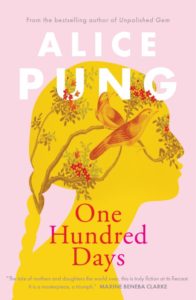
One Hundred Days

Alice Pung

Black Inc

Reviewed by FERNANDA DAHLSTROM


Alice Pung’s fifth book and second novel,
One Hundred Days (Black Inc, 2021), deals with the difficult relationship between sixteen-year-old Karuna and her manipulative and overbearing (but also loving and hardworking) Chinese Filapino mother. Karuna’s father, who is Anglo Australian, has left the family and she has fallen pregnant to a boy she knew only briefly. The setting is 1980s Melbourne. Information is not readily accessible and hysteria about AIDS is rife. Pung tells a simple story that is rich and layered, exploring with compassion both the dysfunction and the strength of a complex mother-daughter relationship and ultimately empowering and vindicating the teenage protagonist. 

=================================

Continue reading for only $5 per month

Subscribe for full access to Mascara Literary Review or login

Continue reading

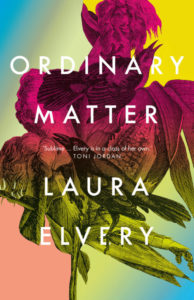
Bec Kavanagh reviews Ordinary Matter by Laura Elvery

Ordinary Matter

by Laura Elvery

UQP

ISBN 9780702262760

Reviewed by BEC KAVANAGH


Laura Elvery’s second collection of short stories,
Ordinary Matter, takes its inspiration from the mere twenty times women have won the Nobel Prize for science. And yet it isn’t science that connects the pieces in this collection, but the ‘softer’ stuff: the women in these stories are united by themes of motherhood, love, art – experiences which are often problematised, or portrayed as obstacles to a more ‘successful’ career-driven life.

Continue reading

Ben Hession reviews Whisper Songs by Tony Birch

Whisper Songs

by Tony Birch

UQP

ISBN 9780702263279

Reviewed by BEN HESSION


Tony Birch is a Naarm (Melbourne) based writer, who is probably better known for his prose, including his short story collections and novels, of which,
The White Girl, won the Indigenous Writers’ Prize of the 2020 New South Wales Premier’s Literary Awards. He was also the winner of the Patrick White Award back in 2017. Whisper Songs is Birch’s second volume of poetry and comes five years after Broken Teeth. Much of Whisper Songs was written during last year’s COVID -19 related lockdowns and may be seen as a meditation on his Aboriginal identity. However, in Whisper Songs, the reader is more than a mere spectator of the poet’s autobiography and revelation. Rather, Birch invites us to share something of a largely personal journey, exploring a sense of heritage and connection to Country.

Throughout Whisper Songs, Birch creates narratives that are underwritten, yet offer a vivid sense of a time and place which are traced towards their meaning and impact. As we see in ‘Dragster’, and the masculine trials of youth: 

red bicycles ring in tandem

slalom empty streets

chrome                             on morning sunlight

tyres                                 on crumbling bitumen

floating                             on air

we rode the world together

fearless 501s barefoot 

no shirts no hands

cigarettes

reckless                            bodies battling

we were                            born to pain
(5)

Similarly, in ‘How Water Works’ the movement of water between the macrocosm and microcosm appears as an essential life-force:

bowl of arctic water
moving slowly south
sleeping ebbing rising
upwelling loops of life
seconds     centimetres
patience slowly spirit
beauty and humility

shape shift onward
through air bodies
entwined with other waters
in plants in soil in Country
(61)

The collection is divided into three sections – Blood, Skin and Water – which are stages of a lateral exploration of something of what Lyn McCredden describes as a ‘locatedness in poetry’ (McCredden 3). In Blood, Birch deals with family connections with much of these educed through a “meat on the bones” (Birch, 267) social history, which, as Carolyn Masel and Matthew Ryan note, with respect to Birch’s short story, ‘Shadowboxing’, provides ‘the map-like evocation of place and the idea of an alternative ‘obscured’ history running through that place’ (Masel, Ryan 5). But rather than use the fictive elaboration of a short story to access the “individual experiences of marginalisation” (Masel, Ryan 5), Birch uses recollection and emotional attachment. This, at times, is elegiac, as we see in ‘Leaving’, with its fusion of day, the suburban place and personal relations: 

a moment of light,
a painted face of beauty
glimpsed in Saturday shop window
forever waiting our return

blood ties on every street corner
aunties uncles cousins
grandparents haunted shades
of black on white all gone   (25-26)

Similarly, we see in the poem, ‘Little Man’, place, time and connection:

searched for you at night
beyond the creaking gate
old haunts street corners
back lanes dressed in rain
big sky darkness

spoke soft words
calling your name
echoes to glimpsed light
fell with a dying moon
our whispered songs for you  

(5)

In this poem, as well as in ‘Dragster’ and others in the collection narratives are not filled out, but are kept allusive with the bonds with family members being as deep as their stories are implicit. This may prove a little difficult to follow, at least initially; though, identity is often about piecing together the past, and the past with the present while our bonds with others are carried within us, unseen. In ‘Blood’, Birch opens us to a small-letter sense of familiarity. In ‘Fading Light’, this allows us feel the sense of loss for the poet’s grandfather: 

my mother a girl of twelve
found his soulless body
slumped across the bathtub
he left her no story
and the coroner gave little away:

              well-built man
             aged forty-seven
             came home from work
             took carving knife
             cut his throat
(7-8)

Blood is symbolic as an elemental part of Birch’s Aboriginal lineage. Its loss, as seen in this poem, or potential for loss, as seen elsewhere, therefore, is emblematic of a disruption that is shown to be violent and self destructive. Importantly, what remains is not silence, but the cold language of the State, and, particularly in Trouble, Trouble, Trouble: Probation File 29/1957′, the colonizing apparatus. Here is the choice is made between the blood associated with internalized violence or the affirmation of identity and the resistance to colonization: 

the boy himself becomes that which he fears
violence courses his veins and therefore –
therefore he must become the protected one
by us for us and himself and for the country
this the only Nation girt by sea
(19)

Blood is thus political as it is personal. It provides that locatedness, which, as McCredden says, ‘is able to speak with earthy, experiential and historical authority, and to offer alternatives to the often too readily universalising, national and global discourses.’ (McCredden 3) And, as demonstrated in the poem Isobel, written for the poet’s granddaughter, the bloodline carries hope and strength for the future:

beautifully stubborn
four years and rising
deep frown eyes fierce
limbs of courage
a girl holding ground
bone and memory
of women reaching back
meeting deep time then
cartwheeling forward
armour for her courage

            she is the circle we gather
(11)

 With blood, Birch establishes a personal sense of locatedness and identity.  Skin, we see, then explores the external definitions of these parameters. The section opens with ‘The Eight Truths of Khan’, wherein Birch’s Punjabi ancestor, must affirm his humanity against the racist formalities of the White Australia Policy, which restrict the movements of people of colour.

‘I agreed that yes, I was fortunate to be allowed to reside
in such a fair prosperous Nation. That evening I again
sat with my wife & child, I again bathed & my wife &
I shared the same bed.’ (33)

In this poem, Birch uses parody as a means of emphasising the absurdity of the restrictions imposed upon his ancestor, as well as the casual and banal nature of the racism: 

applicant Khan should be seen, physically,
& compared to image held of him
by Customs, in grey metal filing cabinet
(alongside the oven) in staff kitchen (36)

Here, and elsewhere in Skin, Birch interrogates history by mimicking the language of institutional racism, recontextualising it, thus denying any erstwhile pretences towards “civilized” or legal neutrality. We see in ‘Forbearer’, the subject’s humanity is set against the dry inventory of attributes that routinely deny it. Again, Birch puts flesh back onto history. In the subsequent poem, ‘A Matter of Lives’, (where the title, itself, alludes to Black Lives Matter), this idea is given a more contemporary setting, with powerful effect, with a reference to the situation concerning Tanya Day and her death in police custody. Here, her humanity is also set against the cynical machinations of mainstream media:

a black woman asleep on a train
is no news is good news
until the day arrives
and she becomes
a fact of death
a number
(44)

Throughout Skin, Birch demonstrates the specialised use of language as an instrument of power for white people over black or brown, who have thus been forced to populate the feared and denigrated ‘Other’. The poem, ‘Razor-wire Nation’, shows this intentioned positioning through a language reserved for an enemy belligerent:

while love is an empty box
we busily tend the cages

gun-turret warriors
for a razor-wire nation  (50)

Conversely, skin and colour as a self-signifier of collective identity allows its assertion as a form of strength and power, against a world “slumbering at home”, as seen in ‘Waiting for a Train with Thelma Plum’:

we slouch beaten
except for a Girl in Blak
kiss of life in black boots
black jeans and hoodie
black/red/yellow flag on her back
headphones soon to pounce

she moves raises an arm
fist clenched ‘Hey!… Hey!’ –
Fuck that                                 (45)

The poem, ‘Tunnerminnerwait’, closes the Skin section. Here, identity is signified through the white skin of the coloniser’s language.  The inherent sense of identity, as elsewhere seen in Skin, is confronted by colonial laws, naming and presumptions. Through capital punishment, these attempt an absolute control with the overbearing threat to one’s own body, one’s own life. Against these, an ineffable, physical connection to Country provides resistance.

his name was Waterbird
and on the morning of
execution he announced

I have three heads

one for your noose
one for my grave
one for my country   (55)

The condemned bears insight, dignity and intransigence. These qualities permeate the underlying premise of ‘Whisper Songs’. In this collection, as blood courses throughout the body, so water does the land, each metaphorically reflecting the other. As Birch writes in ‘Birrarung Billabong’

Our hair was long and curled and magical, our eyes the
richest brown, our skin carried water, our water carried skin.
The sounds of the river rushing at the falls shared a pulse.  (66)

For Birch water is a vital element of the visceral. It becomes, as we see in ‘Desecrate’ – in spite of urbanisation and canalisation: ‘sacred blood of Country/ running with a song’ (76). Water alludes to life and locatedness at its most vivid. As an integral part of Country, it shares a sense of the maternal. In ‘Beneath the Bridge’, concerning the Westgate Bridge collapse, the tenderness is poignant and profound:

when the monster span thundered
across the west the bridge gave way
thirty-five workers came falling
and the Birrarung lay waiting
to gather the dead together 

she gave their souls a home
comforted fear and sadness
and returned battered bodies
to riverbank mourners clasping
soft hands of fatherless children    (74-75)

The essentially feminine nature of Country is rendered once again, in ‘Black Ophelia’:

deny the lord
the holy word
deny the gun

the wire and hoe
caste and colour theft
of ground of bodies

now be and be
with drifting river
with spirit water     (63)

The poem’s title alludes to Ophelia, the character in Shakespeare’s ‘Hamlet’. Unlike Shakespeare’s character, though, black Ophelia does not drown herself, but rather as an individual becomes sublimated with the river. She asserts an autochthonous presence, and an undeniable sovereignty over the land – one that is not negotiable.

go

to Black Ophelia
shimmering within
a sheet of glass 

open lips rising breasts
she sounds – always was
always will be…
(63)

A similar transcendence is seen in the final poem of the collection, ‘The Great Flood of 1971′. Here water overwhelms the landscape, and in turn demonstrates the inherent power of Country. Given the negative impact of organized religion, as noted in the poem ‘Sacred Heart’, the flood offers a chance of a genuine spiritual connection, with a kind of baptism in its own right, but where one becomes unified with nature’s vitality or elan:

surface gasping in a deluge
lightning tearing holes in sky
this river of rising life

            flood me  
(78)

In Whisper Songs, Birch moves beyond ordinarily compassed notions of authenticity, as something that is something self-consciously existential. Birch brings history and Country together in a journey to the soul. It is a journey of pain, poignancy, hope and sometimes humour. Birch’s abilities as a writer adeptly convey the songs whispered along the way. This is the gig. It is time for us to sit and listen.

Cited

McCredden, Lyn. ‘The Locatedness of Poetry’, Journal of the Association for the Study of Australian Literature 11.6 (2009).
Birch, Tony. ‘The Trouble With History’, Australian History Now, Eds. Clark, Anna and Ashton, Paul), New South Publishing, University of New South Wales Press, UNSW (2013).
Masel, Carolyn and Ryan, Matthew. ‘Place, History and Story: Tony Birch and the Yarra River’, Australian Literary Studies 31.2 (2016).
‘Tony Birch’s “Whisper Songs”’. Spoken Word, 3CR, broadcast on 1 July 2021, Naarm (Melbourne).


BEN HESSION is a Wollongong-based writer. His poetry has been published in Eureka StreetInternational Chinese Language ForumCordite, and Can I Tell You A Secret?, the Don Bank Live Poets anthology. Ben’s poem, ‘A Song of Numbers’, was shortlisted for the 2013 Australian Poetry Science Poetry …
Kevin Hart reviews The Strangest Place by Stephen Edgar

The Strangest Place: New and Selected Poems

Stephen Edgar

Black Pepper

ISBN 9780648038740

Reviewed by KEVIN HART


Poetry always involves a delicate negotiation between craft and art. Craft can easily be misunderstood as a set of skills completely external to what is being written. Yet a poet shows craft by moving confidently within the work developing on the page. Often, when one looks at an intricately rhymed stanza, perhaps one with five, six or seven lines of varying length, such as Stephen Edgar favors, one might be tempted to think that the work has been composed, even revised, in the poet’s mind and then set down on the page.

Continue reading

Donnalyn Xu reviews Take Care by Eunice Andrada

Take Care

by Eunice Andrada

Giramondo

ISBN 9781925818796

Reviewed by DONNALYN XU


How do we give shape to what resists language? How do words move against the body, in dialogue with its silence, its noise? These tangled questions emerge from my reading of Eunice Andrada’s second collection of poems,
TAKE CARE, and the writing of this review, which has taken weeks of slow thinking. Like many others, I have found both comfort and discomfort in poetry during a time of immeasurable loss. I leave most things unread, I seek a return to what is comfortable and familiar. In my own work, I attempt poems about windows or

flowers; always in the eyeline of where it hurts, but slightly out-of-focus. Yet, TAKE CARE is piercing in a way that cuts through the haze with a deliberate sharpness. Connected through the theme of rape culture as it exists in everyday and institutional scales, these poems do not flirt around the intensity of their subject matter—they demand your recognition, as well as your unease. As Andrada writes in her author’s statement with Giramondo Press, in TAKE CARE she has “attempted to get as close as possible to the hurting bone”. 

The plurality of meaning layered in the phrase ‘TAKE CARE’ is magnified by loud and insistent capital letters. It is what I say to women instead of saying goodbye, always on my mind in the process of leaving: take care, which also means be careful. Take and care can also be read separately as verbs in their own right, though they might seem contradictory if we consider care as giving, or care as sacrifice. Structured into four parts—take, comfort, revenge, and care—Andrada weaves a tapestry that embraces multitudinous and non-linear paths towards healing.

The body is at the centre of Andrada’s poetry, though not always enfleshed by language—these are the bodies of our ancestors, our mothers, our sisters; the bodies of those who can only be remembered for having been dismembered. In the opening poem “Echolalia”, the collapse is imminent, as a disruption that is also an entry point. Tracing the violence of history in the space “[b]eyond a dilated island”, the rhythmic and rocking imagery of rising water culminates into bullet-like fractured sentences in the present—“Then the hands. Not mine.” The poem ends with a sombre reflection on the constraints of writing about the body through poetry as a medium; the traditions it must wade through, and inevitably carry: “For my human body to be seen as the centre / of a poem, it must be buoyant”. 

‘Buoyant’ evokes a range of images that reverberate throughout the entirety of the collection, as the last word of the first poem. A buoyant body is lifeless, deceased, or maybe even light and at peace, having given in to the currents. Water is a recurring feature in Andrada’s poetry, not only as a symbol, but also structurally, through lines that float in and around empty space, and feelings that simmer. As an ecopoet, Andrada explores environmental and cultural imperialism through the connection between bodies, both human and non-human. The speaker does not simply observe nature, but actively participates in its ecosystems. Or rather, the act of observing is also a form of participation, much like our reading of these poems. In “Kundiman” (a genre of Filipino lovesongs), a Filipino senator orders radio stations broadcasted overseas to play music in the Tagalog language to ward off invaders. The speaker’s tone is cynical about this tactic, but ultimately closes with a sincere desire:

I want to be there with a love song
not to wield as a weapon,
but as a comfort to the water.

A love song is not enough to “thwart a battalion”, but it serves a different purpose, and it requires an approach to softness that extends beyond either weakness or strength. Softness as comfort, not only for each other, but for the pain the land and its waters have suffered, which we carry with us even as we leave its shores. 

So much of the strength in TAKE CARE lies in its varied yet interconnected moments, like ripples on the surface of water. One of the longer poems, “Vengeance Sequence”, is spread across six pages. Divided into sections by a single colon, it follows the same structure as the earlier “Comfort Sequence”. While “Comfort Sequence” uses archival and documentary fragments of text to situate the act of rape in a history of imperial violence, “Vengeance Sequence” considers various scenarios in seemingly speculative and atemporal worlds:

:

The most dignified rape scene on TV
is where the rape doesn’t happen.

He attempts to do it but can’t get hard,
stroking his cock, pliant as shore-washed

seagrass. She can’t stop laughing.
The bliss surges from her throat,

a carafe unfractured, her cackles
erupting and erupting. 

I am drawn to the simplicity of a bolded colon that speaks as loudly as the enormous silence it encompasses. It is a connector symbol, but standing alone, it draws a vertical line. It leads us into sentences that require the immediacy of present-tense to close the distance between the dots, the reader, the persona, and the words themselves. I love the description of bliss as “unfractured”, and the movement of cackles that are “erupting and erupting”. I laugh with the speaker as she laughs. 

The delight that infiltrates Andrada’s writing does not outweigh the necessary ruminations of violence, but allows the reader to gain insight into alternative ways of being that do not replicate the simplistic narratives of grieving that have been assigned to us. I want to read closely into the deeper meaning of the poem as a series of disconnected but interwoven scenes, but perhaps a close reading also entails my fixation on this sudden and unexpected joy. It is the feeling of reading alongside, rather than watching from a distance. The speaker imagines an anti-rape device that comes with a KILL button, and I think, yes, yes. The speaker “take[s] naps to undo the myth that [she is] hardworking”, and I think, well, me too. Relationality is essential to the construction of these poems, and in every personal testimony that both is and isn’t an address to an audience, the speaker appears to ask—where are you standing? How are you reading?

One of my favourite poems in TAKE CARE, “The Chismis on Warhol”, begins with an epigraph from a poem by Alfred A. Yuson entitled “Andy Warhol speaks to his two Filipino maids”. Written from the perspective of American pop artist and filmmaker Warhol, Yuson’s poem offers a poignant and humorous meditation on the meaning of art and American imperialism. Andrada’s poem responds to Yuson (and to the speaker of Yuson’s poem, Warhol himself), not by ‘speaking back’ to the man, but by speaking behind his back; speaking in a language that is entirely our own. I cannot faithfully translate the meaning of the gossip that is ‘chismis’, except to note that my family often calls me chismosa, which has a girlish inflection to it that I revel in, which this poem revels in too. A poem full of chismis and rhetorical questions (“Did you hear the canned sopas / was a hit at the galleries? / How they ate that shit up.”) ends with a question that answers itself: “Did you hear / he calls them ‘girls’? Just girls alone / a few moments, all theirs.”

When I read that line, I feel like I am in the room with them. He calls them girls, but their loneliness is theirs. Andrada is attentive to the colonial narratives that strip Filipino women of their agency, and in writing about these women as more than bodies of service in the imperial machine, she has ascribed them with possibility. There are only questions, only imagined scenes of intimacy. However, the significance lies in the asking, which orients the poem away from what has been lost, towards what we can hope for and wonder.

Of course, I am cautious of intrinsically leaning towards expressions of joy and comfort in a collection that is also a necessary punch to the gut. There were some moments in TAKE CARE that I found so graphic and painful, I had to close my eyes. I was tentative to write about this feeling, but I have come to learn that hesitation and uncertainty are critical tools we must engage with meaningfully. In Curating Difficult Knowledge, Erica Lehrer, Cynthia E. Milton, and Monica Eileen Patternson ask: “what is our responsibility to stories of suffering that we inherit?” I don’t think that poetry can offer a suitable answer to this question; it can only ask it again, in a different language, with a repetition that is comforting, and unsettling.

I often find that the most difficult feeling to draw into poetry is anger. “I’m not an angry person, but I have to be one” is a phrase that I have used many times. It sounds too much like an excuse, like saying “in my defence”, but what am I defending myself from? Anger, or the way I feel it has been unfairly given to me? In “Uninhabitable”, the speaker’s anger does not transform or serve a purpose.

Rage is the whale I must dwell in
when I move through the cities my body
cannot inhabit.

This is no hero’s journey.
The objective of my wrath is not
to save.

The sense of surety in the speaker’s position is echoed in the use of enjambment that cuts like a blade. It reminds me of a passage in Audre Lorde’s 1981 essay “The Uses of Anger”, in which she states, “the angers between women will not kill us if we can articulate them with precision, if we listen to the content of what is said with at least as much intensity as we defend ourselves against the manner of saying. When we turn from anger we turn from insight, saying we will accept only the designs already known, deadly and safely familiar.” In reading TAKE CARE, I felt invited to sit with resistance—against oppressive power structures, and against my own unease. There is movement in resistance, because resistance is also mobilisation. Significantly, the final poem “Echolocation” ends as a call-to-action, much like how Lorde writes about anger as growth:

Our song maps the terrain
of past to future labour.
We trust the others hear us.
They are gathering.

It is also significant that Andrada refers to struggle and survival as a song, which is to say, musicality. There are echoes and resonances that lift off the page. I hear them, I feel compelled to respond. I feel that the loneliness of writing as a Filipina poet living on unceded land—the specificity of that loneliness—is shared by a choir.

A final note on music for a collection that truly sings—the first time I read TAKE CARE in one sun-filled afternoon, I listened to Andrada’s eponymously named Spotify playlist on shuffle. As Rina Sawayama’s “Chosen Family” faded into Rihanna’s “Bitch Better Have My Money”, I was reminded of the varying and often conflicting shades that exist in the act of ‘care’, whether that be anger at the exploitation of caregivers, care for one another, care as a weapon, or care as the most vulnerable and necessary act of survival. What TAKE CARE teaches us is that care is not the antithesis to pain. Sometimes it is joyful, at other times, blinding with red. An anger rises and cools within us. It continues this way, but it does not settle.


Cited

Andrada, Eunice. “Eunice Andrada: a note on TAKE CARE.” Giramondo Publishing. 31 August, 2021, https://giramondopublishing.com/eunice-andrada-a-note-on-take-care/.

Lehrer, Erica, Cynthia E. Milton, and Monica Eileen Patternson (eds). Curating Difficult Knowledge: Violent Pasts in Public Places. London: Palgrave Macmillan, 2011.

Lorde, Audre. “The Uses of Anger: Responding to Racism.” In Your Silence Will Not Protect You, 107–118. London: Silver Press, 2017 [1981].


DONNALYN XU is a Filipino-Chinese writer, poet, and artsworker living on Darug land. Her work has appeared in PerilVoiceworksOverland, and elsewhere. She is currently completing her Honours year in Art History and English at the University of Sydney, and writing her thesis on the poetics and materiality of Filipino national dress.


Amy Walters reviews The Everlasting Sunday by Robert Lukins

Amy Walters reviews The Everlasting Sunday by Robert Lukins

The Everlasting Sunday

by Robert Lukins

ISBN 9780702260056

UQP

Reviewed by AMY WALTERS
 

Robert Lukins’ debut novel follows seventeen-year-old Radford as he commences at Goodwin Manor, “a place for boys who had been found by trouble” (19). The Manor is a dilapidated institution of reform in the Shropshire countryside,
which the Queensland-raised Lukins has said was inspired by an old house he encountered whileworking as a postman in Shropshire.

=================================

Continue reading for only $5 per month

Subscribe for full access to Mascara Literary Review or login

Continue reading

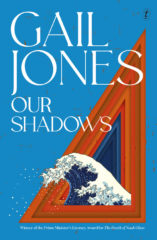
Katelin Farnsworth reviews Our Shadows by Gail Jones

Our Shadows

by Gail Jones

ISBN 9781922330284

Text Publishing 

Reviewed by KATELIN FARNSWORTH 

Our Shadows by Gail Jones is a family saga that examines the intimate lives of three generations living in Kalgoorlie. The story starts with Paddy Hannan, an Irish-born prospector who discovered gold back in 1893. Paddy’s history is woven in and out of the text and we travel back and forth between his story. We also meet sisters Nell and Frances, and grandparents, Fred and Else. The relationships drawn out in this novel are complex and layered, unfolding slowly as you read. There’s no doubt that Jones is a beautiful writer, precise, perceptive, and full of razor-sharp observations. 

Aptly named, shadows imbue this novel. Nell and Frances were close as children however are alienated from one another in adulthood. After the death of their mother, they were raised by their grandparents in Kalgoorlie (the ‘shadow’ of the super pit) and are united by their love of reading. Estranged as adults and now living in Sydney, Nell and Frances both deal with different shadows. Frances is grief stricken, mourning her late husband, Will, while Nell deals with mental health issues. Their grandmother Else has dementia. The book slowly and lyrically unpacks and dissects their relationships together, the way they move and shift, closing and opening. The scenes with Else are touching, written almost like poetry, a true tenderness in the words. 

‘Yes, it was Else, but in an altered state, not only with extreme age but with the air of subtraction and inwardness that a monk might possess. Her eyes were dim with medication. Her skull outline was clear beneath wisps of white hair. Yes, it was Else, who sat unaware and apart, with her long, notched fingers resting inert in her lap. Nell took her hand, but Else did not register her touch.’ (p115)

While Nell, Frances and Else are all living in Sydney, memories of Western Australian – consciously and subconsciously – sit under much of the work. As readers, we are drawn again and again to Kalgoorlie, this vivid place that is almost a character in its own right. There is also a lovely juxtaposition between the water of Sydney and the aridity of Kalgoorlie. 

We meet Fred, Else’s late husband, through Nell and Frances. Fred was a worker in the mines and later a prisoner of the Japanese. Tragedy has filled his life, from haunting scenes in the mines to becoming a prisoner of war. Jones handles these themes delicately. While these tragedies undoubtedly change Fred, shaping his life, the way he understands himself and his future relationships, we see Nell and Frances remember him with courage, kindness, and strength: 

‘Sometimes, on weekends, Fred took the girls prospecting. ‘Speccing’, he called it. In the desert beyond the town, littered with the remains of disused shafts and the mounds of old diggings, they set off together, peeling their eyes, scouring the dirt, searching fastidiously for something golden.’ (p200) 

Mining infuses Our Shadows in multiple ways. Fred attempts to bury the horrors of war through the mines; for Nell and Frances, the mines represent their childhood stories, loss and grief. The unknown, the unseen and the unspoken all play out in this novel. Silence (and the silencing of Aboriginal Country and culture), looms large, even if not at the forefront of the story. This silence is imprecise, as silence often is, because the bulk of the book follows characters who are not Aboriginal and who benefit from systemic privilege. 

Paddy Hannan, the Irish miner, who made his way to Kalgoorlie and found gold in 1893, slowly begins to understand the mines differently. The mines represent intense greed, a place where white people continuously take with little thought or regard to the violence they are enacting. The land is given no respect and the rightful Aboriginal owners are ignored and cast into shadow. Wangkathaa land is devastated by greed and destruction. Jones examines this toxicity with a subtle hand, exploring some of these damages and abuses, as well as the consequences (or no consequences, as it may be). An intense silence exists in Australia’s national identity, one rarely confronted or engaged with. Jones uses Our Shadows to show us that colonisation continues to exist  – a shadow, or shape if you will, that isn’t simply going to go away. In a book already filled with deep shadows, this shadow of colonisation may, however, be the most important one. It  sits underneath everything, every character and every action, even if not always immediately recognised. Colonisation has had a devastating impact on this land: it should not be ignored and Jones does not ignore it, bringing it into the story and asking the reader to consider its effects. 

In the second part of Our Shadows Frances returns to Kalgoorlie in search for more answers about her father. While there, she meets Val. Val is a compassionate and generous Wiluna woman who shares her knowledge with Frances about Aboriginal languages and customs. Aboriginal history is largely ignored by white people, and so these scenes are significant. Although fleeting, these encounters are important not only for Frances, but for the white reader too, serving as a reminder that the land is not theirs to claim, never has been and never will be: it does not belong to them. The friendship between Frances and Val may be complex but it is also essential. Sections with Val are brief, something I think worth mentioning, perhaps highlighting the fact that this is not Jones’ story to tell but still deserves space and time on the page. 

While line by line Jones is a joy to read, at times I was uncertain about how all the pieces came together. With a fragmentary narrative, there were occasions where I drifted off while reading and had to consciously bring myself back to the story. This is a prominent feature of Jones’ writing – her style often travels between the past and the present, cleverly using gaps, stillness and silence to make a point or convey a message. With a history of striking narrative techniques, there is an elusive and indefinable quality to much of Jones’ work. Often experimental, patterns and repetitions abound in her work. In Our Shadows, we see this play out through the use of Japanese artist Hokusai’s art piece The Great Wave. As children, this piece plays an integral role in connecting Nell and Frances to one another, as well as heightening their desire and longing for the ocean. Consequently, a wave-like, almost dreamy quality to the story exists, an ebb and flow, a swelling and a surging. 

Shadows of our pasts are tricky things, weaving in and out of lives often without our knowledge. Coloniality and settler guilt is a recurring theme in Jones’ work and there is a sense of collective loss in the national story. A nation built on invasion, lies and genocide means that everything becomes unstable in a broader sense. We see this instability again and again in Jones’ characters. Paddy, Frances, Nell, Fred, and Else all grapple with various ghosts and with different ideas around loss, silence and memory. Detachment is another strong theme. Perhaps, there is an intentionality to the text, a ‘holding back’ from the author that is designed to mirror something in the characters and bring something – invoke some kind of new feeling – in the reader. Either way, Jones’ writing is nuanced and she writes about memory thoughtfully. The following passage from Frances, thinking about her late husband, speaks to this idea beautifully: 

‘Not all recollections of Will took their toll; some returned her to their body part, and the things they had said to each other. To their shared personal life and their history of seeing and knowing. It was still an enigma to Frances why the past was so difficult to manage. She hoped that eventually her feelings would detach or simplify…’ (p197). 

What does it mean then, for feelings, to disappear? Can lives at once be meaningful and meaningless? This book questions us to consider the shadows of our past, our future shadows, the enigmas that have not yet happened, and the shadows we will leave behind. People are multidimensional and ‘Our Shadows’ shows us some of these dimensions, asking its reader to dissect, think and explore these characters and the shifts in time. 

Our Shadows is a complicated book, with a lot to consider. It is one I will continue to revisit, thinking about greed and silence – the shadows that permeate this country, the echoes left behind, and the way I understand myself, the world I live in, and the deep scars that fill this land we call ‘Australia’. 


KATELIN FARNSWORTH is a writer and reader living on unceded Wurundjeri land. She loves imagining stories and spending time in nature. She was shortlisted for the Penguin Literary Prize in 2020 and won an ASA Mentorship in 2021. 

Dženana Vucic reviews Admit the Joyous Passion of Revolt by Elena Gomez

Admit the Joyous Passion of Revolt

by Elena Gomez

Puncher and Wattmann

ISBN 9781925780741

Reviewed by Dženana Vucic


To read Admit the Joyous Passion of Revolt (2020), Elena Gomez’s second full-length poetry collection, is to be propelled headlong through the dizzy intersect of postmodernity and Marxist-feminist critique, to be flooded with possibilities for distraction, and for engagement. It is a work that not only demands rereading but requires it. Which is not to say that it cannot be drunk down along with your breakfast coffee (it’s slim enough that this is possible), but it is to say that the work is best enjoyed over a series of re-readings, with time for the ideas to settle into your insides, digest. 

Continue reading

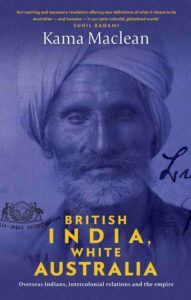
Joshua Bird reviews British India, White Australia by Kama Maclean

British India, White Australia

by Kama Maclean

ISBN 9781742236216

New South Books

Reviewed by JOSHUA BIRD


Perhaps one of the most under-appreciated elements of systems of racial discrimination is their sheer banality. 

Whether it be the efficient genocidal bureaucracy of the Nazi holocaust or the complex racist laws and policies that held together the system of Apartheid in South Africa, their existence reminds us that racism and prejudice are not just the remit of bad people—‘racists’—doing ‘racist’ things. Rather, racism is a concept that explains—indeed generates—entire systems of oppression and exclusion. Such systems are administered soberly and dutifully by governments and their representatives often in pursuit of their own perception of the common good.

For a real-world example of countries whose histories are informed by the administration of racism you could not find two clearer cases in India and Australia. Both countries are connected by a shared experience of colonialism of the British variety yet they participated on quite different ends of the imperial spectrum. The central explanation of that difference is, of course, race. Australia was not only a part of an empire constructed with Whiteness at its core, it was a nation who had only just recently declared most proudly its intention to be the purest, whitest nation in the British Empire. India, on the other hand, was a proud ancient civilisation now denied equal standing within the Empire, despite representing its largest source of resources and income, solely on the basis of its non-White status.

Using race and colonialism as a common thread, British India, White Australia, by Kama Maclean, attempts to explore this complex set of inter-relationships between Australia, India and Britain (as both nations and peoples) from Australian Federation in 1901 until India’s independence in 1947. In the first half of the twentieth century, British propaganda efforts went to great pains to emphasise the kinship of the Imperial relationship. This narrative was particularly emphasised during World War II when the survival of the Empire itself rested very heavily on India’s contribution to the war effort. Yes, despite this narrative of brotherhood, it would be some time before Australia even approached recognising India as a sovereign nation.

Historically, Australian perspectives on India were mediated through the triangulated prism of Britain – and the British Empire. For example, while Australian trade to India was robust, such trade was transacted largely with British colonial enterprises and seen as a component of global Imperial Trade rather than a bilateral economic relationship with India itself. India’s economy was shackled to Britain’s as a prime source of raw materials for British industry and a captive market for British manufactured goods. As Maclean notes, “India was more imagined than experienced in Australia, with the vast majority of transnational connections heavily mediated through the white mechanisms of the British Raj” (Maclean, p55). This was not an accident. Rather, it was by British design and intent. 

From India’s perspective, the ties of Empire served to increase tensions with Australia rather than bind them closer. Australia’s stridently racist immigration policies—which treated British Indians just as unfairly as Chinese or other non-whites—put it at odds with a country looking to assert itself on equal footing within the Empire. Australia, for its part, tended to see Indian criticism of its restrictive policies as indicative of the Indian people’s ‘hyper-sensitive’ nature (Maclean, p233), rather than a genuine grievance borne of justifiable concern. In international forums Australian diplomats did their best to frame the country’s policies of prejudicial exclusion in economic terms rather than explicitly race-based ones. Australia’s concern was with non-whites’ willingness to work for low wages without union membership, it was argued, rather than any sense of racial superiority or prejudice that motivated Australia’s actions. Those paying attention will recognise similarities to contemporary Australian political discourses around migration (for both refugees and non-refugee).

Arguably, for much of the 20th century content to follow Britain’s lead, Australia was most active internationally when combating attempts to progress racial equality. For the antipodean colony, the issues of challenging apartheid, softening the White Australia policy and Indian home rule were all connected—each an equally slippery slope which must be defended against at all costs lest the Empire come undone. Most famously, the advocacy of Australian Prime Minister Hughes was instrumental in halting a resolution in favour of a racial equality clause during the 1919 Paris Peace Conference. Maclean covers negotiations of this kind in great detail in the book, although the casual reader may find the content covering various international agreements and domestic legislation a dense read.

However, British India, White Australia is as much about British hypocrisy on the issue of race as it is about Australia’s own discriminatory policies in relation to Indians. While Britain often joined India in showing dismay over Australia’s policies, this was only because of their perceived impact on the stability of the Empire rather than any higher moral argument. Indeed, Maclean argues that Australia’s race-based immigration regime was entirely consistent with the Empire’s principles and values rather than an aberration from them. 

Race and inherent white superiority were used to justify Britain’s refusal to extend self-rule to India just as much as they were used to justify the exclusion of non-whites from Australia. As Australia’s third Prime Minister Chris Watson argued: 

“The British Government do not think of putting the Hindoo (sic) or any other native of India upon the same plane as the people of the United Kingdom. The ground I take is that the natives of India are British subjects and subjects only, whilst the people of the United Kingdom are citizens as well, and British subjects in Australia are citizens also. That constitutes a wide distinction” (Maclean, pp25-26)

The sensitives of relations within the Empire meant that the reasoning for this distinction was seldom explicitly stated—the racist assumption that Indians were not capable of self-rule (at least not currently). Similarly, Australia’s selective application of a theoretically colour-blind language test allowed the country to effectively bar the migration of non-Whites without stating their true intent.

Ironically, Australians themselves balked at Britain’s use of bureaucracy to discriminate against them in the form of access to roles in the Indian Civil Service (ICS). At the time, Britain required applicants for work in the Indian colonial administration to attend examinations that were held in London, thus limiting access to only those Australians with the time and funds to allow for the trip to Britain. Australian lobbying for the holding of examinations locally were resisted by Britain at least partially on the grounds that giving in to such a request would increase pressure on them to hold similar examinations in India itself—thus opening the door for increased numbers of Indians working in the ICS. As with Australia’s language test, Britain felt the need to maintain a veneer of procedural fairness in enacting its racial discrimination. As Maclean notes, “discrimination was effectively concealed in the garb of the efficient and procedural bureaucracy of the examination” (Maclean, p41).

While the low numbers of Indians migrating to Australia in the early Twentieth Century meant that they were never a target of specific legislation or policies to curb their numbers or influence, they nonetheless suffered at the hands of Australia’s racist policies which aimed to discriminate against all non-Whites equally. Indeed, it was this failure to give British Indians the proper standing expected of fellow members of the Empire that was the greatest source of grievance for Indians in Australia.

Those Indians resident in Australia balked at their second-class standing and were very active in petitioning governments—both domestically and internationally—for a recognition of their special status. Having spilled blood for the Empire in the recent war, surely they had done enough to prove themselves loyal subjects and worthy of respect? ‘No’, was Australia’s response. If anything, Indian migration to Australia represented a new threat to the Australian worker and fed into the long-running inferiority complex of the Colonial Australian. The expansion of Western models of education to the Indian middle classes, including English language training, had created a generation of Indians who could not only compete with Australian workers but exceed them in capacity and skills. 

Despite these tensions, there was engagement and contact between Indians living in Australia and local people. However, given the scarcity of first-person Indian accounts, Maclean is generally forced to adopt the perspective of non-Indian Australians in painting a picture of the lives of Indians in Australia at the time. This includes a fascinating analysis of the presence of Indian hawkers through the family photos and remembrances of those rural Australian families with whom they traded. For many of these isolated families, particularly women, the arrival of a travelling Indian hawker represented an opportunity to sample new wares, share local gossip and access the world beyond the farm. However, such representations are just snippets; distant and casual.

While Maclean herself acknowledges the limitations of first-person sources, the book would have benefited from more illustration of the internal life of Indians resident in Australia at the time. How did they reconcile their identities as Indians, Australians and British subjects? Instead, the greater availability of official documentation over personal accounts means that much of the book is concerned with the formal administrative aspects of Indian identity in Australia in the early twentieth century—such as the advocacy for equal legal and/or residential status. 

In the end, Australia’s reticence in engaging directly with India and Indians gave way to shifting political realities. Even by the 1920s, Britain’s primary role in mediating the Australia-India relationship had started to recede. This allowed for both parties to establish more direct engagement for the first time. Oftentimes this engagement was led by niche organisations; Communists, Theosophists and Friendship societies. The Australian public’s impact on India’s independence movement was minimal at best. Despite this, the book explores the activities and internal machinations of a number of these well-meaning but ultimately ineffectual efforts. 

With Britain’s retreat from Asia during World War II and India’s newly won independence, Australian policy-makers quickly acknowledged the need for a recalibration of its diplomatic priorities. As European powers retreated from their former colonial territories in the region Australia was now looking at a more isolated future. Cultivation of stronger diplomatic ties with India was needed as Australia pivoted to face a new foe—global Communism. Soon both countries would establish respective diplomatic representation, opening channels for direct political communication without British involvement. This would eventually be followed by the first cracks in the White Australia policy, allowing Indians to study, work and migrate to Australia. 

In recent years, political necessity sparked by shifts in international power relations has once again seen Australian political leaders turn their attention to India. This time, however, it is China to whom the West seeks India’s help in balancing. India has become one of Australia’s key strategic partners in responding to the growing economic and military might of China, joining the United States and Japan as members of the Quadrilateral Security Dialogue (‘the Quad’). On the economic front, Australia’s two-way goods and services trade with India now totals a massive $24.4 billion per year, and has become a key market for Australian exporters looking to avoid an over-reliance on China. At the individual level, engagement has never been higher. India is now the second largest country of origin for overseas-born Australian residents, and last year well over 100,000 Indians studied in Australia. Exchange goes both ways, as Australian cricketers ply their wares throughout the Indian Premier League and Indian cuisine and culture now firmly within the mainstream. 

And yet, the central question raised by British India, White Australia remains. Do Australia and India truly share a set of common values and understandings? The poor treatment of Indian-Australians trying to return to Australia during the recent surge of Covid-19’s Delta variant revealed fractures in the relationship. Racist incidents, such as the apparent targeting of Indian taxi drivers in Melbourne, have also undermined any argument that racist attitudes towards Indians are now in the country’s rear-view mirror. While some may suggest that any hope for long-term engagement between India and Australia rests on an embrace of their common history, others like Maclean will continue to assert that in fact it is this shared colonial experience that has prevented the relationship from evolving beyond its racist origins.


JOSHUA BIRD is a community development specialist and scholar who focuses on minority rights and multicultural policy.  He has spent the last twenty years living and working across the Asia-Pacific and has a Masters of Asia-Pacific Studies (2010) and a Doctor of Philosophy in China Studies (2016). Joshua is a regular contributor to the Asian Review of Books and Cha Asian Literary Journal, and his first book Economic Development in China’s Northwest: Entrepreneurship and Identity Along China’s Multi-ethnic Borderland was published by Routledge in 2017.

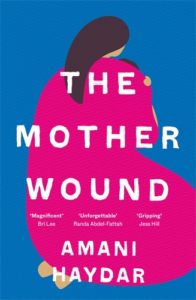
Anne Brewster reviews The Mother Wound by Amani Haydar

The Mother Wound

Amani Haydar

Panmacmillan

ISBN 9781760982454

Reviewed by ANNE BREWSTER


Strong Women

Amani Haydar’s powerful memoir takes its title from Dr Oscar Serrallach’s term ‘the mother wound’, which describes how ‘the relationship between mothers and daughters is affected by unhealed traumatic experiences passed down matriarchal lines’ (333). In her family, Haydar says, the wounds have been inflicted by male aggression, war and migration (329).

If memoirists produce memoirs in order to make their lives count in the public record, Haydar’s memoir is motivated by the strong imperative to make her mother’s life count – for it to be recorded and commemorated publically – as her mother, Salwa Haydar, was the victim of lethal violence at the hands of her husband, Haydar’s father. Amani Haydar has a high profile as a writer, artist, lawyer, community activist, media commentator and advocate for women’s rights, and has talked a lot in the media about her mother’s death so I expect it’s not a spoiler for me to identify this as the event that galvanises Haydar as a memoirist. She herself refers to her mother’s passing proleptically early in the book, before the narrative has even touched much upon her mother.

Haydar spends the first section of the memoir establishing the close and mutually respectful (67) relationship she had with her father as a child and the way he had inspired and dominated her sense of herself and her future. This is a deftly written memoir which skilfully records the changing narrative point of view of the protagonist/memoirist. Haydar describes how as a child she internalised her father’s view of the world, and saw the world in effect through his eyes. This included being inadvertently complicit from the sidelines as a child in his disparagement of her mother. Haydar recognises all too late that her father’s pattern of coercive, controlling, belittling and intimidating behaviour comprises the gendered domestic abuse that would prove fatal to her mother (91). The memoir thus traces Amani Haydar’s rites of passage as she comes to understand the functions of patriarchy as they intersect with gender and race. It describes her dissatisfactions with mainstream feminism and her efforts to ‘carve out’ (58) a feminism that would account for these intersectional complexities.

The feminism that The Mother Wound articulates is informed by scholarship (in particular the history of Muslim women’s writing and feminists working in Islamic frameworks), grass-roots and local activism, and debates on social media. This repurposed feminism allows Haydar to address issues such as the pernicious stereotyping of Arab and Muslim people in the media (for example, the correlations of Muslims with violence), and to challenge the entrenched binaries that promulgate these stereotypes (such as the binary of ‘traditional’ versus ‘modern’ which besets representations of CaLD communities and individuals, a binary mobilised by both the mainstream media and her father’s family alike, to the detriment of Muslim and Arab women).

Haydar identifies the ‘double bind’ that Muslim woman activists and survivors of gendered abuse often find themselves in of having to fend off Islamphobia on the one hand and to challenge patriarchy in their own communities on the other (304). This can result in self-censorship and a reluctance on the part of Muslim and Arab women to ‘share their truth freely’ (304). Haydar’s memoir makes an important contribution to Australian public life in countering this silence and I urge all Australians to buy and read this important book. Beautifully-written, intelligent and passionate, The Mother Wound is profoundly moving in its bravery and breathtakingly astute in its analysis of the operations of race, gender and class. It makes a paradigm-shifting contribution to the genre of life-writing and memoir in Australia.

In the course of reading this book I enthusiastically recommended it to a number of white friends and colleagues. It elicited virtually the same response: ‘oh, that sounds a bit grim’. Why are some things just too unpalatable for white readers? Haydar talks a lot about the lack – in the period following her mother’s death – of the recognition of and adequate ethical responses to her and her sisters’ grief: from her father’s family, the community, the mainstream media and other actors. The book forcefully draws my attention to a significant component of toxic whiteness – its refusal to acknowledge and commemorate the griefs of minoritised peoples and respectfully accord them mainstream space in public culture.

If Amani Haydar’s memoir is a commemoration of her mother and her untimely passing before she had time to realise the many different goals and ambitions of her public and private life, it is also a gesture to her grandmother and her shocking death in the South Lebanon conflict some years earlier. Haydar’s Teta was in a civilian convoy of three vehicles travelling through the countryside to escape shelling when they are killed in an apparently inexplicable Israeli drone attack. As one of her relatives stated: ‘there was nothing around the area where we were attacked, only fruit orchards – no people and no fighters. It was an empty area… we were clearly civilians, we had white flags’ (69).

Haydar meditates on the fact that the mortalities occasioned by war can leave people with a feeling of helplessness, and the sense that there is no recourse to justice. In her work as a lawyer she had attended a workshop on the investigation of war crimes with lawyers and investigators who had worked at the Hague Convention. She found the statistics of civilian mortalities particularly disturbing; ‘In modern warfare it is estimated that eighty per cent of casualties are civilians and seventy per cent of those civilians are estimated to be women and children’ (54). The rationale of ‘acceptable collateral in military operation[s]’ (55) was equally disturbing for her, given her family history. As the only Arab in the room at the workshop she was acutely aware that her own proximity to the Israeli-Lebanese war made her uncomfortable and distressed with the approach of the workshop to this material on civilian deaths which was on occasion cheerful and even jocular (55).

Haydar’s memoir demonstrates the many ways that war intrudes into diasporic peoples’ lives, not just in professional settings like the workshop but also their private living rooms: her family received news of Haydar’s Teta’s death in a tv news report. Hearing of her mother’s violent death with no warning in this way was deeply traumatic for Haydar’s mother and other family members (61). Haydar’s memoir raises the question for me: how can space be made in the national social imaginary (beyond the significant memorials in local communities) for the commemoration of those wars from which diasporic Australians have fled? The memory of these wars already exist within the memories of individuals and collectives; how can they be recognised at the national level?

In its dual homily to her mother’s and grandmother’s untimely deaths, The Mother’s Wound forensically analyses the intertwining of gender and violence in both the settings of the private home and in warfare. It aims to record truths that often remain unrecognised and unacknowledged. This analytical and memorial work comes at a cost. Haydar describes her acute sensitivity to war and violence; even watching the normalised stream of violence on mainstream tv provokes anxiety in her. The imagery is overwhelmingly immediate, real and ‘fleshy’ (129), reminding her inescapably of ‘a heightened sense of [her] own mortality, and the mortality of those around [her]’ (129). She describes numerous occasions when journalists and other people seeking to report on and commodify the grief of Haydar’s family (on the occasions of both her mother’s and her grandmother’s egregious deaths), showed little ethical awareness of and response to Haydar’s and her sisters’ grief. These anecdotes about normalised invisibility of minoritised people’s suffering make me as a middle-class white woman very much aware of the risk Haydar exposes herself to in offering her story to a variety of readers and audiences; and of my own responsibility to try to avoid contributing to this violence and harm.

Haydar insists that in spite of their violent deaths her mother and grandmother were strong women. Although she was indisputably the victim of wrong doing her mother was not only a victim but also a courageous and loving woman, an activist who ‘fought misogyny’ (93) and who left a legacy of resilience, intelligence and helping others (254). In bearing witness to the stories of her mother and grandmother Haydar herself celebrates the spiritual resources of gratitude, faith and joy (307) which sustained her during her writing of the memoir as well as her art practice, her family, community and her activism as a survivor-advocate.


ANNE BREWSTER is Honorary Associate Professor at the University of New South Wales. Her books include Giving This Country a Memory: Contemporary Aboriginal Voices of Australia, (2015), Literary Formations: Postcoloniality, Nationalism, Globalism (1996) and Reading Aboriginal Women’s Autobiography (1995, 2015). She is series editor for Australian Studies: Interdisciplinary Perspectives


Megan Cheong reviews Gunk Baby by Jamie Marina Lau

Megan Cheong reviews Gunk Baby by Jamie Marina Lau

Gunk Baby

by Jamie Marina Lau

Hachette

ISBN 9780733646270

Reviewed by MEGAN CHEONG
 
Consumption and corporeality in late capitalism
A reading of Jamie Marina Lau’s Gunk Baby

After the deliquescent dream of Pink Mountain on Locust Island, Jamie Marina Lau’s Gunk Baby is a wake-up call from a silent number in the small hours of the morning. Leen lives in the fictional outer suburb of Par Mars, a typical sprawl of shopping centres, housing estates, and units fronted by flat open lawns. Yet just beneath all the grass and concrete runs an undertow of surveillance and violence that feels both strange and strangely familiar.

=================================

Continue reading for only $5 per month

Subscribe for full access to Mascara Literary Review or login

Continue reading

Gayatri Nair reviews Monsters by Alison Croggon

Monsters

by Alison Croggon

Scribe

ISBN 9781925713398

Reviewed by GAYATRI NAIR


I initially didn’t want to review this book. It is written by a white woman, and as a person of colour (POC) who wants to elevate diverse writing, I thought it was important to only review other diverse writers. However, after discussion with a mentor and writer I realised that it is also important that we, as POC women especially, participate in criticism, not just of diverse literature but also more established writers. It is possible also to challenge and change traditional criticism by introducing diverse perspectives from diverse critic-subjects. This is called auto-ethnographic criticism, which acknowledges the inextricable link between the personal and the cultural and makes room for non-traditional forms of inquiry and expression. It is a way to quietly address the assumed authority of the ‘literary review’ or the role of ‘critic’. So, in this way it’s subversive for a POC to review white authors and writing.

Alison Croggon I think would appreciate and understand this. Her work Monsters – part essay, interwoven with part memoir – interrogates her role as a white woman and how colonialism and the establishment of the empire has caused harm, not only to those outside it but those who built it. She asks difficult questions, not only of herself but of the reader.

“This figure I see in the foreground, this me. How monstrous am I? What does it mean to be a monster? From Latin monstrum, meaning an abomination…grotesque, hideous, ugly, ghastly, gruesome, horrible …” (pg 160)

Croggon is herself an immigrant, she researches her family’s heritage through murky British military history to both South Africa during the Boer War and India; her family were foot soldiers of the empire. She questions how she can escape this dynasty including spending her formative years under apartheid – and the most racist country in the world.

Croggon’s descriptive way with words and unexpected adjectives and sentence structures demonstrate her expertise as a poet. The rhythms of her writing replicate the ocean and we are sometimes dragged within its depths. The references to other writers, especially poets like Arthur Rimbaud and Sylvia Plath are interlaced with her own criticisms in unique ways. But the stories she tells of her family life and in particular her motherhood are glittering, told with both stylistic prowess and integrity. The way she writes about being a woman, her mother and her own experience of domestic abuse which fractured her life and relationships, and her later recognition of what it was is both compassionate and unrelenting. Her refusal to be a nice woman, her anger at structures that contain women is refreshing.

The critical relationship explored in this this book though is the one with her sister, which is sometimes hard to read. Their relationship is marked by cruelty and stems from their experiences as children, the violence Croggon describes as well as the anger is at once palpable, intimate but also sometimes uncomfortable in its intimacy. Their subsequent estrangement marked by their shared inheritance of violence is traced back in a wonky line to their history as colonisers. This is not an easy read.

“When people feel there isn’t enough to go around, conflict can be vicious. Maybe that’s part of what happened between me and my sister, that sense that there was so little of everything. There wasn’t enough money, there wasn’t enough love. Everything turned into a deadly competition. And we both lost.” (pg 154)

The book asks questions, but it doesn’t give answers. As a reader this can sometimes be frustrating as we are dragged along, it can feel relentless, and it’s unclear what Croggon wants from us as the reader. But there is also an understanding that the reader can accept that life doesn’t have neat conclusions and we can sit with her in trying to make sense of it.

Croggon’s critique of colonialism, which threads its way through the entire book, is her most interesting but also at times jarring. She traces a faint line through her lineage as colonisers and their cruelty to her family’s recent experiences of violence which led to both the fracture in her parents’ relationship and her relationship with her sister. She investigates the idea that like patriarchy hurts everyone (including men), white supremacy also hurts white people. Not only does it hurt those that are colonised, but it also hurts those that perpetrate it. Croggon explains:

“I’m not interested in writing a mea culpa. I’m not interested in throwing ashes on my head and throwing myself on the ground in penitence. I’m not interested in displays of my guilt or my culpability. Take this as read: I was raised in a racist, sexist, hierarchical culture, and just as I had to learn (am still learning) how to undo all the prohibitions imposed by the patriarchs, rows and rows of them in their robes like in medieval paintings, leading all the up to the Throne of God, so I am learning to unlearn racism.” (pg 241)

Whilst this is a novel and valid theory that deserves to be interrogated further, one of the problems with this assertion is that too much focus is on the white experience and not enough on the experiences of those who were oppressed. To her credit Croggon acknowledges this but some of it does feel a bit self-pitying and has elements of white saviour complex. Whilst it is a memoir and this self-reflection is important, there is perhaps too much focus on this narrative when she could have further amplified the stories of the oppressed. She does refer to other Black and brown thinkers like Audre Lorde and Ruby Hamad, but it also feels like a checklist in a post #blacklivesmatter world. This narrative takes away from the stories that need to be told.

Her descriptions and unravelling of the misogynies in canonical works are sharp. And the way she uses theory to unpack her own personal history whilst at times raw is also compelling. Croggon’s use of the English language is superb. Her condemnation of the empire, its inheritance and how it’s destroyed not only external, but her inner world is both uneasy and powerful.

“I was born as part of a monstruous structure – the grotesque, hideous, ugly, ghastly, gruesome, horrible relations of power that constituted colonial Britain. A structure that shaped, me that shapes the very language that I speak and use and love. I am the daughter of an empire that declared itself the natural order of the world.” (pg 160)

“Those voiceless ghosts, only audible in their absence.” (pg 35) By writing her own story, and asking these questions, she gives those ghosts a voice and encourages other stories by those that have been oppressed, to be told. In Monsters, Croggon also makes space for these questions to be answered.


GAYATRI NAIR is an Indian-Australian writer, poet and DJ based on the land of the Wangal people of the Eora nation in Sydney’s inner west. She is a member of Sweatshop: Western Sydney Literacy Movement and has qualifications in Law and Arts, working in human rights policy, research and advocacy. Gayatri has been published in Sweatshop Women and Swampland Magazine.

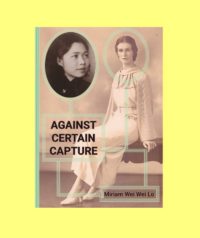
Jackson reviews Against Certain Capture by Miriam Wei Wei Lo

Against Certain Capture

by Miriam Wei Wei Lo

Apothecary Archive

ISBN: 978-0-6488079-7-1


Reviewed by JACKSON

The interestingly eccentric Apothecary Archive recently re-issued Miriam Wei Wei Lo’s collection, Against Certain Capture, which won the 2004 WA Premier’s Book Award for Poetry.

Like many Australian citizens, Lo has a complicated background. She was born in Canada and grew up in Singapore. She has Chinese-Malaysian and Anglo-Australian parents (Lo, About), and their meeting is part of the story of this book, which presents two parallel biographies, one of her Chinese paternal grandmother 梁月仙 (Liáng Yuè Xiān) and one of her Australian grandmother Eva Sounness.

While a prose biography may be lengthy and detailed, a successful verse biography is like a good biopic: it showcases the pivotal events, allowing the reader to extrapolate the story and its significance. Against Certain Capture adopts this approach, offering 21 shortish poems, devoting half to each grandmother. Within their brevity, Lo lucidly evokes these women’s characters and times. 

She does so by subtly deploying poetic craft. The life of 梁月仙 amid the scrabble and crush of twentieth-century China and Malaysia, choosing romance over money and giving birth to Lo’s father in a narrow room above a shop (Lo, Home), is given quick-stepping lines, free-flowing, fast-changing stanzas, and fragments of Chinese. A striking example is “Run”, which appears on the page in three narrow columns, suggesting not only the young woman’s literal and metaphorical journey but also the vertical presentation of traditional Chinese poetry. It opens:

Sometimes life
narrows down
to this
a path
cut shoulder-wide
into grass
two feet
that run
between the
rubber trees
on this
five acres

梁月仙
you hold
your name
and run

Through Lo’s skill with phrase and pattern, we feel the young woman clinging to her cultural identity while labouring for her family’s survival (“the coffeeshop / bankrupt”).

In contrast to 梁月仙, Sounness raised ten children in the dry, expansive Australian rural landscape. Accordingly, her section tends toward slower, prosier lines and more regular stanza patterns. Assessing the farmer she would marry,

she notes that his arms are steady, although his dancing
leaves something to be desired. As they move, she weights
his soberness against bandy legs, his shuffling
two-step, the smell of the farm on his collar. She sways.
(“Saturday Night Dances”)

These examples illustrate how throughout this book the style serves the subject matter. There are no egregious verbal gymnastics. As Andrew Burke comments, Lo’s “diction is so unobtrusive you never notice the words — just what they’re saying”. After all,

There are no pretty words
for hunger.
Only a thin white dribble
squeezed from a cracked nipple,
(“No Pretty Words”)

and dignified maturity deserves understated metaphor:

Eva rises, drawing her years about her —
a cloak of thick and silvering hair
that hangs past her shoulders.
(“Silver”)

Refreshingly, this book is written in the third person. This enhances the sense of intermittently peeking at the two families’ lives as if through a camera. Elsewhere, Lo remarks that she likes “experimenting with aesthetic distance. The practice of Keats’ negative capability … of writing without drawing attention to oneself … was in the back of my mind” (Brennan, Interview).

Sounness, especially, is seen from a distance. In an essay, Lo compares the experiences of researching and writing the two lives. She says writing about Sounness was much more challenging although — and maybe because — she was still alive and Lo interviewed her instead of replying solely upon others’ narratives. This made creating a coherent story more difficult (Lo, “Reconfiguring” 205–207). Perhaps as a result, the Sounness work tends, for me, to be less successful. In particular, there is a good deal of quoted speech which, although Lo handles it skilfully, appears to have been somewhat resistant to rendering in verse. These lines do not ring in my mind after reading like the ones in Lo’s own voice.

Nevertheless, the poems memorably capture the tone of Sounness’s life. Michael Brennan comments that through her poems, Lo “explores family histories with openness, sincerity and a gift for characterisation, giving detail and depth to the conflicts and prejudice, nurturing and love, of the strong women of her family.” He calls Against Certain Capture “an adroit sequence of poems” in which “Lo’s formidable grandmothers … are vividly present” (Miriam). Intriguingly, no-one ever describes a man as “formidable”. Lo herself comments, “I wrote about my grandmothers partly because we live in a world that does not take old ladies very seriously, when I feel that they ought to be taken very seriously indeed” (Brennan, Interview).

Sounness’s recollections are taken especially seriously in “Between a Mother and her Mongol Child”, which juxtaposes the book’s only foray into mid-line whitespace and chopped-up syntax (“connectthe wiring     start / the stop     heart     startstop / the     stopheart”) with a passage from Sounness’s journal (“It took some time before the Mongol became a child”) to vividly express Sounness’s conflicting feelings about raising a child with Down syndrome.

I hope that dated term “Mongol” makes you squirm as I did upon encountering it quoted by a person with Chinese heritage. One reason we read poems is to examine ourselves. As Brennan notes, Lo’s work highlights the “ethnic, cultural and political divisions and contradictions from which contemporary Australian identity evolves, as well as a vital and realistic picture of how the minutiae of culture and identity reshape us over generations” (Miriam). 

I would add that the reason Lo’s poems do this so well is because she chooses not to delineate her sociopolitical concerns explicitly. Hence, readers are free to experience her work on multiple levels, see its connections for themselves, and draw their own conclusions. 

Lo herself comments on this. Discussing poets she terms “hybrid” or “multi-racial” whose work she read as background, she says:

I was also bothered by a general obsession with alienation and the way in which the poetry seemed to become a repetitive performance of various poets’ marginal credentials. I wanted to write something that emphasised not only the relational and communal context of experiences of cultural difference, but also the positive possibilities of hybridity as a mode of being that does not have to be characterised primarily by alienation. (Brennan, Interview)

Perhaps the most important reason Lo writes about her grandmothers is to articulate her personal definition of hybridity, a theoretical term she seems to find apposite, but also uncomfortable because of its “dark linguistic history” (Lo, “Towards” 9–10). To be able to use it, she defines it as seeing oneself as a collection of cultural “parts” in “relationship with each other”. She comments that these “parts” are shaped by familial and historical “factors” and that by writing about her grandmothers, she is attempting to create a “positive” view of hybridity without forgetting how it is affected by prejudiced discourses (“Towards ” 13–14).

One way to do this is through language. The 梁月仙 poems, like Lo, use English as their first language and Chinese as a second (Lo, Home; Brennan, Interview). Because of their appearance and sound, the Chinese fragments significantly enhance the poems’ atmosphere. Lo explains that using Mandarin helped her get inside her grandmother’s head and milieu (Lo, “Towards” 16). It helps the reader, too:

花样的年华,
来如春梦不多时,
去似秋云无觅处。
(“Like the Autumn Clouds, They Are Gone”)

Um … something about flowers and years? I turn to Google, which translates the first line idiomatically as “In the mood for love”, adding wistful romance to Lo’s English version, which beautifully preserves the poetry:

Like flowers, the days of my youth —
they came like the sweet breath of spring
in my dreams, like the autumn clouds
they are gone where they cannot be found.

As Burke observes, this 32-page book is large “in intention and scope”. On finishing it, I felt a little short-changed! I wished I could learn more about the grandmothers’ fascinating lives.

I would also have liked more of the poetry to savour. As Lo herself remarks, “Poetry has to be about pleasure (poetry for its own sake) and it will be relevant and valuable as long as some of us enjoy reading and writing it” (Brennan, Interview). I have certainly enjoyed reading and contemplating this book.


References

Brennan, Michael. Interview with Miriam Wei Wei Lo. July 2011, https://www.poetryinternational.org/pi/cou_article/19021/Interview-with-Miriam-Wei-Wei-Lo/en/tile.
Lo, Miriam Wei Wei. Sept. 2009, https://www.poetryinternational.org/pi/poet/14885/Miriam-Wei-Wei-Lo/en/tile.
Burke, Andrew. Miriam Lo’s ’Against Certain Capture’. Sept. 2004, https://hispirits.blogspot.com/2004/09/miriam-los-against-certain-capture.html.
Lo, Miriam Wei Wei. About. 2021, https://miriamweiweilo.com/.
“Home” FAQ. 2021, https://miriamweiweilo.com/home-faq.
“Reconfiguring a Necessary Entrapment : A Tale of Two Grandmothers.” Beyond Good and Evil? : Essays on the Literature and Culture of the Asia-Pacific Region, edited by Dennis Haskell et al., University of Western Australia Press for the Westerly Centre, 2005, pp. 199–209.
“Towards a Particular Hybridity: A Beginning.” Westerly, vol. 44, no. 4, 1999, pp. 9–20, https://westerlymag.com.au//wp-content/uploads/2016/02/WesterlyVol.44no.4.pdf.


JACKSON was born in Cumbria, England, and lives in Australia and New Zealand. Her four full-length poetry collections include A coat of ashes (Recent Work Press 2019) and The emptied bridge (Mulla Mulla Press 2019). Her work has appeared in many journals and anthologies, notably the Fremantle Press Anthology of Western Australian Poetry. Her awards include the Ros Spencer Poetry Prize. In 2018 she completed her PhD in Writing at Edith Cowan University, winning the University Research Medal and two other awards. During 2018 and 2019 she taught English in China. She works as a poetry editor and casual academic. thepoetjackson.com

Josie/Jocelyn Deane reviews I said the sea was folded by Erik Jensen

I Said The Sea Was Folded

by Erik Jensen

Black Inc

ISBN: 9781760642914

Reviewed by JOSIE/JOCELYN DEANE

The first poem, chronologically, in I said the sea was folded begins 

I don’t know if you read poetry
I don’t know if I write it.
(p.55)

Jane Hirshfield tells the speaker of the book, in another, that poems “are a diary note/ to remember what happened”. Poetry— its writing, language and the ways it can make sense of love/wounded time— is the first preoccupation of Erik Jensen’s book, in spite of its promotion as “love poems”. 

If I said the sea was folded has a unifying trick, it is the framing of poetry— as an activity, an artefact, a mediation of language—  as inherently concerned with itself. This isn’t new— every kind of poetry is implicated by the limits of its field— but through its dramatization, Jensen makes it the engine of his poems, and the narrative at their core. It insists that any kind of therapy or catharsis poetry can affect first passes through the poem as a text, revelatory and profoundly alienating at the same time, for reader and speaker. It’s no surprise that the book ends with a gloss on what is inexpressible, as “the background against which/ anything I could express has its meaning”; any poetry concerned with itself-as-poetry ends in the same place,  turns liberating and restrictive. 

Most of the poems directly enact this passage through themselves—and the medium of the speaker— detailing their own construction. The book is divided into 3 non-linear chronological segments, starting from the end of a relationship. Some play on a motif that appears across each segment, decontextualizing as time rewinds. Poems refer back to each other, to their germ at the beginning of the relationship, only to emerge bitter and accusatory at the end. A poem about the love language of turtles— precious in its inexpressibility through human terms, its lack of projection— is foreshadowed by its later, first appearance, when the speaker spits 

why did you shout last night, when all we wanted
was to feel the simple, placable love
of a turtle stacked up on a turtle?
(p.14)

Other works— ‘Pinter’s Betrayal’, ‘Nick Payne’s Constellations’— use non-linear time to excavate the normativity of works inspired by love: inverting the dramatic arc of meet cute, juxtaposing romantic gestures with their fizzling out, coupling them the self-interest. It has the effect— ironically— of emphasising the radical contingency of romantic relationships. Something portrayed as normal/monolithic is tessellated with a thousand shards of gender-play, class signifiers and naturalisation.  Addressing their partner, the speaker defines the poems in their book, subject and object, as “the ways I’ve tried to look”, approaching their partner’s non-binary self, “broken off in the parts I’ve wanted to see”. This “trying to look”, defined by its engagement with failure, finds its corollary in the inexpressibility of poetry, that “Words are not enough… they exist too much/ for the people that made them”, as the speaker reports their partner saying.

 If the poems pass through themselves in I said the sea was folded, that passage involves reaching for each other, and— through each other— the absent beloved, remote in space/ time and— the speaker dramatizes— driven away by the normativity of poetic discursiveness and— the speaker insinuates— the speaker’s own norminess, their reproductions of those norms in speech. The poems as a result are sparse, connotative, to the point of vagueness, the recording of imagistic details, juggling/juxtaposing poetic diction with simple, deliberately banal records of the relationship, as if to invite and stave off interpretation. They “hold in place/even when the other/is no longer here”. 

Linguistic reference, not only to themselves but as a whole, becomes a key technical, thematic and ethical concern of the poems. Through reference they transcend, feed back into each other’s use of metaphor/imagery and establish a poetic whole out of the disjointed timeline, all while their essential emptiness and arbitrariness are emphasised. Individually, the poems can read as circling a void. A list of vague, deliberately poeticized descriptions of trees “fixed against the sky… their branches bent/as if the cold had stunted them”, “hedges of agapanthus” and “money/after it had been spent” conclude with “I suppose what I’m trying to say is/ I love you”, direct address immediately couched in/ out of the speaker’s suspicion of language and its stock trade. In one poem the speaker’s grandmother offers a warning, in two lines, “against poems/ she said they are forever”, the rest of the blank page almost a literalisation of this. There’s a sense of almost-tragic irony in the poems: they enact a double movement between sense-making and performative contradiction. In the prologue Jensen offers a mea culpa to the poem’s addressee: “I wish I met you now/but of course I met you then/and the rest of that time/is just what happened”. Reading through the book linearly, using the poetry’s logic to piece the continuity together, following the speaker’s own desire to “let you be/ to feel it for yourself”, we end in a place full of promise and retroactive empathy that cannot be real. 

It’s in this continually moving/retreating space that the ethical desire of I said the sea was folded lives. In writing “love poetry” where the beloved is conspicuously absent, their construction put in air-quotes, Jensen tries to build a space where the deferral of reference comes to signify a queer, non-binary being, the “background against which/ whatever I could express has its meaning” . In this he mirrors, and directly draws on, Maggie Nelson, citing her “complaint/about the instability of likeness” that retroactively informs the poetics of the book. As the speaker murmurs: “one tree is like another tree/but not too much”. In this space hollowed out by the poems— Jensen implies— a love poem that can adequately represent a non-binary beloved, from a cisgender perspective, can take shape. A kind of representation— the paradox is intentional— predicated on inexpressibility, the perfect silence of a “good ally” that doesn’t overstep their boundaries. Jensen frames this as a hard won ethical lesson on his part, after the breakup, “Nothing occurs in order/although it takes a whole life to realise/so I haven’t”. At the same, it’s a lesson predicated on cis incomprehension, and inevitable tragedy. If the cisnormativity of love poetry is critiqued through the book’s structure/poetic style, it seems to conclude in a fatalism complementary to “good allies”: I will inevitably, tragically misrepresent you in my poetry, and I’m truly sorry. My intentions were good. Cis people, this is what you must take heed of to avoid my sorry fate, the limits of my poetic language and world.

 If the poems of the book set up a negative dialectic, opening up space for non-binary reference/critique, the cis speaker remains an unmoved mover, perfectly still, separated from all that gender through their work. But the true issue is, as a non-binary person, I can’t believe in the inexpressible. Or at least the version reified by Jensen or Nelson. A reckoning with what being non-binary implies— a critique of colonial gender construction, the ongoing role of gender in upholding white patriarchy and capitalist accumulation, the kind of limiting subjectivity that is affixed to the “non-binary beloved”— seems beyond it. If non-binary space— Jensen writes— is a kind of via negativa, I couldn’t think of something more obstructive to it than this deployment of the “inexpressible”, or the poetry it suggests. It makes me think of the tweet: a weeping voice tells someone that they can’t simply say everything is a gender. The person, unmoved, points at a weird cloud, a cat, a sloth-mug: gender, gender, gender. 

What does this all add up to? A series of finely detailed, observant poems that don’t hang together? A structure and poetics that turns that lack into a good technique, a kind of join-the-dots that performs an interesting self-critique of poetic language and tradition, which— like Nelson’s work— is more important for what it crystalizes than opens up? In the end, I’m encouraged to take this kind of poetry from cis lovers of non-binary people, in the same way I’m encouraged to accept good allyship… What I have time for in the work I should appreciate, and the idea of the inexpressible I’ll try to disabuse, to prevent it causing potential mischief among the good cis people. Meanwhile, I’ll be over here with my partners.

References:

  1. Nelson, Maggie. The Argonauts, Minneapolis, Greywolf Press, 2015, print. 

JOSIE/JOCELYN DEANE is a writer/student at the University of Melbourne. Their work has appeared in CorditeAustralian Poetry Journal and Overland, among others. In 2021 they were one of the recipients of the Queensland Poetry Festival Ekphrasis award. They live on unceded Wurundjeri land.

Announcing the 2021 Mascara Bundanon Writer’s Residency Winner

We’re thrilled to announce that the winner for the 2021 Mascara Bundanon Writer’s Residency is
 
Isabelle Li

Isabelle Li is a Chinese Australian writer and translator. She has published in various anthologies and literary journals in Australia including The Best Australian Stories, Southerly, Westerly and UTS Writers’ Anthology. Her collection of short stories A Chinese Affair was published by Margaret River Press in 2016. Her prose translations have appeared in Sydney Review of Books and her poetry translations in Mascara, World Literature and Works. Her Chinese translation of Sebastian Barry’s novel The Secret Scripture is published by Zhejiang Literature; Art Publishing House. Isabelle is currently studying her Doctor of Creative Arts at Western Sydney University.
JUDGE’S COMMENTS

Isabelle Li’s ‘The Northern Tomb’ is exciting, engaging, and very promising. It employs a smooth narrative voice, suffused with telling details and implications of character; a facility for drawing the way characters gently push and pull against each other. There are many clever, artful details about the narrator, her son Dawei, and Mr Zhao. It is confidently handled. There are also clever hints throughout about the cultural setting and details of contemporary life. Li shows a deft touch and subtle hand for the telling detail. Straightforward and raw, it inscribes real and personal experiences in Australia and provincial China, replete with their violence and personal destitution. The emotional leaps are handled well through stoicism and resignation. Her writing is a mature example of the trans-migration of the imagination and its understated translation into melancholia and dislocation.

 
We thank our 2021 judges: DECLAN FRY and BRIAN CASTRO

A few words from Mascara

“The applications we received speak to the sheer talent, voice and diversity of stories, essays, mixed media and poems in our cohorts. We were thrilled with the response, the vividness and creative lifeblood infusing the projects.”

About

In partnership with the Bundanon Trust, the inaugural Mascara Bundanon Writer’s residency is an exciting opportunity for an emerging or established First Nations or CaLD writer with an innovative project that pushes their writing craft into new expressive and conceptual territory. We received applications in poetry, fiction, non-fiction, graphic fiction. The winner receives a two week residency at Bundanon, a stipend of $1,000 and a manuscript reading to be arranged with Ultimo Press. A chance to immerse in the layered landscape and history of Bundanon, a place of renewal, where new relationships to country, history and creative practices are formed. We thank the Wodi Wodi and Yuin people for their care of and connection to land, culture and community.

SHORTLIST 

Timmah Ball

Timmah Ball is a non-fiction writer, researcher and creative practitioner of Ballardong Noongar heritage whose practice is influenced by a short career in urban planning. Her writing has appeared in a range of anthologies and literary magazines such as The Sydney Review of Books, Meanjin, The Griffith Review and Columbia University’s The Avery Review. In 2016 she won the Westerly Patricia Hackett Prize and is currently an Arts House Makeshift Publics artist in resident and editor of First Nations writing for The Westerly Magazine.
JUDGE’S COMMENTS

Timmah Ball’s Blue Print for Another World is remarkable for its melancholic tone and questions the power of conceiving design and planning to refigure Australia as ‘a multifaceted continent whose unique and divergent cultures make up a complex ecosystem rather than the western construct of states border, regions and capital cities.’ It is marked by its searching, frank assessments of self and place and the contradictions of reflecting on change within the luxuries of capitalism: ‘in the cycle of deep discussion we only ever brush the edge of change.’ This is a work of ficto-criticism and it cleverly reconstructs a map viewed from a complex First Nations ecosystem. Her writing is richly engaged, revealing a strong social commitment to the connection between poetics and cartography, between language and country.


Luke Patterson

Luke Patterson is a Gamilaroi poet and folklorist living on Gadigal lands. He is interested in the ways bioregional identities and consciousness are expressed through localised and vernacular forms. Luke’s research and creative pursuits are grounded in his extensive work with Aboriginal and other community-based organizations across Australia.



JUDGE’S COMMENTS

TEK expands on the “Authority” and constitutes a poetic and methodological experiment that plays on the anthropologically derived term “traditional ecological knowledge”. Patterson’s poetry is muscular and sinuous. Its interlaced rhyme patterns and use of assonance and slant rhyme are notable, providing music and movement to the verse. He has a great command of language and his commitment to ecology and the environment is unquestionable since he combines this with knowledge and history. The cadences and rhythms of his work are outstanding: city and country; capitalism and indigeneity; climate and chaos. 


Saba Vasefi

Saba Vasefi’s personal lived experience as a refugee and exiled feminist poet and writer together gives her unique experience and insight. Since seeking asylum in Australia and started to write in English, I have been focused  on completing my PhD and fulfilling my journalistic work. For four years, she was director of Sydney International Poetry and Arts Festival, and two years director of Diaspora symposium. Recent Work Press has published her current project the Borderless, A Transnational Anthology of Feminist Poetry

JUDGE’S COMMENTS

Saba Vasefi’s poetry is dramatic and lyrical. There is a conflation of poetry and autobiography, which gives her work a frankness that is limpid and clear-sighted. Saba Vasefi’s poetry is notable for the contrasts it draws between the mundane and violent: ‘No matter how many holy verses / they made my mouth express, / no prayers found their God.’ A highlight is ‘The Forbidden Gender’ which begins with a contrast between its quotidian details and the shock of the last line: ‘The road had potholes, / the school had veils, / and the students / lay dead under their burqas in a well.’ It includes perhaps one of the best couplets in the collection: ‘Instead, we were free / to die as much as we desired …’


Pip Newling reviews Song of the Crocodile by Nardi Simpson

Song of the Crocodile

by Nardi Simpson

ISBN 9780733643743

Hachette 2020

Reviewed by PIP NEWLING


To read Song of the Crocodile is to immerse yourself in an unfolding relationship to place. You may not recognise it immediately but the profound connection to place shared by Simpson through this story is a slow build to love, yearning, recognition and respect for Country.  The novel is a confident and accomplished debut by Nardi Simpson, a Yuwaalaraay woman best known for her singing and song writing as a member of the Sydney band the Stiff Gins. It is a profound intergenerational Australian story of family and Country that deserves to be as celebrated and well-read as Tim Winton’s Cloudstreet.

The novel illuminates a way of thinking, of loving and of living. Simpson’s musicality, the fluid way she uses language, both English and Yuwaalaraay, throughout underscores the narrative by creating landscapes of emotion. It reveals connectedness and relationship across time and place, allowing language and Country to breathe. Song of the Crocodile is a lyrical achievement of story, language, and heart.

Set in a time resembling the 1950s, the book opens with Simpson walking us into Darnmoor, a small regional town in the north-west of NSW with the tag line ‘Gateway to Happiness’ on its welcome sign. We see the early morning quiet streets, the shuttered shops and the war memorial in the centre that provides the focus for the town. We walk through the town, leaving the ‘inoffensive, modest and calm’ façade of Darnmoor, to the Council tip, a bora ground now covered in the town rubbish, and then on further to the Mangamanga, a great river near where the local Aboriginal people live on a place called the Campgrounds located at the end of Old Black Road.

This introduction sets the foundation for all that will follow; the demarcation of bodies, dreams and knowledge, and what happens when boundaries are pushed. Powerfully, the story is told only through the experience of the Aboriginal characters. The white characters are significant actors, changing hopes and lives, but they are not the emotional or narrative focus.

The characters

The story is of three generations of women, Margaret Lightning, her daughter Celie Billymil, and Mili, Celie’s daughter.

Living on the Campgrounds and working in Darnmoor, Margaret is quiet and hardworking, navigating the white town with caution. She works at the hospital, doing the laundry and walks into town each day using side streets to reach her destination. The demarcation of race occurs in the hospital too, with Aboriginal patients installed on a side verandah with Margaret acting as their nurse, cleaner and counsellor, and conduit to the white management. Racism is ever present, in the demand that the sheets used for the Aboriginal patients are burnt rather than washed and re-used, in the level of care for the Aboriginal patients, the amount of information Aboriginal patients are provided about their health.

Celie is a kind, calm constant energy in the story. She suffers loss with dignity and determination to provide a future for Mili, her daughter, and she uses her knowledge of the town to create opportunity.

Mili is the future generation. She lives in change, where her newly fashioned hopes are regularly pushed down and obstructed by the white systems of power in the town. Mili becomes a bridge between the Aboriginal and white worlds, a burden of much weight.

Ancestors feature too, some being stars, trees and dust. They are ever present and active, guiding and preparing the earthbound people for the future while drawing on the old ones for advice and support. The sky-bound observe from the ‘the roof of the plains’ and move across the Milky Way, called Warrambool in Yuwaalaraay language.

Some ancestors that drive the story are Jakybird, the Songman who brings the choir together for the song of the crocodile; Garriya, the malevolent single-minded crocodile who lies in the earth far below the town waiting for his chance to return; Margaret and Celie’s lightning kin who herald the rain; Murrudhi Gindamalaa (Laughing Star) who protects and provides for the newly dead; Malawildhuulmuranga (the Littlest Shadow at the Darkest Time Before the Dawn) who disappears into dark nights hiding diamonds, stars, within her; and Burrenjean, (the featherless bird) the human form of magpie lark who ‘makes the country sing’ despite being name-called as mudlark. Her feather father reassures her of the significance of her earth-bound origin when he tells her:

‘The mud is the beginning of our connectedness. The beginning of our responsibility, the reason we are needed…

What is mud but the joining of all that is above and all below?’ (p210)

Connectedness

Simpson seamlessly conveys the world above, on and below the plains as one. Her telling of Aboriginal philosophy, of Country, belonging and lore, details consequence and relationship for all creatures, not just human. In Song of the Crocodile, all things are elemental and connected; all things are in fluid relationship to each other, including the writer and reader.

Her inventive way of weaving Yuwaalaraay words and meaning throughout the English without direct explanation, creates space and invites the reader to read in a different way, from a different angle. There is no singular understanding or story in this novel. It is layered and readers will find different connections within it.

The characters experience connections, often surprising themselves. By the river, when the women gather to comfort Margaret, who has been disrespected and disappointed (again) by white townspeople actions, Idy, an older Aboriginal woman, begins singing. Margaret joins in. She knows the words, and the power of the song, but can’t remember when she learnt it. Celie and Mili both, find comfort from tragedy in the Double D, an ancient coolabah tree by the river that saw the boras, long before the town was first laid out.

Another tree, where Celie’s husband died, along the Old Black Road, draws Celie, newborn baby Mili and Celie’s young nephews:

‘Aunty Ceil, Nan told me about the trees, how they remember everything. How they hold memories for people… But here, around here, is where he lived too. Aunt, sit down.

… Nan taught me all about it. They hold life. The bad stuff they take away through their roots and release it into the ground.’ (p67)

For Malawildhuulmuranga, her connection is planetary, as her Dhaa explains, ‘You are a daughter of dawn, the only thing separating darkness from light and the only thing that joins them.’ (p82)

Jakybird assesses and marvels at Paddy, Mili’s son who is in deep despair:

‘He watched Paddy sway into town, messy, loose, stumbling, but erect. This must have been powerful magic, remaining upright when all conspired to pull him down’. (p344)

Paddy reminds Jakybird of Garriya, now crocodile but who was once a friend, and the connection is made again between the ancient and the now.

The connection of life and death is always close too. At one point, Wil, Mili’s husband who has died, tries to reach Paddy his son, to induce a flicker of hope in Paddy’s heart:

‘High in the star, Wil moved memories into his son. They were only colours: the deep blue of a uniform, the bright orange of a council hat. Flashes of smiles, places they’d been, or the feel of a fishing line or the ruffling of his hair.’ (p350)

Connection is everywhere in this story, connection to all creatures, to the past and to the future. Even when the characters feel most alone, the reader knows they are not.

Demarcations and boundaries

The town geographically delineates between Aboriginal and white clearly. Darnmoor, as most real Australian towns did, corrals the local Aboriginal people outside the white perimeter, past the rubbish tip at the end of the Old Black Road. The history of this practice extends back through to the first settler fence-builders and town planners on this land. For instance, the town I grew up in, Taree on Biripi Country on the NSW mid north coast, pushed/ took/stole/drove local Biripi people to a reserve, Purfleet, south of the town across the river.

Song of the Crocodile reveals these practices as oppressive, common and complex. Some Aboriginal people are allowed inside the unspecified fence, but this comes with negotiation and always a cost. We see the cost to Margaret first:

‘When the purple bush blooms began to thin then disappear and the edge of a tared road loomed ahead, Margaret’s voice began to soften. At the street sign, she pushed the notes further into the back of her throat, constricting their flow and burying them within her body once again. As her shoes hit the asphalt of Charity Street, she fell completely silent.’ (p11).

In the novel, just as in the real world, Aboriginal women use their intimate knowledge of the white world strategically, while the white characters have no insight into how little they understand of – or are required by – the Aboriginal world. This considered and deliberate reveal, of how an oppressed people know their oppressors intimately while the oppressors have no clue, was a highlight in the story for me.

White actions have impacts on the Campgrounds community. These impacts are frequently dismissed – or even unimagined – because white people believe they hold the power and can choose not to notice, not to listen. We see the impacts roll down the generations affecting people and land the same. The white settler idea of progress – unsustainable growth through exploitation of land and people – clashes fundamentally with the integrated, cyclical nurturing and honouring connections to past, present and future that most of the Aboriginal characters carry in the story.

The Darnmoor inhabitants praise the achievements of white men above all else. Like many real Australian towns, the townspeople invest in appearances not community, in short term thinking, unsustainable futures and ignore or decry other ways and other people. The town rubbish tip placed on the bora grounds is just one example. Another is the construction of a levee around Darnmoor to hold back flood waters.

The town celebrates the completion of the levee, but the levee creates further demarcation between the Aboriginal and non-Aboriginal people of the area. When Mili’s tears begin to flow, and all the travesties of humanity she has had to endure come to fruition, the danger of ignoring Country is clear. Garriya gathers his energy and slowly surfaces, the sky inhabitants dance the old bora grounds, which never disappear or age no matter how significant their apparent destruction appears, and:

‘… the townspeople watched the levee, holding their breath, waiting to see if the mound would breach, wondering if all they had created would be destroyed and washed away.’ (p401)

These practices of demarcation – white choices – are damaging and shamefully long-lived ones. They are still present in many towns across Australia. Through fiction, Simpson powerfully writes the truth of the contemporary relationship between Aboriginal and non-Aboriginal people.

The gateway

Jakybird warns the sky inhabitants, sitting around icy fires in Warrambool, the Milky Way, that the singing of Garriya ‘… is a hard one; some of you will die a second time in its singing’. (p354).

Darnmoor is not a generative gateway, and certainly not one to happiness as that welcome sign states. Warrambool, the literal heavens, is a gateway to the next place, for some a return to the earth, for others to sing again, others to sleep and wait some more. The act of singing is also a gateway, for it is part of culture, of belonging, of the turnabout of the world. It leads us to another place, another future.

The novel itself is a gateway too. Its landscape is wide and considered as Simpson tells the truth of our ongoing relationship with First Nations people of this Country. She details the changes to landscape that compound negatively and highlights the lack of accountability and short-sightedness of our settler society.

While Song of the Crocodile is a local, family saga, it speaks to our national story, and Simpson, with heart, attention and tenderness, shows readers a perspective that most of us will never have imagined before. This is what great fiction does, implicates and expands the reader’s emotional and philosophical terrain.

Towards the end of the novel, Malawildhuulmuranga asks one of the old ones ‘… why do you want to destroy it?’ and he answers, ‘How do we begin again, if, first, we don’t let go?’. (p365)

These are powerful cycles of renewal. We know change will only be made if we learn the lessons of the old ones. There is hope here, in this story, if we listen and learn.


PIP NEWLING was born on unceded Wirrayaraay Country, grew up on Biripi Country and lives and works on Dharawahl and Gadigal Country. She thanks all Elders from these lands, past, present, emerging and future, for blessing her with the health Country provides and the opportunity to benefit from their custodianship.