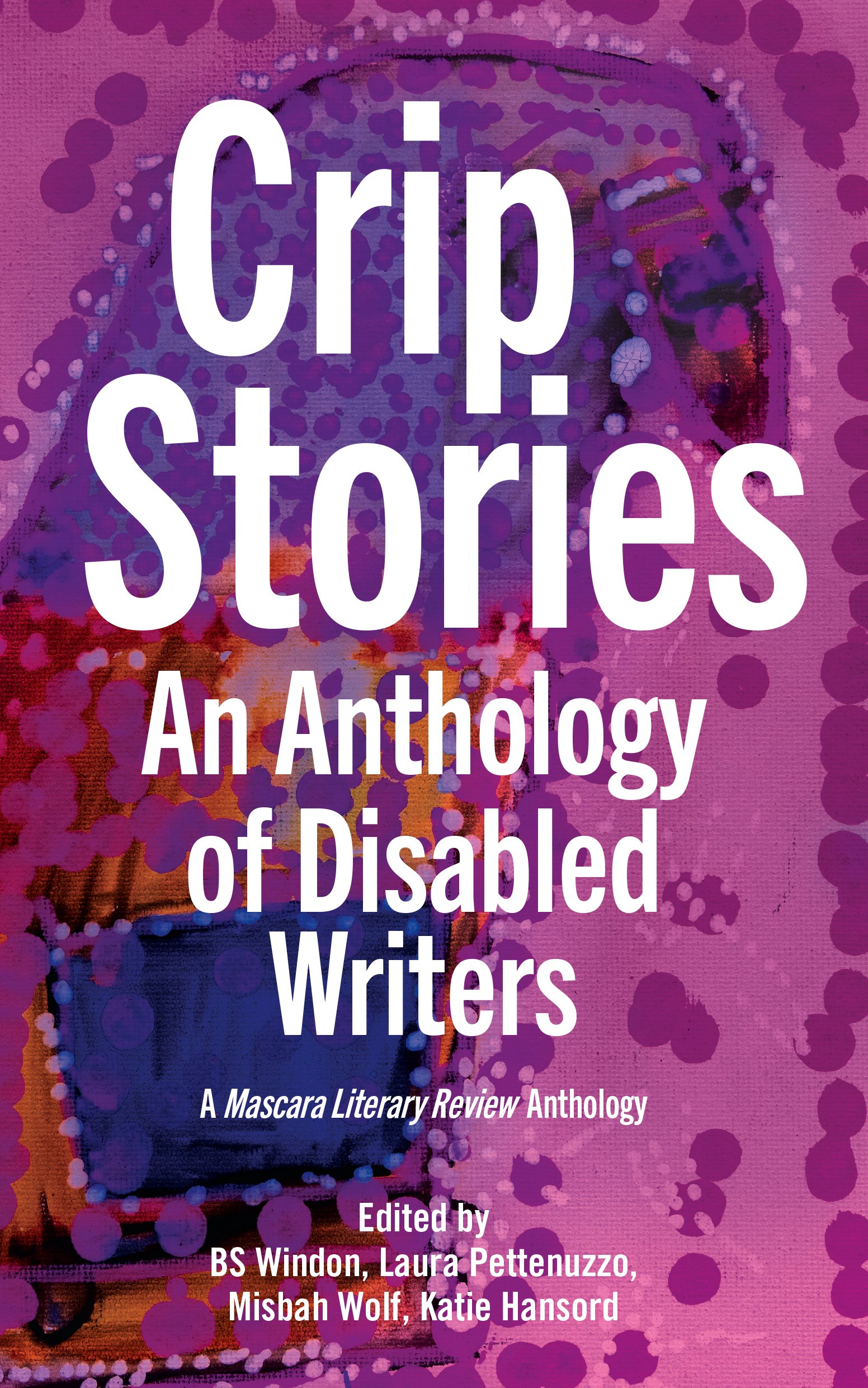
 Crip Stories: An Anthology of Disabled Writers
A Mascara Anthology
Edited by BS Windon, Laura Pettenuzzo, Misbah Wolf and Katie Hansord
ISBN 9781761170478
Reviewed by LIEU CHI NGUYEN
As politicians debate National Disability Insurance Scheme (NDIS) funding, in the setting of continued inequity for Australians with disabilities, this book could not have been timelier. Crip Stories: An Anthology of Disabled Writers, edited by BS Windon, Laura Pettenuzzo, Misbah Wolf and Katie Hansord, was created through a collaboration between Mascara Literary Review, Creative Australia and NewSouth Publishing. The partnership was a substantial and strategic investment that enabled Mascara to break new ground. Situating themselves in a ‘long lineage’ of texts such as Disability Visibility: First-person stories from the twenty-first century, edited by the late Alice Wong, the editors aimed to ‘honour the writers, activists, and communities who cracked open the canon, fought for access, and told stories outside official archives’ (xiv) through centring lived experience of disability as told by people actually experiencing it … increasing literary visibility and advocacy [and] challenging the rampant experiences of harm, stigma, dehumanisation, ableism, inaccessibility, shaming, exclusion, and misinformation (xiv).
In the first instance, Crip Stories has certainly done this with all the aforementioned editors living with disability. Alongside their editorial roles, they also contributed work to the anthology, making up a total of thirty-five voices who serve as a veritable chorus of disabled storytelling. No doubt a reflection of the diverse disabled leadership within the editorial team, many of the words found in these pages are from BIPOC and LGBTQIA+ writers, making this an unprecedentedly impressive contribution to not only disability literature but to diversity in the Australian literary scene, giving time, space and expression to those who may be multiply marginalised.
From the title itself (‘crip’ is a reclaiming of a historical slur) to the subject matter, Crip Stories is steeped with a multiplicity of meaning that ultimately represents, interrogates and upholds ‘disability pride’. The editors refuse to define this phrase but express it as a stance of ‘refusal to hide our disability or minimise our access to needs for the comfort of non-disabled people’ (xvii). Contextually, seminal late-twentieth century disability studies’ scholars and writers, not limited to Audre Lorde, Rosemarie Garland-Thompson and David Mitchell and Sharon Snyder, have argued that for much of Anglosphere history, the meaning, socio-cultural place and existence of disability has been one of marginalisation, for a group of people that are ultimately very varied. The challenges that society imposes on those with disability intersects with other identities not limited to race, gender and sexual orientation. These thematic webs permeate the anthology, and rightly so. It is of note that all the included texts are a true form, namely memoir, poetry and personal essays. There is a power and gravitas to the truth directly being told to the us, the reader, as a method of encouraging empathy.
It is from this ‘open heart’ perspective the editors have encouraged, as a non-disabled person, that I approach the works in this anthology. As a doctoral candidate whose dissertation topic intersects with disability, and who is aware of how the normative perspective of disability is one of physical challenges (think of the predominance of the wheelchair as disability symbology), it is great to see the first two works by scholar and writer, Irina Frovola and Wiradjuri writer, Sharleigh Crittenden respectively, are of invisible illnesses (3-15). Frovola’s twin poems, visually and linguistically playfully juxtapose the spoon analogy of daily energy within academic institutions (‘Spoon Theory’) with the life-affirming freedom of art and nature (‘Spirit’) (3-5). Crittenden’s creative non-fiction is particularly affecting, describing her experiences of being Aboriginal, a mother, a former child in the foster system, and having diagnoses of hemiplegic migraines, endometriosis, trauma-related mental ill-health and epilepsy on an unceded land built for drivers and a medical system that can both dismiss and intrusively monitor. She asserts, ‘my joy and my chaos as intertwined and inseparable’ (12).
Other writers directly reference the social model of disability which state that people are disabled by barriers in society rather than their impairments or differences as is often claimed by the biomedical model. Ari Spanos, who introduces themselves, in their own conversationally-toned personal essay (64-72) as ‘neurodivergent, disabled, mad, queer, genderqueer and intersex’ (64) and from a Greek heritage, states ‘being Autistic and ADHD disables me in this society’ (68) and describes not being able to work a full-time job due to fatigue and executive functioning challenges (69). And while Spanos’ experience of Greek culture means they experienced traditional gender role pressures that are not true to them, family and generosity afford a love and support that would be otherwise be incompatible with post-colonial Australia’s cultural hyper-individualism. Systems being the ironic perpetrator of harm is expressed in Dulgubarra-Yidinji writer, journalist and comedian, Skye Cusack’s oft-times stream of consciousness memoir, ‘Here’s what I think happened’ (78-86) where trauma-related mental ill-health leads to an infuriating spiral through the police and healthcare systems and ultimately, where no clear justice is found. Cusack, like Spanos points to her stability and wellness as a testament to her ‘grassroots community and…self-determination’ (85).
Violinist and writer, CB Mako similarly links the intersections of chronic illness, race and poverty in navigating life for them and their daughter who is immunocompromised and disabled, in their creative non-fiction piece (56-60). For many of us able-bodied people, the Covid-19 pandemic seems like some ancient two-year long fever-dream, but for Mako and her little family, incredibly hard decisions have to be made between ‘[buying] medication for long Covid or [buying] food for [her] offspring (60). The ongoing threat of Covid long after state and federal governments lifted isolation measures, is harrowingly told in Carly-Jay Metcalf’s medical memoir of contracting Covid-19 in 2024 as a person with cystic fibrosis and double-lung transplant recipient (87-92). Both these writers reference the mask, which for them is not an impracticality or controversy but a medical practicality which is a metonymic visual Othering caused by disability. It is a grim reference to a history of disabled people, writers or otherwise, being isolated and excluded from living a full and meaningful life.
While hardship and injustice permeate the pages of Crip Stories, there is also rebellion, joy and compassion. In ‘Return’, TextaQueen’s first of a suite of three poems, early morning rebellion away from the ‘ableds” exists on the Internet (51-52). In personal essays, writer, speaker and Crip Stories’ editor, Laura Pettenuzzo finds joy in writing (177-181), queer, autistic writer and paralegal, Joey Harper challenges cringe culture with an analysis of nationally beloved red-heeler, Bingo from the Bluey cartoon (182-185) and multi-talented-and-skilled belonging practitioner, Akii Ngo, ends her piece with a triumphant description of her advocacy work which hopes for a better future for those facing similar barriers (109-117).
There is a tenet that developed in the disability space from the 1990s, that says, ‘nothing about us without us’. This adage is quintessential to Crip Stories, which stands in its own right as carefully, lovingly and generously curated, upholding the multitude of declarations and creations of its contributors. I read this book over a couple of days in snippets as well as on hours-long sittings. Every time, I felt like I was listening to a friend, colleague or educator and often all of the above. The themes of rebellion, the social model and disability through art, the spectre of Covid and intersectional identity and justice interrogated by a congregation of diverse voices, echo off each other within the text. Crip Stories has created a new and important corner of disability storytelling.
References:
Australian Federation of Disability Organisations. Social Model of Disability. Australian Federation of Disability Organisations, n.d., https://afdo.org.au/social-model-of-disability/. Accessed 13 September 2026.
Australian Government. Australian Institute of Health and Welfare. People with disability in Australia 2024. Australian Institute of Health and Welfare, 23 April 2024, https://www.aihw.gov.au/reports/disability/people-with-disability-in-australia/contents/health. Accessed 13 September 2026.
Basford Canales, Sarah. ‘Controversial NDIS bill passes Senate with ‘substantial’ amendments as Labor and Coalition strike deal.’ The Guardian, 18 August 2026, https://www.theguardian.com/australia-news/2026/aug/18/controversial-ndis-bill-undergoes-substantial-amendments-as-labor-and-coalition-strike-deal. Accessed 13 September 2026.
Windon, BS et al, editors. Crip Stories: An Anthology of Disabled Writers, New South Publishing, 2026.
LIEU CHI NGUYEN is a Vietnamese-Australian writer and core member of Sweatshop Literacy Movement, residing on the unceded lands of the Yirrganydji people. Her short fiction, non-fiction and poetry have been published in SBS Voices, Mascara Literary Review, Kill Your Darlings, The Australian Muslim Review and various anthologies, most recently, Love (Sweatshop 2025). Her fiction and poetry have been shortlisted for the RUSSH Literary Showcase 2026 and 2020 Heroines Women’s Writing Prize. Outside of writing, she is a Media and Communications doctoral candidate at the University of New England and a clinical psychiatrist.