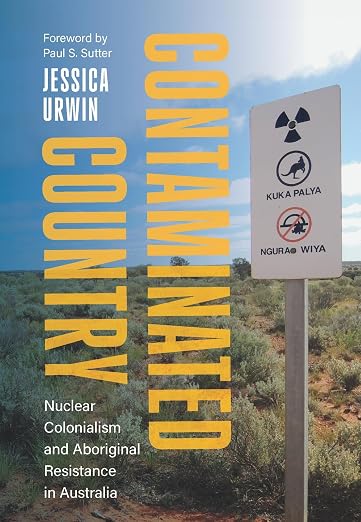
 Contaminated Country
by Jessica Urwin
Melbourne University Publishing
University of Washington Press
ISBN: 9780295753782
Reviewed by SAMUEL J. COX
At 7AM on October 15 1953 Britain’s first inland nuclear test, code-named Totem I, took place at Emu Field in a supposedly isolated desert region of northwestern South Australia. Despite assurances the region was uninhabited, Yami Lester was among the Anangu people who encountered the ‘black mist’ of a radioactive fallout cloud that unexpectedly drifted northeast across the country. Over the subsequent four years, Yami gradually lost his sight and was completely blind by the age of sixteen. As Australia debates a nuclear future once again, and global awareness of anthropogenic damage to the planet continues to heighten, Jessica Urwin’s Contaminated Country returns to reassess the complex legacy of this continent’s nuclear history.
The public awakening to Australia’s nuclear history occurred with the ‘McClelland’ Royal Commission of 1984-85, but as Urwin shows, this awakening has a divided legacy. On the one hand, it allowed Indigenous testimony to emerge for the first time, helping bring Yami Lester’s first-person account into print, alongside subsequent community histories such as Maralinga: The Anangu Story (2009). On the other hand, the Royal Commission was biased by Hawke-era New Nationalism and emerging republicanism, which ensures, as Paul Sutter notes in his foreword, Australia has largely been perceived as the ‘victim of nuclear imperialism’ (ix). Urwin’s Contaminated Country brings the more established history of nuclear weapons testing into a wider framework of nuclear colonialism, connecting these acts of imperialism to the nation’s deeper history of mineral extraction and settler-colonial dispossession of Indigenous lands.
Urwin’s frame of nuclear colonialism is informed by North American scholarship. Together with Contaminated Country’s focus on Indigenous Country in northern South Australia, this enables Urwin to tell a century-long history with continuity. A feature of nuclear colonialism is the targeting of peripheral, Indigenous inhabited lands for polluting and contaminating industries. It is therefore no coincidence that South Australia, with its vast arid interior lies at the ‘center of Australia’s nuclear past, present and future’ (Urwin 11). Nuclear testing promised to catapult a region that Western anthropology had deemed to be ‘stone age’ into modernity by transforming it into ‘a site of modern utility’ (9). It is the perceived settler right to claim land by putting it to ‘proper use’ (however improper) that links the various claims on Country across this book.
Instead of opening with the dramatic blast of nuclear detonation, Contaminated Country traces the roots of nuclear colonialism in Australia to the early discovery of radium and uranium in the Flinders Ranges. Urwin’s seemingly most peripheral chapter is also among the book’s most original, tracing the role of renowned Antarctic explorer and University of Adelaide academic Douglas Mawson in these early exploration efforts. Mawson sought to establish his authority in the field even as he founded the short-lived ‘Radium Extraction Company’, which employed the Indigenous knowledge of tracker and cameleer, Claypan George. Most importantly, this chapter charts the transformation of radium and uranium from a ‘marvel of science’ to, by 1944, a ‘mineral of national and imperial significance’ (39). Mawson’s involvement is emblematic of the shift from lone explorer-scientists to increasingly systematised, state-based endeavours of national and imperial significance.
This era of state-led nuclearisation culminates in the establishment of a missile testing range at Woomera and subsequent nuclear testing at Emu Field and Maralinga. From the initial postwar decision to establish Woomera as a site for British missile development, the logic of British imperialism was clear: Australia offered vast expanses of seemingly open terrain, geographic isolation and distance from Britain itself. The motivations of the Australian government are less immediately obvious. Menzies’s Anglophilia has traditionally served as a convenient scapegoat, whereas Urwin argues that more pragmatic, self-interested ambitions, including access to technology and the prospect of protection under the British nuclear umbrella, enjoyed bipartisan support. Indeed, any simplistic account of Australia as a subordinate victim is deeply complicated by its unique position as a self-governing nation that offered up its territory for nuclear testing by a former imperial power. By seizing land in northern South Australia previously designated as an Aboriginal Reserve, the state exercised its own colonial authority over ‘remote’ Country, exposing how quickly concerns over Indigenous welfare were discarded in the face of strategic interests.
Urwin shows how, unbelievably, local news reports characterised the expropriation and militarisation of these lands in utopian terms of modernisation: Woomera military base was characterised as an ‘oasis’ or ‘Eden’ in the desert (48). The past may be a foreign country, as the old adage goes, but Urwin shows it is not so distant here as to provide an adequate alibi. Significant public opposition emerged from the outset. Presbyterian campaigner for Aboriginal rights, Charles Duguid, who had also been instrumental in establishing the Ernabella mission as a means of limiting pastoral incursion into Anangu lands in the 1930s, became the public face of this opposition. As early as 1946, Duguid was condemning America’s treatment of the Marshallese on Bikini Atoll and linking it locally to the violence of removing Anangu from their homelands, who could not be compensated for the loss of their ‘spirit lands’ (49). Writing in a London newspaper, he also anticipated that the missile range would rapidly expand into a nuclear testing ground where Indigenous people became ‘human guinea-pigs’ (50). For Urwin, the predominant settler conception of the desert is epitomised by military writer Ivan Southall’s declaration in the early 1960s that its ‘spirit had expired… man had arrived too late’ (47), but Duguid’s intervention exposes the ideological convenience of this interpretation.
Urwin draws on the concept of ‘wastelanding’ to illustrate how the desert was rendered rhetorically useless to legitimise its seizure. The strongest evidence against the supposed emptiness of these lands lies, paradoxically, in the extraordinary measures the state took to empty them, epitomised by its lone patrol officer, Walter MacDougall. Macdougall’s tools included the biopolitical deployment of rations, the mobilisation of Indigenous people’s own epistemologies to sow fear, and the active de-signification of the landscape through the destruction of sacred sites in the Maralinga testing zone. And yet, as culturally destructive as these measures were, they also had the distinction of being utterly inadequate. MacDougall was tasked with single-handedly monitoring and restricting Aboriginal movement across an area in excess of 62,000 square miles. Ironically, the comparatively rich (in desert terms) ecosystems of scrubby spinifex and mulga country made traversal in military vehicles and the tracking of Indigenous people virtually impossible. These failings are exemplified by the story of Edie Milpuddie and her husband Tjanyindi, who were found camping near the bomb crater by military personnel six months after the blast.
Alongside the denigration of Indigenous culture as ‘primitive’, and the apparent incongruity of Indigenous inhabitation within the militarised landscape of modernity, Urwin notes the curious appropriation of Indigenous language and symbolism. ‘Woomera’ takes its name from the Dharug word for spear-thrower; the Emu Field nuclear tests were codenamed ‘Totem I’; while ‘Maralinga’ was named after a Pitjantjatjara word supposed to mean ‘fields of thunder’ (Urwin 53). So even as Indigenous people were excluded from their Country, their languages and cultural symbols were appropriated by the nuclear project, which as Urwin notes has occurred elsewhere. This analysis of symbolic and cultural politics brought to mind Annelise Roberts’s exploration of how the simultaneous denial and evocation of Aboriginality brings together ‘the existential anxieties of the nuclear age’ and the ‘violence and dispossession of colonialism’.(1)
The next five chapters of Contaminated Country trace the story of nuclear colonialism beyond desert irradiation, examining opposition to French nuclear testing in the Pacific, the expansion of uranium mining in the 1980s, the Royal Commission into British testing and the growth of Indigenous resistance, before turning to the Coober Pedy Women’s campaign from 1997 to 2004 against the proposed nuclear waste dump at Billa Kalina. Each of these sections offers insightful revelations. For example, Australia’s vigorous opposition to French nuclear testing in the 1960s and 1970s was connected to the global rise of the environmental and civil rights movements, even as the nation’s own nuclear history remained unexamined. Meanwhile, the economic stagnation caused by the oil shocks of the 1970s prompted a global turn towards alternative fuel sources, making uranium development a settler strategic imperative, morally linked to economic ‘progress’. The uranium industry’s triumph in the 1980s, following the heady days of seventies anti-nuclearism, enabled the approval of Olympic Dam on Kokatha Country in northern South Australia, despite the subsequent negative impacts on Canegrass Swamp, depletion of artesian-fed desert mound springs and multiple tailing pond spills.
Yet the 1980s also gave rise to the ‘McClelland’ Royal Commission into British nuclear testing. Urwin sifts through its complex legacy admirably, arguing that the commission cannot be separated from the nation’s attempts to distance itself from a colonial past. Nonetheless, the commission gave a platform for Indigenous witnesses, exposed the ongoing failures of the previous British clean up—highlighted by 20 kilograms of plutonium being found—and the colonial nature of inadequate risk assessments, which were based on a Western lifestyle. In a low-cost political move, the government returned the irradiated lands of the Anangu, even as the fight to clean them up continued. The differing worldviews at play were evident in Anangu’s decision not to choose the most radical option, which involved removing the top 16 cm of topsoil and plant life, with the affected environment taking more than 100 years to recover. Anangu’s decision not to pursue this option demonstrated a holistic understanding of Country (even contaminated) as shared with other life forms. One of the most dramatic and effective assertions of Anangu agency in increasingly global forums occurred when a delegation visited London for the second time, to press the case for compensation. Despite continuing British assurances that the land had been sufficiently cleaned up, when the Anangu dropped a bag of Maralinga sand on a table in front of British officials, sudden proximity to irradiation caused those in the room to ‘physically recoil; some gasped’ (Urwin 181). Subsequently, Britain’s Defence Minister committed to providing compensation to Maralinga Tjarutja in a matter of months.
Contaminated Country concludes with the story of Kupa Piti Kungka Tjuta, the Coober Pedy Senior Women’s fight against the Howard Government’s nuclear waste dump, planned for the Billa Kalina region of South Australia in 1998. For these women, as Urwin shows, the proposed dump was merely the latest in a litany of colonial impositions on their land: beginning with pastoral incursions, continuing through atomic testing and uranium mining, and returning with the proposed Billa Kalina waste dump. The impetus for the government’s decision had been rising anxieties over the proximity of nuclear waste held at Lucas Heights to suburban Sydney. The attempt to utilise Indigenous land in the South Australian desert once again effectively recreated the geospatial logic which prompted initial British nuclear testing—its suitability due to its distance from major urban centres and the desert region’s perceived expendability. The Kungka Tjuta mobilised significant public opposition through the Irati Wanti (‘the poison, leave it’) campaign, and the Howard Government abandoned the plan in 2004.
Overall, Contaminated Country reorganises Australia’s atomic history around the global framework of nuclear colonialism, establishing continuities between the settler-colonial expropriation of Indigenous lands and subsequent Aboriginal resistance. Urwin’s return to Australia’s atomic past is timely: as her last paragraph notes, a ‘nuclear renaissance is afoot’ (218). A once-secretive history is again rising to the headline-grabbing surface, from the Coalition’s nuclear power policy and the unfathomably costly AUKUS submarine programme, to another recently aborted nuclear waste dump (thwarted by an Indigenous legal challenge). I would have welcomed a little more space dedicated to this ‘renaissance’, and to what Urwin believes her reframing of nuclear history might contribute to debates about the country’s nuclear future. The Anthropocene is also flagged by Paul Sutter’s foreword, without being substantially developed. Yet perhaps one of Contaminated Country’s greatest strengths is that the depth of its historical work invites conversations beyond nuclear history: with Clinton Fernandes’s geopolitical critique of Australia as a ‘subimperial’ power; with Elleke Boehmer’s critique of how the Southern Hemisphere has been imagined as ‘a dumping ground at the bottom of the world’(2); and with Anthropocene studies on the environmental consequences and uneven geographies of technological modernity.
The geological visibility of nuclear testing makes its connection to the Anthropocene especially significant. Judith Wright’s 1985 poem ‘Patterns’ captures how every human on Earth now bears the nuclear signature: ‘Strontium in the bones (the mass-number 90)’(3). Urwin’s account widens, complicates and centres Australia’s key role in these contaminating legacies, all the while exposing how the worst consequences have been borne so unevenly on Indigenous Country.
Notes
1. Annelise Roberts, ‘Atomic Totem: Australian Settler Nuclearism, the Disavowal of Aboriginality, and Morbid Reconciliation’, Apocalyptica 2, no. 1 (2023): 107–27, https://doi.org/10.17885/heiup.apoc.2023.1.24896
2. Elleke Boehmer, Southern Imagining: A Literary and Cultural History of the Far Southern Hemisphere (Princeton, NJ: Princeton University Press, 2026), 12.
3. Judith Wright, Collected Poems (Manchester: Carcanet Press, 1994), 426.
SAMUEL J. COX is a critic and postdoctoral researcher at the University of Adelaide who will be commencing a Humboldt Research Fellowship at the University of Potsdam in 2027. Samuel’s research focuses on the intersection of literature, culture and environment in Australia and the Southern Hemisphere. His first monograph, Dust Country: Australian Literature in the Age of the Anthropocene, is forthcoming in Routledge’s Transdisciplinary Souths series. His scholarly essays have won ASAL’s A.D. Hope Prize, the ALS PhD Essay Prize and HCSA’s Wakefield Press Essay Prize.