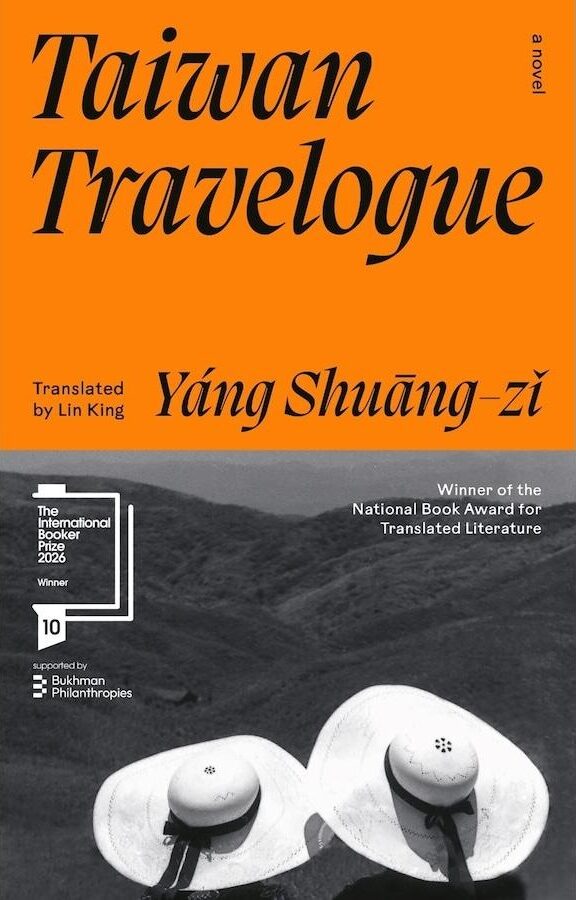
 Taiwan Travelogue
by Yáng Shuāng-zǐ
Translated by Lin King
ISBN: 9781761382338
Scribe Publications
Reviewed by CHRISTINE YUNN-YU SUN
Taiwan Travelogue, written by Taiwanese author Yáng Shuāng-zǐ and translated into English by Lin King, is the first book originally written in the Chinese language to win the International Booker Award. It is also the first book written in Chinese to win the National Book Award for Translated Literature in the U.S.
First published in Traditional Chinese in 2020, Taiwan Travelogue won the 2021 Golden Tripod Award, the highest literary honour in Taiwan. The book’s English edition was published in the U.S. in November 2024, then in the U.K. in March 2026. This review is based on the English edition published in Australia in May 2026.
Why mention all these details? Because it was King who personally acquired the English translation rights to Taiwan Travelogue from Yáng in 2019 and then spent eight long months translating the book and preparing a submission package. She then spent nearly a year submitting the package to seven publishers – with five of them never bothering to respond – before finally securing Graywolf Press as the U.S. publisher of the book’s English translation.
What has happened since then, as they say, is history. And, as of the writing of this review, that history is still being written, as the translation rights to Taiwan Travelogue have been sold to nearly 30 languages/countries across the world. (1) There is one language/territory the book is yet able to enter, however – and that is the Simplified Chinese market in the People’s Republic of China (PRC). This is despite Yáng’s hope that ‘if this book can, in one way or another, make its way into China and be read by Chinese readers, I think we would have an opportunity for dialogue and communication… [That would] let more Chinese people understand what kind of future Taiwanese people want – which is not the same as what many in China imagine’. (2)
Interrogating Colonialism
Taiwan Travelogue tells the story of Japanese novelist Aoyama Chizuko, who travels from her hometown Nagasaki to Taiwan in May 1938 to experience the life and authentic cuisine in that “Southern Island” as a colony of the Japanese Empire. Chizuko soon meets Taiwanese woman Ông Tshian-hóh, who serves as her local guide and interpreter. As the pair travel by train and sample a great variety of dishes across the island, including those prepared by Ông herself, Chizuko becomes increasingly infatuated with her. But their budding romance ultimately dissolves due to the power imbalance between the coloniser and the colonised.
The novel explores the unequal dynamics between Chizuko and Ông through their everyday interactions. From the very start, Chizuko identifies Ông by her Japanese name Ō Chizuru; she then insists she ‘must’
have Ông as a friend and affectionately nicknames the latter ‘Chi-chan’, regardless of the fact that the suffix ‘-chan’ is too cute and casual for a work relationship such as theirs. Senior in age and taller in stature, Chizuko further tries to protect Ông whenever she perceives the latter is being abused/insulted by others, to such an extent that she has a set of kimono made for Ông because, in her words, ‘for people whose eyes are only capable of seeing ethnicity in clothes, wouldn’t a kimono act as a form of a protection for you?'(3) Later in the novel, Chizuko repeatedly asks Ông to return to Nagasaki with her because ‘this is the best possible arrangement’ for the latter as an “Islander” that she as a ‘Mainlander’ can think of. ‘It makes sense for a caged bird to seek more open lands… If what you’re missing is a rising wind to lift your wings, then let me be your easterly wind!'(4)
Ultimately, it is precisely Chizuko’s attempt to be ‘noble, considerate and kind’ that drives her beloved Taiwanese companion away. In Ông’s words: ‘The truth is that gentle Aoyama-san never once asked me: Do you want this protection?… The person you treasure and care for is the docile Islander interpreter who needs your protection. Yet that person is not the real Ō Chizuru – not the real Ông Tshian-hóh – not the real me!'(5) In the end, it takes another character, Taiwan-born Japanese Mishima Aizō, to expose the blind spot in Chizuko’s colonial perspective – not only has she been appreciating the life and cuisine in Taiwan as exotic novelties, but her romanticisation of the Japanese Empire’s development of that ‘Southern Island’ is merely intellectual arrogance as a byproduct of her colonial privilege. Worse, Chizuko’s observation that ‘the Empire has given rise to some wonderful things on the Island’ is ‘tantamount to an insult to the Island and the Islanders’. In the words of Aizō to the novelist: ‘The so-called wonderful things are only wonderful to Mainlanders, and more specifically, they are only wonderful to you.'(6)
Highlighting ‘Taiwanese Consciousness’
In spite of such explicit criticism against Japanese colonialism, some readers from the PRC have accused Taiwan Travelogue of romanticising colonialism and glossing over Japan’s colonial-era atrocities. For example, at a press conference held by the PRC’s State Council Taiwan Affairs Office on May 27, 2026, spokesperson and director of the Office’s information bureau Chen Binhua declared that ‘writers on both sides of the Taiwan Strait should take a firm national stand, respect historical facts, face up to and deeply understand the huge suffering inflicted upon the Chinese people and the people of the world by Japan’s launching of the war of aggression and fascism, and use responsible, high-quality works to promote the spiritual affinity of compatriots on both sides’.(8)
In her interview with the International Booker Prize in May 2026, Yáng suggested that, compared to Korea that was once also a colony of the Japanese Empire, Taiwanese people regard that era ‘with a much more conflicted mix of distaste and nostalgia’.(9) Later, in an interview with the National Public Radio (NPR) at the end of July 2026, her response to the aforementioned accusation by PRC readers is worth quoting to some length:
During Japan’s colonial period, we experienced suffering and oppression, but that period was also an important part of Taiwan’s modernisation. So, people’s emotions are complicated.
It is made even more complicated by the fact that after the war, Japan left and the Republic of China came and very quickly adopted the former coloniser’s methods of ruling people. They basically accomplished what the Japanese colonial government had spent 50 years doing, for example, replacing the language. That created a big rupture, so in this context, it’s understandable why some people in retrospect ended up Japan wasn’t so bad.
The reason that Korea and China both view Japan differently is that they didn’t experience the Republic of China regime that followed…
I am completely criticising colonialism. My criticism is this: even when a coloniser tries to treat the colonised equally, the conclusion is that they still cannot do it. It shows us that colonialism is pervasive, and that the colonial system is fundamentally bad. Even if this regime built many modern facilities on this island, none of that solves the fact that it deprived the people on the colonised land of their original rights
…
Some people think we can use ancestry to determine who is Taiwanese. I think that is dangerous. I hope everybody can identify with Taiwan not based on ancestry but instead based on our identification with this country and this land. No matter where you came from, how you came, whether you are a new resident or third generation, we are all Taiwanese. (10)
Here, the author’s sentiment echoes her aforementioned hope that Taiwan Travelogue could help ‘let more Chinese people understand what kind of future Taiwanese people want – which is not the same as what many in China imagine’. Specifically, the novel highlights a distinct ‘Taiwanese Consciousness’ that defies the ‘grand narrative’ long upheld by the PRC that people on both sides of the Taiwan Strait share the same ‘Chinese’ destiny. In the story, Chizuko’s fervent desire to protect and find the ‘best arrangement’ for Ông is a reminder that however ‘good’ the coloniser’s intentions are, they are unable to recognise their own exploitation of the colonised.(11) Worse, the powerful and self-centred coloniser cannot see – or chooses to ignore – the fact that they are denying the rights and dignity of the colonised to make their own choices. It is just like Chizuko’s statement that as much as the Empire’s ‘coercive methods’ of transplanting Japanese sakura and forcing them upon the Taiwanese soil are ‘brutish’ and ‘unpleasant’, the beautiful cherry blossoms are ‘innocent of any crime’ and ‘it would be a dream’ if she and Ông could go and see the flowers together. As described by the character Aizō: ‘There is nothing in the world more difficult to refuse than self-righteous goodwill.’ (12)
Emphasising ‘Taiwanese Literature’
In her aforementioned interview with the International Booker Prize, Yáng stated: ‘Using a contemporary Taiwanese lens, I wanted to untangle the complex circumstances that Taiwan’s people faced in the past, and to explore what kind of future we ought to strive toward.'(13) That ‘contemporary Taiwanese lens’ shows that as of June 2026, only 2.5% of the people in Taiwan identified themselves as ‘Chinese’, a considerable drop from 25.5% in 1992 when representatives from both sides of the Taiwan Strait agreed to commence exchanges and dialogue. Also in 1992, 46.4% of the people in Taiwan identified themselves as ‘both Taiwanese and Chinese’, but that figure had decreased to 30.7% by June 2026. (14)
In sharp contrast, only 17.6% of the people in Taiwan identified themselves as ‘Taiwanese’ in 1992, but that figure had skyrocketed to 63.1% as of June 2026, a slight dip from the peak of 64.3% in 2020 when the PRC imposed its National Security Law that criminalises what Beijing perceives to be acts of secession, subversion, terrorism and collusion with foreign organisations by any person in Hong Kong. Since then, the increasingly heavy restriction of free speech, substantial reduction of local autonomy and ruthless oppression of political dissent in Hong Kong has been a wakeup call for the people in Taiwan, prompting them to contemplate what kind of national future they truly desire. It further inspires many contemporary authors to dig deeper into Taiwan’s past, especially those aspects of the island’s history that, in their view, had long been denied or hidden by the country’s Nationalist administrations.
Take the novel’s Preface, where Taiwan-born Japanese author and scholar Hiyoshi Sagako introduces not only Chizuko’s background but also the novel’s historical context. More importantly, she provides the novel’s Japanese original and first Traditional Chinese editions, and asks readers to ‘please remain cognisant of Aoyama Chizuko’s status as one of the colonisers within the story’.(15) But Hiyoshi Sagako, or 新日嵯峨子 in Traditional Chinese characters, is a made-up pen name shared by Yáng and a group of Taiwanese writers who are interested in exploring the many shades of ambiguity between literary creation and interpretation, origin and reinvention, memory and history, and stories and the so-called facts. Therefore, the use of this invented researcher (16) to introduce Taiwan Travelogue is but one more of Yáng’s literary strategies to disguise the novel as a new Traditional Chinese translation of a rediscovered Japanese text, in the author’s intention to resist and further challenge any ‘monolithic writing practice that seeks to establish fixed meanings and perpetuate social values’.(17)
Needless to say, that ‘monolithic writing practice’ includes and is not limited to any grand and/or individual narrative that seeks to set Taiwan in the ‘concrete’ that is the PRC’s definition of the island nation. In this sense, the novel’s English translation reflects not only Yáng’s intention but also King’s own attempt to emphasise the unique ‘Taiwanese literature’ as being much more than ‘Chinese-language literature from Taiwan’. For example, King provides a variety of historical, cultural and literary context and explains some of her translation decisions to help anglophone readers better understand the Taiwan of the 1930s as a colony of the Japanese Empire. She also uses Hanyu Pinyin to help distinguish the Mandarin, Japanese and Taiwanese Hokkien pronunciations that share the same characters in Yáng’s original text in Traditional Chinese, but such use is kept at the bare minimum, because Pinyin as the most common romanisation system for Mandarin was invented in the PRC in 1958. Even when ‘China’ does make an appearance as ‘Shina’ in the novel, the term only refers to either the Qing Empire that ceded Taiwan to Japan in 1895 or the country with which Japan was in war in 1938.
Finally, it is in those small details that King adds to and omits from Yáng’s original text that the translator’s intention to emphasise the unique ‘Taiwanese Literature’ is most obvious. For example, by elaborating on the Mǎtsǔ Islands on Page 19, Ālǐshān on Page 78, Koxinga on Pages 80-81, Seimon District on Page 156, and Kannon Bodhisattva (but not Benzaiten) on Page 195, the translator’s role is similar to that of a cultural guide. Then, on Page 284, King further takes on the role of a cultural navigator, explaining the short and subtle sentences ‘considering the current social atmosphere in Taiwan’ (「考量台灣當前社會風氣」) and ‘I earnestly hope the future would bring a shift in the political and social situation’ (「衷心期盼未來時局變化」) in Yáng’s original text. Above all, the fact that the Translator’s Note on Page 275 is presented as being written by “Wáng Chién-hò” instead of ‘Ông Tshian-hóh’ is perhaps most revealing, as Ông and her husband, a Taiwanese man raised and educated in Japan, are likely to have relocated to the U.S. in view of the political repression of Taiwanese citizens on the island after the Second World War. In spite of that, King’s use of a new location ‘Columbia, Missouri’ in her English translation remains both inconsistent and unfathomable. (18)
With that said, there is no doubt that King has achieved remarkable success not only in bringing Yáng’s multilayered text to the world but also in helping contemporary anglophone readers comprehend Taiwan’s multilingual, multicultural and multiethnic heritage. More importantly, rather than submitting to the common practice of seeing Taiwan as ‘one of the most politically sensitive territories in the world, claimed by Beijing as part of China’ (19) – Taiwan Travelogue is presented as a literary work composed and translated by Taiwanese artists, exploring Taiwan’s complicated past while imploring and even challenging readers both within and outside of the island to consider the fact that Taiwan is and will always want to remain as a self-governing democratic society. In this sense, it would be interesting to observe how King, who identifies as both Taiwanese and American (instead of ‘Taiwanese American’), continues to introduce(Taiwan as ‘not a chorus but a cacophony, self-contradicting and unruly, just like any healthy, robust democracy’ through her future translation work. (20)
Notes
1. The Grayhawk Agency (https://grayhawk-agency.com/book/taiwan-travelogue/). Retrieved on August 2, 2026.
2. “‘Taiwan Travelogue’ writer hopes book sparks dialogue”, Taipei Times, May 22, 2026 (https://www.taipeitimes.com/News/taiwan/archives/2026/05/22/2003857778). Retrieved on July 29, 2026.
3. Taiwan Travelogue, p.162.
4. Taiwan Travelogue, p.205-206.
5. Taiwan Travelogue, p.229.
6. Curiously, the phrase “tantamount to an insult to the Island and the Islanders” in Yáng’s
7. Taiwan Travelogue, p.246-247.
8. “Can Taiwan Travelogue enter China? Taiwan Affairs Office: Writers should take a firm national stand”(「臺灣漫遊錄」能否進中國?國台辦:應站穩民族立場), Central News Agency, May 27, 2026 (https://www.cna.com.tw/news/acn/202605270110.aspx). Retrieved on August 4, 2026. Chen Binhua’s original words are: “兩岸作家都應站穩民族立場,尊重歷史事實,正視並深刻理解日本發動侵略戰爭和法西斯主義給中國人民、世界人民帶來的巨大的傷害。以負責任的優質的作品,促進兩岸同胞心靈契合。”
9. “An interview with Yáng Shuāng-zǐ and Lin King, author and translator of Taiwanese Travelogue”, International Booker Prize, March 16, 2026 (https://thebookerprizes.com/the-booker-library/features/an-interview-with-yang-shuang-zi-and-lin-king). Retrieved on August 4, 2026.
10. “Taiwan Travelogue rethinks history, colonialism, and identity”, National Public Radio (NPR), July 29, 2026 (https://www.npr.org/2026/07/29/g-s1-136110/taiwan-travelogue-rethinks-history-colonialism-and-identity). Retrieved on August 4, 2026.
11. The word “exploitation” comes from the book’s Preface by Hiyoshi Sagako: “If we ask about the book’s core theme, it is undoubtedly the power imbalance between the coloniser and the colonised. However, power relationships…are a normal part of the world – just like elders and juniors in a family, where the power dynamic goes without saying, yet the anguish suppressed by this power is often difficult to explain… Whether it comes with ‘goodwill’, the hateful aspect of power is its ignorance or removal of the subject. The juniors cannot sustain themselves if they don’t fight back, but in the eyes of the elders, such feeble resistance may seem like foolish rebellion of the youth. This is another despicable aspect of power: those who are used to exercising their power are unable to recognise their own exploitation of others.” (「若問本書糾纏著的核心,無疑是殖民者與被殖民者間的權力不對等,但權力關係⋯⋯是世間常態——像家族裡的長輩與晚輩,權力關係自不待言,但這份被壓抑在權力底下的苦悶,卻往往無法簡單說明。⋯⋯無論是否懷著『善意』,權力的可憎之處,就在於主體被無視或移除,若不抵抗就無法維持自我,但這點微弱的抵抗看在長輩眼裡,卻可能是少不更事的愚蠢叛逆,這是權力的另一個可憎之處:習於權力者無法意識到剝削。」) This and a number of other paragraphs in the Preface in Yáng’s original Chinese text are omitted in King’s English translation.
12. Taiwan Travelogue, p.247-249.
13. “An interview with Yáng Shuāng-zǐ and Lin King, author and translator of Taiwanese Travelogue”.
14. “Taiwanese/Chinese Identity (1992/06~2026/06)”, Election Study Centre, National Chengchi University, July 3, 2026 (https://esc.nccu.edu.tw/PageDoc/Detail?fid=7800&id=6961). Retrieved on August 4, 2026.
15. Taiwan Travelogue, p.xiv. In fact, the last two sentences of the Preface, i.e. “I would like to draw attention to…one of the colonisers within the story”, are not in Yáng’s original Chinese text and appear only in King’s English translation.
16. In Yáng’s original Chinese text, 新日嵯峨子 is introduced as a “novelist, anthropologist and literary critic” whose birth and death dates remain unknown. This introduction is omitted in King’s English translation. It should be pointed out here that the pronunciation of this coined name is しんじつさがす, which means “真実を探す” or “searching for truth”.
17. See “Bastardizing Memory Through Shōjo: Cultural and Historical Translation in Yáng Shuāng-zǐ’s Taiwan Travelogue: A Novel《臺灣漫遊錄》” by Chialan Sharon Wang, Taiwan Lit and the Global Sinosphere, February 14, 2025 (https://taiwanlit.org/articles/bastardizing-memory-through-shōjo-cultural-and-historical-translation-in-yang-shuang-zis-taiwan-travelogue-a-novel-臺灣漫遊錄). Retrieved on August 4, 2026.
18. In both Yáng’s original Chinese text and at the beginning of King’s English translation of Wáng Chién-hò’s “Translator’s Note”, Wáng indicates her home in 1976 was in Austin, Texas, but later concludes her “Translator’s Note” in 1977 in “Columbia, Missouri”. Meanwhile, in Yáng’s original Chinese text of Wú Chèng-měi’s “Editor’s Note”, Wu, as Wáng’s daughter, indicates her parents’ home was in Austin in 1959 and she had visited her mother there in 1987. But both locations are changed to Columbia in King’s English translation.
19. “‘I refuse to be a second-class citizen in my own land’: Taiwanese International Booker winner Yáng Shuāng-zǐ” by Emma Loffhagen, The Guardian, May 22, 2026 (https://www.theguardian.com/books/2026/may/21/yang-shuang-zi-interview-lin-king-taiwan-travelogue-international-booker). Retrieved on August 4, 2026.
20. “Taiwan Travelogue wins the International Booker Prize 2026”, The Booker Prize via YouTube, May 20, 2026 (https://www.youtube.com/watch?v=v7gT-MATmhg). Retrieved on August 4, 2026.