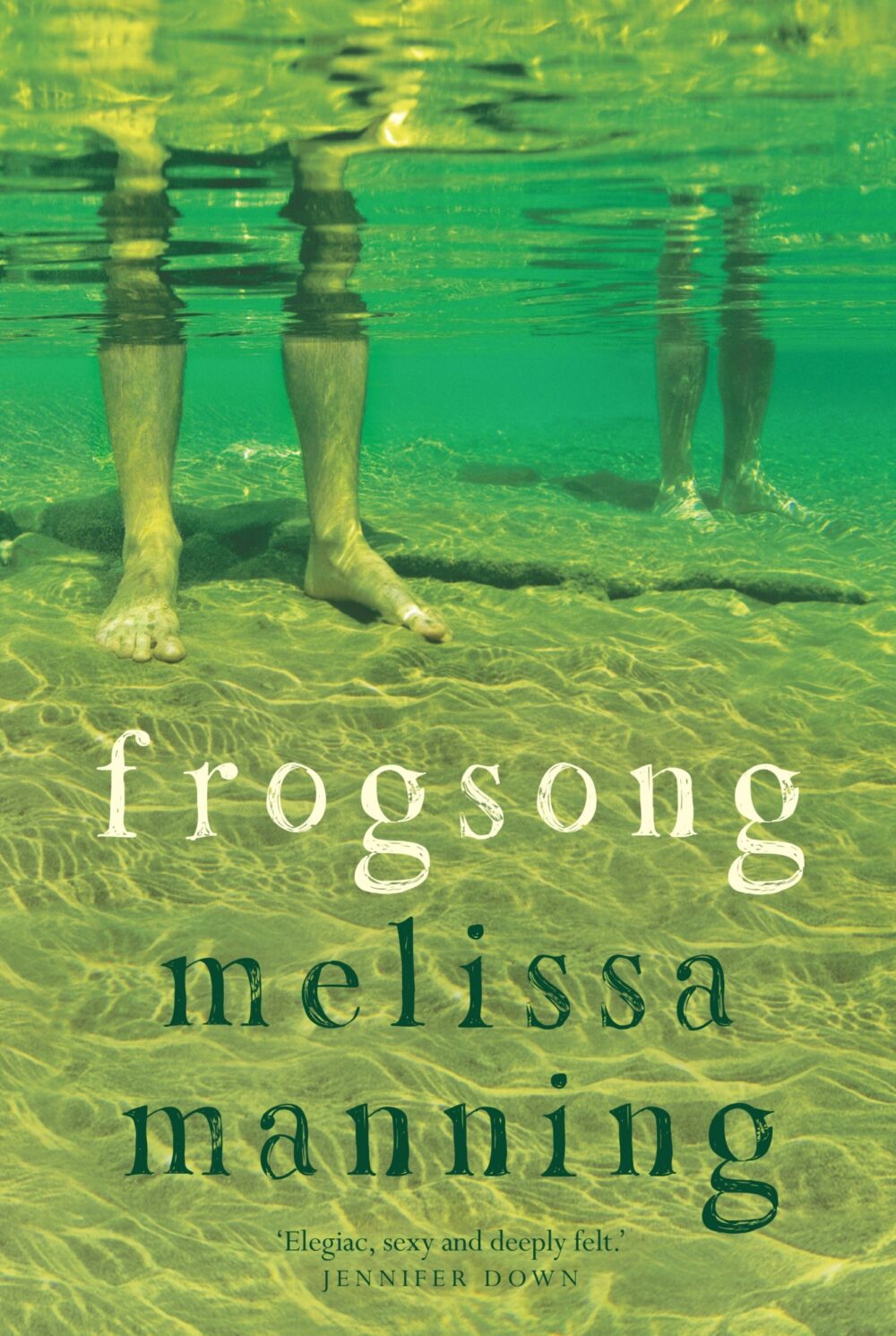
 Frogsong
by Melissa Manning
University of Queensland Press
ISBN: 9780702269233
Reviewed by KATARINA DJERIC
Melissa Manning’s 2026 sophomore novel Frogsong feels like an ode to childhood and the inexorable passing of time that strips us of that innocence of youth. It is a story that lingers in your presence long after finishing it, making you grapple with mortality, not only your own, but of those you cherish. Frogsong evokes the achingly present weight of responsibility we feel towards those who do not value their own mortality as much as you wish them to. A persistent theme of loss permeates the novel, loss of a loved one and loss of a place through environmental collapse. Manning has brilliantly crafted a story with the overwhelming sense of vulnerability in our infancy that manifests itself throughout our lives at critical moments, shaping us in such a visceral manner.
The novel is split into four parts, each representing the gradual metamorphosis of a frog. This plays beautifully into the story, particularly seeing Caro’s development from childhood to adulthood and the wider conversation of her cultural heterogeneity which untethers her from the environment she inhibits. Her early years are marked by her best friend Danny and his parents Col and Diane. We are first brought to the waterhole near their homes in rural Tasmania where memories are shared within its shallow depths, and their relationship shapes into one of fierce dependence on each other. The waterhole is described with childhood reverence, unblemished by tragedy, a place of unbridled joy, “in her mind’s eye, she and Danny. Arms in silt. Cupped palms. Tadpoles and frogs. His enormous grin. Hands pocketed. Spikes of memory in sun-glints on water. Ripples of emotion loosening the boundary between past and present” (p.3). The waterhole represents the liminal boundary between innocence and the lives they live corrupted by grief.
The dreamlike essence of the first chapter awakens to Diane’s funeral in chapter two. The loss of her is felt significantly in the novel. She continually haunts Caro, slinking into the narrative and lingering within the pages. Caro sees the apparition of Diane when she feels unmoored and questioning her place in the world, a manifestation of her desire for maternal comfort. Grief is a central character within the book, pulling up a chair and demanding the attention of the reader. Manning describes grief in such a simple yet evocative way, which highlights Caro’s existentialist unmooring from herself and yearning for a sense of self not marked by loss. The writing is sparse, an element that allows for so much to be said between the lines and in the silences of the characters.
Danny was such a fascinating character to read, insofar as he almost felt unknowable. He put so much of himself into his art, giving the reader and Caro only glimpses of himself between each brushstroke. It was as though the moment he lost his mum, he became a phantom himself, haunting Caro alongside Diane. He was always only half present in the narrative, the other half buried alongside his mum. We only see him through the eyes of Caro, a boy just as lost as her, finding comfort in the arms of addiction. His reliance on alcohol and later drugs upends their shared life, emphasising the beginning of their gradual fracturing.
Danny and Caro’s relationship held so many intricacies. The love they share becomes distorted through grief, yet they cling to the remnants of that bond, no matter how fraught, until they lose sight of who is really at the other end of the rope. Caro’s promise to Diane to always look out for Col and Danny weighs heavily on her, degrading her sense of self and further entrenching her into their grief. Once they move into an apartment together after graduation, we truly see the cracks in the foundation of their relationship and Danny’s struggle with addiction. A large part of the novel is dedicated to Caro caring for Danny and losing a part of herself in the process. She begins to resent him but cannot allow herself to leave. It was heartbreaking to see Danny slip further away from everyone; his pain and anguish fully palpable to all who encountered him. Manning portrayed a character consumed by their grief, unable to move forward, stuck in limbo. Her depiction of a mother and child’s bond transcending the mortal boundary was strikingly sombre and devastating in its unbridling sense of finality.
Grief sits on Caro’s shoulders throughout her adolescence and early adulthood, alongside the responsibility of caring for Danny and Col. This pervasive grief of hers is a manifestation of the cultural loss and displacement experienced by second generation immigrant families that is not directly addressed, rather dealt with internally. The symbolism of the frog as an invisible singer within a natural landscape connects to Caro and her grief within a fractured landscape. Manning explores this alienation and pressure to assimilate to western culture, which further isolates Caro from her own family. She never had a close bond with her own mum, choosing instead to foster her connection to Diane, creating a chasm with her own family, her home becoming as alien to her as the landscape she inhabits. This is further emphasised in the disappearances of Danny that gradually lead to his departure from the novel and Caro’s life, “she was meant to be the one who was leaving. But she’d stayed and now here she was tipping a box of bicarb soda and a bottle of vinegar into the toilet. Scrubbing away stains. Thinking about the way Danny had been disappearing in increments” (p.144). When he is gone indefinitely, she leaves Tasmania for Lisbon, where her mother’s family comes from. This signals a shift within Caro, as it allows her to examine her life outside of her grief and sense of obligation to Danny and Col. Her cultural heterogeneity divides her, separating who she was in Tasmania with who she is in Lisbon, connecting with her mother’s cultural ties to Lisbon and bridging the divide between them. “She wondered if it would become too heavy over time, the weight of wearing someone else’s skin. Thought maybe she had been doing that for a long time already” (p.189). Her stay in Lisbon gives her permission to become someone not moored by her past.
Much like her 2021 debut collection of short stories Smokehouse, Manning portrays the intersection between loss, grief and addiction, with connection to place. Both of her books are set in Tasmania and depict a landscape that holds a violent past of colonisation and invasion, which is felt keenly in her writing. In a short story she wrote for Overland in 2018 called ‘Muck’, Manning’s character is bereft, not only of a loved one, but the destruction of the floods which shattered the already haunted landscape, “I try not to think about it, but it’s wound into me like some tiny wire threaded through my veins, like it’s part of me. And there’s no middle anymore, just the beginning and the end”. Loss is a common thread throughout Manning’s works; she encapsulates the feeling of isolation and being trapped in one moment of time by the degradation of the environment through climate change with clarity and insight, which emphasises the further conversation of cultural loss that sits within her narratives.
There is no complete sense of closure in this book, yet I felt comfortable leaving Caro in the narrative where she finally found a sense of belonging that was distinct to who she was with Danny. Caro allows herself to continue on without him, forging a path that gives her agency and freedom to grow. The feeling of unease towards Danny’s unfathomable ending sticks with not only Caro, but the reader as well. Caro is left with memories, ones shaped by love and loss, forged and immortalised by the waterhole of youth, of beginnings and endings. I am amazed at Manning’s sparse yet impactful prose. This book did not need an over-abundance of words; it spoke volumes in the silences and shared whispers between the childhood best-friends. Frogsong conjures the themes of cultural silence and erasure by delving into ideas of existentialism through Caro’s character. Her loss as a second-generation immigrant is illuminated through her loss of place and family. It was everything that was not spoken aloud that drove the narrative forward.
Works Cited:
Manning, M. (2021). Smokehouse. University of Queensland Press.
Manning, M. (2018). ‘Muck’. Overland, 230(5).
KATARINA DJERIC is a writer and bookseller in Nipaluna/Hobart. She graduated from the University of Tasmania with a B. A in Creative Writing.