Funeral by Jamie Wang
Subscriber Only Access
Sorry you must be logged in and a current subscriber to view this content.
Please login and/or purchase a subscription.
Accessibility Tools
Sorry you must be logged in and a current subscriber to view this content.
Please login and/or purchase a subscription.
 When My Brother was an Aztec
By Natalie Diaz
ISBN 9781556593833
Reviewed by AIMEE A. NORTON
Natalie Diaz’s debut collection is a book about appetites. It contains raw, narrative poems that pivot on her brother’s meth addiction. Lyric surrealism is interspersed throughout and serves both as a welcome reprieve from the brutality of the narrative, but also expertly explores the universal hunger that brings people to their own personal tables of conflict and gluttony. The setting is the Mojave Indian Reservation where Diaz grew up and where she currently works with the last fluent speakers of Mojave to save the severely endangered language.
Diaz’s poems grind with a savagery that doesn’t often make it onto the page. The Aztecs are a culture known for ritualized violence and a theater of terror epitomized by state-organized human sacrifice. Diaz does well to sew the Aztecs together with drug culture in the Southwestern US which is an area saturated with narcotics related violence. Addiction itself is shown as a ritualized self-violence. The title poem ‘When My Brother Was an Aztec’ begins hauntingly.
He lived in our basement and sacrificed my parents
Every morning. It was awful. Unforgivable. But they kept coming
back for more. They loved him, was all they could say.
The poem ends just as hauntingly when Diaz describes her parents searching for their missing limbs, looking for their fingers…
To pry, to climb out of whatever dark belly my brother, the Aztec
their son, had fed them to.
Readers witness the violence of meth addiction, see the blackened spoons and the sores on her brother’s lips, hear the tribal cops outside on the lawn, understand from the poem titled ‘As a Consequence of My Brother Stealing All the Light Bulbs’ that her parents live without light. The tone is unapologetic and fierce. It is unblinking on a topic that breaks many families. Yet a close read reveals unmistakable joy in the writing. Diaz celebrates that language can express these truths, even if they are hard truths. The poems are alive on the page, delivered with a skill that often hides underneath the intensity of the material.
The characters devour, feed, starve, gorge, thirst and more. In the poem ‘Cloud Watching’, Diaz writes “So, when the cavalry came, / we ate their horses. Then, unfortunately, our bellies were filled / with bullet holes.” In ‘Soiree Fantastique’, her brother sets a table for a party attended by Houdini, Jesus, Antigone and others. It ends when the poet explains to a distressed Antigone “We aren’t here to eat, we are being eaten. / Come, pretty girl, let us devour our lives.” The effect of all this devouring on the reader is that it makes one insatiable for more of Diaz’s poems.
There are three parts to the book. The first section serves as an introduction to life on the reservation. We meet ‘A Woman with No Legs’ who “curses in Mojave some mornings Prays in English most nights Told me to keep my eyes open for the white man named Diabetes who is out there somewhere carrying her legs in red biohazard bags”. We visit a jalopy bar called ‘The Injun That Could’. We learn of a literal dismantling of the Hopi culture when a road is cut through Arizona in ‘The Facts of Art’. This section feels more historical and cultural than personal. For the lovers of form, Diaz scatters a Ghazal, a Pantoum, an Abcedarian, a list poem and prose poems throughout the collection.
The third section contains a handful of love and lust poems such as Monday Aubade:
to shut my eyes one more night
On the delta of shadows
between your shoulder blades –
mysterious wings tethered inside
the pale cage of your body – run through
by Lorca’s horn of moonlight,
strange unicorn loose along the dim streets
separating our skins;
The surrealism persists in the love poems. Often, the act of loving is portrayed as a kind of sacrifice. The answer to the poem titled ‘When the Beloved Asks, ‘What Would You Do if you Woke Up and I Was a Shark?’ ‘ is clear: “I’d place my head onto that dark alter of jaws” and “it would be no different from what I do each day – voyaging the salt-sharp sea of your body”. It’s obvious that Lorca has been a substantial influence on Diaz. She places a passionate poem titled ‘Lorca’s Red Dresses’ smack in the middle of the third section as well as mentioning him in ‘Monday Aubade’ and other poems.
The engine of the book is the second section. These poems cast and recast the brother as various characters: a Judas effigy, an Aztec, a Gethsemane, a bad king, a lost fucked-up Magus, a zoo of imaginary beings, a Huitzilopochtli (a half-man half-hummingbird god) and various characters from myth. The theme of the book is being present in the face of a powerful destroyer, or living through an encounter with the destroyer, witnessing the wreckage and not turning away. Ruin is wrought by her brother’s meth addiction. There’s a reach to her talent that challenges the importance of her work being limited by identity. I read a few of her poems to Plath’s ghost saying, “Look here, you aren’t the only one that can plate up mouthwatering, award-winning anger for male relatives”.
Destruction of Native American culture by Europeans settlers and the continued, historical bigotry is featured in the poems. Ships appear throughout the book as harmful things. Take the wonderfully-titled poem ‘If Eve Side-Stealer & Mary Busted-Chest Ruled the World’ which is an alternative retelling of first people and creation, the last stanza reads:
What if the world was an Indian
whose head & back were flat from being strapped
to a cradleboard as a baby & when she slept
she had nightmares lit up by yellow-haired men & ships
scraping anchors in her throat? What if she wailed
all night while great waves rose up carrying the fleets
across her flat back, over the edge of the flat world?
I struggled with the question in this poem: what if? Diaz refuses to answer it. The mind still asks: What if we erase just this one chapter where the Hopi’s burial sites are dug up for a new road? Or, what if a daughter is not stoned to death? What if Diaz’s brother had not gone to war and had not crawled into bed with death? Diaz knows this can not be. It is as likely as the world being flat. Her answer is a refusal to see anything other than the violent, beautiful world we have that is full of lightning. This is a brave approach. Yes, destruction is also generative. If there was an end to violence, then nothing new could be born.
Still, I wonder whether the perspective and tone in When My Brother Was an Aztec, which is in part the powerful backstory of Diaz’s life, will shift now that this fearless narrative is spoken. I predict that the book breaks open a future to be found in Diaz’s not-yet-written poems to show what a world would look like if she were the boss goddess. One truth is: the future exists. Another truth is: we get to help shape it. I confess that I read utopian science-fiction, so I know that Diaz has exactly the kind of brutally honest mind that should broker destiny by introducing a few options and answering that question: what if Eve Side-Stealer and Mary Busted-Chest ruled the world? I still want to know. I’m hoping her second book tells me. Diaz signed my copy of this book with “sumach ahotk” which is Mojave for “dream well”. Yes, let’s dream well.
In my opinion, this book will have a powerful effect on American poetry. By adding her forceful voice to the spectrum of next generation Native American poets such as Esther Belin and Orlando White, she’s already earned much recognition. Diaz has received the Lannan Literary Fellowship, Balcones Poetry Prize, the Pablo Neruda Prize for Poetry and made the shortlist for a 2014 PEN/Open Book Award. The collection ends as it began – with hunger – when a lion devours a man. The lion protests he “didn’t want to eat the man like a piece of fruit”. The man “had earned his own deliciousness by ringing a stick against the lion’s cage”. The book has earned its deliciousness by ringing, too. My recommendation is to set the table and let the feasting begin.
AIMEE A NORTON is a research astronomer at Stanford University. Her research has appeared in the Astrophysical Journal, Solar Physics, and National Geographic News among other places. She is also an emerging poet who has published in Mascara Literary Review, Rabbit, Softblow, Many Mountains Moving, Paper Wasp, The Drunken Boat, Byline and Literature in North Queensland (LiNQ).
Sorry you must be logged in and a current subscriber to view this content.
Please login and/or purchase a subscription.
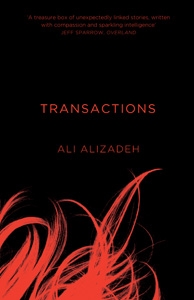
Transactions
By Ali Alizadeh
University of Queensland Press
ISBN 9780702249785
Reviewed by ELIZABETH BRYER
Ali Alizadeh’s Transactions is a panoramic cycle of vignettes that depict characters in a globalised world on the margins of Western and, most particularly, capitalist society. A vast array of characters jostle within its pages: assassins, prostitutes, poets, protesters and Oz-Exploitation directors, to name a few. Indeed, much of the delight to be had on reading the collection is in unravelling exactly how these
=================================Sorry you must be logged in and a current subscriber to view the rest of this content.
Please login and/or purchase a subscription.
Sorry you must be logged in and a current subscriber to view this content.
Please login and/or purchase a subscription.
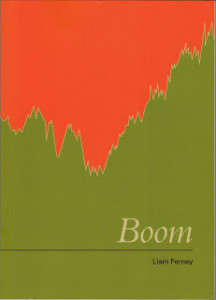 Boom
Boom
by Liam Ferney
Grande Parade Poets
ISBN 978-0-9871291-4-7
Reviewed by MELINDA BUFTON
Liam Ferney’s Boom (Grand Parade Poets, 2013) is a much-anticipated collection of tightly-knit poetry, threaded with the things he has seen and the spaces he’s occupied, cast with a sardonic glance and the flick of a metaphoric burnt-down cigarette. It is the Steve McQueen of poetry collections, to my mind. Or perhaps, even more accurately, it is a smart, enthusiastic 30-something guy at a party describing what it is about Steve McQueen that matters. In really articulate tones, and with tie askew, because he’s come from work. We get potency and we get the sublime, with a lot of grit all around the edges. Intriguingly, the grit comes in the form of elegant sentences that surprise, their content seemingly slipped in under the radar of form. I wouldn’t say this is the aim; just that the music of the lines takes your senses first, and then come the beautiful clusters of pop disintegration, fuzzy images of the right brand of cynicism, a professional eye on the world’s seams. In an early poem within the collection, ‘Expecting Turbulence’, we get this:
First chance I get I’m SoCo mofo
backdrop a drained out montage, colours
of a nunsploitation print abandoned in a can.
(p 19)
In ‘that thin mercury sound’ (below) we get some more; pleasing rhythm with a certain amount of give, encompassing some event that could have been a bad day in the office or an international relations nightmare (Ferney is a poet who often mentions his work in public relations and politics, and we have this in the satisfyingly detailed bio included at the back of the book). We don’t know; it doesn’t matter. What matters is he’s buried it in here for us to have, and that is an absolution that cleanses much more than a top-marks performance review or a constitutional crisis averted (am I right, day-jobbers?).
lost in a hard drive somewhere between
formats and a nasty Trojan horse the length
of an absence stretches like a hair band
co-opted into service as a lock a galleon
(p 47)
In addition to the poems with a fast, chopping sensibility, there are also more narrative inclusions. A stand-out of the collection is a poem which takes us into the story of a relationship and a trip, ‘The September Project’ (below). It has a litany of living that situates our minds eye into a maybe-Bukowski landscape (without the domestic violence), or somewhere past in a collage that feels both American and Australian, but may include Korea, as many of the poems do. He gives her Converse to ‘scuff at the mudguard’, and they wash dishes for bad pay and write. The poem has pace, and an expansive sense of possibility that grows even while the relationship falters, as we know it will (It’s that kind of poem). It’s the most lovely example of written melancholy, seen to particular effect towards the end:
in winter she was cold she was starting to remember
as he was learning to forget and they could not
sit still the September project through mountains
in boats across the vortex a continent as vast as hope
and that September they had the strangest dreams
while the wind stilled in the middle of the early dark
in a city where they had no currency and the tea
tastes metallic they watched sharks arcing through the ocean
(p 44)
At the conclusion, Ferney ends with a line that ‘the September project was never submitted’. It’s this, in combination with an earlier moment in the poem ‘the September project was something/they could use in creative writing seminars/for all time..’ that makes us smile because we know this little hook, and that it saves us all – Ferney, and his readers – from too much sentimentality.
Once we would have just called that postmodern, that the self-reflexive was a smart attribute with which to back away from content that dealt in the romantic. Now, like late-model masculinity, we can treat it as an extra ingredient to the sentimental. It is the dash of bitters in the sweet lemon and lime. (And no, I’m not going to move on any time soon from this imagery. How could I waste such an opportunity, when Ferney has a poem in here called ‘The Man Who Shot Liberty Valance’? And given that his first collection was entitled Popular Mechanics? I’m in good company.)
‘Millenium Lite Redux’ is a dense poem that skates us through place via questions. It is typical of the many compact poems within the collection, and displays more of the fluidity that calls to mind John Forbes, but with the multi-faceted knowing that comes from having occupied so many roles and places already. That is, a Liam Ferney poem about the dole is not a poem that assumes the role of poet first and foremost. It’s a poem that says, quite rightly, how do I work these angles to get to the next place I need to be. It’s a poem that says ‘the diary is a newstart fraud de art’ and ‘if you don’t have the ingredients don’t try to cook’, and then, in the close of the second stanza ‘and I think I understand the saints/stranded so far from home’.
Boom is poetry without swagger and with plenty of humility, yet the sum of this is a kind of roar and a knowledge of social and cultural lexicons laid out like samples for us to buy. It reminds us, even within the lines, not to be a wanker; ‘us’ being the nexus of the poet, the work, the readers.
& that’s how
You get suckerpunched:
Using bigger &
Bigger words
As if somebody had tattooed
A scrabble player’s aesthetic
Over poetry’s flexed bicep.
(‘Crumpled Elegance’ p 15)
Despite its range of poems, it hangs together well due to the assuredness of voice (assured, even when it’s asking questions of itself). It asks us to come inside the poems and take those parts we want, and while we’re there, to have a look at those parts that have been laid in via code, and to not flip out if they don’t give themselves up to us immediately (or ever). It’s a text-y feast and there’s plenty to be had. Dial room service and say ‘Bring me some man poetry of the modern day’, and you’ll get Boom. Tucked in a white paper bag, like white toast in a Bathurst motel; exactly what you want.
MELINDA BUFTON is a Melbourne poet and reviewer, Her work has appeared in a number of publications including Cordite, Rabbit, The Age and translated in Chinese poetry journal Du Shi. Her debut collection is forthcoming from Inken Publisch (www.inkenpublisch.com).
Sorry you must be logged in and a current subscriber to view this content.
Please login and/or purchase a subscription.
Sorry you must be logged in and a current subscriber to view this content.
Please login and/or purchase a subscription.
Sorry you must be logged in and a current subscriber to view this content.
Please login and/or purchase a subscription.

 Mogwie-Idan Stories of the Land
by Lionel Fogarty
ISBN 978-1-922181-02-2
Reviewed by TIM WRIGHT
Arguments for the importance and power of Fogarty’s poetry have been made by a number of writers since the 1980s. Some prominent examples are: the forewords to Fogarty’s first two collections, written by Cheryl Buchanan and Gary Foley respectively, Mudrooroo’s early critical attention and championing of his work, Philip Mead’s comparative reading of Fogarty (alongside ΠO) in his study of Australian poetry, Networked Language (2008), John Kinsella’s statement in the 2009 Penguin Anthology of Australian Poetry (and quoted by Ali Alizadeh in the introduction to this volume) that Fogarty is ‘the most vital poet writing in Australia today’, and Stuart Cooke’s reading of Fogarty’s work in his recent comparative study of Australian and Chilean poetry, Speaking the Earth’s Languages (2013). At almost 160 pages Mogwie-Idan announces itself as a major collection. It is also a generous one, containing the poems of the earlier published chapbook Connection Requital along with the 50 poems of Mogwie-Idan, and a susbtantial selection of Fogarty’s drawings.
The range of subjects Fogarty’s poetry deals with is informed by his many years involvement (since the mid-1970s) in Aboriginal activism, and direct references to this history appear in poems such as ‘Tent Embassy 1971-2021’. About the subject matter of his poetry Fogarty is unambiguous; in an interview with Michael Brennan he says, ‘Deaths in Custody is the most important subject in my poetry, as well as Land Rights and general struggles of national affairs.’ Political matters such as these are entirely personal for Fogarty, as they are for many, perhaps all, Aboriginal people. One need only read Fogarty’s author biographies to learn that state repression has been a part of his life. The most extreme manifestations of this would be the charges made of conspiracy against the state, as part of the ‘Brisbane Three’ in 1974-75 (the three were acquitted), and the death of his brother, the dancer Daniel Yock, at the hands of police, in 1993. As has been described by himself and others, the protest of Fogarty’s poetry is taken into the fabric of English; it can be seen as an attempt, as he has said, to conquer, or crush, English.
The poems draw from Munultjali dialect (for which a glossary is provided), however the poetry’s most radical linguistic element is its frequent a-grammaticality, its torquing of conventional English syntax such that, for example, nouns are rendered as verbs and vice versa, or ‘wrong’ verb forms are used. Sabina Paula Hopfer writes that in reading Fogarty’s work she is ‘made to understand what language genocide feels like rather than what it means in abstract terms.’ She writes that Fogarty’s words, referring to two of his early collections, ‘pound down on the non-Indigenous reader like hail stones, so that the reading experience is one of complete exhaustion and despair.’ I have remembered this description of Fogarty’s work since I first read it nine years ago. While I believe the metaphor of hail is an accurate one to carry the force of Fogarty’s poetry, I now to think that Hopfer’s reading of it risks overemphasising the response of despair. What about the exhilaration of reading the poems/getting hit on the head with hail? I would want also to emphasise the potential dialogic space that is created by the linguistic complexity of Fogarty’s poetry, one that a reader is required to work towards. Michael Brennan argues that Fogarty’s manipulation of English obliges reciprocity of the reader, and so, the possibility of dialogue, writing that his poetry ‘can be seen not simply as a counter discourse but as an integrated, less dialectically defined, reconception of English – literature and usage – wherein a reciprocal biculturalisation is demanded of the colonisers.’
‘Connection Requital’, the opening sequence, is a blast of nine poems written entirely in capitals. Fogarty’s formal decision to use capitals only in this sequence appears to mark a new degree of urgency in his work – significant given the sense of urgency his poetry has always contained. In ‘Mutual Fever’ the tone is almost biblical – or bushfire scene – in its intensity and imagery:
A WATERLESS SEA OF ASHES
FIREFLIES ROARED LIGHTS AROUND A SMALL BUSH
BLAZING CARCASSES MOANED TO BE DREAMT
PRE-DAWN STAGGERED WITH ONE MAN
WHO DRANK GLOBULES FLOODED WATERS PURE AHAHAH
The longest poem in the book, ‘Wisdom of the Poet’, is for the Chilean-Australian poet Juan Garrido-Salgado. It demonstrates the strategic function inherent in Fogarty’s songman and spokesman roles. In this case, the poem is a message of solidarity across different cultures. But it is more than this – ‘Wisdom of the Poet’ moves breezily between the ancestral, and aspects of the current political and economic situation of Aboriginal people. We read reflections on the Mabo judgement, questions of law and culture (‘White women playing our digeridoo instrument / Can’t do nothing, they’re protected by the government’), of Australian Aboriginal history (‘Only 40 years ago / My race of people were suffragettes’), of Aboriginal leadership and media overload (‘TV’s black leaders selling out / zonked out with a sore head / ‘cause watching TV left my brain dead’), and advice to younger generations (‘black people need to be educated white man’s way / so we can know what they write and what they say’). There is much else in this poem that is not as easy to categorise; the second half moves into a different realm entirely, of the personal and spiritual. The final lines return to economics and specifically to the question (still hardly dealt with in Australia) of financial compensation:
We had civilisation before they came
so us know the way to a future
Chile Mapuche we are with you to liberation
The day will come
when all rich classes must pay for crimes
of past and present
You may think this is silly
but we really want compensation
The poem ‘Conducted at Native Religion’ begins with an epigraph from the former Premier of Queensland, Anna Bligh, during the 2011 Brisbane floods: ‘We are Queenslanders, from north of the border. They keep knocking us down, but we keep getting up. . .’. The mawkish ‘battler’-ism of Bligh’s speechwriter’s statement is highlighted when pulled into the context of Fogarty’s poem – as is the irony of Bligh taking on the Aboriginal discourse of survival for a comparatively minor threat to existence (that is, compared to colonialism): ‘Even a full supreme court illegals our public ears / Let injustice be in the hand of those political ‘nit wits’’. An older poem, dated May 1990, ‘Overseas Telephone’, details beautiful collisions of sense, ‘Few always joined with your / intermittent distance / like seasons are intense with / the sun’s radio’. The first half of the poem is in tones that are humorous, chatty, flirty, loving; the images in the second half are violent and extreme:
I’ve been given a violent
foaming hearing
But I never panic when you
cut throats
I am the peaceful liberty love
of political prisoners
Your raped sounds burst
explosions of speeches
Everything endured by me
will inflict my sadness to
love melancholy dart eyes
My silence is not an absence
Your power vultures more despair
I see your horrified voice
You are patriotic to filth
and drink urine mixed with cement
A later line in the poem, ‘I am murdered ten million yesterdays’, might resolve in different ways: ‘I murdered ten million yesterday’ or the very different ‘I murdered ten million yesterdays’ or as two discrete statements ‘I am murdered’ ‘ten million yesterdays’. Ten million yesterdays works out to around 27,000 years. Speaking of time on these kinds of scales is frequent in Fogarty’s work; he is not the modernist poet obsessed with the illuminated ‘moment’. Rather, Fogarty’s diction is often world-historical in scope. Western calendar years flash up throughout the collection, in a parody of chronology: ‘Living here in 2020 sometimes / gives me the 1920’s even 1770’ (‘2020’). The consciousness of history is clear in the title of another poem in the collection, ‘Past Lies Are Present’, which perhaps says enough, though its specificity to Australian politics is clear in the first lines, ‘Past lies are present / A fake sorry is given’.
The poem ‘Decipherer’ is one of the more abstract in the collection:
Uncharted activated waters
reveal unflushed originators.
My true darling breath of exhilarating
vision is acute in testifying customs.
I am I, charted in deliverance by black myriads
codified relations comes of purification.
Global psychic energies only will mark
awareness by Aborigines’ new ages wildfire.
Uncharted harmony and I get accent
ingredients to equivalent windswept.
Reveal flourished in our astrological eyes.
Herd warriors worry no more
History unbalanced kept me ‘dead’ indecipherable.
Future ballad themes honour me
chilly little crystal humour ‘Ha, Ha, Ha’.
To decipher is ‘to turn into ordinary writing’. ‘Decipherer’ may be in part addressed to the reader or critic who would handle Fogarty’s poetry as a kind of cipher or code for which there existed a key that would unlock ordinary writing (whatever that might be). This would be opposed to those understandings of it described earlier by Brennan, as constituting a ‘reconception of English’, and thus requiring the reader to move outwards, further towards the language, rather than trying to draw it closer to her or him. One approach may be to read Fogarty’s poetry guided by a term he has used in interviews, the mosaic: ‘I am mosaic in reading, I nitpick readings. I often read back to front, similar to Chinese’; ‘Most of the time I use words in mosaic of catalysing . . .’. Thus the repeated phrases of ‘Decipherer’ – ‘My true darling’, ‘History unbalanced’, ‘uncharted’/‘charted’, ‘wildfire’ – might be analogous to differently coloured fragments, generating a pattern of concepts or ideas that the poem explores. The mosaic is suggestive too of the way sense is sometimes, as in ‘Decipherer’, ‘scattered’ through Fogarty’s poems, such that they resist line by line interpretations, yet at the same time are held together by their sonic patterning:
Between sound and colour ‘I am a bit’
Between music strangely I’m beyond white time
Affirmation give techniques limitless in my
Plain chant transfiguration musics
Fogarty’s torquing of syntax is also at work in this poem. In the earlier line ‘Reveal flourished in our astrological eyes’, ‘reveal’ can be read as objectified, a quality which ‘flourished’; or, we may read ‘flourished’ as an adjective – ‘with flourishes’ – the object of the verb ‘reveal’. Considered this way, the function of both ‘reveal’ and ‘flourish’ are turned outwards, enstranged. ‘My true darling breath’ is in a Romantic diction that may be parodic. It is immediately torqued, in that, where a reader may expect a noun, following ‘of’, there is an adjective – ‘exhilarating’ – which can be read as enjambed, flowing onto the next line, ‘of exhilarating / vision is acute in testifying customs’, or as a discrete line. Where a rest or the consolidation of an image might be expected, we find the ground hasn’t appeared yet and we have to keep moving. Stuart Cooke, writing of Fogarty’s poem ‘Heart of a european . . .’, describes evocatively this mode of reading that Fogarty’s poetry calls for:
There are portions of grammatically correct English here, but no sooner do they appear than they have dissolved into a kind of word-music. Consequently, those intelligible phrases have the effect of punctuating the swirl of rhythm and rhyme with moments of clarity, which the reader “clings” to, as if stopping at the occasional water hole to rest before moving onto the scrub.
Reproductions of Fogarty’s drawings are throughout the book, and arrive like gifts. While I am aware that these drawings contain meanings for Fogarty and his community not known to me, I attempt here a necessarily limited description. The drawings contain recurring ideas and motifs: mandala-like circles, or wheels; shields, boomerangs or boomerang-like shapes, tendrils or vines and straight ruler-drawn connecting lines between bodies. In many, there is a sense of suspension, of subtle yet firmly and intricately maintained connection between otherwise independent bodies. There is a sense of both organic and mechanical motion; each drawing appears to be a complete system of articulated, or in some way engaged, parts. In the drawing ‘Gauwal (Far away)’ a cord emerges from an orifice within a blob that could be muscle-tissue; half-way down the picture surface this splits into two strings, and from inside the cord another line emerges, resembling rosary beads or a chain. At the base of the picture a solid log is suspended by the cord which divides the picture surface vertically, and on which or within which are various insignia: egg-like shapes connected as if within an intestine, circles, a diamond striated. The drawing is one of the more minimal of Fogarty’s works, most of the picture surface being blank background. The bodies are ‘far away’, as the English part of the title says, yet undeniably connected. Including the image used for the cover, there are twenty drawings in the book, which are each printed to the edge of the page, unframed. The effect is that the drawings come to be placed in a more equal relationship with the poetry, interleaved not supplementary or illustrative.
A Southerly issue of 2002 contains facsimiles of Fogarty’s poems in manuscript, his drawings intertwined with the words of the poems. In Mogwie-Idan the poems and drawings are on separate pages, but there is a broader sense of written word flowing into the drawing and back out again. This relation between word and image is set up in the opening of Mogwie-Idan, which literally invites readers in – ‘Jingi Whallo / Hello how are you all?’ – and goes on to acknowledge the traditional people, ending on an ellipsis which ‘leads’ the eye directly to the drawing on the facing page, ‘Burrima (Fire Man)’. Throughout the book the reader is able to consider analogies between the fully articulated, holistic systems of these drawings and those same qualities present in the poems.
The book ends with the extraordinary poem, ‘Power Live in the Spears’, a kind of chant, which in its insistence recalls one of Fogarty’s influences, Oodgeroo Noonuccal; the cumulative effect of the lines becomes an incantation:
Power live in the spears
Power live in the worries
Power air in the didgeridoo
Power run on the people heart
Bear off the power come from the land
NOTES
1. Johnson, Colin, ‘Guerilla Poetry: Lionel Fogarty’s Response to Language Genocide’, Westerly, No. 3, September 1986, pp. 47-55
2. Brennan, Michael, ‘Interview with Lionel Fogarty’, Poetry International, http://www.poetryinternationalweb.net, July 10, 2011
3. Hopfer, Sabina Paul, ‘Re-Reading Lionel Fogarty: An Attempt to Feel Into Texts Speaking of Decolonisation, Southerly, Vol. 6, No. 2, 2002, p. 60
4. ibid, p. 47
5. Brennan, Michael, ‘Interview with Lionel Fogarty’, Poetry International, http://www.poetryinternationalweb.net, July 10, 2011
6. ibid.
7. Ball, Timmah, ‘An Interview with Poet Lionel Fogarty’, Etchings Indigenous Treaty, Ilura Press, Melbourne, 2011, pp. 129-135
8. Cooke, Stuart, ‘Tracing a Trajectory from Songpoetry to Contemporary Aboriginal Poetry’, A Companion to Australian Aboriginal Literature, edited by Belinda Wheeler, Camden House, Rochester, NY, 2013, p. 104
TIM WRIGHT has poems included in the anthology ‘Outcrop’ (Black Rider Press, 2013). He recently constructed a chapbook, titled Weekend’s End.
Sorry you must be logged in and a current subscriber to view this content.
Please login and/or purchase a subscription.
 Jen Crawford is a New Zealand poet who coordinates the Creative Writing Programme at Nanyang Technological University, Singapore. Her poetry collections include Bad Appendix, Pop Riveter and Napoleon Swings. New work can be found in Axon 5, Brief 49 and Shearsman 95 & 96.
citronella
when dalliance returns, the one after the other, dallying
while dallying who’ll
for the token a night gathers pools
pool a woman carrying children into
citronella gathers to its pools a whistle, sailing
night arrow across the track’s prepared
burnishment absorbing the election’s
sweat through to the presidential election’s absorbing
the porous rubber collects,
radio interns a racetrack, pinned
inhaling a sterile water,
in ballooning and extinguishing colonies evenly
making a sugar-burn esophagus crackle
like chlorine; like forest fire like chlorine.
forest fire.
breath pools. chlorine cohabits
in a form of indonesia through the opening vessel.
fires for the palm through the opening
to the cordial, flicking cards
at snapping light. the horses rear
crackling mosquitoes. and should they
go round mosquito death too.
or around the light oneoneone two.
a tempo (implicit memory)
these two silk birds are frayed and then it touches them. these two
frayed silk birds. into the river diving and emerging. one such silk
is a cracked river stone and this is the surface of its silk, the green
surface of its time in that silk time, its water. you could cut your foot
on that accurate division. if you weren’t aware. you could lay
your hand on it and feel the sharpness aware in your hand.
these silk birds come down from the leaves of the grey way up
on the edge of the cliff, they come down to the water to drink. they
fly past the roots that break the cliff and through the stone cuts water.
absolutely slowly and too fast to see. so holds acceleration in array.
where when the riverbed bares its posture and then softens, there
go into the memory of water, into the likely inclination of future
water. and these forms will get undone. by their full registration
of pressure, heat and sound. into holding together, into dry and
adrift. the dive is whole into each particle, held or adrift.
Sorry you must be logged in and a current subscriber to view this content.
Please login and/or purchase a subscription.
Sorry you must be logged in and a current subscriber to view this content.
Please login and/or purchase a subscription.
Sorry you must be logged in and a current subscriber to view this content.
Please login and/or purchase a subscription.
Sorry you must be logged in and a current subscriber to view this content.
Please login and/or purchase a subscription.
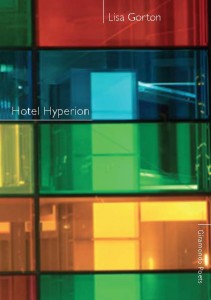
Hotel Hyperion
By Lisa Gorton
Giramondo, May 2013, 50pp
ISBN 9781922146274
In her second collection of poems, Hotel Hyperion, Lisa Gorton shows us how memory is “a place less like place than like memory itself” (“Dreams and Artefacts”): a surface, which we may see through but not penetrate. These poems are concerned with the melancholy experience of spatial and temporal distances, and how these reflect the distance between one life—one self—and another.
It’s a concern that Gorton established in her first collection, Press Release, and that she has critically explored in her work on John Donne. In her award-winning essay, “John Donne’s Use of Space”, Gorton describes the metaphysical poet’s selection of “a master-image upon which he maps many, various, and sometimes contradictory ideas.” It’s useful to consider to what extent this is also a description of Gorton’s poetics, particularly the way they are plotted and polished in Hotel Hyperion.
The “master-image” of Hotel Hyperion takes multiple shapes—telescope, diorama, Snow Dome, spacesuit, crystal, house—which the poet treats as one type, “things closed in glass” (“Room and Bell”). Upon these, Gorton maps her
essay on memory. Her imagery tingles with the chill of synthetic and airtight spaces, their bloodless particles and unearthly quiet:
Patiently, ticket by ticket, a soft-stepped crowd
advances into the mimic ships hull half-
sailed out of the foyer wall, as if advancing into
somebody else’s dream —
the interior, windowless, where perspex cases bear,
each to its single light, small relics —
(“Dreams and Artefacts”)
We imagine the speaker’s voice ringing in sparse rooms, between echoing footsteps; and always through this book, the muffled white noise of rain outside:
long rain breaking itself onto the footpath,
breaking easily into the surface of itself
like a dream without emblems, an in-drawn shine.
Overhead, clouds build and ruin imaginary cities,
slo-mo historical epics with the sound down,
playing to no one.
(“Dreams and Artefacts”)
A host of speakers—visitors, mothers, children, guardians—inhabits these spaces in Hotel Hyperion. The book’s few domestic scenarios are a red herring, as even homely settings become uncanny. For example, In the sequence “Room and Bell” (which might be the book’s finest section), Gorton gradually makes the comforting imagery of a childhood bedroom transparent: revealed as the deep memory of an adult speaker who, as a child, was already haunted in this very space by a spectre of her grown self. This revelation is amplified to disturbing proportions in the poem “Screen, Memory”, in which the speaker, who has come to accept the sealed interior of a space ship as home, miscalls a memory of bushwalking. In fact, she has received the “memory” from images screened onboard the ship.
In examining memory, Gorton is not simply concerned with the act of remembrance; she is interested in how memory reveals the very quality of being. In “Room and Bell”, experience is haunted or doubled by the shadow of our own consciousness. In “Screen, Memory”, as in all of the poems in Hotel Hyperion, the speaker is a witness and collector of reality—that is to say, the speaker is memory itself—for whom experience is refracted through the glass of other lives, other beings.
Beneath her book’s master-images, Gorton extends metaphors of intricacy and reversion. These become self-generating through the poet’s structural techniques of repetition, reiteration and variation. Perhaps the book’s most striking instance of such technique is its reprise of “Press Release”, the titular poem of Gorton’s previous collection: here reprinted as the seed of a new titular sequence, “The Hotel Hyperion”. As well as the rain already mentioned, lesser examples of returning meta-images include: moving clouds; a miniaturised ship (through a telescope, in a bottle, in a Snow Dome); displayed relics; and Mantegna’s The Triumph of Caesar. Their return mimics mild amnesia, once again reflecting memory’s fallibility; and, at the same time their presence reminds us that coincidence is the poet’s deliberate and provocative art.
At the level of line and sequence, Hotel Hyperion itself becomes the prismatic object it describes. In this book Gorton has claimed the long line with a determination and consistency unprecedented in her work. It allows her to extend whole corridors of thought without pause:
In a Storm Glass crystals
with the exactness peculiar to foreboding make neural
flare shapes: ultrasound-
coloured threads cross-stitched with blank, as of sensation
excised and, here, preserved in light.
(“A Description of the Storm Glass and Brief Guide to its Use in Forecasting Weather”)
This new affect of breathlessness contrasts Gorton’s essayistic register and typically rhetorical tone. This disconcerting tension adds urgency and pitch to these poems, signaling their linkages whilst pulling the reader by the arm, down the cold and glassy passages of their imagery. Amplifying the long lines, multiplying those corridors into networks of association, Gorton makes extravagant use of parataxis. This effect is most notably built through her liberal use of the dash, which creates the appearance of delayed conclusion:
A solution of camphor sealed in glass, they mass,
weather by weather, crystalline forms that vary
with electric change in air, and make a trophy of their
ruin —
so the clear spirit, which held all yesterday grey-
shadowed light,
this morning raises its more precise hallucination —
Jamesian
treasury of scruples, or that more formal vaulting of
remorse —
(“A Description of the Storm Glass and Brief Guide to its Use in Forecasting Weather”)
The shape of these lines flirts with prose, but Gorton’s style is steeped in lyricism; even the prose paragraphs of “Room and Bell” are sprung with musical punctuation, pace and sound effect. In the above lines, Gorton interrupts the long breath with abrupt enjambment. Frequently, line breaks hang on words that might conventionally be considered weak hinges: “of their” and “vaulting of”, for instance. However, Gorton’s reasoning of these breaks is formally precise, bringing attention not so much to the end-word as to the one hung beneath. Those words take the weight of a whole line. They are like a tolling bell or a heart sinking: ruin, remorse.
These micro-structures are more broadly reproduced by the arrangement of the book’s contents. Read as a lyric essay, each of its five parts contains a sequence or suite. Each sequence or suite forms images realised in the next. In “The Hotel Hyperion”, this structure reflects the sequence’s narrative of human generations, its poems ordered episodically to represent the reliance of one life and civilization upon another. The book’s final section, an ekphrastic sequence about Mantegna’s painting, The Triumph of Caesar, culminates this structure: framed by a contemporary viewer, looking into to Mantegna’s Renaissance viewpoint, which looks into to the Roman—and so we have Western tradition seen down the barrel of art’s telescope.
It’s a structural conceit that echoes Gorton’s own reading of Donne, specifically her focus on how his:
… one image of a circle and its centre, and the arrangement of relations that it represents in spatial terms… takes its shape and meaning from the shape and meaning of space in the ‘closed cosmos,’ where space is arranged in concentric circles. Donne describes the cosmic arrangement as ‘natures nest of boxes: the heavens contain the earth; the earth, cities; cities, men. And all these are concentric…’ and contained by ‘all the vaults and circles of the severall spheres of heaven’ [sic].
Whereas Donne views the experience of “men” as being ultimately situated within the circle of God, Gorton’s focus turns in the opposite direction. In her poems, we see—briefly, behind us—cities; but her focus is on the human sphere; and, within its circle, the mind; and within that, art. In “The Triumph of Caesar” Gorton seems to be telling us that art’s quality is the same as memory. But, like Donne’s idea of space, her idea of art is not totally Platonic. She suggests that art’s mediated quality does not mean that it fails truth; rather, art makes a true extension of human being. Like the way the mind captures and stores experience, art represents intricately nested perspectives with blurry, scrubbed-out peripheries:
The picture is mostly of legs —
it shows the Triumph from a child’s viewpoint.
Soldiers and horses — so many, they crowd
perspective out. Only a few figures stand entire
at the boundary of the picture as if they would step
the next instant into that vast which is not there —
(“The Triumph of Caesar”)
This “mapping” of one horizon upon another is more complex than the single-point perspective claimed by Renaissance art. Indeed, according to Gorton’s viewer, the single-point perspective is already fallacious in Mantegna’s painting:
The pattern their legs make repeats
the pattern of lances, angles drawn against the clouds
like a working out of every possibility. Captured arms,
bulls crowned for sacrifice, prisoners, victories and
loads of coin, spears and catapults, colossal statues, elephants —
sights that replace each other, new and again
new, the way I remember highways from the back seat
of my parents’ car — fields stacked with light
which did not pass but poured through me —
(“The Triumph of Caesar”)
In another instance of return, this childhood anecdote is also the subject of a nearby poem, “Freeways”. As well as return or reversion, this gesture reveals a palimpsestic quality in Gorton’s writing, which draws our attention back to the act of making (poesis). In this way, she points to her own art of language and asks that we consider how we have inhabited the space of this book; how we have entered into its fictions and “perspective by perspective, into that vanishing point” (“The Triumph of Caesar”).
As an ekphrasis poem, “The Triumph of Caesar” isn’t particularly challenging—it largely follows the tradition of descriptive viewing (but for that lively intervention by the persona, above). Its reason for being is larger than itself, informed by and containing the conceit of the entire book. The poem performs this role capably enough—but then, as part of that conceit, it must.
Its absolute answerability to the intricate structure of the book might cause some readers to itch for escape. If Hotel Hyperion not only represents but resembles a “thing closed in glass”, does it cast light outwards, beyond its own bounds; or does it infinitely recede, “so self-consistent / its corridors turned into themselves” (“Screen, Memory”)? Do we, as in “A Description of the Storm Glass”, find ourselves posed by Gorton as “a reader, like the picture of a reader”?
The brevity (50pp) and self-contained unity of Hotel Hyperion resemble a chapbook. Unlike a longer and more various collection of poems, it may be read in one sitting, allowing intense engagement with its plotted images and structural dimensions. If Gorton’s poetic design locks out something, it might be the aberrant image; the unanswered question. Yearning for a flaw in its gorgeous glass layers, I feel the reader’s experience may be constrained by the poet’s fixed fidelity to one idea, so fully explored.
Gorton has observed of Donne that his “image of concentric circles” hosts not only complimentary ideas but also contradictions. Gorton comprehends her work so deeply and thoughtfully as a poet of ideas and as an editor, one wonders whether her mapping and re-mapping of this book’s idea has erased the possibility of contradiction; if there is any corner of this “house of images / where nothing is lost” (“Dreams and Artefacts”) that she has not fully remembered.
Sorry you must be logged in and a current subscriber to view this content.
Please login and/or purchase a subscription.
Sorry you must be logged in and a current subscriber to view this content.
Please login and/or purchase a subscription.
Sorry you must be logged in and a current subscriber to view this content.
Please login and/or purchase a subscription.