Priyadarshi Patnaik
Subscriber Only Access
Sorry you must be logged in and a current subscriber to view this content.
Please login and/or purchase a subscription.
Accessibility Tools
Sorry you must be logged in and a current subscriber to view this content.
Please login and/or purchase a subscription.
Sorry you must be logged in and a current subscriber to view this content.
Please login and/or purchase a subscription.
Sorry you must be logged in and a current subscriber to view this content.
Please login and/or purchase a subscription.
Sorry you must be logged in and a current subscriber to view this content.
Please login and/or purchase a subscription.
Sorry you must be logged in and a current subscriber to view this content.
Please login and/or purchase a subscription.
Sorry you must be logged in and a current subscriber to view this content.
Please login and/or purchase a subscription.
Sorry you must be logged in and a current subscriber to view this content.
Please login and/or purchase a subscription.
Sorry you must be logged in and a current subscriber to view this content.
Please login and/or purchase a subscription.
.jpg) Anca Vlasopolos was born in Bucharest, Rumania. Her father, a political prisoner of the Communist regime in Rumania, died when Anca was eight. After a sojourn in Paris and Brussels, at fourteen she immigrated to the United States with her mother, a prominent Rumanian intellectual and a survivor of Auschwitz. Anca is a professor of English and Comparative Literature at Wayne State University in Detroit, Michigan. Her poetry collection is titled Penguins In A Warming World. Anca is also the author of an award winning novel, The New Bedford Samurai and the memoir No Return Address: A Memoir of Displacement.
Anca Vlasopolos was born in Bucharest, Rumania. Her father, a political prisoner of the Communist regime in Rumania, died when Anca was eight. After a sojourn in Paris and Brussels, at fourteen she immigrated to the United States with her mother, a prominent Rumanian intellectual and a survivor of Auschwitz. Anca is a professor of English and Comparative Literature at Wayne State University in Detroit, Michigan. Her poetry collection is titled Penguins In A Warming World. Anca is also the author of an award winning novel, The New Bedford Samurai and the memoir No Return Address: A Memoir of Displacement.
Wedded Bliss
gold bands glint
over a plastic bucket
where two pairs of hands
lovingly
gut
fish no bigger
than the hands
this could be a portrait
of marriage
man and woman
in harmonious
complicity
fish gored bleeding
from the side
Above the Bird’s Eye View
winter this year
sprang
a lynx
from still full-leaved branches
huge paws of wind to bat us
should we raise eyes toward light
or sigh at the thin horizon
arriving earlier each day
in this desolation in drab and gray
i look from a second-story window
see him—olive camouflage
for a pulsebeat unzipped
his rich summer gold
streaking
sun bullet
bursting through lynx dominion
Sorry you must be logged in and a current subscriber to view this content.
Please login and/or purchase a subscription.
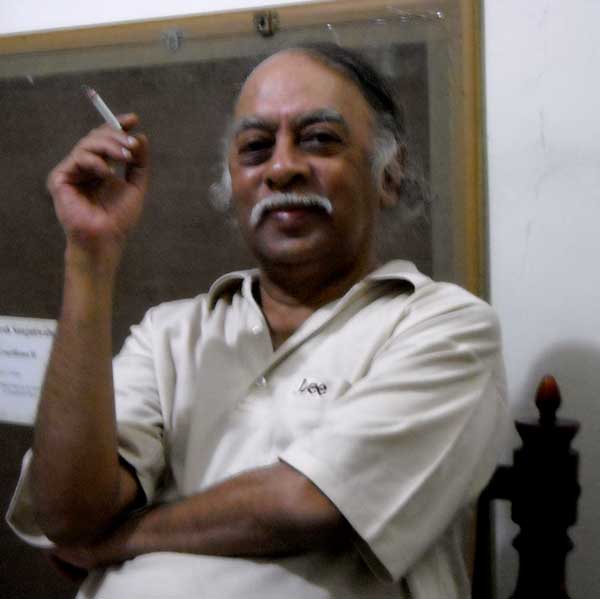
Dilip Chitre n 1938 in Baroda, India. Studied in Mumbai. After graduating in 1959, taught English for three years in Ethiopia, returning to Mumbai in 1963, worked as a journalist, columnist, commentator, editor. Was Fellow of the International Writing Program, University of Iowa, Iowa City, USA from 1975 to 1977, Back in India, made films, painted, roamed around. Now live in Pune, Maharashtra for the last 25 years. Published 30 books in all, 5 in German translation, Won many prizes, honours, and awards. Travelled all over Europe, parts of Asia, and Africa.
The Ninth Breakfast: Astrological Forecast
Sometimes a mere sausage portends,
Waiter, the coming shadow
Of Saturn. Sad days begin
Insignificantly. But sinister days
Foretell their ways. The innocent sausage in one’s plate
Grows into a cobra. And one knows
That the tables have begun
To turn.
On a Saturday you never
Get horseshoes for breakfast.
But a severe exhortation
In the morning’s editorial
On the duties of a citizen.
Here, where the cows are sacred,
And pigs taboo, a starving mob
Glares at your subversive sausage
Whose shape, moreover, is an implicit
Insult to Shiva’s phallus,
And you choke because you know
One man
Is another man’s breakfast.
No thanks. I’ll only have tea and toast.
Absence From Myself
I am emptying my shelves and my drawers
I cannot cope with their contents
Any longer. They connect with a past
That hardly seems mine though known to me.
The shelves contain books, of course,
And some of them go a long way
Into a memory not exactly my own
Where my treacherous roots lie
Into humanity’s favourite myths.
The drawers contain documents, notes,
Unfinished manuscripts, faded photographs,
Letters, memorabilia, and possessions
That could be called mere fetishes.
Alternatively, one could call it heritage.
My father’s dead and my only son died too
Within just a short span separating them
And I would be someone sandwiched
Between them—a piece of living history
Between two dead ends.
I am the one that has endured and survived
Two ends of history and the emptiness
Of shelves and drawers and largely
Unwritten books, abandoned poems,
Unfinished paintings, unrealised films,
Spaces more empty than filled,
Occupied and left.
Spaces, spaces, spaces.
Time leaves no detail untouched
And time takes all details away.
My ancestor’s gone and so is my successor.
That leaves me no space but
Here and now, no room to negotiate,
Not even an edge to fall off from.
I am exquisitely here and now
And where I never before was
Nor ever will be.
Moreover, this is not an end.
From Moscow To Leningrad (1980)
From Moscow to Leningrad
I was travelling through a three-dimensional notebook
The notebook had mile after mile of snow
The notebook had railway tracks
Close to my chest there was a broken
Anthill the size of a woman
Close to my chest were eighteen she-cobras
Close to my chest was powdered turmeric
My body flung northwards
Pointed to the Pole
Whose sins were washed out by that journey
Whose wounds bled away in that journey
There were characters written in the notebook
Spreading like fire through the snow
In the shape of a spark.
Underneath the Chandeliers Hung by Stalin
Underneath the chandeliers hung by Stalin
People swarm to buy bread
And at a distance stand the churches of Christ
Detached and compassionate
Underneath this Russian snow there could be
Several flowering plants of poetry
Countless thorny solitudes
The bones of former citizens
On the Way to Petrograd/Leningrad
(—for Irina )
Time turns to ice
Boots fall into a vanishing line
The grief of black living eyes
Lies hidden in the groin
Ointment on a tender spot
Graft on an alien branch
In the closed car of a train
Disoriented copulation
The ice of coals shovelled into
A couple of hours of intimacy
The rail track is refreshed by
Wheels speeding over it
From Moscow to Leningrad
You commit adultery and it’s a torture
And this Express goes
Right up to Finland
Towards the land of White Nights
The tall ghost of Peter the Great
The solid buildings of the navy
The palaces, the squares, the canals,
The innocent eyes of Mandelstam
Pushkin’s love affair
Lenin’s speech
Dostoevsky’s vigil in terror
And the European masterpieces
In the Hermitage
Before the Revolution and after
All this is eternal
The Great War and the great peace
The pleading breasts
Of a starved woman
Her thighs gone awry
Vodka dripping over her shoulders and body
And as a frightened sparrow hits a wall in its search for a window in the dark
Her breath enters my nostrils and my mouth as she gasps for air
I do not dare to write a poem
On all this
Our own relatives will become the angels of death
To exile us into Siberia
Sorry you must be logged in and a current subscriber to view this content.
Please login and/or purchase a subscription.
Sorry you must be logged in and a current subscriber to view this content.
Please login and/or purchase a subscription.
Sorry you must be logged in and a current subscriber to view this content.
Please login and/or purchase a subscription.
Sorry you must be logged in and a current subscriber to view this content.
Please login and/or purchase a subscription.
Sorry you must be logged in and a current subscriber to view this content.
Please login and/or purchase a subscription.
Sorry you must be logged in and a current subscriber to view this content.
Please login and/or purchase a subscription.
Sorry you must be logged in and a current subscriber to view this content.
Please login and/or purchase a subscription.
.jpg)
Enoch Ng Kwang Cheng is a poet, literary translator and publisher. Since 1997, Ng has been at the helm of firstfruits publications. In 2005 he won the Golden Point Award for Chinese Poetry. In 1991 his first book of poems were awarded Best First Book by the Taiwanese literary journal The Modernist. His poetry has been featured in journals in Singapore, India, Malaysia and Taiwan, and anthologized in China and Singapore. Ng is one of the awardees of the Singapore National Arts Council Arts Creation Fund 2009.
 Yeo Wei Wei is a teacher, literary translator, and writer. Her interest in translation began during her PhD in English at the University of Cambridge. Her translations have recently been published or are forthcoming in journals in India, Taiwan, and the U. S. She is currently working on a translation volume of Enoch Ng Kwang Cheng’s poems (to be published in 2010). She lives in Singapore.
(二)马戏
Sorry you must be logged in and a current subscriber to view this content.
Please login and/or purchase a subscription.