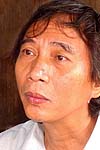
A poet and sports reporter, Thanh Thao was born in Quang Ngai Province, grew up in Hanoi, took a degree in literature from Hanoi University, and now lives once more in Quang Ngai. He was a correspondent for Vietnamese Army Radio in the Southern campaign of the war with the United States. He became famous for his long antiwar poem “A Soldier Speaks of His Generation,” which was sent directly from the heat of battle to his hometown newspaper in the North. He is a member of the Vietnamese Writers Association and poetry committee and president of its branch in Quang Ngai province. Even though this position usually comes with Communist Party membership, he is not a member, the first such exception in history. Winner of the National Prize for a Lifetime Contribution to Literature in 2001 and two National Book Awards—for The Footprints Passing a Meadow in 1979 and the book-length poem The Waves of the Sun in 1996—he is one of the most popular contemporary poets in Vietnam. An admirer of the Russian poets Boris Pasternak and Sergei Essenin and the Spanish poet Federico García Lorca, Thanh Thao has grafted the early modernist style of western lyric to his own. The publication of individual poems in the 1970s and his collection The Rubik’s Cube,1985, stunned the quiet world of Vietnamese poetry. He has published at least fifteen poetry collections and several other literary works.
The following poems are translated by Nguyen Do and Paul Hoover and will be anthologised in a collection of Contemporary Vietnamese Poets called Black Dog, Black Night forthcoming in 2008 by Milkweed Editions.
Suddenly
suddenly
his face turned to the past
turned to a sigh
turned to hopelessness
suddenly
without apology
a man flew through the treetops
leaving behind a woman, a thin trail of smoke
suddenly
the ships searched for a place to rest
the stars searched for a place to be seen
crowding into a puddle of water
where it gives birth to the sky
suddenly
as the poems searched for their flames
March 12
comes a faint sound of women selling rice cakes
on my birthday
it makes me remember
a packet of rice
a bowl of dried sweet potato mixed with molasses
a mother thin as the morning light
and laughter beside a heap of trash
now I have become my thoughts
and love what I lack
on my birthday a boat floats to an empty space
a lonely street in which some leaves are rolling
a wood-burning stove is poked, its fire like a whisper,
echoes from fifty-six years ago
a day as pale as today
that no one cared about, no one remembered
a little puppy is dumbstruck looking at a lonely street
a boy with country blood was born in a town
in a quiet time before the storms and flames
it was a childhood rippling with dragonfly wings
and fireflies whispered at night
in front of the house, the river where I had swum since I was six
not with an otter’s skill
but in the natural way of kids
to sink or to swim
2
fifty-six stairs
some of them weepy and some with hiccups
I have almost forgotten them
like a fisherman with the fish netted
3
how can I burn fifty-six candles
in the wind
if only in my life I could save a single one of them
but I blow them out instead
impossible!
This poem first appeared in New American Writing 23
Andante for the Millennium (2000)
I
When I circle myself,
the way a dog marks its place by pissing,
that’s when I break through,
because the high trees are calling,
the stars loudly call,
small bits of nothingness whisper,
a colorless beam of light
passes into my mind,
a woman pushes a trash can as if beating the drumhead of evening.
These are signs to me
to quickly clean up my mind,
be on time collecting the trash,
put the all away in the all,
to be perfectly clear.
That’s the time,
as a star disappears,
when word after word appears.
II
The wind blew me
a sideways look.
I crouched like a mimosa
looking at its thorns
which are the tears of a tree
gazing at a dump where the moon is bright as milk.
A festival of dogs
barks at the moon and laughs.
They can smell tragedy,
call out with the same emotions
of those who search the night –
a job, a hope, a refuge,
an
emptiness,
all that the dark night promises.
III
With two pens,
two chopsticks,
I’m going to look for the source of water
slowly and quietly.
Look, the pen is a little nervous,
breathing with every stroke.
I know I’m in a drought;
go slowly and silently.
IV
When I was young,
I spent my time like rain sinking into sand.
Now I add leaf to leaf
on the branch,
save a box of matches to keep warm in winter.
The old box can’t be recognized by its cover.
In childhood I held a black cricket.
Now at five in the morning, a kid is learning to walk on crutches,
a truck vomits black smog into the new millennium,
a mentally ill woman with amnesia runs beneath a street light,
behind the sunrise
the mayflies cease for a moment
all their searching and finding.
V
I already know
that other worlds
are no different –
a bird that tries to love its cage
has no need to begin singing.
Untitled
Up and down a fishing rod
to fish dreams of the past,
the dreams
of snatching shadows from under the green sadness
of water hyacinths.
I come again to my father and mother’s home
where a newly planted yellow plum suddenly blooms
like a spotlight on a flood plain,
like my mother’s eyes
staring from the garden’s corner
where custard apple has a pure greenness.
I come again
to the well,
its perfectly rounded sky,
and the tree’s oblique shadow
like my mother’s shape,
the faint sound of bells
and the rainy bells of the leaves
twinkling as they watch me;
childhood’s crystalline cloud
drifts.
I’m silent as a coconut palm
that doesn’t know why it bore fruit!
To Suddenly Remember
like someone beating a drum, the rain dropped on my waterproof army poncho
which was torn and badly needed mending
my friends were like forest trees, diminishing day by day
the war cut them down
like an electric trimmer
but now they’re all at peace
I remember also that evening, as a child,
the sweetness of the banana in my mother’s hand,
even sweeter when she carried me on her back!
the road over the dike echoed the soul of the river
dark brown sails and bamboo shadows floating slowly
a bridge where an older man got tired
and lay down to rest but not sleep
the room where he keeps only the barest necessities
the ripe smell of bananas
some old chairs
and a small ancient teapot
the aged sunlight
an evening of summer rain
and the bomb’s echo from the Duong bridge that sounded like rolling thunder
my parents lived there in a home
a ten-square-meter country
but because of our greater home
my parents didn’t prevent me
from going into battle
not hoping for a brave death or “rainbow”
I’m the hand on a compass
that only turns toward our room
where everything is old
Note: In Vietnam, the word for “rainbow” also refers to an honor or glorious achievement.
This poem first appeared in New American Writing 23
MiMi
I
I saw you, Mi, run around the moon’s back
barking
you were the best of dogs
you could outbark all the shadows
had footsteps like clouds
you still console me on the hottest of days
II
when someone loudly calls my name
I always depend on your eyes
which were brown as the earth
III
when the wind was gathering wave after wave
and the light of sunrise waved up and down
you flew past on four feet
in a good mood on a sad day
your ears twitched gently toward darkness
IV
haven’t seen you on a staircase
haven’t seen you in the air
our home was suddenly vast
with the faintest sound of your steps
you moved through the walls
V
your muzzle rubs against my heart
the night bursts into tears
A Leaf
someday
a green tree will hand me a leaf
inscribed with unclear words
as we are closely related
lonely and silent at night
miserable by day
it will have something it wants to say
someday
Wave Oscillation
I
Following me are sad dreams
in which my dying mother’s face appears,
like nights of worry as the rough sea drones.
Mother, so lovely, where did you vanish?
How do I turn time back to the past? How?
II
For all of my life, two shade trees have consoled me.
Whose footsteps remain
on the village trail?
What lights are in your eyes now that the rain has cleared?
Now the small stain of a star rises deeply,
a horizontal line that separates two sufferings,
but still leaves the spicy, fragrant smoke of our stove
in the garden with its dark green banana leaves –
from morning to night you still walk back and forth there!
1988
And You Wake Me Up, Ginsberg . . .
And you wake me up, Ginsberg, where I sleep on a log like a dog that sometimes speaks in sleeping, waves its tail
and howls with smoldering anger. And you wake me up with an owl in front of a forest, a drop of morning haze,
the sound of a person on the street recovering his previous life, the wind shredding newspapers, a series of drafts
extolling the mass media, and a bicycle rolling and flickering on a hot day. And you wake up me, a suppressed
kid, a miserable, homeless man; all untruths are listed under my name; my success and prosperity are confirmed,
recycled most likely from waste. But no one can recycle the pain and tears, although they want to create literature.
You wake me up as roughly as a cop rouses a beggar dreaming on a park bench, rubbing his eyes as he thinks
about dreaming another dream. The paths I have been walking, both long and short, are meaningless; however, I
wait and, while waiting, I sink into the newspapers, throwing word after word, all those miserable words, in
exchange for a few pennies by the never-green leaves. This summer is so hot; I’m really tired. But you wake me
up, Ginsberg, I stand up as the morning rises, a howling rises, the green of never-green leaves rises. We live
without limits, but who knows what is best to do in these heavy times. The howling in blood, the rebel cells, isn’t
strong enough to become a tumor, but it doesn’t matter. I know someone who gives people immortality pills or
secretly puts mines of expectation in their chests; they will make this world shiver before it sinks again in their
sleep. Their mission is like a fly in a bowl of soup. I’m sick; please turn the sunlight blue until it’s salvation. You
wake me up in time, which the sun confirms by raising its hands in my direction. And now I’m as immovable as a
dusty plastic sunflower.
1998
This Is Usual
You tell me that I’m melancholy, but what the hell is it if I’m healthy as you,
and what is your power based on?
In a rainstorm we hear the sound of sighing – we can’t say
what we think or try to say what we don’t know.
The river is as puzzling as breath; it decorates its voice.
You don’t talk, but the way you are silent
speaks more than speaking.
I have experienced many holes, many rains, which crash into the shade
through leaves and branches,
which are in shock.
I lean on time to catch the time that doesn’t run out.
To ignore the land is to be old, dry, lean, and thirsty.
You persuade me by lying down in my cocoon then searching
for a way home, looking calmly at a catfish that gives birth
at the top of a banyan tree
in the summer-fool-crazy rainstorm.
2004
A Journey
A daydream takes me; I go into the private darkness of light.
The darkness differs significantly from reality, but it is still the reality
of a cow chewing the sunset; on one side is the yellow sunrise, on the other the darkness of sunset –
the faint border between
reunion, separation, reunion.
We have lived by suddenly moving, freely and easily,
from this area to another.
The lonely one who travels only with his mind
on unending hallways
to meet relatives who passed away
is as happy as any tourist
with blocked views.
Please,
don’t dig any holes that will break my journey!
1994
The Goal
A truck. The dark, nasty night. Losing direction. Trying to climb down in order to climb up. Can’t see that
truck. Can’t see the way home. Fences. Strangers. Another truck. But not the one I was looking for. That’s
probably Truong Son. There must be another war. But no. The truck. My “brother” the driver vanishes. I’m
suddenly very confused. Can’t see the goal. Where do I go? The night is like a cocoon. Pictures flicker. There are
human beings, but I’m unable to speak to them. No way home. No address. A stair slopes increasingly
up. Slipping. Down is easier than up. Slipping down then vanishing. Trying to talk louder by remaining
quiet. Trying to speak without a sound. All that remains are the views skimming along in the side mirror.
1988
Note: Truong Son is the longest mountain range in Vietnam, running from north to south; along with the Ho Chi Minh Trail, it serves as the border between Laos and Vietnam.
If I Knew
Drawing the bow intensely then suddenly releasing. No arrow. But feeling little pain. Maybe the arrow secretly
shot back, but I don’t know. Sometimes I choke when I swallow something. Don’t know where it runs to. A heat
between my chest and my belly. I have been neither waiting nor expecting very much. But how come that arrow
still comes back? The darkness flows into secret corners. I crouch like a rock or root. Someone sits on me,
mumbles and spits then leaves. The night gnashes and grinds. I don’t want to be alone, to be the bare branch
waving alone, like a cow or buffalo waves its tail. I want to say something for someone. But no one is here, or
they are here but I didn’t know. Don’t know what to say. Everyone counts their steps on their own separate
path. The sound of counting makes it a path. I don’t know how to count or I count wrong. Do I have no path? Here
are the breaking lines on the dike where my self is flooding. Why do I stand on the bank of my river life,
frightened to jump into it, even just to get wet? Who doesn’t dare to swim doesn’t dare to sink!
1998
A Soldier Speaks of His Generation
The day we leave,
the doors of the passenger train open wide.
There’s no longer a reason for secrets.
The soldiers young as bamboo shoots
playfully stick their heads from the windows.
The soldiers, young as bamboo shoots,
in uniforms too big for them,
crowd together like tree leaves on the stairs between the cars.
The train whistles too loudly
And too long, as if broken,
like the voice of a boy who nearly has his man’s voice now.
In our generation,
that train whistle is a declaration.
The generation in which each day is a battle,
its mission heavier than the barrel of mortar 82
that we carry on our shoulders.
The generation that never sleeps,
that goes half naked and patiently digs trenches,
that is naked and calm in its thinking,
that goes on its way as the past generation has gone,
by ways various and new.
In the forest, names are quickly engraved on trees.
The canteens are engraved with the letters N and T.
Each backpack contains a uniform,
some dried fish sauce, and a small lump of steamed rice.
The camp’s woodstoves flame on the stone bank of a creek,
above which hang tall cans of sour soup
made from Giang leaves and shrimp sauce.
What we have,
we share,
share on the ground
completely.
To enemies, we spend all we have in battle.
To friends, we give until all we have is gone.
If you see that our skins are black from the sun,
our misshapen bodies seem older than they are,
and you can count the calluses on our hands
along with the war medals – still, nothing quite describes us.
Oh, the clearing in Dau forest with its dry, curved leaves!
Every footstep crackles like a human voice.
In the night as we march,
several fires suddenly flare on the trail,
our generation with fire in our hearts
to light the way to our goal.
One night when rain lashes on all four sides,
We’re in Thap Muoi with no tree to hide us.
As the swamp floods, we have to push our boats against the rising tide.
The horizon lies behind whoever drags himself ahead,
Silhouetted by the flash of lightning.
Our generation has never slept, walks every night in the flood.
Mud covers us thickly from head to foot.
So our voices are those of cowboys,
and our gazes are sharp as a thorn,
because the fire that can burn in a bog is the true fire.
When it flames up,
it burns with all of its strength.
What do you want to tell me in the hazy night, Quoc,
as you sing passionately the whole flood season?
The Dien Dien flower raises its hot yellow petals
like the face of a hand that sunlight lands and stays on.
Our country comes from our hearts, simply,
Like this Thap Muoi that need no further decoration
and is completely silent.
Stronger than any romance, this love goes directly
to any person
who doesn’t care about the limits of language.
Unexpectedly, I meet my close friend again.
We both lie down on a My Long trail,
on an army coat under the dark sky,
where just this evening a B-52 harrowed the earth three times,
where for several years the bomb craters are uncountable,
where I suddenly speak a simple dream:
“When peace truly comes,
I will go to trail number four, spread out a coat and lie down
completely satisfied.”
My friend gazes
at a star rising from a water-filled crater.
His eyes look so strange; I see
they contain both the star and the crater . . .
A vortex spins on the roof of an ancient forest.
The wind whistles a long time inside the empty shells of trees.
The bats flicker in and out of sight.
A flattened place in the cane grass smolders.
We have passed the limits of the dry season,
passed the rainy season, the long limits of the rainy season
when every night our soaked hammocks hang on Tram poles.
Our boats move across the river under the faint flares of the American army.
Sometimes, in awe of the skyline filled with red clouds at evening,
we forget we are older than we are.
Our feet walk in rubber sandals across a hundred mountains,
but our shadows never walk ahead of our futures.
Battles of come again in memory.
Rockets explode against the sky in a mass of smoke.
Our hearts beat nervously in our very first fight.
Our army-issue canteens smell as they burn
on the roofs of the trenches.
And the garbage cans lie strewn all around.
In the silence and deafness between two bombings,
a hen’s voice suddenly calls
from a small, ruined canal.
Our generation has never lived on memory
so we don’t rely on the past’s radiance.
Our souls are fresh as Chuong wind,
our sky the pure blue of a sunlit day.
The transport boats sail the crowded Bang Lang canal.
That evening rockets attack,
bending down the Binh Bat trees.
Sunset covers both banks like blood.
The canal turns white from the flow of toxic gases.
Suddenly I see my face on the water’s surface,
among those poisonous mists,
on which floats the Binh Bat fruit,
on which floats our breaking country,
and I see
also floating the faces of many people,
some of them friends and some I have never seen.
They are so very young
as they flicker along on the stream
into a distant meadow
on an endless evening.
They’re the people who fought here first,
twenty years ago as one generation,
and also the ones who will come later,
twenty years from today.
That evening
on the small canal
artillery attacks and flowing water.
How clearly you can see
the faces of
our generation!
1973
This poem was very controversial in Vietnam after it was published in Hanoi’s largest literary review, Van Nghe, and was prohibited by the government until 1988, when Vietnam reconstructed its economy and politics.
This poem first appeared in New American Writing 23
Giang is a wild vegetable, sour to the taste, which North Vietnamese soldiers used in soup.
Dau is a kind of tree commonly found in the forests of southwest Vietnam.
Thap Muoi is a swamp where one of the largest North Vietnamese army camps was located.
Quoc is a nocturnal bird that sings “quoc, quoc, quoc“; it also means “country.”
Dien Dien is a wildflower.
My Long is the name of a trail in Thap Muoi swamp.
Binh Bat is a kind of tree that can be found in Thap Muoi swamp.
Chuong is a kind of southwest wind.