Maxine Beneba Clarke
Subscriber Only Access
Sorry you must be logged in and a current subscriber to view this content.
Please login and/or purchase a subscription.
Accessibility Tools
Sorry you must be logged in and a current subscriber to view this content.
Please login and/or purchase a subscription.
Sorry you must be logged in and a current subscriber to view this content.
Please login and/or purchase a subscription.
Sorry you must be logged in and a current subscriber to view this content.
Please login and/or purchase a subscription.
Sorry you must be logged in and a current subscriber to view this content.
Please login and/or purchase a subscription.
Sorry you must be logged in and a current subscriber to view this content.
Please login and/or purchase a subscription.
Sorry you must be logged in and a current subscriber to view this content.
Please login and/or purchase a subscription.
Eileen Chong is a Sydney poet who was born in Singapore. In 2010 she won the Poets Union Youth Fellowship and was the Australian Poetry Fellow for 2011-2012. Her first collection of poems, Burning Rice, was published in the New Voices Series 2012 by Australian Poetry. The book was highly commended in the Anne Elder Award 2012 and was shortlisted for the Prime Minister’s Literary Awards 2013.
Noodles in Hong Kong
We’d walked downhill along Star Street
and emerged onto a version of Hong Kong
Sorry you must be logged in and a current subscriber to view the rest of this content.
Please login and/or purchase a subscription.

Mike Ladd lives and writes in Adelaide. He produces Poetica each week on ABC Radio National. Mike’s most recent book is Karrawirra Parri: Walking the Torrens from Source to Sea published by Wakefield Press in 2012.
Gasoline Flowers
Mohamed Bouazizi,
wanting living space
and a little justice,
became an orange-yellow orchid
Tich Quang Duc,
a wavering lotus of flame
Palden Choetso – a smoky iris,
deadly bright at its centre.
For his land of snow
and a spinning prayer,
Tsering Tashi was a gaping petro hibiscus.

Elizabeth Allen is a Sydney poet and the events manager at Gleebooks. She is also the Associate Publisher at Vagabond Press. Her poetry has been published widely in Australian journals. She is the author of Forgetful Hands (Vagabond Press, 2005) and Body Language (Vagabond Press, 2012), which won the Anne Elder Award.
Winter Lilyfield
The mint and the rosemary
endure in the concrete backyard.
The star jasmine is taking over the
shed and the end of the clothesline
which is bare. A single sock lies
in the dead dried leaves and
a pair of lacy black underpants hang
off one of the succulent’s long spikes.
I can guess which flatmate they belong to.
The leaves are gathering in the corner
of our concrete backyard.
Lacy knickers
token of the summer dalliance
we wish we had.
Neighbourhood watch
Early one Saturday morning you watch
her as she shuts the door to her three
bedroom terrace & crosses the road,
highlighted for a moment in the sunshine.
She is wearing a red & white made590 skirt,
a black Witchery top with a blue plastic bird
brooch, Salt Water Sandals on her feet
& a hat made from a patchwork of recycled
vintage fabrics. She has a Monsterthreads
jumper over one arm & a tote bag with an owl
on it over the other & a KeepCup in her hand
(in your mind you can smell the coffee).
Some days she walks to the GoGet parked at the end
of the street. But today she appears to be walking
in the direction of the local organic produce markets
where she will no doubt buy carbon neutral food.
Sometimes you wonder what she is doing inside
her house: eating ash-coated goats cheese
on sourdough bread while listening to FBi radio,
or flicking through a magazine of new emerging
writers, or rewatching Mad Men? You think,
not for the first time, about how she would
be such a good character for a play: the wealthy
girl from the North Shore who makes her way
to the hipster wilds of the inner west & goes
no further, apart from occasional trips into
Marrickville for Pho or to Parramatta to visit
the one friend she has who lives out there;
how she would be so easy to write,
how it would be so easy to mock her
so much harder to take her seriously.
Sorry you must be logged in and a current subscriber to view this content.
Please login and/or purchase a subscription.

Manisha Anjali is a folk story writer based in Melbourne, Australia. She has also lived in Fiji and New Zealand. Manisha won the People’s Choice Award for her short story Goldie the Turtle in the NZ Writer’s College Short Story Competition in 2012. She was awarded a Hot Desk Fellowship by The Wheeler Centre in 2013. She is currently working on her debut novel, Peanuts.
Fever Dreams
Aji has put me in a small cupboard. I am to lie here in the darkness with the hots and colds until it all goes away. My eyes are sticky. They have glue coming out of them. It hurts to keep them open. But I am afraid to close them completely in case they glue themselves shut forever. Then Aji would have to cut my eyes open with a knife. I have big red spots from my chinny-chin-chin down to my ankles. They itch like a bastard but I am not allowed to touch. Aji will smack me if she sees me scratching. The hots and colds keep me awake and put me to sleep. I am somewhere in between real life and a scary dream. I can hear my brothers and sisters playing hide-and-seek outside among the trees; and my pussycat is scratching on the cupboard door because she is worried about me.
=================================Sorry you must be logged in and a current subscriber to view the rest of this content.
Please login and/or purchase a subscription.
Sorry you must be logged in and a current subscriber to view this content.
Please login and/or purchase a subscription.
Sorry you must be logged in and a current subscriber to view this content.
Please login and/or purchase a subscription.
 Born on Wakka Wakka land at Barambah, which is now known as Cherbourg Aboriginal Reserve, Lionel Fogarty has travelled nationally and internationally presenting and performing his work. Since the seventies Lionel has been a prominent activist, poet writer and artist; a Murri spokesperson for Indigenous Rights in Australia and overseas. His poetry art work and oral presentation illustrates his linguistic uniqueness and overwhelming passion to re-territorialized Aboriginal language culture and meaning which speaks for Aboriginal people of Australia. In 2012 he received the Scalon prize for Connection Requital and his most recent collection is Mogwie Idan: Stories of the land (Vagabond)
Advance Those Asian An Pacific Writers Poets
As an murri writer pitch fee in carvings
Asian unity we need is most important
They are the beings on top of us an on the side of us.
At our arms is the Pacific of knowing
We need to unite for rights in all writing powers.
Our Asians are on our earth if we walk under the seabeds we sleep together
Think were there’s no sea the waves of our humanity is the same.
Most of this Asian Pacific is in fights just like love’s that was taken from them.
Most times the spirit of unity is not walled or housed but air free smell free and giving a shared stories.
Life at all times shown must have no different, but there are the bright lights, when we are blind.
Asian is not cassation
Pacific are not anglosacktion
The peace of mind was a balance in space respect the times of the once timeless minds.
Can the truth of Asian Pacific writer give us justices of causes?
Yo if they don’t get out work in their community’s then the pushishing world is at a lost.
So black fell writers this sacred future timing is important.
Remember in school we were taught they whites run them.
Will not true, wave have tunes
Our dancing not same, yes but thing can say and feel.
Our looks are not same but we see in painting art looks don’t mean we apart.
Just see them real reading our stories our culture of what a fight makes to be right.
Asian we can love on open eyes
Pacific we can love on open arms
They weren’t our oppression
We know here lot bugged like the white man’s peoples.
But that not the ones on homeland
Our skies in outback here beds and houses their skies.
The rain of road ships trucks all the days off all foods.
Delightment nights in fashion of opposite
Many souls wants to be unhurt unsafe offences of the desire to unity of the heart to art writing our Asian mobs have done in reply.
Our bodies spill the tempers but the spirit is one.
The moody Pacific mingling in our
Countries are negative at times
Yet these shinning sail them away says are sometimes can’t stand their own peoples.
All people of Pacific Asian are star travelling poetry, but the destination get contemplation.
All Pacific Asian needs our first Australia words to fill their emptiness.
A thousand pages in the food dish will feed the mind body as one.
Require our bush land sea sky without a cost to cut your bloods.
Reason now Asian Pacific letters to us natives down under not of sorry uncountable.
Capture our song mouth lip in our written sweat drop off the spear pen we given.
Let Asian knowledge refinement to out first Australia writers.
Make our books be the beach to lay on.
Make the millions turn the pages our, Pacific Brother Sisters writers learn and action to us, Asian as not drafting a trees felling over
pain sad and down and ousters.
Scream to the injustices quieted by birds in flying over the perpetually aggravation.
Don’t like the lit bug Aussies,
Hum began to like the Asian Pacific forgive but don’t forget.
Don’t like the collar reserve sir to the loudly thunder statures.
Pacific some trash our calendar histories,
Yet most of them know savagery is a wall-to-wall things.
And the sea makes all inland the body of man and women’s.
Asian history must be on our side for future frail fake are not civilianise.
The words here is to rib the rid of bone requiem deceit in the rackets.
Asians are not my or my people’s root yet flowers grow eye for an eyes.
Pacific are not my feet to eat, yet praise be it, to the writers not white in minds + bodies.
Coming back to poems over seas, yes the Asian Pacific touches our fingers without we know.
Half the write it’s not gods or goddess just same as land love, when a rainbow is felt by the two people’s the down under people
walk and talk sing and dance the dust on the pages of histories futures.
We cut the trails off for the smell to be tongued all around the Asian Pacific worlds.
They were never boat people but cues to cuss and shared to share.
The Makassar came then stayed so we live equal passion and ate blood on blood drank the earth as writers to today.
Some kill we had in need not for power over powers that be.
Bourgeois Asian sits a write poor at the doors life’s still die
Bourgeois Pacific sits on grass head thinking their freedom is the tongues they speak, well-written word must unite our respect too.
Mocked as nothing off shores, we last strong winged sails from shores to shores epics anew to write.
The warm beat on ward unawakened the sense in clearer washed skies.
Asian Pacific stories of the homesick
Aspire the creation unstained.
Asian Pacific attains our noon moons recoiling colour crews to be lacerated by our mythologies.
Banished now those ambush settlements away from a chained writers fears.
Bewail our progression painted to sing dance the one possess in peace over wars of grief.
Bound and adore our call for our poets to condemn flack fades of history awaking.
Monument the trust of patient and see our races unbridled.
Reappeared the repeated memories were no games are drop to knee.
The Asian Pacific volunteer are payed by the society vaporises.
We crawl not the injustices to arm our fingers and hand on legs for we yearn face on face rhyme to fierce any dodges of our writers.
Long lives the history of the struggle funny or wild to attack conditions.
Asian Pacific you all are the originality
Enfold the valleys in lust and rages
The country on earth is all that gives generation the chance to write and arts.
Shape our unity with perfect visionary give maturity to the immaturity other writers are old in the wall of racisms.
Mountain the unseen Mountains in our writer’s poet to rich on every Aborigine wish.
From the dawn of futures to the Australia dedicated longings,
We still must affectionate our Pacific Asian writers quarrel darkest mining to suddenly give hope over fury kept.
Fortune are moved by famous gallantry to stop genocides,
We must dominate all authority
Never surrender prophetic to the reflection of oppression
We must courage our welcomed one on number so high.
Customs are to carry on more so than the drunken stupor older chiefs.
Now speak of the harmony Asian Pacific’s
Bungalow all poor and unrest the brigade,
Harvest the learners even grabs soil in all barefoot victorious to rejoice rein in return.
Blunders those evil when the writers are burial; in shroud to justices by poets not massacred.
False people’s say they are ministers not the truth of people’s on peoples,
So stirred the ancestral emotions.
Let the Asian Pacific warriors live message UN broken.
Let the Asian Pacific warrior’s faith the barely crawled belly of mischievous.
Come Brothers of the Asian Pacific writers pleasant our pride for a truce in a thousand devour years, no colony can con.
The tall tales are Europeanism to blame for steering hopeless taste and treaty’s surprises.
Dreamtime multiple declare all mistakes be a past tears for those unfriendly warpaths.
Familiar our write-to-write together now Pacifica Asian’s narrow and bigger……….
Sort of Sorry
Sort of sorry tears on drops
Were no eyes?
Sore cries
Walk pass the changed season
Sing passion to the changed leavening.
Mouths lay at the below eyes of beds.
Now writing is unwritten
So ear in took raw deals.
Then as a stood sorry people
Said no more tears.
Smiles embraced the truth for saddest
Wiped an extinct body.
No sorry business changes things
No loaded crying stops crimes
Walk pass the changing seasons
Walls seek space for the lonely faces
She saw pain in a lane of flyaway planes.
He sewed rains drops fallen by
The baby’s unborn restrings.
Sorry you must be logged in and a current subscriber to view this content.
Please login and/or purchase a subscription.
 Belle Ling is a graduate from the University of Hong Kong, and has completed a Master of Creative Writing at the University of Sydney. She has a special interest in writing poetry. Her favourite novelist is Haruki Murakami, and her beloved poems are those which can capture insightful images with in-depth philosophical meanings.
A Good Morning in the Crowded Train
Upon the window of the shuffled train, the sunlight eyes are churned white.
Eyes closed, heads grinding in circle, heels tap balance, disturbed by an awkward
halt—then resume their momentum as the train reels, as if smoothing all the angular
shoulders until they are as round as the river-washed pebbles—any uncertain frictions among
shirts, any unnoticed nudges, any sharp pokes of noses are harmonized
in the hypnotic back-and-forth of our heads and our heels. No ruins, no cries, no
surprises intrude when the space between one another is tied by the repetitive
rhythm. Sweat behind my ear, nearly tiptoes onto his shoulder—drops and is swept
by an unbuckled cuff, air-probing, of an unknown face—my vertebrae are chained,
his half-zipped fly slides over my thigh—fingers collide, chime—exchanging unborn rhymes.
His yawn—sour milk and leftover tuna—unsettles my dream of a Sultan’s perfumed verandah.
My forehead, rimmed by his chin, begs his collarbones globe
as a soft-fat pillow, as willows sway across the window—that gradually-eased hiss,
that deep ebb, zips our long-missed dreams rolling in our laces and fabrics. In-depth,
severely-pressed—his shoelaces, etched into my soles, don’t tussle. My jade-rabbit
pendant, that vivid verdant, is unconsciously-locked in his creamy collar,
as a green bean-sprout entwined in cotton. The wheels keep tracking the rail left-and-right, my
eyes trail his ribs, that strain and slack—as aligned handrails
surface and vanish, hardly held. Hot air curls my eyelashes, flicks my mind’s haze—
“Excuse me”, I say. “I’m sorry,” he beams. The door closes—
hard as husk—I look at the train until it’s reduced into a dark dot in the dense green.
Aussie
Dust, grit, ash,
keen sheen in lashes
of weeds;
your sweat appears
as a solid glow.
An eddy of rose
in your fist
draws in the winds
of all directions,
fast, firm, not fierce.
Impression
“Take it back,” I call,
I recall—petals in the winds. Rippling,
the church bells, remind me
of the air, the water, the light
and—the blue sky—all the basics
for a decent day,
for the first day
a human starts to breathe, or for—
the moment that time
is first numbered as days,
which, unfortunately, can’t outlast
the time of universe in reverse—
my undated calendar,
and your watch ridded of hands
are the most reliable.
I haven’t noticed
the tree outside—
my balcony is Jacaranda until
the sunshine determines to rinse away
the densely-vivid purple:
those blurring whites.
The strong shine on the apex
of the cross—that sharp
and cold point is hardly tamed, not even
the sisters’ buzzing lips:
regular amens can’t prop up
three trampled daisies.
“Take it back,” I call,
yes, I recall—the remains in your pocket—
ripped cloths, molten honey and several
unclassified name cards
plus a familiar scent that’s long
been forgotten, or—
long been hid
for being forgotten.
Red tea and ice, as clouds
pass over, turn dim and gleam again—
a colour, between cool and warmth,
beyond exact depictions of all kinds,
doesn’t know how to cheat:
we’re just two ordinary passers-by,
who can’t afford to lie.
Sorry you must be logged in and a current subscriber to view this content.
Please login and/or purchase a subscription.
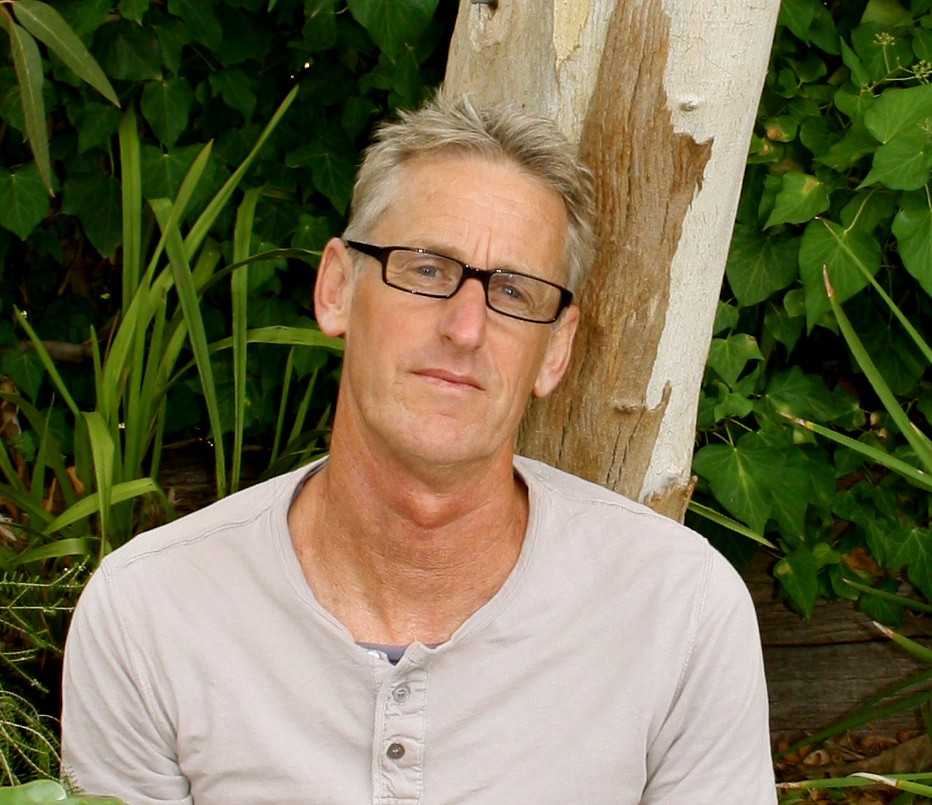 Mark Smith is an educator, writer and surfer (not necessarily in that order) living on Victoria’s West Coast. In the last 12 months he has had stories published in Visible Ink, Offset and Headspring. He has been long-listed for the Fish Prize in Ireland and, most recently, won the EJ Brady Short Story prize for a story entitled Milk For India. (This story was awarded second prize in the FAW National Literary Awards short story category). Unlike every other writer on the planet, he is not working on a novel – or at least he is not telling anyone if he is.
The road ribbons out in front of T-Bone. He looks over the steering wheel and shields his eyes from the sun reflecting off the bonnet. All the straight lines, the metal, the fences, the wire, the hot nights on his bench, all of them behind him now and ahead of him his mother’s country.
Viewed from above, the old Hi-Lux ute is a piece of dull metal pushing slowly west, a vast plume of dust erupting with its passing. After the river crossing the road runs straight for twenty kilometres before it elbows south, corrects itself and heads toward the distant coast. The river curls around behind it like a great snake before it fans out to cover the flood plain. The lush trees and grasses cling to its bank, a green skin slithering between the stony ridges that lead to the dry heart of the continent.
For eight months all T-Bone has thought about is driving west along the Port Keats Road, steering a course between the sharp rocks and the bulldust on the shoulder.
Jimmy sits in the passenger seat of the Hi-Lux. He clings to the handle above the door and braces his body against the constant vibration. The car’s suspension is shot and the column shift is held in fourth by an occy strap that comes up through a hole in the floor. Every now and again he drinks from a water bottle and passes it to his nephew. T-Bone takes it without looking and gulps quick mouthfuls. Occasionally a tourist’s neat and shiny four-wheel drive passes the other way and fills the cabin with dust. T-Bone eases to the side to let them through then guns the ute into the billowing cloud they leave in their wake.
T-Bone is comfortable with distance. He grew up in the back of cars and utes riding high in the hot breeze or swaddled in blankets at night with his brothers, his cousins, his uncles and aunts. His family was always going somewhere. A football match at Adelaide River, a music festival in Darwin or out to shoot geese on Lizzy Downs station. As a child he tried to memorise the road, looking for the washouts and cutaways that spaced themselves between home and Daly River. Each journey threw up a new marker, a burned out wreck, a swath cut through dreaming country by a new pipeline or a turn-off to a camp that only the old women could see. He looked where they pointed, noting the lean of a particular tree or the shape of a termite mound. He found a place for them in the map in his head that slowly filled the gap between what he wanted to know and what the old people knew. Now he marked the stages of his journey home by these landmarks and the memories they held.
Jimmy had barely spoken since he picked up T-Bone in Darwin. He had driven overnight and arrived in the near-empty car park just as the sun crested the walls and caught the wire. Exhausted, he lay down across the seat and fell asleep, covering his face with his hat to cut out some of the light. T-Bone opened the door and stood in the glare. He carried a large duffle bag over one shoulder and smaller bag jammed under his arm. He wedged them behind the seat and tapped his uncle lightly on the leg.
Jimmy didn’t move but spoke from underneath his hat. ‘What kept ya?’
T-Bone smiled, ‘Bin waitin’ long?’
‘Eight months or so,’ Jimmy replied, tilting the hat off his face.
‘Sorry Uncle. Would’ve come out earlier if I’d known.’
‘Still a cheeky bastard then.’
Jimmy sat up and looked at his nephew as he slid in behind the wheel. ‘You put on weight,’ he said before he rested his head against the side column and dropped the hat over his eyes again. He didn’t wake until they were well clear of the city’s outskirts, with only the occasional petrol station to interrupt the monotony of the flat scrubland. The radio was on and T-Bone was driving one-handed, the other hanging out the side window, trailing in the breeze.
‘What was it like in there T?’ Jimmy asked.
T-Bone looked straight out at the road and mouthed the words to the country song that was playing through the one working speaker. He had thoughts for what it was like, but not words. He couldn’t describe how it had emptied him out, broken him open and left him hollow. He wanted to tell his uncle how at first he’d dreamed in colour, the rich green of country after the wet, the dark purple of those big storm heads in the build up, the red and yellow flash of black cockatoos taking off. But slowly the colour had drained away to grey, then nothing. No dreaming, just restless sleep with the sweat trickling off him on to the mattress. He’d spent days at a time in there trying to remember things that didn’t have a place anymore. He couldn’t remember the sound the rain made when it hit the river or how it changed the way it smelled, the way it moved.
‘Food was okay. Three meals a day. Didn’t have to do no cooking,’ he replied.
They stopped at the Daly crossing in the harsh midday light of the dry season. The grey-green river eddied and spilled under the crossing, making its way down under the new bridge that would open up the road right through the wet season. They sat in the shadows up on the high bank and ate the bread and jam they’d bought at the Adelaide River truck stop. T-Bone spread his toes through the coarse sand, burying them up to his ankles. Then he walked down to the water.
‘You watch out for those crocs,’ warned Jimmy.
‘Not worried ‘bout no crocs Uncle,’ he called over his shoulder. ‘They better watch out for me though.’
T-Bone cupped his hands in the water, splashed his face and ran cool fingers through his hair. He was coming into his mother’s country and he wanted his sweat to flow down the river and announce his return, to fan out across the flood plain and let those magpie geese and turtles know he was back. He knew the barramundi would tell his story all the way down to the sea, passing the word on when they rested in the deep billabongs, swimming his name back out into the current where the salt water mixed with the fresh. The water loosened T-Bone’s limbs and quelled a little of the restlessness that had been building in him as his release date had approached. He felt as though he had been holding his breath for weeks. He sat on his haunches and allowed himself a smile only the river could see.
Back in the car they crossed the dry spillway and accelerated up the steep grade on the other side. The country levelled out again and the road broadened, wide enough now for five cars. They passed the turn-off to the mango farm and the fishing camp down river. T-Bone took the tobacco pouch from his shirt pocket and rolled a cigarette one-handed, sealing it with a quick lick of his tongue. He sat it between his lips and pushed the lighter into the dashboard. It sprang out and he lit his cigarette. Seeing a mob of startled wallabies bounding for cover he braced the steering wheel with his knees and, holding an imaginary rifle in his hands, made a cracking sound with his tongue and exhaled smoke from his nostrils.
Jimmy looked at him and smiled. He had forgotten how young his nephew was. T-Bone gave him a sheepish grin and quickly turned away.
‘I forgot all those stories in there Uncle; all those stories Mum told us. Y’know, the ones about the brolga and that old pelican. The turtle and the porcupine. I tried real hard to remember ‘em but I couldn’t. I lost ‘em in there, somewhere in the corners and the walls. I lost ‘em and couldn’t remember ‘em.’
Jimmy looked straight ahead and nodded.
‘You lonely in there T?’ He asked.
‘I felt sick for home the whole time Uncle. Sick for family.’
‘Family missed you the whole time T. Your Mum says you took ‘er heart in there with you. Reckons she hasn’t been able to breathe proper since you been away. She on dialysis now too. Twice a week’
‘She can’t breathe it’s more likely those smokes I reckon. Shouldn’t be smokin’ at her age,’ he said, flicking his cigarette out onto the road.
T-Bone returned his attention to the wheel ruts tracking through the sand and rocks. He thought about the last time he had seen his mother. She had travelled up to Darwin for the court case, slept with the long-grassers and arrived late. He looked for her in the thin crowd but the proceedings began before she got there. He struggled to answer any of the questions because he had no one there to look at. He stared at the floor and said ‘I don’t remember.’ The copper read the charges in a tired voice, his uniform pulling tightly across his belly and his hat on the table in front of him.
T-Bone didn’t hear the sentence but when the guard took him by the arm his mother called out from the back of the room. She spoke in language and the words followed him back down the stairs and into the cells where they got lost in the shouting and noise. ‘You come home now,’ she said. ‘You come home.’
The road flattened out, the blue-green escarpment up towards Emu Plains growing out of the horizon. T-Bone drove with the window open, filling his lungs with the smells of the country. As they approached a track heading off to their left he slowed and pulled the ute to the side of the road.
‘What you doin’ T?’ Jimmy asked.
‘Gotta drop somethin’ off for that Pidji mob. Meet someone here.’ He didn’t know how they would know to be there. It was one thing he’d learned in the last eight months, the things he didn’t need to think about.
He braked slowly and brought the car to a stop, leaving the engine idling. When the dust settled they saw an old man and woman sitting under a yellow-box tree at the side of the track. They waited. The old woman ate from a packet of chips and looked past them to the other side of the road. The old man raised his hand, the palm flat, then tilted it from side to side. ‘What?’ It said.
‘Name T-Bone,’ he called. ‘Got a bag for that Pidji mob. Belongs to the boy who passed on.’
The old man grabbed at a low branch of the yellow-box and climbed to his feet. He stood with his hands in the small of his back and rocked forward a little. He might have been fifty or seventy, his brow covered by a felt hat and his mouth hidden behind a grey beard. He stood there swaying for a while then shuffled over to the car.
‘You got a smoke?’ He asked.
T-Bone handed him his packet of rollies. The old man fumbled with the papers and rolled a thin cigarette. Jimmy and T-Bone watched silently as he took a box of matches out of his pocket, cupped his hands and lit the cigarette. He inhaled and began to cough, leaning over and spitting a lump of phlegm into the dirt.
When he had drawn enough breath to speak he leaned into the car and asked, ‘You know ‘im in there? That boy?’
T-Bone paused, then replied, ‘Sorry Old Man. I didn’t know that boy. The priest, that Father Michael bloke, he give me this bag here and says if I can drop it off for that Pidji mob.’
He reached behind the seat and pulled out the small bag with Adidas written on the side. He passed it through the window to the old man who took it with his right hand and pushed the packet of rollies into his top pocket with his left. He held the bag in his hands for a moment, as though weighing its importance, then walked back, took hold of the low branch of the yellow box to balance himself and dropped it next to the old woman. She undid the zip and emptied the contents into the dirt – a couple of shirts, a pair of black shorts, a bright red and yellow football jumper, a cigarette lighter and a small toiletries bag. She looked back up at Jimmy and T-Bone for a long minute then pushed the items back into the bag, along with her chips and a soft-drink bottle. She reached up and the old man helped her to her feet. Without a word they turned and started walking up the track. The woman hugged the bag to her chest.
T-Bone found first gear and revved the motor. He eased back out onto the road then pushed the accelerator to the floor. He didn’t look in the rear-view mirror.
T-Bone tried not to think about the boy. He had arrived just after the wet started and because they’d known T-Bone’s country was near his they had put them together. The boy had been sentenced to two years for a couple of burglaries in Darwin. They caught him when he found a slab of beer in a garage and rather than carry it away he decided to drink it there. He passed out in the backyard and woke in the police van. All of this T-Bone had drawn out of him over weeks. He was shy around the older boys and T-Bone looked out for him. He’d never had to fight for him but there had been a couple of times he had to make his presence felt. The boy would barely speak during the day but after lights out, in the comfort and safety of the dark, he’d talk about his family and football.
‘I got a big chance being drafted if I wasn’t in ‘ere,’ he said one night. ‘Move down to Adelaide and live with my uncle. He played fifty games with West Torrens. Reckons he could get me start.’
T-Bone had never heard him talk like this. He couldn’t see the boy in the dark but he could hear his foot tapping rhythmically on the end of the bunk.
‘What position you play?’ He asked.
‘Anywhere I can run. I got some pace. My uncle he says I run like a rabbit. Play on the wing most times. Plenty of room to run.’
T-Bone had stayed quiet then. He knew two years inside would kill off any chance of the boy’s dream being realised. The next week he found him in the laundry, with all that dark blood on the stainless steel bench and his clothes soaked in it. He was propped up against the back wall, his arms limp by his side, the gashes along his forearms pulsing blood down over his hands to the floor. At first T-Bone couldn’t look at his face, just the chipped nails on his toes and thick soles of his feet. He didn’t know what else to do so he took his shirt off and started to bind the boy’s wrists. Then he wiped the sticky blood on his shorts and went to raise the alarm.
As they drove further west it seemed to T-Bone that the land was wider than he remembered, the horizon more distant, the sky more blue. In that place the only thing he could be certain of was the sky, the big emptiness of it, but even that ended in coiled wire. He took to standing in the middle of the yard and cupping his hands either side of his face, creating a blue window bordered by skin. Occasionally a bird flew into his hole in the sky, a brown kite or a cockatiel. He would be tempted to follow it but he knew it would end in the wire. So he learned to let them pass through, temporary visitors in his half real, half imagined world. One day at the start of the dry season, T-Bone felt someone standing beside him in the yard. He turned to look at the boy. His hands were cupped at the side of his face and his head was tilted towards the sky. T-Bone couldn’t see his mouth but now, two hundred kilometres away and going home, he liked to think that maybe he was smiling.
With the shuddering and swaying of the Hi Lux along the Port Keats Road, he was putting distance between himself and everything back there, his cell, the concrete, the boy. He felt the grit of dirt between his teeth and saw the dust falling on his skin. He ran his hand along his arm and pushed it into his pores.
High above, a Wedgetail peels off toward the arteries of the Fish River. The Hi Lux is holding sway over the red ribbon road, inching its way closer to the wider expanse of the ocean. The great green snake of the Daly is lost in the haze of heat lifting off the land and filling the air. The word of T-Bone’s return is passing all the way down the river to the sea.
Sorry you must be logged in and a current subscriber to view this content.
Please login and/or purchase a subscription.
Sorry you must be logged in and a current subscriber to view this content.
Please login and/or purchase a subscription.