Judith Bishop reviews Selected Poems from Les Fleurs du Mal by Charles Baudelaire (trans. Jan Owen)
Subscriber Only Access
Sorry you must be logged in and a current subscriber to view this content.
Please login and/or purchase a subscription.
Accessibility Tools
Sorry you must be logged in and a current subscriber to view this content.
Please login and/or purchase a subscription.

 Dirty Words
by Natalie Harkin
Cordite Books
ISBN 978-0-994259-63-9
Reviewed by PIP NEWLING
‘Consider this words
 like lives
have histories
actions
like knives
cut-deep’ (p.23)
Natalie Harkin’s first collection of poetry, Dirty Words, illustrates the effects of words down the generations of white Australia’s history. Harkin is a Narungga writer from South Australia and this suite of poems, what Harkin calls ‘an A to Z index of poetry’, begins with ‘Apology’ and continues through ‘Genocide’, ‘Political Correctness’, ‘Xenophobia’ finally completing the cycle with ‘Zero Tolerance’. Describing the work as a short survey through Australia’s recent political and racial history though, while doing justice to the overarching structure of the collection, undermines the real power of Harkin’s work.
Writing into the space between popular assumptions and lived experience Harkin is interested in examining the real and the remembered against the commonly held conclusion. Overlaid with statements by politicians, comments on contemporary Australian society, and texts from the white documentation of this country, Harkin makes obvious the effect of words on lives and histories, both past and future.
Harkin describes how an Aunty would undertake the ‘much work to be done’ as her ‘sing-chant-rage’ and Peter Minter, in his introduction, picks up on this phrase, expanding the triptych to encompass the whole work. Dirty Words is a ‘sing-chant-rage’ but it is also a lament and a call to action.
In particular, the poems form a snapshot of the years from 1996 through to 2014, with former Prime Minister’s John Howard, Kevin Rudd and Tony Abbott, the Intervention, land rights and sovereignty, and the Stolen Generations, all appearing within the text. Many of the poems draw on archival texts as far ranging as government legislation, politicians speeches, royal commission recommendations, academic writing, news reports, magazines and personal letters to contextualise and expose racist attitudes towards Aboriginal people in this country, attitudes that are still present in government policy for, and community expectations of, Aboriginal people generally.
For instance, ‘D’ in Harkin’s dictionary is for ‘Domestic’ and begins with a quote from academic and writer Professor Jackie Huggins,
‘The stories of Aboriginal women domestic servants cannot be told enough. They illuminate a deeply-rooted racist facet of Australia’s history. They tell of the trials tribulations and triumphs amidst the backdrop of oppression.’ (p10)
What these histories do within the text is to reveal how interconnected we all are to colonialism in its history and its present within this country. The point of view that Harkin brings to these issues is personal but also national, revealing the links of complicity, trauma and loss. To highlight the complicity of white women (for whose domesticity were these women serving?) in the processes of colonisation, discrimination and oppression Harkin quotes directly from a 1926 publication, The Australian Woman’s Mirror, and shifts the phrasing and enjambments to force the reader to slow, to grasp the extent of the horror these young women endured:
I got her direct from a camp some miles from here and until she
became used to things I had to tolerate the company of her mother and
younger sister for a fortnight [she] was then about 12 years …’ (p7)
That line ‘I got her from a camp’, and the (white) space around it, catches me every time I read this work, reminding me of the everyday power that has been exerted by individuals throughout white Australia’s history. It is also a phrase that, for me as a white woman of this land, holds the mirror clear and still. Harkin’s work is without irony and can be brutal in her demand that the reader recognise herself on the page.
This focus on Aboriginal women’s experience of colonisation is one of the themes of the work, particularly under the inclusion for ‘R’, Resistance. Here Harkin invokes her Aunties lives as rhyme and rage and sophistication and vision, listing their character, work, accomplishments and her ongoing relationship to them:
These days I think of Aunty Irene … and her look grounds me’, (p25)
These days I think of Aunty Elaine … all tough-love-grit …
all elder-knowledge-strength’ (p26)
These days I think of Aunty Charlotte …
one of the wise-ones she survived
this country’s shame and lived on to tell it Like. It. Is’ (p27)
These days I think of Aunty Veronica… big-
hearted-warrior-woman …
she fought hard proud strong …
today’s picket-lines and rallies
are too gentle without her today’s healing-circles are broken
without her’ (p28)
These days I think of Aunty Doreen … her brilliant photographic-
memory begins … almost impossible to take in … she
puts me in my place family history
stories float gently…’ (p29)
These days I think of Aunty Vi …
we always end up talking about what connects us …
quietly writing documenting speaking for justice education
peace … this yearning for
more conversation is an un-settled mourning …’ (p30)
This section closes with Harkin’s action of remembering how useful it is to remember who and what has gone before:
These days
I think of the women
who fought and loved so hard
I raise my hand catch their last breath
with clenched-fist-resist
I thank them
The image Harkin creates here also draws the reader to that powerful image of the African American athletes on the winners podium at the 1968 Olympic Games, fists raised with pride and so they could not be ignored. Similarly, Harkin’s embedding of these women in her text, and these passages are the foundation of the work, means that their lives, their energy, their purpose can not be ignored or dissembled or dismissed.
There is much movement throughout all the poems: oceans storm, tall ships float, words are carried, we are instructed to walk, we are told of hugs, of protests, of talk, of going bush and of love in many guises. Harkin understands the way words can lift and sweep the reader along, and how to create shock and surprise on the page. As I read, from front to back, then dipping in and out, then back to front, perspectives changed, vistas loomed and retreated, some phrases glimmered as though they were mirages in the desert:
Old boats
elicit great excitement
heady feverish
national pride
old boats
re-enact silence
as frontier-myths
glide
into tomorrow (p34)
The other foundation of the work is the land itself and Dirty Words is a significant pleading for environmental restraint and recuperation. ‘Apology’ might be expected to draw on the Stolen Generations and Kevin Rudd’s 2007 apology to those Aboriginal people taken from their families because of government policy. But Harkin neatly and profoundly uses this moment to place the issue of uranium mining up front, linking the mining of uranium in Australia, Aboriginal land rights, and cultural dispossession to the Fukushima and Chernobyl disasters:
‘with heart-resolve
Traditional Owners state
their Apology
Welcome Mr Naoto Kan
[ex-Prime Minister of Japan]
we are very sad
we are very sad
the ongoing disaster
in Japan
come witness the impact
of where it began
at the start
of this nuclear
cycle
This work can be opened at any page and the reader will be met with a layered, complex, re-telling of contemporary Australia. Harkin’s words carry weight and demand the reader recognise their relationship to the map of Australia that Harkin writes. Dirty Words is shimmering rage, weary heartbrokenness and careful optimism and it stands tall and unwavering, a landmark in Australian publishing.
PIP NEWLING’s first book was Knockabout Girl: A Memoir (HCA) and her creative nonfiction writing has been published in Meanjin, Kill Your Darlings and the Fish Anthology. She is currently writing about local swimming pools, and has a Doctor of Creative Arts (Creative Writing) from Wollongong University in which she wrote about place, race and community and wrote a memoir of her hometown, Taree in NSW.
 John Kinsella’s most recent books of poetry are Firebreaks (WW Norton, 2016) and Drowning in Wheat: Selected Poems (Picador, 2016). His most recent book of short stories is Crow’s Breath (Transit Lounge, 2015). He is a Fellow of Churchill College, Cambridge University, a Professorial Research Fellow at UWA, and Professor of Literature and Sustainability at Curtin University.
Australia’s New White Paper on Defence and Blake’s Illustration of Dante’s Inferno, Canto 21: Devils Proffering Protection
Smug as pulling an all-night session cooking the books,
a half a trillion is sucked out of the country over
half a decade, all those zeroes, all that decimation.
A regional power. A projection of force. Consolidation
behind borders. Balance. ‘De-coupling from economy’
so fall or fail, the percentage will stay steady for Defence.
Horns and pointed tails, they get drones. With drones
you can go anywhere through the three worlds. North
or south, east or west. Investment. Capability. Readiness.
This is already less of a poem because it does more than
suggest. It is not allowed to do its own work. Language
is the loser here. The fluted gowns of Dante and Virgil
can’t bring enough solemnity or joie de vivre to this
unique and happy moment. The musculature of devils
is something addictive, awe-inspiring. At first,
they use reasonable language, but if challenged
they smell of burning and so do you. This is the acid
used in manufacture, and it’s the by-products
of Innovation, Industry and Co-operation. No use
resorting to personal insults as the spreadsheets
are filled in. Electronic warfare. Flesh-hooks
new punctuation marks. Think of it this way:
a novelist, one who has no empathy with the bush
in any real way whatsoever, stays for a few weeks
among the parrots and eucalypts, and captures
a bit of the stereotypical for his page. The renditions
of urban culture or colonialism or small towns
need rounding out. He is writing a White Paper
on habitation and nature. The edges where, say, a possum
rubs against the tin roof, or pokes its nose into food stores,
or pisses through the ceiling. Or maybe the essentialism
of parrotology, its scope for global renovation, a redemptive
unleashing on the thinktanks of the world. Policy. Inspiration.
Defending the wealth of words none of us can feel whole.
They are sieved through the orb-weaver’s web, through
Defence Department computers. That not-quite blood
red Blake gets. A watering-down. Sickly. Water spitting
on the barbecue hotplate. Redemption for the Australian
factory floor now home-made cars are gone. Rackety cockatoos.
On Blake’s Illustration for Canto 8 of Dante’s Purgatory: Kammmolch (Great Crested Newt)
The vipers are asleep.
The pond with shadows
cut away on the Spitzberg
is frozen solid, bristling
with sticks poked in to test
viscosity, then locked into place.
This is the breeding
refuge of the Kammmolch,
red list species.
Off their face, young men
and women, boys and girls,
stagger around its bleak eye.
They settle on a fallen conifer,
a bench of moss, and stare.
The Kammmolch awaits
the pond’s release,
unravelling of winter.
Contemporary angels
hover over beech and oak,
seeing through to the forest
floor, the sad youth.
Down in the Neckar
and Ammar valleys,
election posters
are getting workovers.
Citizens are crossing swords.
So many interferences.
The paths through the forest
are bituminised. Once, on terraces,
grapes were grown. Down below,
where the Kammmolch once ranged,
sediment accrues. The fragment
of forest looks to diversity
to absorb the come-down
from methamphetamines, that look:
Kammmolch hoping to breed
where forces have shut them out.
Tread carefully in your withdrawal.
May the pond take eggs and light.
Sorry you must be logged in and a current subscriber to view this content.
Please login and/or purchase a subscription.
Sorry you must be logged in and a current subscriber to view this content.
Please login and/or purchase a subscription.
 Teya Brooks Pribac is a vegan and animal advocate, working between Australia and Europe. She engages in various verbal and visual art forms as a hobbyist. She’s currently a doctoral candidate at the University of Sydney researching animal grief. She lives in the Blue Mountains of New South Wales with other animals.
CRAZY ANIMALADIES
I.
When I first met her I didn’t realise she was a crazy animalady.
She moved light and carefree among her books ranging from poetry to geophysics.
Sometimes out of the blue she’d say something in one of the many languages she mastered,
not to prove anything to anyone, just because she felt like it.
Dancing to the notes of Mozart or some gentle Blues, depending on the mood,
every night she’d carefully arrange the silver on the dining table, always inclusive of a dessertspoon even when she’d not had time to make dessert.
 William Russell, born in Victoria, has been published in journals and anthologies in Australia and overseas, including: This Australia; Meanjin; Borderlands; Antipodes; and Paintbrush—and Inside Black Australia; Spirit Song; and The Sting in the Wattle. Poems like Red, God Gave Us Trees To Cut Down, Blackberrying and Tali Karng: Twilight Snake have been included in international anthologies and education curricula. Peer poet-playwright Gerry Bostock spoke of him as someone really up against the odds: “a blind, ex-serviceman of the Vietnam era, with PTSD, a fair-skinned Aboriginal male—and, worst of all, a poet.” William draws from defining and extraordinary life experience, disability and deep cultural roots to create a diverse repertoire of poetry.
Bellbirds
This fella here…
king, king, king, king…
White fella call him Bellbird—
Yeh, he sound just like little bells—
king, king…
We call him King.
White fella loves these bellbirds—
king, king, king, king—
All day singing like every tree
Is hung with bells whose random toll
King, king, from every quarter.
Bellbirds: they are liked by the White fella
Because, they are just like the White fella.
They march into a country king, king,
And chase all the other birds away.
All their king, king, kinging is them talking
About where all their land is…
king, king, kweek…
They farm lerp on leaves for food,
And soon enough, all the trees die.
King, kweek, dtjak, dtjak, dtjak.
This forest changes—another habitat—
Another ecology. No bells today,
Something new tomorrow…
Bang, brroomm.
The wind sighs through the forest
And branches sway…
Crash.
Broken Legs
I prefer tongue-tied knowledge to ignorant loquacity.
—Marcus Tullius Cicero
In the earliest hours of winter
My mind commands adamantine
Thoughts as sharp as the frost
Of morning.
Yet my tongue is marled tight
In my head and the keen words
Are as lost as the leaves of trees.
Winter comes.
Sante Fe
Eggs, over easy, on a bed of chili and fried potato,
washed down with Mexican hot chocolate:
breakfast in Santa Fe.
I
The moon wears a shadow-shawl
over her bright-silvern head
and tied beneath her protruding chin.
She is attempting to enter the window
past garlands of dried red chiles
to the chocolate and watermelon.
Frost enters the casita with the moon.
An owl sighs in the stark tree of the court;
it has eaten, and now watches the moon’s
progress through the window toward the chocolate.
Stars rain in a clear black sky, and a coyote
howls—demanding the moon’s attention.
II
Juniper and piñon smoke marry
to fly with the silent owl
over adobe and around flakes of snow.
The moon kisses the chocolate
but the frost is thwarted by a fire.
And the coyote moves further up the cañon.
III
Morning:
the moon has tasted the chocolate;
I have slept late and now am hungry
for a simple, warming breakfast.
Under a turquoise sky and a dry straw sun,
the adobe has the color of ripe persimmon.
The air is chill and barely moves.
There is a long, deep and descending crack
in the wall of the courtyard outside my casita—
filled with iced snow and a feather of an owl.
I walk up Galosteo toward the shops.
Piñon and juniper incense drifts—no,
sidles along the calles like a cursed dog.
Eggs, over easy, on a bed of chili and fried potato,
washed down with Mexican hot chocolate:
breakfast in Santa Fe.
The Epicurean
He shovels food into his mouth
like a stoker stoking coal;
fingering every morsel
as though the tips of his fingers
are preliminary taste buds
assaying the grease and grit
of his hamburger and chips.
He quaffs the dregs of his beer,
snorts like a pig at a trough,
then delicately dabs his lips
with the corner of his napkin—
every inch the epicurean.

 My name is Tan Duc Thanh Nguyen. Writing found me at a time I needed it most. It has helped me to heal and has shown me a world I didn’t know existed.
Through poetry, I’ve learnt different ways of expressing myself. Discovering, knowing, understanding the person I am.
I can’t imagine my life without poetry. My desire is to share a little part of myself with the world in hopes of spreading the importance of poetry in our lives.
(30 October 1983 – 9 May 2018)
Wandering Endlessly
As stars shines brightest
Against backdrops of night
Moon leaves nothing hidden
Revealing its full potentials
Beautiful, whole; in silence
Wandering while awake
Wandering while asleep
In my dreams I’ve searched
In my reality I seeked
Endlessly finding answers
Upon questions unknown
Sunshines down
Lighting my way
Determined to supply
Lending a helping hand
Making sure; I don’t trip and fall
Moonlight arrives
Retiring lights of day
Taking over for awhile
Letting sunshine slumber
Resting after a long day
Endlessly in my pursuit
Wandering from reality to dreams
Hopefully realising my purpose
Knowingly; only in guesses
Uncertainties still fills my mind
Perhaps fear and doubt
Prevents any further progress
Across fields of nightmares
Ocean without a bottom
Mountains high above clouds
Forests, deep within jungles
Unexplored by mankind
Drifting as wind blows
Flowing as rivers falls
Waking moments or dreams
Both being very similar
Difficult to identify differences
Telling them apart
Snowflakes slowly dances
Only to be melted into water
Sometimes even flames
Creatures and all
 Painting Red Orchids
by Eileen Chong
ISBN 978-1-922080-66-0
Reviewed by GEOFF PAGE
Painting Red Orchids is Eileen Chong’s third collection in six years. Born in Singapore, she has lived in Sydney since 2007. Although her Chinese roots run deep she is also very much a citizen of her adopted city and country.
The influence of classical Chinese poetry, from various periods is strong, both in Chong’s tone and, to a lesser extent, in her content — or so it would appear to this reviewer, judging from translations he has read over the years. Chong works with an awareness of this tradition but her particular achievement is the way she is able to be faithful to the specifics of the eras involved and yet still sound contemporary and universally relevant. There is nothing archaic here.
A fine example of all this skill occurs in Chong’s four-part poem, “Magnolia”, a monologue from the viewpoint of Hua Mu Lan who dressed as a man to take her father’s place in the emperor’s army and rose to the rank of general during the Northern Wei dynasty (386 – 536 AD). A stanza in the first part, dealing with the need to hide her menstruation, is particularly graphic: “I carry a skin of water and squat in the grasses. / Now it it safe to loosen my robes. Carefully, I clean myself. / Even in the dark, my hands are sticky with blood.” The link between this blood and the blood soon to be shed in battle is more than a little poignant.
In the second part of the sequence, Mu Lan describes her first kill, a chicken back in her childhood: “I carried her to the back of the hut, her heartbeat / pulsing in my palm. Her feathers so alive against my skin.” In the third section, Mu Lan defines her role explicitly: “Not for me the embroidered magnolias of marriage; / I give birth to nothing but blades, arrows and death.”
It is believed that, after twelve years of warfare, Mu Lan returned to her village. The poem’s last stanza reveals an interesting ambivalence: “If I were a hawk I would take off, wing towards / the west and the setting sun. I would hunt only / to survive, I would feather a nest, I would fly.” There’s a nice balance here, and throughout the poem, a rejoicing in the exploits of a notable proto-feminist and a clear sense of what she had to give up in order to achieve them.
A different, but no less convincing, Chinese element in Chong’s poetry appears in her poems about Chinese cuisine — its preparation, cooking and consumption. In poems such as “Cooking for One”, “Xiao Long Bao (Little Dragon Dumplings)” and “Sun Ming Restaurant, Parramatta”, among others, there is clearly a relish for tastily-cooked flesh that might well make a vegan curl back in disgust. Parts of these poems, as in “Xiao Long Bao (Little Dragon Dumplings)”, for instance, can also read like a (well-written) recipe: “Finely shredded young ginger topped / with black rice vinegar and a dash of soy / form the dipping source.” At the end of her dumpling poem the poet talks about the acute gastronomical response of her non-Chinese lover to what he has just eaten: “I still remember the look on your face when you ate / your first little dragon dumpling. Sudden understanding.”
“Sudden understanding” is not, however, a resolution that conveniently arrives through another important strand in Painting Red Orchids, i.e. Chong’s poems about a break-up with one long-time lover and the beginnings of a new relationship. These poems are arranged in a cluster but also recur through the book. At the end of “Adrift”, for instance, the poet talks of how “The mussel man / clutched the paper-wrapped package / to his chest and said, Bless you, lady. / I need all the blessings I can get — / I am adrift, far from rock and shore.” In “Taboo”, shortly afterwards, she reflects: “How much did I want? / All the years, and none. // Your foot on my calf, / heavy in the dark. // Your breathing laboured, / my heart withdrawn.”
Some sort of explanation is offered in “Split Moon”: “I said the word and broke us — / but chiselling away at our foundation / were years of the unsaid; of silences / drawn out and covered over. // Did I do it right? I do not know. / The moon does not speak. / We have divided the whole, / we are left with less than our halves.”
Poems of this kind, with slightly laborious images like “chiselling away at our foundations”, speak to an almost universal experience but are often difficult to bring off aesthetically. Almost all poets write them at one stage or another (and they can often be effective therapeutically). It doesn’t seem fair that they are not always among the poet’s best work. The injunction that the subject of Chong’s “break-up” poems calls for in “Last Leaf”is instructive. Her female narrator starts by saying: “I’d said yes / You then said no poems / A poem falls: / the last leaf of the season.” It’s possible hurt pride or her ex-partner’s need for privacy were not his only reasons for saying “no poems”.
Some of the most memorable poems in Painting Red Orchids occur when Chong’s Chinese materials or vantage points are seamlessly integrated with something more western, sometimes with a deal of surrealism thrown in. The last six lines of “Dream Fish” are a good example of what is most characteristic about this eloquent, engaging and continually-developing poet: “We only kissed at the end, the moon watching / the old scene play out. Mosquitoes and two people / discovering how to taste each other. In the bedroom / bright with lamps, roses shed their petals in half-arcs // around the vase. Pollen dust and the taste of musk. / You released the fish — its escape: a rapid beating of drums.”
GEOFF PAGE is a Canberra based poet and critic. He edited Best Australian Poems 2015 and his latest collection is Plevna, a verse biography, (UWA).
 brush
brush
by joanne burns
Giramondo Publishing
ISBN 978-1-922146-71-7
Reviewed by NAME
‘It must give pleasure’[1]
It should be no surprise that I am a big fan of joanne burns’ poetry. Although brush is not a New and Selected per se, it is a excellent introduction to her work and a substantial confirmation of the poet’s talent and importance in Australian Literature.[2] This is burns’ sixteenth volume of poetry; her first title Snatch was published in London in 1972.
=================================Sorry you must be logged in and a current subscriber to view the rest of this content.
Please login and/or purchase a subscription.
 The Special
by David Stavanger
University of Queensland Press
ISBN 978-0-7022-5319-5
Reviewed by MICHELE SEMINARA
This book is dedicated to the dead
who are bravely living
(and to those who wake wild-eyed in the dark)
So begins David Stavanger’s first full length collection, The Special, published by UQP as wining manuscript of the 2013 Thomas Shapcott Poetry Prize. As the dedication suggests, this book is an unsettling read; one feels, intentionally so. The poems deal with what is dark and broken in the human psyche, informed, presumably, by the poet’s own personal and professional experiences with mental illness.
 Engraft
by Michele Seminara
Reviewed by ANNA COUANI
Not so long ago, publishing a first book of poetry was akin to dropping a pebble into a bottomless well. Today, although the poetry scene is a confined one, Engraft by Michele Seminara finds itself in a much more vibrant situation. After only a few months, the book has been launched four times in Sydney, Melbourne and Newcastle and has been widely publicised in social media. Engraft was launched by Martin Langford in Sydney, Saba Vasefi at the International Women Writers Festival in Parliament House in Sydney and by Anne Walsh in Newcastle. The people at Island Press, all from the old Poets Union days, all volunteer labour, as well as other collaborators in Michele’s literary network, should be commended for their level of organisation and promotion, usually something peculiar to the major presses.
Because of online publishing and commentary and the democratising effect of it, it’s so much easier now for a writer to be embedded in the literary scene and become a voice within it rather than having to wait on gatekeepers to allow admission. The embeddedness of this book is partly due to the fact that Michele, as a mature person entering the literary scene, has quickly moved into editing and publishing, working with Verity La and publishing reviews in online journals such as Mascara. And she is able to sell her book from her own blog, a testimony to the loosening of the publisher’s reins, maybe only possible in the small press context where the author is more empowered.
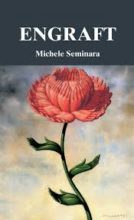
Michele’s maturity and life experiences inform the poetry and are crucial to it. The cover of the book, an image of a flower made of petals with multiple uplifted hands like a supplicant, belies the work within it. Not the work of a supplicant, but of someone who has entered the literary scene and gotten down to business. This approach is evident in her poem Slip where she exhorts:
Oh be still, Ruth, I admonish, and do not lie
at the master’s feet — but rise
from your fate and know that you are God!
If you were asked — to turn that corner,
walk into that room, say yes
to that dance — would you?
Or would you answer
(quickly, so as not to wake the unborn) — No!
Then watch in awe as this life slips away.
The title Engraft is an appropriate one for the collection. It suggests the mature perspective of a writer who understands the conundrum of originality and how we’re all writing inside a set of conventions. But it also refers explicitly to the fact that some of the poems are hybrid. Some are found and remix poems from the texts of other writers, mostly iconic writers of the past like Kafka, Dickinson, Shakespeare, Lowell, Plath, Joyce, Duras. In some cases, the language Michele uses mimics the slightly archaic language and conventions of some of those writers. In a sense, this process matches the emotional intensity that Michele injects into her work, departs from the prosaic, the deadpan. In Engraft, she rewrites Shakespeare’s sonnet 15:
Man is conceived upon this sullied stage
and like a seedling grows, but then decreases.
He vaunts his youthful sap in brave conceit,
till wasteful time decays his day to night.
Everything holds but a little moment –
even your perfection cannot stay.
So I’ll make war with time and as he takes you,
make love, and with my pen engraft you new.
The subject matter of the poems often seems intensely personal and autobiographical but then it’s not quite clear whether that’s because she’s assembling lines from other writers, finding equivalents to her own experience in their work, or simply writing in a high emotional key about her own experience. There is substantial inflected affect throughout the work and a mood of excitement and enthusiasm. There are a number of poems about writing and the need to write. In the poem, Dog, the writer compares herself to a dog driven to sniff in the long green strands/of its siren-muse,/burrowing to inhale/the prized and pungent self. She cleverly alternates between being pulled into writing like a sniffing dog but then also being jerked back out of it:
World jerks my neck, master to
slave, and drags me
from word’s wonderment
There are allusions to highly dramatic events and interactions, drawing the reader into a seemingly autobiographical disrupted narrative of some sort. The work is tantalising but you’re left thirsting for facts of the writer’s life, curious to know what all those dramas are, that are suggested but not made explicit.
ANNA COUANI is a Sydney poet, teacher and visual artist. She a was involved in small press publishing and writers’ groups from 1975 till 1992. Her most recent chapbook is Small Wonders (Flying Islands Books, Macao, 2012). She currently runs an art gallery in Glebe, Sydney.
Sorry you must be logged in and a current subscriber to view this content.
Please login and/or purchase a subscription.
Sorry you must be logged in and a current subscriber to view this content.
Please login and/or purchase a subscription.
Sorry you must be logged in and a current subscriber to view this content.
Please login and/or purchase a subscription.
Sorry you must be logged in and a current subscriber to view this content.
Please login and/or purchase a subscription.
Sorry you must be logged in and a current subscriber to view this content.
Please login and/or purchase a subscription.
Sorry you must be logged in and a current subscriber to view this content.
Please login and/or purchase a subscription.
 Martin Kovan completed graduate studies in English at Sydney University and UC Davis. His poetry, prose and non-fiction have been published in Australia by Cordite Poetry Review, Overland Journal, Antithesis, Tirra Lirra, Colloquy, Westerly, Peril Magazine, Group Magazine, and Southerly, and in a number of publications overseas. He has lived for long periods in Europe, India and SE Asia, and also works in academic ethics and philosophy.
In Khost Province
The roads—still mostly unpaved. I’ve always thought I’d get used to the shuddering, the relentless jarring of the bones. All the other places—always the same. (In Iraq, Markus said he got haemorrhoids, not from sitting on rubble, on broken concrete for sometimes hours at a time, in the middle of a hotzone, waiting for the free exit. He got them from the days, weeks, travelling
=================================Sorry you must be logged in and a current subscriber to view the rest of this content.
Please login and/or purchase a subscription.
 Raelee Chapman grew up in Albury-Wodonga. Since 2011, she has lived in Singapore with her family. Her fiction and narrative non-fiction has been published in Australia and overseas in places such as Southerly, Lip Magazine & Expat Living among others. She is currently compiling an anthology of short stories set in Singapore for Monsoon Books.
Golden Girl
It’s a tar thick night. A cool mist licks at her heels. He can no longer touch her skin now that she is hiding. She knows he is looking for her in the swirling mist. This is how girls vanish. She treads light as a marsupial over the rotting leaves. He fumbles and lugs, heavy through the bush. The bats watch, their eyes pinned on him like a hundred needles casting a voodoo spell. There is a full moon, a fat halo of light leading her. The air tastes sweet as she leaves Big Man’s scent of tobacco leaf and three day post-shower stench behind. No longer will she sleep pressed into his sweaty armpits listening to his enlarged heart’s odd beats. Soon she’ll no longer hear him flailing behind her.
At night-time she has trained one ear, the ear not pressed against him, for the distant, syncopating hum of a highway. She doesn’t remember the road or the way to it, when she came here, her eyes were closed. She can hear him swearing, grunting, stopping to pant, holding onto paper-bark trees, sheaving their Bible-page thin peelings. His bare feet are nicked by bindi-eyes and scratched by low scrub. For there was no time to put on boots. “Bathroom,” she’d whispered and slung off his heavy arm. She stepped out of bed and crouched by their bottom drawer and paused her hands resting on its contents for only a moment. Summoning her strength. Big Man let her use the flush toilet these days, instead of the chamber pot by the bed. He was more relaxed since she’d given birth to their son.
She moves on, stealth in the night towards the white noise of the highway and leaves behind all that was familiar to her for the last six years. The lonely wooden farm house with tannin-stained windows and gap-tooth steps. She had tripped many times on those steps. An ideal haunt, so well hidden in thick bush if you didn’t know it was there, you would never find it. There is one road in and one road out. She avoids that road.
She passes the pile of ashes where they sometimes lit a fire. Where onetime a black fella arrived unannounced with a dead kangaroo over his shoulder. Road kill. They accepted his invitation to cook and share the meat. The visitor never spoke, he saw her with the lead-rope looped around her waist connected to Big Man’s belt and said nothing. The black fella slept by the fire that night on a dirt mattress he made with his hands and was gone the next morning.
Her soles kick up and scatter ashes through the archway Big Man made with scraggly sticks. Where they married, wattle wreath in her hair, its sunny pollen dusting her nose and cheeks. “My golden girl,” he had called her. There were no witnesses, perhaps not a proper marriage. Big Man said the rites or made them up. It was the first time he let her off the lead rope tied around her waist since the day she arrived. She was fourteen, he was forty-one.
In the bush she finds clothes, dotted in trees, lifted by the wind years ago from their simple rope clothesline. These clothes made a run for it before she did. How often she’d wished the wind could carry her. In a copse she recognizes what Big Man called the birthing tree, where her son was born in the dirt. Big Man had wrapped him in a flannelette shirt and squeezed her breasts to show her there was milk. The baby softened Big Man. How often he holds their son aloft, a naked pudding baby, a trophy, both of them cooing. He could no longer restrain her so closely now that their son needed constant attention, feeding, bathing, changing. He was more trusting. But when Big Man went out, he locked her in a windowless back room without a fan because once before their son was born he found her with an electrical cord around her neck.
When her son tumbled forth from her womb, a new and instant love came with it, saving her. He is what gave her strength and makes her push on. Her son is the only light in that dirty house. A house she could never get clean, that has decades of filth and grime entrenched in every grain of wood, every porous surface, rusty tap and sink. Mice and cockroaches scuttle across the floorboards and her son loves to watch them wide-eyed and clap his clumsy hands.
A branch snaps and she hears him stop dead in his tracks. She can hear it too, the boy’s wailing. It has taken on a more desperate pitch as though he can sense what is happening. He is tucked in his little bed made from a deep, empty chest drawer, nestled in old clothes. She knows now Big Man won’t follow. This is the only way. Her only chance. If she takes the boy, he will hunt her down, never let her go. She will come back to claim her son. Someday Big Man will be locked up. She wonders who will hold his lead rope. She will swoop up her dirt-stained son and wipe him clean of Big Man, of this place.
She hears him turn back, his soles slap crashing back to their son. She follows the moon’s spotlight. She is robed in her ivory shroud. When Big Man looks up, seeking light for his path, all he sees is sky as dark as a tar canvas.