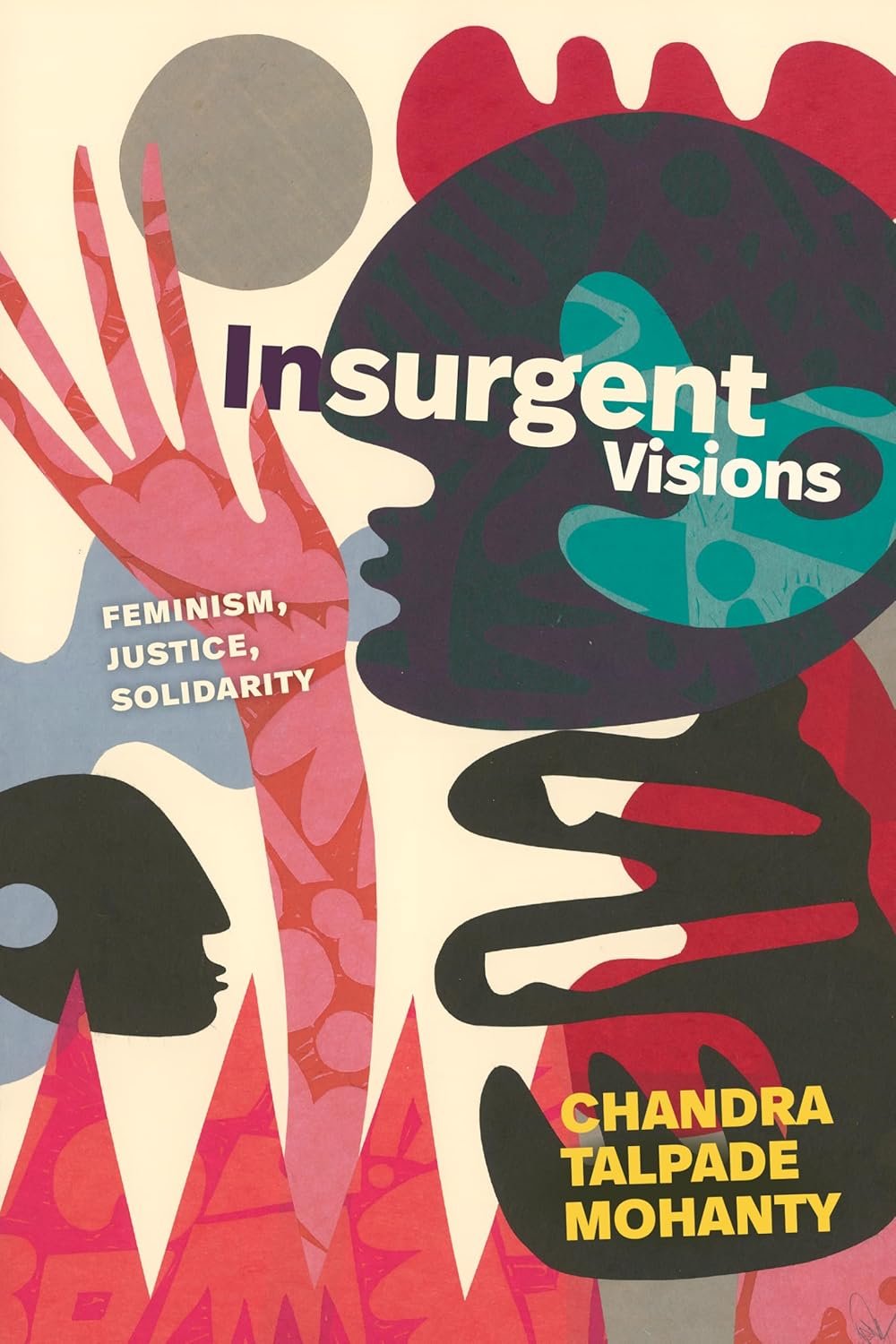
 Insurgent Visions: Feminism, Justice, Solidarity
by Chandra Talpade Mohanty
ISBN: 978-1-4780-3222-9
Reviewed by PAUL GIFFARD-FORET
Chandra Talpade Mohanty’s latest book published in 2025 by Duke University Press is an event in itself, if only because her previous and only other book was published more than twenty years ago in 2003 by the same publisher, but also because Mohanty’s radical feminism has inspired generations of politically committed academics across the world and in particular in the Global South for her astute, complex and sophisticated, yet forthright analysis of systems of oppression and exploitation from the standpoint of some of the most marginalised communities — immigrant women of colour, female workers in sweatshops, Indigenous people, refugees or noncitizens fighting for survival in borderlands ranging from Mexico to Kashmir or Palestine. If Mohanty is not what may be called a prolific writer, it is likely due to her militant work outside of the academy. Being an ‘activist scholar’ as Mohanty has described herself takes a lot of time and effort despite being poorly valued and appreciated by the neoliberal corporate university. As Mohanty writes in Part Two of her book on “Neoliberal academic landscapes, transnational feminisms, cross-border solidarity”: “In North America, the binary that distinguishes the “academy” from the “community” or the academic from the activist […] has assisted in the creation of apparently distinct spaces where the former is privileged over the latter.” (164)
Mohanty’s critique of US higher education and of academia in particular is one of the many enlightening, thought-provoking aspects of her book. Elsewhere in a chapter running as a discussion with other feminist activist scholars and originally published in 2015, Mohanty quotes fellow academic Leila Farah on the woman of colour’s burden. Unlike Rudyard Kipling’s so-called white man’s burden, tasked with having to ‘civilise’ the non-western world, diasporic women of colour like Mohanty are posited as native informants whose insurgent knowledges from the ground up risk being co-opted, appropriated, commoditised, and ultimately domesticated by the US academy. As Farah puts it:
Since all institutions are complicit with the neoliberal project in many ways, those who straddle academic lives and employ feminist praxis within communities outside of the hallowed halls often are positioned to act as intermediaries, breaking the age binaries of formal and informal education and knowledge production, bearing a great burden in repositioning and reconciling these multiple spaces. Unfortunately, that increasingly seems to be women of color who are non-US based originally… (97)
While those age-old binaries are still effective in 2025, even the problematic positioning of immigrant women of colour within the US academy has been rendered precarious and is now potentially under threat following the far-right accession to power under the aegis of the Trump administration. This non-negligeable shift may be a reason for the publication of Insurgent Visions. Indeed, it is not just that insurgent disciplinary fields such as gender, queer, postcolonial, indigenous or environmental studies have been disconnected from the social movements from which they emerged in the 1960s and 1970s, or that they have become increasingly institutionalised as a result of a broader shift toward a money-spinning, profit-run, fee-paying higher education industry. As the far-right is winning the battle of ideas (the so-called ‘culture wars’), those abovementioned disciplines have been falling under repeated attacks through defunding, the closure of entire departments and their replacement with conservative, traditional value-oriented curricula that promote heteronormativity, white supremacy, hypermasculinity, or climate-denialism instead.
While Mohanty’s tone may at times sound alarming (and rightly so), her analysis of the historical moment we are in remains by and large hopeful that with the disappearance of ‘intermediaries’, to quote Farah’s term again, new opportunities will open up that “recall the genealogy of public intellectuals, radical political education movements, and public scholarship that is anchored in cultures of dissent,” (162) as well as “examin[e] those knowledges that derive from political mobilizations that push up, in, and against the academy, ultimately foregrounding the existence of multiple genealogies of radical transnational feminist practice.” (163) Mohanty extensively draws upon two recent grassroots mobilisations in the US context — the Black Lives Matter protests in the wake of George Floyd’s death in 2020, and the university campus encampments in the wake of the war on Gaza in 2025 — to prove her case that a revival of a revolutionary spirit of revolt and resistance is possible amongst younger generations, this even in a dire context whereby, as Mohanty acknowledges, “both US foreign and domestic policy at this time are corporate and military driven. Both have led to the militarization of daily life around the world and in the United States — specifically for immigrants, refugees, and people of color.” (146)
The fact that these two protest movements quickly spread beyond US borders is significant insofar as another key aspect of Mohanty’s book relates to the question of the transnational. Her skillful ability to unpack, deconstruct, and remobilise this much-touted term for militant purposes shows Mohanty at her best as she smoothly and elegantly deals with the whole gamut of available theory at hand while simultaneously placing her intricate theoretical reflections at the service of community organising at a ‘glocal’ (global and local at once) level. Whereas, as Mohanty deplores, “ “transnational” often becomes a placeholder for business as usual, marked as “progressive” in the face of a conservative, xenophobic backlash,” (134) she also asks in her conclusion to a chapter entitled “Transnational Feminist Crossings: on Neoliberalism and Radical Critique”: “What would it mean to be attentive to the politics of activist feminist communities in different sites in the Global South and North as they imagine and create cross-border feminist solidarities anchored in struggles on the ground?” (201)
Through her attempts to articulate a transnational frame/network of solidarity across multiple faultlines (racialised gender, the international or sexual divisions of labour, or the North/South divide), Mohanty in her book seeks to build and elaborate upon those two academic essays for which she is most renown, namely “Under Western Eyes [UWE]: Feminist Scholarship and Colonial Discourses” (1988) and “Under Western Eyes Revisited [UWE-R]: Feminist Solidarity Through Anticapitalist Struggles” (2003). Whilst, on the one hand, UWR (a reference to Joseph Conrad’s novel) strived to carve up space for a nascent third world critique of white feminism in the wake of decolonial national liberation movements of the 1960s/70s and neoliberal structural adjustment programs of the 1980s/90s targeting what would become known as the Global South following the Fall of the USSR, on the other hand, UWE-R aimed to grapple with the reality of a New Global Order under the American umbrella (so-called Pax Americana) concomitant with the rise of anti-globalisation/capitalist protest as in Seattle or Genoa.
Insurgent Visions may be construed in this regard as an effort to reconcile or ‘dovetail’ (to use one of Mohanty’s most favored word in her book) the ‘particularist’ bend of UWE with the ‘universalist’ penchant of UWE-R in light of the fact that we now live in a highly ‘uneven and combined’ world (to use Leon Trotsky’s phrase) following the gradual decline of the global American hegemon (a decline that dates back as early as the 2001 Twin Tower attacks and has been compounded by the Afghanistan debacle of 2021). Hence, do we find scattered across her book elements of what could be dubbed Mohanty’s third conceptual shift:
Our conceptual foci would need to shift, and that might be possible when different cross-border practices, spaces, and temporalities are brought into ideological and geographic proximity with one another in ways that produce connectivity and intersubjectivity (albeit a tense or uneven one) rather than an absolute alterity. (177)
This question about the connectivity of multiple though unequally organized geographies, temporalities, and interests […] raises additional questions about the analytic and political consequences of deploying an either/or framing: either connectivity or separation. (174)
This shift begins in the lives of women, learns from their perspective, and formulates policies that are attentive to local, place-based struggles as they exist within structures of privilege, power, and inequality. (78)
While place-based struggles and contextual approaches to women’s resistance […] are key to understanding larger struggles for gendered economic justice, it is the universal principles embodied in the right to equity and dignity […] that constitute the broad parameters of our vision of gender justice. (61-2)
In her deployment of a radical transnational politics, Mohanty chiefly deals with, and moves back and forth between, three geographical locations and contexts in her book, while embracing an intersectional approach that helps her nagivate and find commonalities of struggle. Whether it be in the context of justice for Palestine, the US carceral/military state, or Hindu fundamentalism (Hinduvta) in India, it is mostly poor (and in India lower-caste Dalit), Brown/Black (but also White, itself a colour as Mohanty emphasises), queer, indigenous, and/or Muslim women of colour who must bear the brunt of institutionalised social stigma imposed upon them. As Mohanty argues: “Since the early 1990s, the geopolitical triad of the United States, Israel, and India have shared a vision of threat and security based on Islam and Muslims as the common enemy, cemented through close and ongoing economic and military alliances.” (122) One also has in mind those trans/homophobic policies implemented in the Trump era (one of the most recent being a ban on transgender people in the military), or the way that the US privatised prison industry has disproportionately targeted poor women of colour in recent years, all the more so since, as Mohanty adds, “mass incarceration is the other side of the coin of mass deportation” (122) through the separation of Brown and Black families, women and children at the US/Mexico border. At the grassroots level, though, the insurgent visions of Dalit, Palestinian, and Brown/Black communities in the US all point to a common, universal horizon begging “the larger question here [on] how to move from the politics of representation to a politics of equity and justice.” (68)
Yet perhaps the most essential question raised by Mohanty in her book (a question that will bring us back to the figure of the activist scholar) bears upon the ethical (one may even say moral) responsibility that each one of us in our respective constituencies hold: “Who resides in which spaces? Who belongs and who are rendered outsiders? Who is constituted as the knowledgeable and the unknowledgeable? Which knowledges and ways of knowing are legitimised and which are discounted?” (165) From her privileged position as a US resident-citizen and established academic, Mohanty has chosen throughout her professional life to invest and redistribute her time and effort into “knowledge [that] is produced by activist and community-based political work” (68), while speaking truth to power without at the same time capitalising on it to advance her own career. To herself as well as to the educated, left-leaning reader of her book who may share Mohanty’s insurgent vision, she thus asks as a leitmotiv and a source of motivation at once: “What am I doing with my power and my privileges? To me, that is the question that people who live in the United States need to ask. What are the privileges that you have, and what are you doing with those privileges?” (44)
PAUL GIFFARD-FORET holds a Ph.D. from Monash University in Australia. His thesis focused on the literature of Australian women authors of Southeast Asian background. He now works as a lecturer at the Sorbonne-Nouvelle University in France.