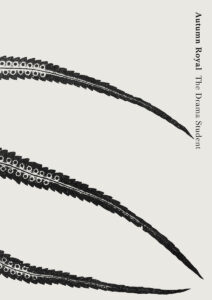
 The Drama Student
by Autumn Royal
ISBN 9781922725394
Reviewed by PARIS ROSEMONT
It is not often one encounters a poetry collection that stays so Desdemona-faithful to the thematic premise of its title. Autumn Royal’s The Drama Student (Giramondo, 2023) delivers. It opens with the poem ‘Causing a scene’, a prologue of sorts to the sections that follow, aptly punctuated into: ‘Scene One’, ‘Interlude’, ‘Scene Two’, and ‘Encore’. Each poem in this collection interacts with the notion of performance in various guises – whether on the stage, or behind the scenes. The narratives shift and morph like a kaleidoscopic hall of mirrors. We see only the selective fragments the poet has chosen to share, glimpsing a fractured world of intrigue and curiosities. The result is intimate and quirky, confusing, humorous, and at times confronting.
Theatrical references abound. From anecdotes about auditions (p1), dramatic method (p10), agents and roles (pp17-18), melodrama and searing acts (p21), casting (pp22-23), theatrical skills and dimly lit tragedies (p41), plotlines (p42), and authentic dialogue (p43), the list can—and does—go on. This sweeping theatrical epic culminates in a five-page opus titled ‘Soliloquy’ (pp59-63). The collection’s central theme is indelibly embedded into each poem. One of the great strengths of Royal’s writing lies in the multi-layered richness of concept and wordplay. Often, this is presented via metaphysical observations:
One must become perverse when adapting
to this genre. I’ve flattened myself to fit through
scripted doorways and babbled away
my dimensions. This leaves no suspense.
We’re dealing with pre-existing material
and I’ve forgotten who speaks next. I need a prompt –
(‘Raising a subject’ p5)
Royal holds the reader captivated by the performative confessional. Yet, it is not long before the reader develops an awareness of certain smokescreens—how we sit on the ‘audience’ side of the dividing line, and that the poet is toying with us with selective truths, unreliable narratives, plot twists, and deliberately planted red herrings: ‘such a buttery trick’ (‘Soliloquy’ p60). We are left questioning what is real and what is part of the act.
Reality, and the assumptions we make, are challenged. There is a visceral nature to this poetry. The body becomes a vehicle for acting, a vessel for emotions, and a vestibule for hurt and harm. Beauty standards are conversely seized and shed; the source of vanity, power and revulsion.
…the only option to show you
what I mean is to expose my midriff. … – stroking
my bloated abdomen and thinking about how you
wore singlets to bed to hide your tummy – we both
knew it existed … I will gorge – bare
my guts in actions you cannot disrupt while my
digestive tract is processing, and I am full of shit.
(‘Elegy / my affliction’ p38)
There is a curious interplay between the body, embodiment, and disembodiment. In ‘Form, like body, should never be assumed’ (p37), Royal writes:
…a nightie is a throat, deeply penetrated
if assuming that there is a throat
for the ground to tenderly stroke over–
as opposed to being lifted from
the ground, up past the feet,
supposing there are feet and a ground.
It is reminiscent of Carmen Maria Machado’s bizarrely disembodied characters in ‘Her Body and Other Parties’, oozing a surreal sensuality and eroticism. Later, the poet/actor asks herself:
After having my make-up prepared for filming – I often peer into the mirror and ask the shining surface if it is my insatiable greed which motivates me towards such youthful casting, or simply my wish to embody anyone but myself.
(‘Timeless Beauty’ pp22-23)
Here, as in many of Royal’s poems, acting becomes a form of masking – both physically and metaphorically – of stepping out of the flawed, damaged, or vulnerable parts of oneself, and choosing the armour of reinvention.
A thematic thread woven to great effect in The Drama Student is the warp and weft of costuming. Indeed, the first poem in the first ‘scene’ of this collection opens with: ‘It’s time to dress your body in this unrevised final draft’ (‘Raising a subject’ p5). There’s a dressing-gown cloaking shoulders and a nylon neck piece in ‘Acting in awe’ (pp12-13), ‘Form, like body, should never be assumed’ (p37) gives us a stained nightie, a shoulder strap, and rumours knotted like fabric, ‘On lucidity’ (p41) offers an entire top-loader full of dresses draped across a foldable clothes horse ‘skirting fragile textures’. ‘Nightgown slips’ (p45) examines: ‘silk submerge(d) in a silver tub of tepid water…agitation shaped by human touch’ and ‘the way language immeasurably clings even when whispered or delicately cut’. ‘Considered in relation to’ (p50) adds to the wardrobe more nighties (a prized nightie, at that) and:
…the fluid fall of the ruddy gown, so slept
in, so worn–with its low-scooped neckline, so low
and so scooped…
whilst introducing ‘the ultimate activewear basic, a must-have accessory in your workout wardrobe’. ‘Soliloquy’ (pp59-63) describes inhabiting a character’s backstory by ‘devot[ing] months to dressing in her clothes and wearing wigs in her exact hair colour and texture’. And ‘Materials list’ (pp26-27) gives us a profusion of fabric, mesh, pockets, a dress, and sleeves. The poet articulates her intent:
I want these words to thicken – to form a cloth case for the bolster
stuffed with denial. No adequate substitute
has ever been found for felt and this end line is fabrication.
The permeability of mesh makes a repeated cameo in this collection. From its initial appearance as ‘mesh patterns and a need to touch’ (‘Materials list’ p26), to ‘a mesh with many situated beginnings’ (‘On lucidity’ p41), right through to the closing image: ‘in full mesh I will gallop’ (‘Soliloquy’ p63), which also, in its layered meaning, gives the faithful stainless steel clothes horse first spotted in ‘On lucidity’ a reprisal.
The ‘Interlude’ is a dreamlike series of vignettes punctuating Scenes One and Two. Titled ‘Approaching a bedside table’ I, II, and III respectively, these palate cleansers are again reminiscent of Machado’s writing—in this instance, her memoir ‘In the Dream House’, where a series of micro-chapters each reframe the central relationship through a different voice and lens. So too does Royal’s bedside table get repositioned, repurposed, and reframed, each micro-scene shifting in cadence.
The final section, ‘Scene Two’, contains a multitude of intertextual pieces. This gathers force, amplifying with the closing soliloquy in ‘Encore’—a text-dense intertextual masterpiece leapfrogging between ideas and segueing from source references to responses then catapulting into rapid-fire word associations that sling one thought into the stream-of-conscious next:
Wistful music plays as a dentist reminds me to floss after he pulls out my prized tooth. I ask him if you can ever really wash away memories from your mouth? My grandfather’s teeth. I have smelt the horrid breath of lost lovers as I kiss them all good night – tasting a mouth giving over to another mouth as shallow pools form. A brick drops from the ceiling landing next to my feet – reminding me to remind myself that I am an idiot. This word means a lot to me. I have been called it many times. Me and my idiocy are very close. We finish each other’s sentences. I express this through screaming–and what is the point of screaming without receiving the appropriate level off attention? asks Panda Wong. I seek attention by cradling my chin with my hands – a form of preciseness of what I, myself am seeking. I told you – I warned you. I am an idiot.
‘Soliloquy’ (pp59-63)
Too often, when intertextual references are invoked, the source material is left to do much of the heavy lifting whilst sitting on the surface without being properly folded into the batter. Not so with Royal’s work. Whilst the cast list of the closing poem reads like a Who’s Who of great poets, writers, and thinkers, what is remarkable is that each quote is purposefully selected and seamlessly integrated into the fresh work, thus earning its place.
The Drama Student is an utter delight of a collection that razzle dazzles in all the right places. It is tactile, performative poetry that is felt, absorbed, and experienced on a multi-sensory level, where emotions enter tangible dimensions and may become something ‘I shawl over my knees’ (‘Catwalk’ p17). Ever the entertainer, Royal raises chuckles with the wry tone and breezy appeal of the bombastic, sardonic, and melodramatic (‘(Regarding) the pain of others’ pp42-43). However, beyond the craft and showmanship, we see softer glimmers – ‘the stains of violence our intimacy provokes’ (‘Leaf-shadow’ p44). It is this breadth and versatility of character and role that is compelling. As the curtains close, are we really any closer to knowing who this enigmatic poet-actress is? She has left us suspended in our suspense. Cue applause.
PARIS ROSEMONT is a multi-award-winning Thai Australian poet, performer, educator, and author of Banana Girl (2023) and Barefoot Poetess (2025). Her books have received awards and accolades in Australia, Greece, UK and USA. Paris’s poetry has been published in a plethora of literary journals and anthologies including Australian Poetry Journal, FemAsia Magazine, Rabbit, Splinter, and Verge. She was the winner of the Matthew Rocca Poetry Prize 2025 (Verandah Literary Journal; an initiative of Deakin University), First Prize in the Hammond House Publishing Origins Poetry Prize 2023 (UK), received a Best of the Net 2025 nomination from Sky Island Journal, and was awarded Honourable Mention in the Fish Poetry Prize 2025 (Top 10 in the world, as selected by judge Billy Collins). She has judged for the Western Australian Premier’s Book Awards 2025 and Sydney Fringe Festival 2024. Paris is a member of the Randwick City Council Arts & Cultural Advisory Committee, Guest Editor for Written Off Literary Journal, and sits on the Hunter Writers’ Centre Board. She may be found at www.parisrosemont.com