 Worthy of the Event
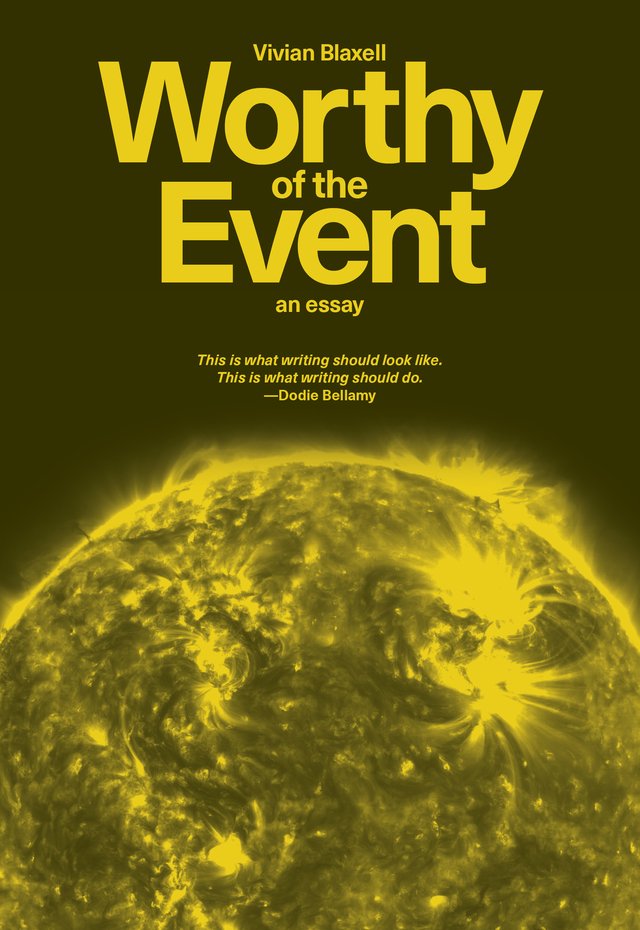
by Vivian Blaxell
ISBN: 9781964322995
Reviewed by KAYA WILSON
A reaching, layered and tender rejection of the rules-based essay
It was in the early panic of Trump’s second term- when the trans podcasts I listen to were discussing the contents of their Go bags, the Executive Orders were coming thick and fast and it felt like the trans community in the US was living out the first line of the Niemöller speech, First they came for..- that Vivian Blaxell announced her North American book tour for Worthy of the Event. And off she went.
Blaxell is hard to pin down. Dodie Bellamy describes her as a ‘sort of 21st century Proust committed to TMI’. Torrey Peters gave her a shoutout in the Guardian as ‘sharp and amusingly tart’ (1). She has been a professor of political philosophy and Japanese history, a sex worker, a queer rural kid. There are clues to the particulars scattered through the text but tethering yourself to the events of her life is not what Blaxell wants you to do. Worthy of the Event is better experienced with Blaxell as a guide than as a destination. To read this book well, is to let her take you with her. On a train in Mexico, a stairwell in Istanbul. The book is alive with the stimulation of travel and a delicate dose of glamour.
Her prose is clever, witty, there are breasts that ‘seem to want you to consider them for a position’(p.170), her ‘favourite Sergio Rossi shoes used to moo’ (p.112) and Nietzsche’s ‘ectoplasmic moustaches curl like smoke’ (p.80). There are hard and soft landings, with the rejections and diamond rings of lovers and exclusivity of class. There are one-liners from enraged men ‘I’m not into transes, fake women’ (p.69), ‘Put it away’ (p.27). There are friends like Norma Mapagu, that keep Blaxell earthside. Norma Mapagu! A star really, worthy of the event. All make for an emotional pinball of tough society and love. There is at least one academic hall, but it doesn’t have quite the punch of the Liverpool St turf wars, ‘you fucking…slag’(p. 185). Now in her 70’s, Worthy of the Event could be called a debut but it feels like anything but.
The seven essays of the book stand alone but are very much an album. They are digressive and agile and essayistic per se; they follow themes of sorts and they come back to a point, but it’s best to let go when you read them. ‘I: the disappointments’, first published in Overland, begins with ‘My vagina disappoints me,’ (p.9) and edges closer and closer to an elegy to acceptance. ‘VII: the practice’ challenges the essay itself– ‘I could throw my own body at the essay form….that fantasy of progress, resolution’. (p.257) Nothing is untouched and nothing is not considered. But for a text with such a density of ideas, there is an ease to the prose and for all the railing against prescription, there is a floating tenderness as Vivian plays squirrel videos for her cat and immerses herself in the stories of others. ‘II: mouse eats communion wafer’ and ‘VI: stardust‘ are nothing short of lovely. The descriptive language she uses for herself is gentle, too. It stays away from the language of politik. She does not identify as, or make declarations, as a. She tells more of her transness as ‘girls like me’ (p.47) or ‘not the kind of girl he imagined me to be’ (p.27)and herself, often, as beautiful.
In Worthy of the Event, you will have your perspective shifted; Blaxell is unafraid of a questing venture. There is much to be learnt about Japanese poets, high-end blowjobs, low-end blowjobs and the plight of sea creatures caged in aquaria, but it is all in service of ideas on how to live, of being and becoming, more Montaigne than travelogue. Her fantasy as a travel writer is to be the one that reaches other worlds, dimensions, to return transformed, from ‘ordinary to astonishing.’
The text is referential, sometimes explicitly, but until you’ve read all of Dodie Bellamy and Eileen Myles and Gertude Stein, you, as I, may not get it all. It is a book to return to, to find more each time, the self-referential loops between chapters, emphatic concepts you missed in the first read. Blaxell explores herself as emulative, a self-described practitioner of Aemulatio in the final chapter, ‘VII: the practice’, where she plays with the style of others as she is describing them- the many ands, the semi-colon. And emulation there may be, but this work stands in singularity. When I first read it, I felt like I felt on reading Jean Genet, with his ‘ripped azure’ (2). Something sophisticated and beautiful and enduringly free. There is a reaching in Blaxell, to becoming, to the other worldly, a spinning away from this world.
We try to tell the newly hatched trans folk not to publish an op-ed in the first two years of transition. In the same way that we generally advise teenagers to hold off on that tattoo. Someone has to in that heady time of eyes-on-you and an anxious need to explain. But those times do pass and what felt so desperately important can start to feel petty and superficial. Some time ago, when I was fresher, Blaxell advised me, in correspondence about my own book, to pay attention to the next 30 years. I am about a decade deep now and through the hardening of my own disappointments, I have entered a more enigmatic era, with the aloofness of a troubled 90’s royal – never complain, never explain. Blaxell herself, is far ahead, taking a running jump into the horizon. She cites the violence she has experienced in the Harvard style ‘Sydney 1967,1968, 1977′ (p.72) and the book holds a body count and a prickliness that flashes from time to time. You don’t survive ‘all that tranny stuff’(p.205) and come out, I don’t know, chill. Blaxell survived, we know as we read this book, as Old Sybil declares prophetically when she tells a youthful Blaxell to ‘Get the fuck off this corner’ (p.105) and to get here, to write Worthy of the Event, Blaxell has been paying attention.
What I am left with, what stays with me after reading this book is a dancing image, of legs in the air. An enduring question of what being trans is, beyond what you reveal or don’t reveal and apart from the connection and self-realisation, is what you do with the gaze. And that is I feel where Blaxell most declares herself. On being asked to strip for a Doctor, unnecessary yet ‘predictable’ (p.104), she tells us:
“I spread my legs and I open my arms and I show Doctor the full abundance of my beauty and my glamourous complexity. I am a special animal. I am a white peacock. I am narwhal. I am a black bird of paradise. I am coorinna. I am a dire wolf. I am a unicorn. I am a dragon. I am phoenix. I am transexual woman, I am animal becoming, I am traversal itself, and he can barely breathe, like a tourist on the Serengeti, he is entranced. I have Doctor where Doctor needs to be: you dancing monkey, dance.”
(p.104)
It’s hard to know how this book will be received. It seems to be gaining traction, it has had excellent write-ups across the US and Australia. I know it’s selling well in Brunswick St. Bookstore, Luke, with their handwritten staff write-up tells us it made them ‘want to live more!’ But whether or not it lands a big prize or pushes into the mainstream, Worthy of the Event feels like a life’s work, it is layered and tough, singular and fresh and it dances off the page.
As the comedian Nico Carney puts it, whoever said all publicity is good publicity clearly wasn’t trans. The moral universe of the western world does not appear to be arcing our way. Worthy of the Event stands on its own a dimension away from all of that, with ‘eyeliner everywhere eye-related and somewhat beyond’ (p.97). This book is an Event. The question is whether we are we worthy of it.
Cited
- What we’re reading: writers and readers on the books they enjoyed in April | Books | The Guardian
- Genet. A Thief’s Journal, “Inland, I went through landscapes of sharp rocks that gnawed the sky and ripped the azure.” page 77 of the Grove/Frechtman translation.
KAYA WILSON is a writer, tsunami scientist, and lover of all things ocean who somehow finds himself living in Canberra. Their first book, As Beautiful as Any Other was listed by The Guardian as one of the 25 best Australian books of 2021 and was shortlisted for the ACT Book of the Year in 2022. His second book, a young adult novel titled Romeo: A Tale of Four Jumps, was written with an artsACT grant and is currently in submission.