Tiel Aisha Ansari
Subscriber Only Access
Sorry you must be logged in and a current subscriber to view this content.
Please login and/or purchase a subscription.
Accessibility Tools
Sorry you must be logged in and a current subscriber to view this content.
Please login and/or purchase a subscription.

Jason Wee is an artist and a writer. He is a co-editor of Softblow Poetry Journal and the author of My Suit (Math Paper Press 2011). He lives in Cambridge, New York and Singapore.
Parts
Think of an older body lying on
top of a younger body.
Think of that body above waking up
slightly startled at the sight
Sorry you must be logged in and a current subscriber to view the rest of this content.
Please login and/or purchase a subscription.

Vanni Taing is currently pursuing an MFA in poetry at Western Michigan University, and is a 2010 recipient of WMU’s Gwen Frostic Creative Writing scholarship. Her work has appeared in Lantern Review, CURA, and others.
The Boat
I built my home in a bottle. My father said I should have built a plane, but I said, no. Think of the expenses. A Gulfstream can burn anywhere from 250 to 440 gallons of fuel an hour. Where will the money come from, I ask him, I have no money. So I built a small boat in my bottle to retire to when I tired of my mother’s accusations: You want get raped, huh? You cut hair like boy. You ugly.
Her knuckles clock the glass. I do not come out. I strap myself in and wait for the gales to subside. She rolls the bottle, round and round and I hear the sounds of air: pressure, release, confinement. I peer up the thick neck and study its narrow mouth.
Sorry you must be logged in and a current subscriber to view this content.
Please login and/or purchase a subscription.
Sorry you must be logged in and a current subscriber to view this content.
Please login and/or purchase a subscription.
Sorry you must be logged in and a current subscriber to view this content.
Please login and/or purchase a subscription.
Prose poetry is essentially an urban form, although we should do better to refer to it as both essentially and existentially an urban form. A cursory look at the development of the prose poem in mid-nineteenth-century France provides an insight into just why and how this form came to embody the modern metropolis in which it is invariably set and with which it coincides.[1]
As Baron Haussmann’s wave of urban renewal swept through Paris, bringing it—expropriations and all—from the Middle Ages right up to the cutting edge of Modernity, with which it became instantly synonymous,[2] Charles Baudelaire was achieving fame as the author of Les Fleurs du mal (The Flowers of Evil). But even as his fame spread, Baudelaire’s disenchantment with the lot of the poet, and his verses, was leading him towards a new mode of expression. Where, famously, he had previously painted the poet as, inter alia, an albatross, majestic in the air but clumsy on the ground, he now sought to bring poetry down from the abstract objectivity of the Heavens into the mundanity of the city streets. And if he chose to smash the verse form of his art against the cobblestones of Paris, it was precisely because the city was as much beyond his comprehension as his poems were to the man in the street. The Paris that he remembered was fast becoming a mythology as the Paris that met his senses morphed ever faster into a space that was not his. In short, Paris was no longer what it had once been. And yet, of course, Paris was still undeniably Paris, with all that this signified. The new poetics that Baudelaire created captured this tension between the Paris that was and the Paris that was not. It was a poetics to encapsulate this paradox, both overarching it and pulsing at its heart: it would simultaneously present Paris in its everyday, prosaic reality and re-present it in all its poetic associations.[3] The new poem symbolized a new critical stance in relation to the modern world and quickly became the instant-belated lens of Modernity itself: the oxymoronic ‘prose poem’ got both inside Paris (with the close-up of the developing art of photography) and soared above it (like the Montgolfière that adorned posters of the expositions universelles), capturing it doubly, (re)presenting it as the auto-antonymic capital of the alienating new urban experience.
The oxymoronic nature of the prose poem cannot be overstated—it is markedly not a prosaic form of poetry or a poetic form of prose. It makes no attempt to synthesize the binary terms of the albatross’s predicament. Instead, Paris is now both on the wing and on the ground, poetic and prosaic, at the same time. As Baudelaire notes in his prefatory letter to Arsène Houssaye, his collection of little prose poems, or Paris Spleen “has neither head nor tail, since, on the contrary, everything in it is both head and tail, alternately and reciprocally”.[4] In this way, every line of every prose poem serves no purpose other than to pose the conundrum of prose poetics, and in so doing to perform Parisian self-alterity. Thus, the poems typically balance on a central axis, ostensibly offering two distinct halves (a poetic one and a prosaic one). But on closer inspection, the poetic half exalts the Beauty of “things” and the prosaic half teems with capitalized Abstract Values; indeed, the central axis itself (marked by a knock on a door or a disingenuous adverb of concession) functions as a problematic limen, both demarcating and promoting transgression.
Nowhere is this structure more flagrantly displayed than in the French title itself, Les Petits Poèmes en prose : Le Spleen de Paris, which lends itself to a chiasmatic analysis. The axis is the colon that separates title from subtitle, and the two halves, thus formed, reference each other across it. Notice how the littleness of the prose poems is elevated by French title capitalization on the one side and how the visceral reality of spleen is identically altered on the other.[5] The initial oxymoron of the prose poem suggests, chiasmatically, that Paris (in all its glory) opposes spleen, but the capitalization of Paris, which cannot be written any other way, simultaneously veils and symbolizes its double meaning. Paris then both opposes spleen in the subtitle and picks up the upwards motion of Spleen (its elevation from the splenetic to the ethereal), tending to overarch the dynamics of the combined title. In this way, Paris equals prose poem, always already. Which means, of course, that in addition to being, always and only, prose poetry, the prose poems are also, always and only, Paris, whether their action is set in a city street, a desert island or nowhere at all. Hence, the famous “Any Where out of the World”, which is all about aspiration to travel and not about travel per se. For, in all the prose poems, intense motion (and counter-motion) is brought back to earth as powerfully as it transcends. This is the centrifugal and centripetal power of the city. And this is why prose poetry is, essentially and existentially, an urban form.
Alistair Rolls,
The University of Newcastle, NSW
[1] For a history of the British prose poem, see Nikki Santilli, Such Rare Citings: The Prose Poem in English Literature (Madison, NJ: Fairleigh Dickinson University Press, 2002)
[2] Arguably, Paris was not only synonymous with Modernity as it unfolded in France, but the French capital’s ultra-reflexive reappraisal of itself made it metonymic of Modernity worldwide. See, for example, David Harvey, Paris, Capital of Modernity (New York; London: Routledge, 2003) and Patrice Higonnet, Paris, capitale du monde (Paris: Tallandier, 2006).
[3] For an excellent reading of presentation versus representation (or re-presentation) in Baudelaire’s prose poems, see Michel Covin, L’Homme de la rue : Essai sur la poétique baudelairienne (Paris: L’Harmattan, 2000).
[4] I am quoting here from Louise Varène’s translation of Les Petits Poèmes en prose : Le Spleen de Paris, published as Paris Spleen (New York: New Directions, 1970), p. IX.
[5] For a more detailed analysis of Baudelaire’s title along these lines, see Covin, op. cit.
Sorry you must be logged in and a current subscriber to view this content.
Please login and/or purchase a subscription.
Sorry you must be logged in and a current subscriber to view this content.
Please login and/or purchase a subscription.
Sorry you must be logged in and a current subscriber to view this content.
Please login and/or purchase a subscription.
 Keith Mac Nider is an historian, clairvoyant and grief counsellor who loves living by the sea with his wife and dog.
A friend read her poems to me the other day. Beautiful, deft, cultured verses that rippled across my heart. We sat at a wooden table in her kitchen, coffee cups steaming, a sunny cool autumn morning. I closed my eyes, listened. One image especially moved me, evoked the past from nearly thirty years ago: the image of an old blue-veined hand stretching out to reach a delicate vase.
=================================Sorry you must be logged in and a current subscriber to view the rest of this content.
Please login and/or purchase a subscription.
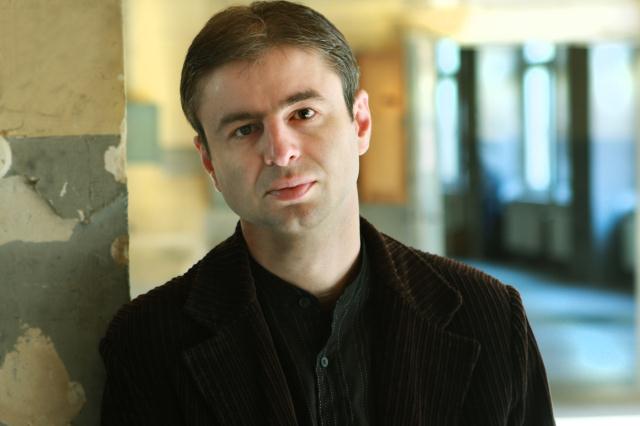 Nikola Madzirov was born in 1973 in Strumica, Macedonia in a family of Balkan Wars refugees. His first collection of poetry, »Zaklučeni vo gradot« (tr: Locked in the City), won the »Studentski zbor« prize for best début. In the same year he published his second book, »Nekade nikade« (tr: Somewhere Nowhere), also a poetry collection, which won the Aco-Karamanov prize. The anthology »Vo gradot, nekade« (tr: In the City, Somewhere) followed in 2004, and in 2007 he published his last poetry collection to date, »Premesten kamen« (tr: Relocated Stone), for which he was awarded the prestigious Miladinov-Brothers Prize and the Hubert-Burda Prize for Literature.
Madzirov was poetry editor of the Macedonian e-magazine »Blesok« and is the Macedonian co-ordinator of the international network Lyrikline. He lives in Macedonia and works as a poet, essayist and literary translator.
—Lucian Blaga
(translated by Peggy and Graham W. Reid)
I haven’t the courage of a relocated stone.
You’ll find me stretched on a damp bench
beyond all army camps and arenas.
I’m empty as a plastic bag
filled with air.
With hands parted and fingers joined
I indicate a roof.
My absence is a consequence
of all recounted histories and deliberate longings.
I have a heart pierced by a rib.
Fragments of glass float through my blood
and clouds hidden behind white cells.
The ring on my hand has no shadow of its own
and is reminiscent of the sun. I haven’t the courage
of a relocated star.
(translated by Peggy and Graham W. Reid)
The streets were asphalted
before we were born and all
the constellations were already formed.
The leaves were rotting
on the edge of the pavement,
the silver was tarnishing
on the workers’ skin,
someone’s bones were growing through
the length of the sleep.
Europe was uniting
before we were born and
a woman’s hair was spreading
calmly over the surface
of the sea.
(translated by Magdalena Horvat and Adam Reed)
I separated myself from each truth about the beginnings
of rivers, trees, and cities.
I have a name that will be a street of goodbyes
and a heart that appears on X-ray films.
I separated myself even from you, mother of all skies
and carefree houses.
Now my blood is a refugee that belongs
to several souls and open wounds.
My god lives in the phosphorous of a match,
in the ashes holding the shape of the firewood.
I don’t need a map of the world when I fall asleep.
Now the shadow of a stalk of wheat covers my hope,
and my word is as valuable
as an old family watch that doesn’t keep time.
I separated from myself, to arrive at your skin
smelling of honey and wind, at your name
signifying restlessness that calms me down,
opening the doors to the cities in which I sleep,
but don’t live.
I separated myself from the air, the water, the fire.
The earth I was made from
is built into my home.
ABOUT THE TRANSLATORS
Peggy Reid, M.A. (Cantab), Doctor honoris causa, Skopje, M.B.E., born Bath, U.K., 1939, taught English at Ss. Cyril and Methodius University, Skopje, Macedonia, for twenty years between 1969 and 2006. Translator/co-translator from Macedonian of novels, poetry, plays and works of nonfiction. Lives in Edinburgh, U.K.
Graham W. Reid, M.A., M.B.E. born Edinburgh, 1938. Read English at Trinity College, Cambridge. Taught English for twenty-five years at Ss. Cyril & Methodius University, Skopje, Macedonia. Widely translated both poetry and prose from Macedonian into English. M.A. thesis at Bradford University on Reflections of Rural-Urban Migration in Contemporary Macedonian Poetry. Currently lives in Edinburgh, U.K.
Magdalena Horvat (born 1978, Skopje, Macedonia) is the author of two poetry collections: This is it, your (2006) and Bluish and other poems (2010). Among the books she has translated into Macedonian are Sylvia Plath’s The Bell Jar and Fiona Sampson’s The Distance Between Us. She currently lives in Athens, Georgia.
Adam Reed (born 1978, Athens, Georgia) has co-translated/edited several poetry collections, anthologies and works of nonfiction from Macedonian into English. He taught English, Writing and History courses at University American College Skopje, Macedonia, for several years. He currently lives in Athens, Georgia.
Sorry you must be logged in and a current subscriber to view this content.
Please login and/or purchase a subscription.
 David Herd is a poet, critic and teacher. His forthcoming collections of poetry include All Just (Carcanet, 2012) and Outwith (Bookthug, 2012). He is the author of two critical works, John Ashbery and American Poetry and Enthusiast! Essays on Modern American Literature, and his essays and reviews have been widely published in journals, magazines and newspapers. Recent writings on poetry and politics have appeared in PN Review, Parallax and Almost Island. He is Professor of Modern Literature at the University of Kent, where he directs the Centre for Modern Poetry.
3 poems becoming elegy
1
This back pocket’s for keepsake,
An invitation to an exhibition,
Items to remember and maybe one day use.
Or discard,
Structures pass,
All structures pass,
The clear cut of an October morning carries a heavy moon.
Which we’ll see again
Notwithstanding all the indicators.
It is ultimately elegy underwrites the poem.
Shatters it.
Structures pass.
Assemblies of people.
The poem choosing bashfully
Here among.
2
And as the dream of every cell
is to become two cells,
so what the poem hankers after
is another poem,
splitting itself off,
feeding on the residue,
among stones,
among structures untouched
where the elegy lies
where the poem handles circumstance
caught among the fibres of the old guy’s clothes,
the hats,
he wore great hats,
the thought is difficult,
cell by cell,
October among.
3
Lately it has become apparent
that the nation is deserving elegy.
There are practices among us
we are tending to forget.
For which the elegy works because the poem is here among
modeling its behaviour on things which pass.
Codes, counteractions,
The poem has its lists.
The disorientation of the citizen
detained without charge.
Not, actually,
Understanding where he is.
Vulnerable, isolate.
Things pass.
You among
When the plums were first ready
before the first one fell
when the roses were not yet planted
and the ground was dry,
before the eucalyptus was cut down
bent double beside the gate
before the sea surged
before the value in the market dropped,
as the mallow came through
not for the first time
beside the road helped
by a brief warming,
as copies proliferated
as the clematis bloomed
as people arrived
to complete a hazardous crossing,
as the errors accumulated
before the apples ripened,
before the news broke, before the panic
before the denial stopped,
in dense populations
among prosperous economies
when the plums were first ready
but before the first one fell
before the goldfinches had gone,
before the nets were dry
before the crisis was with us
before a big old moon
as you walked from the table
to the kitchen door
we were glad that night
to have you among us.
Ecology
Along the broken road
nearby the disparate houses
where summers, coming into purple
the mallow blooms,
scattered,
carting children,
complex tools and fishing nets,
women,
‘environment acting’,
stop and exchange;
beneath wires where
afternoons
goldfinches gather,
‘Adoration of the Child and the Young St. John’,
nearby the outbuildings,
a variant,
slipped open early,
‘based on conflict’,
as morning comes;
where seagulls stand allover into language,
where mallows bloom purple along the broken road,
scattered, disparate,
‘beautifully economical’,
you stood one time
struggling
to arrive at terms.
Ecology (out set)
What stands discrete
scattered against the outbuildings
mallow goldfinch complex terms
and you, stood there
not knowing if you’re coming or going
‘beautifully economical’
‘hostile world’
One by one
The poem splits,
It has no desire to become a nation,
It traffics in meanings, roots among stones,
Mallow,
People,
The things they have with them,
Corrugated outbuildings
Along the broken road.
Immigrant through the streets
It craves sources of stability,
Processes it might settle its elegy among;
It splits,
To begin again,
It seeks the moon broken across the estuary,
People arriving,
One by one.
Sorry you must be logged in and a current subscriber to view this content.
Please login and/or purchase a subscription.
Sorry you must be logged in and a current subscriber to view this content.
Please login and/or purchase a subscription.
Sorry you must be logged in and a current subscriber to view this content.
Please login and/or purchase a subscription.
Sorry you must be logged in and a current subscriber to view this content.
Please login and/or purchase a subscription.
PREFACE
By invitation this paper was presented at The Political Imagination, a Conference on Poetry held by in April 2012 at Monash and Deakin University co-ordinated by Dr Ali Alizadeh, Dr Ann Vickery and Professor Lyn McCredden. I wanted it to be considered for a journal of literary scholarship and so, after some consideration, I submitted it to an on-line refereed journal. Notwithstanding my independently-situated research the essay was returned to me within four days without readers’ reports and with the following comment:
Thank you for your submission to —-. After an initial read, the editors feel that —- isn’t the best match for your submission. Although very interesting and well-written, the piece would be better suited to a cultural studies or postcolonial theory journal. We do hope that you pursue publication with a different journal, one that could offer a better fit for your article. Thank you very much for your interest in contributing to —- .
This may be fortuitous as Mascara has, I suspect, a wider national readership than the journal in question. I don’t think the concerns this essay raises should be quarantined.
This essay attempts to assemble a radical critique of contemporary Australian literature, which in its orientation and its networks of power and interest inaugurates itself as a subject in the guise of nationalism while ignoring the divisions of cultural capital and labour. This is an exclusive and essentially White paradigm that articulates difference in Euro-Imperialist terms, elaborating discourses of difference, counter-narratives, multiculturalism, postcolonialism and non-determination while concealing its agency, its neo-colonisation and domination of Otherness. And by “Other” I am referring generally to those marginalised and disempowered by the narratives of Australian literature, history, law, political economy and adopted ideology (of the West, that is) and I am speaking as an Asian Australian writer unfortunately privy to the gatekeepers of Australian literary culture. I’ll have to ask you to indulge me in that my essay is an intentionally polemic commentary, embedded in a space I enter as a writer of colour, hybridity and Asian background rather than as Anglo-academic or cultural theorist. And I make this entreaty because in advancing my argument I am aware of causing dichotomies to arise within the trace of this text.
So how does the term “subalternity” come into all of this? I would like to argue that Spivakian subalternity emphasises the notions of economic disenfranchisement and how representation of such groups by the empowered intellectual West is co-opted into a cultural domination. I argue that this parallels our Australian postcolonial context with respect to how disenfranchised groups are being represented.
For instance Australian literary and specifically poetic representations of Asia are most frequently configured from European philosophical perspectives on ethnography, desire, grammatology, materiality etc. They may appropriate or fetishize Asian culture or themes as objects of knowledge. Some poetic representations are touristic or voyeuristic. Invariably they fail to articulate the complex sense of inheritance and belonging embodied in Asian-Australian identity. More broadly speaking, there is a lacuna in the representation of the Asian Australian presence in our literature across all genres. Relatively few numbers of Asian-Australians are being supported for cultural residencies through Asialink or indeed being nominated for awards or being reviewed in mainstream publications and journals. They are not able to hold the same expectations as their Anglo-Australian colleagues. Does this make them subaltern? No, that is not my point. Many of these imbalances reflect institutional legacies but they also constitute a covert discourse which privileges, in economic and cultural terms, coteries of race and class. Ouyang Yu’s essays on multiculturalism “Absence Asia: What’s Wrong With Australia?” first brought my attention to these alarming discrepancies. Yu’s oeuvre has since been absorbed into the postmodern mainstream, abetted by lines of patriarchal mobility and access denied to those marginalised.
So why have I chosen this seemingly obscure term? I turn to Spivak for three reasons. Firstly because she inspires me as a poet of philosophy and multi-lingual translator of Derrida, whose work in relativising the transcendental I deeply admire for its ethical applications and anti-logocentrism. Secondly because she is an engaged feminist who has critiqued the global alliance politics among women of dominant social and cultural groups, and thirdly because she is a diasporic South Asian; if not a Goan, she is a Bengali, so to reference her work opens up for me a transnational and interdisciplinary dialogue with which I can connect. Spivak provides us with a brilliant methodology, a set of analytic tools, to work towards the establishment of agency and the lines of mobility and to situate the body as the site of metonymy and resistance.
If we are to describe a poetics of subalternity we need to consider the various resonances of the term “subaltern”. The term was used by the Italian Marxist Antonio Gramsci as a synonym for subordination of the rural based southern Italian peasantry in his memoir Prison Notebooks, however translators point out that during Gramsci’s fascist incarceration, the term ‘subaltern’ was a code word for the Marxist term proletariat, and also that at times Gramsci uses the term to mean ‘instrumental’. If so this complicates the Marxist notion of the proletariat being revolutionary in character as a result of their economic conditions but it does invite an appreciation of the common nature of the subaltern, their intrinsic weaknesses and strengths. For the Subaltern Studies Collective, the term was used to describe a class or group of contingent militant activism which was heterogeneous and discontinuously organised compared to the more national agitation during anti-Partition and Independence resistance, yet who were unable to represent themselves in the elite historiography. Subaltern Studies historians point out that such a history is grounded in British colonial ideology. These historians, people like Guha and Chakrabarty, attempted to recuperate the consciousness and intent of the subaltern in a positivist way, and moreover they reframed the social and political changes, to quote Spivak:
“ in relation to histories of domination and exploitation rather than within the great modes-of-production narrative”
(CSS )
So while their postcolonial framework provides an interpretation that exceeds the Marxist modes of progression from feudalism to capitalism, Spivak critiques their discourse which she sees as “insidiously objectifying” the subaltern, thus positioning her inquiry in “Can the Subaltern Speak?”
But Spivak’s main concern is with the occlusions in political thinking by the Western male intellectual as proxy for the disempowered. Contentiously she critiques Deleuze and Foucault of being blind to the international division of labour. She critiques them for conflating the desire of the oppressed with the interests of the radical Western intellectual, thereby essentialising the concepts of power and desire to construct an undivided political subject “the oppressed who can know and speak for themselves.” She deconstructs representation, emphasising its double meaning, political representation being interdependent of aesthetic representation and she argues that it is from beyond both of these spaces that oppressed subjects speak, act and know for themselves. Now clearly a concept such as this has resonance with an Asian Australian poetics, which is a marginalised poetics. Apart from tokenism, what kind of endorsements or validity do these groups receive in terms of their political representation vis-a-vis other cultural subjects or agents? Aesthetic representation is related but not the same as its political counterpart. What are the obstructions and limitations being imposed upon us, and by who? Why are there only certain kinds of narratives being articulated and whose narratives are they? Who are the arbiters determining our cultural paradigms? How come our representing academics and creative writers remain so quarantined? Let’s stop to consider how many marginalised writers simply leave this country or become economically and physically exhausted, if not overwhelmed by insanity at the kind of indifference that their work receives. I’d like to suggest that this constitutes a form of epistemic violence, a set of pathologies imposed by neo-colonialism which critics like Fanon alludes to in his postcolonial classic, Wretched of the Earth.
If you require further evidence consider how our aesthetic representation has been repressed and Orientalised; examples of this include the Windchimes anthology, which contains many more Anglo-Australian poets writing about Asia than Asian poets, an imbalance that Kim Cheng Boey et al. are hoping to address in a forthcoming Puncher and Wattmann Anthology. It is in this respect that Spivak asserts that subalternity is a position without identity, without access to lines of social or cultural mobility. This is not to say that the subaltern cannot speak. The essential argument of Spivak is that when the gendered subaltern performs an act of resistance without the infrastructure that would make us recognise resistance, her act goes unnoticed, it is not registered as a sovereign speech act. Or in other words, it is not that she cannot act or speak, it is that there is nobody listening. Subalternity provides us with a powerful metaphor then. It enables us to more fully acknowledge that it is the sovereign speech act, the endorsement, the registration of identity within speech that ultimately confers agency or subjectship.
What does this mean for us? The implications are that to simply ventriloquise the Other as a gesture of empathy or refined embarrassment is to conceal one’s own conspiracy with the kinds of linear, institutionalised narratives that exclude the Other. What needs to happen is the infrastructure to enable subject formation of those marginalised and disenfranchised. It’s intriguing that Spivak advocates a redistribution of cultural capital through rehabilitated education. She emphasises the importance of imaginative constructs which enable us learn from the subaltern, to become sensitive to the fact the reason is not our sole European master, that there is no singularity of reason but rather many kinds of reason and that we can foster this kind of suppleness in our minds. But this suppleness would require both a resistance and a negotiation. Because to be tolerant without resistance is ultimately to transcendentalise the belief or territory on which we stand, but this desire can be halted or transgressed if we follow the traces of other texts and if we keep in mind the traces of suffering, trauma and epistemic violence. It’s in this respect that subalternity aligns itself with deconstructionism.
Spivak adopts a revisionist critique and reconstruction of Marxism thinking in order to make it relevant to the postcolonial world. But this is complicated by the situation where colonisation is no longer being driven by nationalism but by transnational economic interests in globalisation. The relationship between colonist and colonised is no longer simply the relationship between Empire and metropolis, though we also need to consider the relationship between emerging nationalism and globalisation through foreign policy. Literary critics like Jahan Ramazani proposes that it is from a transnational or cross-cultural framework of analysis that we need to consider the ruptures of decolonisation, migration, diaspora. In his book A Transnational Poetics he argues boldly for a reconceptualization of 21st century poetics straddling various geographic, historic and cultural divides, a circuitry between global North and South, East and West. While he acknowledges the homogenising model of globalisation, his aesthetic analysis eruditely maps the confluences that exceed national paradigms. But there is a difference between the concept of transnationalism and the category of ‘A Transnationlist Poetics’ which Ramazani undertakes with what becomes an essentialising discourse from which the subaltern is discussed but conspicuously absent.
Ramazani’s analysis is inclusive of postcolonial criticism, and beautifully traces the Trans-atlantic modernist tradition and is particularly strong in its exegesis of certain elements: decolonisation, mourning, modernist bricolage. Arguably the book describes but does not sufficiently differentiate its own categories of “postcolonial”, “translocal”, “diaspora” “migration” While it celebrates an energetic circuitry, “the rich self-divisions and split-affiliations, the imaginative exuberance” (162) of cross-cultural forms, its focus is to universalise the poetry of transition, decentering and renaming, and it fails to adequately describe those excluded or marginalised by its own paradigms. While referencing various appropriate historical and political events it is underpinned by a political tolerance and by a capitalist interest in the expansion of its own burgeoning field of literary criticism. If postcoloniality is the condition of a comprador groups of Western-trained intelligentsia mediating between the third world and the West through cultural capital as Appiah claims (132) then a transnationalist poetics may well constitute a similar group mediating through global networks for their own benefit in a post-political mis-en-scene. It may be a group who consider themselves politically, geographically, culturally and linguistically radical, while not necessarily being anti-capitalist or committed to developing a more democratic cultural sphere.
Can we even consider Australian poetics to be transnational? I think journals like Cordite with their Australia-Korea feature in particular, and journals like Mascara are leaning strongly in this direction. Meanjin has published many Asian writers and Australian Poetry Journal has made a promising start. Southerly, under the editorship of David Brooks and Kate Lilley has run recent issues on Transnational Mobilities, India, China, Indigenous Literature showcasing a diversity of counter-nationalist narratives emerging in this country. I feel that Overland’s focus is more local though the journal undoubtedly publishes some migrant and Indigenous writers. The experimentalism is risk-taking but is it too narrowly pitched? What about journals like Australian Book Review, Kill Your Darlings, Westerly, Island, Wet Ink, Griffith Review? Let’s consider the publishers. Thankfully some, like Vagabond, 5IP, UQP and Giramondo have supported collections by a sprinkling of migrant poets. But overall, the trend has and continues to be towards the European migrant over the coloured or Asian Australian reflecting the entrenched cultural legacies of the racist White Australian Immigration policy, which took 25 years to legally dismantle. Some scholars, like postcolonial feminist, Mridula Nath Chakraborty from UWS have gone so far as to ask the rhetorical question, “Which Asian are we talking about?”
But even if there are forays into the Asian encounter, how deeply does Australian poetics engage with this Otherness? My research has been external to a pedagogical space, though dallying with it in a sense. I have studied philosophy, theory and creative writing at a graduate level but my deepest influences have been drawn from my independent study of Hinduism and Buddhism. They are comparative spiritual practices in which the notions of time, self, birth, decay, dream, wakefulness and reality differ markedly from Western configurations, where logic, rationality and language take primacy. In this respect the craft of many Asian writers may be evaluated in negative terms such that sensuality or perceptual expression is described as ‘exotic’, ‘ephemeral’, ‘transcendental’ or even ‘anthropomorphic.’ This kind of Orientalist, colonial view of Asia by Australia infuses many of our literary encounters to varying extents. Both Said and Spivak have argued that writing as a cultured and gendered space is colonised by language and its philosophical assumptions, preserving the West as its subject and method. As Said reminds us, in 1914, 85% of the earth’s surface was under European control. Said applauds writing as a decolonising practice. In Culture and Imperialism Said describes the ideological resistance which extends and legitimises a fundamentally political and legal process:
“Culture played a very important indeed indispensable role” (221) in validating and justifying Empire, securing it, as well as in eroding and undermining it. Unlike some Third World theorists, like Chinwezu, who propose a poetics that is purged of foreign contamination in the guise of European models, diction, imagery and tones, for Said cross-cultural affiliations and hybridity are crucial to the poetry of decolonisation.
We are familiar with strategies of hybridity which can be performative and subversive of speech acts, materially and symbolically, but I’d like to reference métissage as an interstitial space, an interlacing between cultures and languages, between genres, texts, identities, praxis. If subalternity as a concept can metonymise the Subject of its own text, so métissage can be a metaphor for the creative strategy of fluidity, of braiding. Métissage is performative, inquiring, discursive, ambivalent, narrational often autobiographical, situated, ethical and embodied. I think of the bricolage of Adam Aitken, or Sudesh Mishra; the cross-cultural narratives of Miriam-Wei Wei Lo; the post-confessional hermeneutics of Dipti Saravannmuttu, the transliterations and abstractions in my own collection, Vishvarūpa. These poetic encounters with Asia are extremely varied but what they share in their personal journeys of identity and agency is to speak for themselves, to find a language for this contingent identity. This latent transformation, this recasting of history and power is a form of political representation exceeding aesthetics, to return to Spivak’s analysis. As a decolonising performance, it diverges, and should be differentiated, from counterpart poetic encounters into Asia (such as those of Kerry Leves, Margaret Bradstock, Judith Beveridge, Vicki Viidikas, Caroline Caddy, Kit Kelen, Chris Mooney-Singh). But such creative efforts to locate resistance beyond the constructs of Orientalism would need to be understood in a framework that exists outside of Australian nationalism. By geographical and historical determinants many Asian-Australian poets are writing from diasporic contexts.
So how does this situate poets of the Asian diaspora within Australian postcolonialism? Spivak attributes diasporic qualities to subalternity when she defines it as a differential space, a polytropos, wandering, fluent in its forms. Polytropos was Homer’s epithet for Odysseus. This word in its Greek origins describes the turns and twists of fortune as well as the strategic resourcefulness, the many minds of Odysseus. The word also breaks down into trope, in one sense meaning ‘figures of speech’.
Perhaps transnationalism like subalternity is more useful to us as a concept, rather than as a category. Concepts, like signs, may be structured and decentered in relation to one another. Not only does categorical analysis of literature risk becoming hierarchical, it is envitably aligned to publicity and marketing which oversimplifies its differences. In the case of a moniker like ‘Asian-Australian’, Simone Lazaroo (among others) has written about the complexities and limitations of the category, in terms of sterotypes, labels, oversimplified analysis which sometimes leads to inappropriately filtered reviewing. So how secure are designations like Asian-Australian and what is their purpose? Strategic essentialism can be a useful way for minority groups to utilise their common ground to achieve political goals. Spivak has largely retracted her use of the term, but she distinguishes it as a strategy from a theory. As a strategy which is not didactic or explanatory, it may help to provide a more situated account of agency for disempowered groups. If I was to describe myself, I would refer to my ethnicity as Goan-Anglo-Australian rather than as Asian-Australian. The former designates the singularity of my identity whereas the latter is a way of tracing aspects of my writing that connect in ways which record meaningful alliances with other writers. Both are decolonising strategies. Both operate to resist the assumptions implied by the cultural homogenisation of colonialism, as well as the discourses of social institutions which act as interlocutors to construct my gendered subjectivity.
In Australia our experience remains grounded in nationalisms and neo-colonialism. Our critics tip toe around the sensitive and dangerously porous term ‘transnational’ with oblique descriptions like “multicultural”, “cosmopolitan” or even “non-Anglophone.” This betrays anxiety about the future and uncertainty. But does it not also weaken the political representation of the groups to whom it refers? Is it not a less specific kind of essentialism? Timothy Yu in his essay on Transnationalism and Diaspora in American Literature refines the nuances of Ramazani’s discussion by raising the very real threat that Transnationalism poses for Asian-American studies, and by referencing the blurring of concepts like ethnicity and diaspora. Diaspora, Yu argues is becoming a preferred paradigm for theorists describing the work of Chinese, Black and Asian poets, connecting them with communities and cultures that cross national boundaries not solely as exiles of colonial expansion but by global dispersal. A diasporic account reappraises the Harlem Renaissance, shifting it from an African-American counter-poetics resisting an elite Eurocentric modernism, towards a more transnational axis in which blackness is being framed across a range of national identities. Yu suggests that the transpacific diaspora with its historical and cultural flows to/from America provides another node of exchange by which American national frameworks may be reimagined. He outlines some of the limitations for these poets and describes a poetics in which subjectivity is continuously renewed by movement, impermanence, fluidity, while at the same time registering national boundaries.
But whether we are talking about the cosmopolitan expatriate or what Yu describes as the “transnational circulation of migrants, capitals, texts” (636) we are not talking about the subaltern, we are talking about the dominance of globalisation and its compounding interests, its theorising intellectuals. Spivak is one of the few intellectuals seriously engaged in the economic and material issues that are external to discourse, language and identity, between the globalised north and south: namely armaments, commodities, drugs, exploitation, debt, migrant labour.
So to summarise, subalternity is perhaps most useful to Asian Australian poetics as an abstraction, a way of metonymysing, a way of imagining what kind of infrastructure needs to be built to establish agency of the disenfranchised. An abstraction can build a discourse not for any moral superiority, but simply and practically to fill the fault lines in our fractured spaces of theoretical crisis. If we return to Gramsci’s use of the subaltern, it is with some probability a code word for instrumentality as well as for subordination. What subalternity offers as a concept is a form of activist thinking that challenges us to rethink our poetics more radically, whether that be via the nexus of parochialisms, nationalisms, or transnationalisms. We can use its analogy to dissect the differences between material and creative capital, political and aesthetic representation. It drives us as a global community of writers and intellectuals to expunge the conflations, by which with complicity, we oppress and exploit Otherness, to deconstruct capitalism’s ethics-shaped hole. Because ultimately, speech is about recognition, and subalternity is about the division of labour and which side of that divide you happen to stand.
Cited Works
Fanon, F. Wretched of the Earth. New York: Grove Press, 1963.
Gramsci, Antonio. 1971. Selections from the Prison Notebooks of Antonio Gramsci, ed. and trans. Quintin Hoare and Geoffrey Nowell Smith,. New York: International.
Lazaroo, Simone. “Not Just Another Migrant Story” Australian Humanities Review, 45, 2008 http://www.australianhumanitiesreview.org/archive/Issue-November-2008/lazaroo.html
Ramazani, Jahan. A Transnationlist Poetics. Chicago: University of Chicago Press, 2009.
Noel Rowe, Vivian Smith Ed Windchimes. Pandanus, 2006.
Said, Edward W. Culture and Imperialism. New York: Knopf, 1993, 221.
Spivak, “Can The Subaltern Speak” in Marxism and the Interpretation of Culture. Eds. Cary Nelson and Lawrence Grossberg. Urbana, IL: University of Illinois Press, 1988: 271-313.
Yu, Ouyang, “Absence Asia: What’s Wrong With Australia?” from Bias: offensively Chinese/Australian Melbourne: Otherland, 2008.
Yu, Timothy. “Transnationalism and Diaspora in American Poetry” in Oxford Handbook of Modern and Contemporary American Poetry New York: OUP, 2012: 624-637.
~ ~ ~
MICHELLE CAHILL writes poetry and fiction. She was short listed in the ACT Premier’s Literary Award for her first collection The Accidental Cage and in the Victorian Premier’s Literary Awards and Alec Bolton Prize for Vishvarūpa. Her work is anthologised in 30 Australian Poets, Ed. Felicity Plunkett (UQP) and The Yellow Nib Anthology of Modern English Poetry by Indians Ed. Sudeep Sen and Ciaran Carson (Belfast, QUP). She is the artistic director of Mascara Literary Review.
Sorry you must be logged in and a current subscriber to view this content.
Please login and/or purchase a subscription.