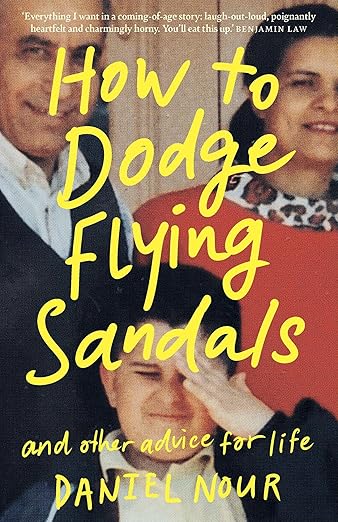
 How to Dodge Flying Sandals
Daniel Nour
ISBN 9781923046573
Reviewed by THUY ON
There is a trajectory that is followed by most memoirists: the incremental build-up of many unhappy happenstances that lead to the peak of anguish and an epiphany of sorts before lessons are duly learned and a hard-won resolution is granted. The term ‘misery memoir’ is pejorative, but there’s a nub of truth in such a description: many authors do wallow in the mire, particularly of other people’s making, and many memoirs seem to be commissioned largely because of the hardships suffered and the resilience shown by the narrator, ultimately leading to some kind of rosy outcome that champions survival over victimhood.
We all know how these memoirs usually go. Whatever the background of the protagonist, there is trauma underpinning their stories; trauma is used as a foundational linchpin that holds the narrative together. An earnest tone will also carry the heavy weight of the book from beginning to end, with gravitas favoured over levity.
However, Daniel Nour’s How to Dodge Flying Sandals and Other Advice for Life playfully subverts the standard memoir in several ways. This debut book deals with the double whammy of identity crises: the trials of being a child of Eygptian immigrants in Western Sydney and of being queer. Individually, each and either subset of circumstances are likely to create more than a twinge of discomfort for a young adult testing out the parameters of selfhood, but combined, their twin challenges can cause great volatility and uncertainty to a sensitive teenager. How Nour navigates both is the subject of the book.
In some ways he dramatises the usual tropes of an ethnic memoir; the expected checklist is acknowledged and honoured: the uneasy straddling between cultures, the generational gap that causes confusion and rebellion, the push and pull of conformity and independence. But the most distinctive way that Sandals differs from other memoirs is that it uses humour as a coping mechanism and as a way to diffuse tension.
The first clue that this book is atypical is in the title. It’s not written in chronological order but in the way of self-help guides. Every chapter is titled “How to….” (for instance, Succeed Academically, Become a Father, Date Men, Survive a Global Pandemic). Each milestone is filtered through Nour’s own experiences and there’s a stand-up comic’s lightness of touch and impeccable timing that informs each section. The second clue is that Nour’s author notes point out that he has taken some “liberties”. It’s a gentle admission perhaps that some of the set pieces within the book have been amplified and tweaked for comedic purposes, and hence we’re looking at an unreliable narrator here rather than someone committed to scrupulous truth-telling.
How to Dodge Flying Sandals is like a collection of short stories, episodic in style, and together these snapshots aim for an emotional truth about growing up in an Egyptian-Australian household as a person of faith (Coptic Catholic) while coming to terms with your sexuality. Told in a series of standalone vignettes, the structure allows Nour to use flashbacks and move back and forth in time, which means that the chapters can feel disjointed, but they also allow you to dip in and out of the book (like rifling through an anthology of tales) rather than have to read from beginning to end.
Interestingly enough, there is no chapter devoted to the title instructive, How to Dodge Flying Sandals. It stands as an overall metaphor for the memoir itself, insofar as among the raft of challenges faced by young Arabs, Nour explores various ways of dodging cultural and gender stereotypes as well as religious guilt and parental expectations.
From the very first chapter, “How to Die”, we’re introduced to a motley crew of extended relatives at the funeral of Nour’s grandfather, Gidoo. The scene is chaotic, with grieving and garrulous members arguing about death proprieties, money owed and inheritance promises all at the same time. Already we can see Nour’s knack for characterisation and dialogue (Sandals can easily be transferred into an audio book for a bonus suite of accents).
Family dynamics aside, the author’s self-exploration continues throughout the book, with several chapters showing how his nascent sexuality is routinely quashed by everyday homophobia. Here he is, in all his childish innocence and early gay sensibilities, wondering what he will do when he grows up, asking his mother (who quickly shuts the question down), “What if I don’t want to get married but travel everywhere and tell big speeches on stage in a dress? And I’ll have my friends Steve and Jeremy with me and kiss them.” (p.11) His father is more direct when five-year-old Nour wears a pink chiffon dress and is duly told, “Habibi, only girls wear dresses … You’re my big man, my big boy so I need you to act like a man, not a faffy.” (p.130)
Yet, regardless of how they feel about his queerness, the love and support of his parents are shown to be unconditional. Even when they can’t attend his high school graduation, they take photos of Nour, and “Their faces are shining with happiness like a feast is laid out for the whole family” (p.71). At another point, his father reassures him, “You should never feel embarrassed about who you are, habibi.” (p.28)
Such fraught internal discussions of who he is versus who he should be is coupled with the young Nour’s body shame (fears of being called ‘Bitch-tits” at school swimming makes him cringe about undressing in the boys’ change rooms) and worries about societal prejudices of his background (“If you tell people you’re Egyptian they’ll say you’re a terrorist and beat you up,” (p.31) cautions his older sister Rita). It’s a credit to Nour that despite contentious subjects around sex and race, there is still a seam of humour that runs through even the most overwrought situations. This is because he often laughs at himself and generously invites us to laugh alongside him.
His vulnerabilities and follies are exposed so we can better understand and empathise with his rocky passage to adulthood, a path paved with self-hate, bullying, peer group pressure and hypocrisy. It’s this willingness to own up to his confusion that makes How to Dodge Flying Sandals engaging and emotionally honest. We witness him being so deep in the closet he’ll criticise same-sex marriage on national television in a show called Christians Today (“How to Be a Big TV Star”). The gay awakening was still yet to surface.
The beauty is in the details, and the book is studded with close observations. Like how, while his father is at work in a newsagency (4am starts, 9pm home time), Nour’s weekday substitute is Sesame Street’s The Count, “his accent and massive Arab-looking nose is strangely comforting.” (p.11)
Though the bulk of the book concentrates on his childhood and adolescence, How to Dodge Flying Sandals also documents the first steps of Nour’s fledgling career in words (“How to Break News”.) He was previously awarded the NSW Premier’s Young Journalism Award by Multicultural NSW. That Nour also dabbles in improv comedy explains the humour in the memoir.
Instead of simply recounting events and incidences, the tales in How to Dodge Flying Sandals are crafted in such a way that it utilises all the skillset of a fiction writer, with plot, dialogue and characterisation carefully considered. The only difference is that Nour uses his own life as material to enable you to step into his sandals. The result is the antithesis to the “misery memoir”. It’s a book that may tread familiar grounds in terms of the struggle for self-acceptance despite myriad pressures, but it captures all the awkwardness, stresses and triumphs of a young Arab queer man growing up in Australia and does so not with hand-wringing angst, but with laughter in every chapter.
THUY ON is an arts journalist, editor, critic and poet. She’s the author of three poetry collections, all published by UWAP: Turbulence (2020), Decadence (2022) and Essence (2025). Thuy’s currently working on her fourth book, and yes, its title will rhyme with the previous books!