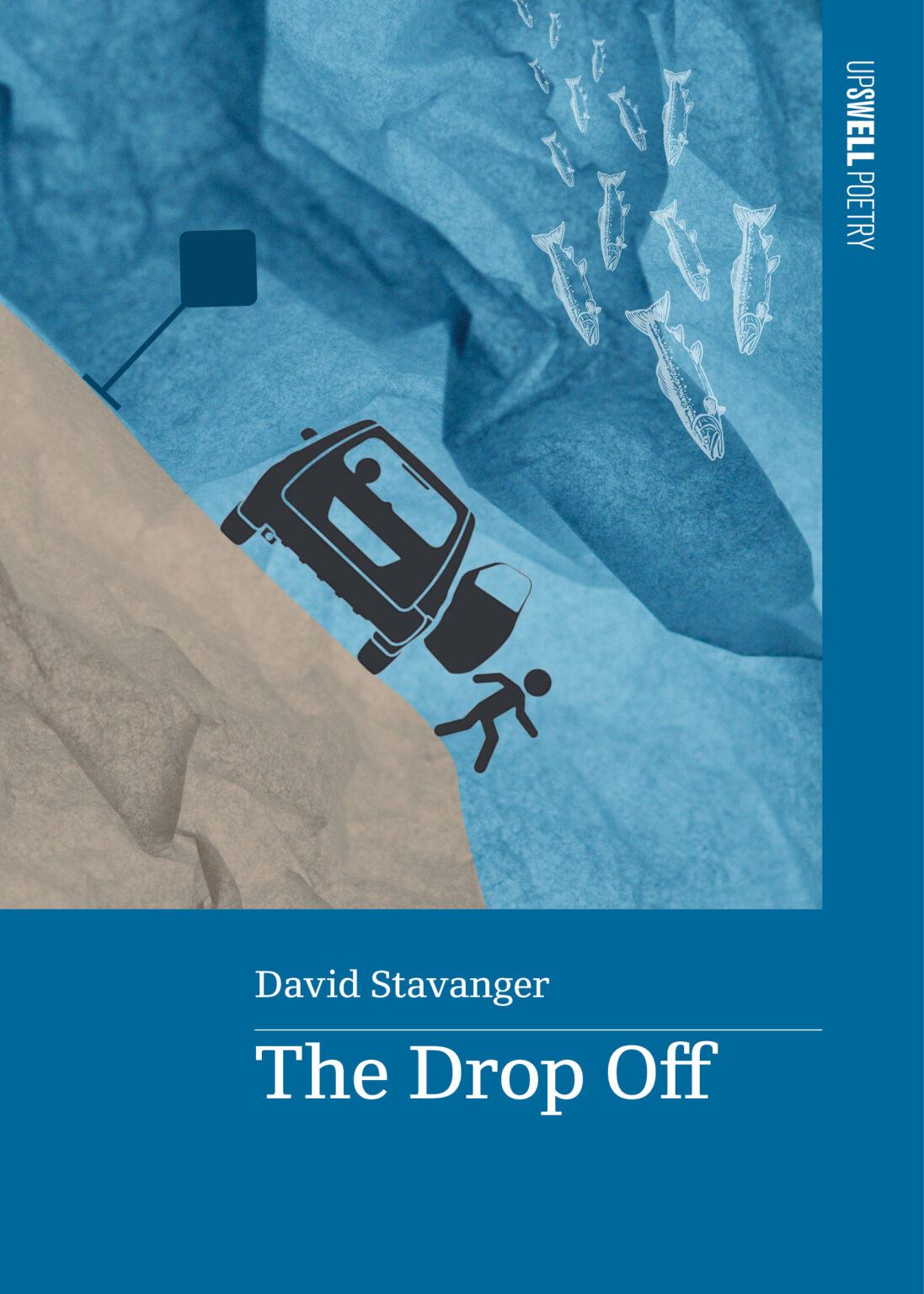
 The Drop Off
by David Stavanger
ISBN 978-0-6459840-8-8
Reviewed by PAUL SCULLY
David Stavanger’s The Drop Off is a reflection on divorce and shared parenthood and a paean of sorts to his son, interrupted by expressions of world weariness with the institutions of modern capitalism, an alternative alienation, and near-ekphrastic reactions to a painting by Marcel Duchamp and a photograph George Karger (of Marcel Duchamp). Stavanger’s evident love and admiration for his son, to whom the work is dedicated, offsets the bitterness that surfaces occasionally and withstands the humour that tends more to sublimate than expunge the irony. It is hard to gauge when the divorce poems might have been written given his son is almost an adult by the end of the collection.
Stylistically, The Drop Off is a collage of forms–verse and prose poetry, satire, the recompilation of found or invented phrases, redactions, what might pass as micro-fiction and even a table of wordplay he labels ‘Dad/Bingo’, and is framed as one continuous collection. Within that, ‘The Drop Off’ is a sequence of sixteen parts that starts at no. 3. It is prefaced by ‘The Chess Game’, the first of the Duchamp poems where, perhaps somewhat tartly, “we’re willing to sacrifice our Queens” and “One day we’ll play/without consent order/on the outskirts of Paris” (p11); ‘I’ve been thinking about your birth lately’, in which “I crave the crown of fine hair, the physicality of the child” (p12) and “It’s hard to say what kind of parents we will become./ There’s no way to inoculate against this future heartbreak” (p13), the second line of retroactive effect; and ‘Joint Statement’, which abounds in seemingly cut-out “post-truth” (p14) euphemisms that attempt a positive and mutual gloss on the decision to separate, e.g. “parting ways is as natural as procreating” (p14) and “we have mutually resolved to end this transaction amicably” (p14) yet, at the same time, “it’s really hard to hard-launch this divorce” (p15). This is humour with a sardonic edge and pleads for a human place in the production process that divorce has become.
‘The Drop Off’ itself chronicles the immediate aftermath of the divorce, that “modern dilemma” (p16), the new rituals of the drop off, the pick-up and the “duck pond” (p18) as neutral territory, the recalibration of Father’s Day, a move interstate and chaperoned flights, a third person “care navigator” (p27) to oversee exchanges, the emergence of new partners and the distance that might overtake communications with an ex-partner. The final stanza of this sequence (p31) captures the dislocation and loss engendered by these experiences but also the acceptance that his son needs to chart a way through them to find their own place:
Last night you dreamt about receiving a call
requesting you come down to the station
to verify your son’s identity. You offered
the officer memories, together and apart.
The dream police don’t accept these as proof.
They show you a photo of who your son could be.
When you are awake, they are free to choose their fate.
Stavanger changes tack for the next twenty pages or so and, four poems in, to prose formats. As suggested earlier, these changes are not announced by a new section, but are offered possibly as the next movement in a symphony of sorts that will return eventually to its underlying theme in later movements. Things are not as sequestered as this sounds and concerns occasionally bleed across each other as you might expect in something that is as both conscious and sub-conscious as poetry. An alternative take might be that the poet has been rendered generally out-of-joint with the world.
This is not intended to invalidate the concerns he expresses which range across the environment, militarism and commerce. The personal also intrudes in a variety of medical settings. Examples of the poetry here include:
If it burns, tax it. If it keeps burning, regulate it. And if it stops
burning, subsidise it. I am sick of the government being in my life.
– ‘[We’re going to get nailed]’, p33.
Henry Kissinger is dead.
Never a war he didn’t adore.
‘Credible military threats’ can be subdued.
– ‘Disconcerting tendencies’, p34.
… our lungs are an auditorium of unsustainable applause.
– ‘recline’, p36.
“The kidney that was removed when I was seventeen
is still out there seeking sensations, ghosts of organs
[3]
never mature into a functioning self”
– ‘Cystometrogram’, p38.
… Dentistry VS Psychiatry. Being in people’s mouths versus being in people’s heads. Psychiatrists =
no expensive equipment or supples. Still get to drill holes in people. Dentist = based on science and a
love of soft drinks. Still get to have an intimate relationship with someone in a chair.
– ‘← Intensifier →’, p42
The oscillation between oculist and occultist,
the crumpled coat on the road vs a dead body
[knowledge of the measurable/knowledge of the hidden].
– ‘Vision’, p50
The two currents merge more fully in ‘The Experience Economy’, which is presented in square-bracketed paragraphs and as extended, satirical wordplay. The poem journeys from childbirth, “a destination”, where “goods and services” are required as well as “unpaid labour” for the “assembly” work, the product of “the sensation of desire as existential demand, delivery as constant supply” and the “first-born … a non-fungible commodity” (pp54-57). The poem continues in this vein until “a shared calendar” emerges where “coloured squares will remind you who you planned to love”.
After traversing topics that range from swimming with his son, jaffas at the cinema, almost anachronistic perhaps, the Lindt café siege, a previously unknown sister from an out-of-wedlock relationship of the poet’s mother, kale as a substitute mother, buying a dog, child support, Texan relatives and the life of a tenant, the collection arrives at another important sequence with numbered instalments and concomitant with the parent theme, ‘Fifteen ways to be erased’, co-written by Stavanger and his son, Saul. It is an exploration of bullying, which “is a sea of faces, morphing and changing. Its only desire is to consume itself is consume itself” (p85). It is also an experience shared in different ways and times by father and son. There are aspects of refuge, subterfuge, moving schools and tendencies for authority figures to doubt the veracity of the report and advise parent and son to ignore name-calling. The latter are perhaps as damaging as the bullying–“Hesitation marks appear in the margins of my son’s learning. They begin to doubt words, even when they were written down or bolded in emails or on their own lips …Every adult … becomes unreliable” (p83). ‘Montage’ offers a happy ending of sorts where the protagonists’ relationship attains a warming and assured integrity–“David is holding the compression of time. Both hands are closed and open. Stills are spilling from his mouth (positive and negative). There are no other props or cast nearby” (p100).
David Stavanger is a wry commentator with a propensity and fondness for bons mots, but who nonetheless feels deeply. For me the two strands are not always double-helical, nor is the interweaving of the social with the intimate across poems in this unbroken collection. This is probably as much personal preference as criticism. What cannot be disputed is Stavanger’s love for his son and their graduation into a self-sustained life. Love strikes me as the ultimate destination of this collection, and we can all arrive happily there.
PAUL SCULLY is a Sydney-based poet with four published collections, the latest being The Literary Detective and Other Crimes published by Bonfire Press in 2025. He holds a Doctor of Arts from Sydney University. His work has been commended and shortlisted in major Australian poetry prizes and published in print and online journals in Australia, Ireland, the UK and USA. His website is http://paulscullypoet.com.au/.