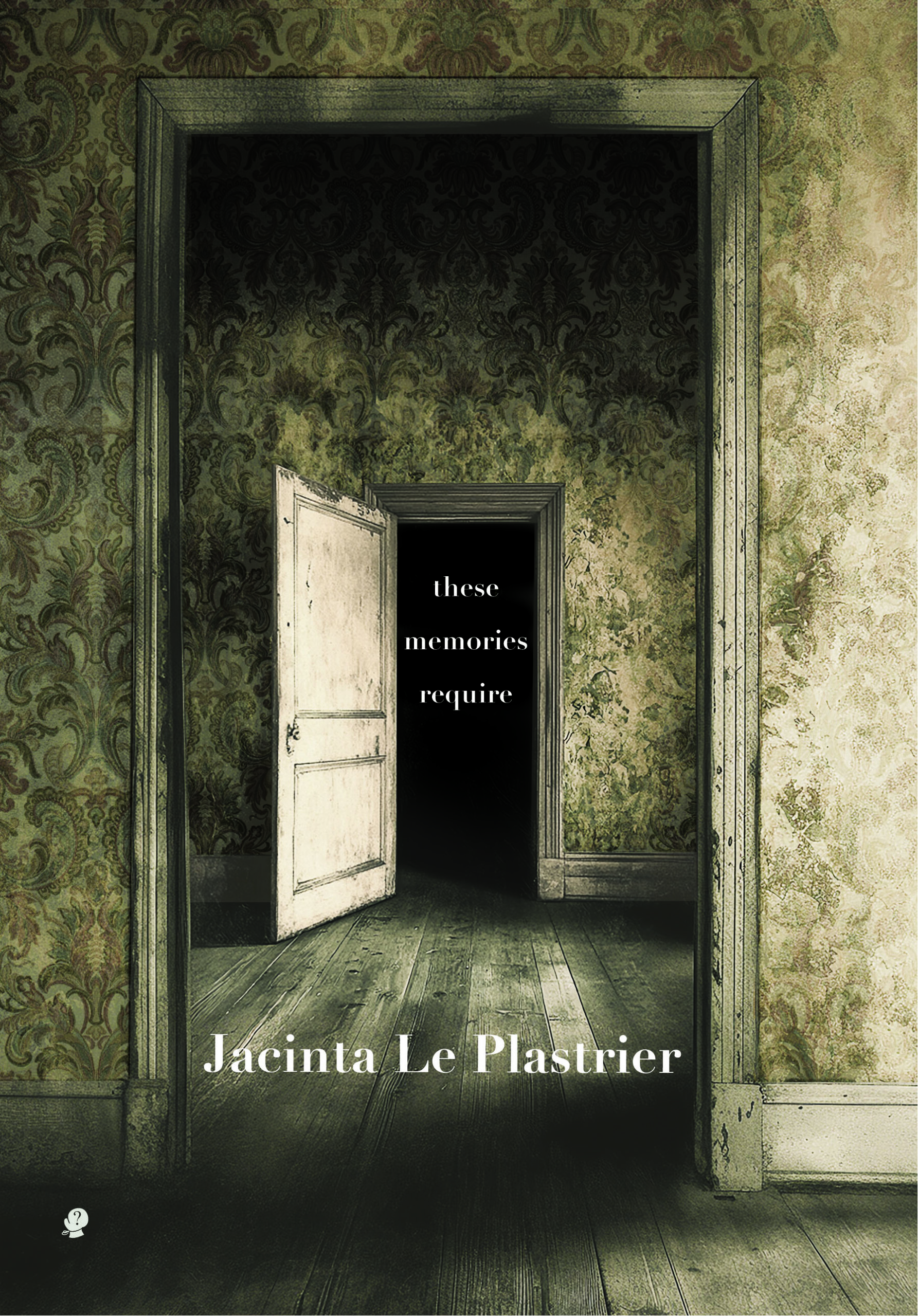
 these memories require
Jacinta Le Plastrier
ISBN: 9781923099661
Reviewed by PARIS ROSEMONT
Jacinta Le Plastrier’s these memories require is a delicately woven poetry collection blending emotion and intellect whilst pressing on the bruises of trauma and memory. It traverses complex terrain, from lived experience to the ethically observed, through to remnants of the historical as well as collective ancestral memory. That’s a lot of suffering to pack into one collection. For the most part, Le Plastrier is adept at treading with just the right amount of balance, a tightrope walker poised on the edge of each carefully curated word. Control over craft is evident in the precision of expression in stark contrast to a sense of powerlessness careening through the traumatic subject-matter itself. The imagery displays dualities wedding beauty with brutality, forming ‘Scabs, hard as rubies’ (‘untitled (o,)’ p9).
There is much that is left teasingly unsaid in this gripping collection. From the very title these memories require, pseudo-cliffhangers challenge the reader to ponder, to reflect, to fill in the blanks, to (attempt to) complete. As the mise en abyme of nested doorways within doorways on the cover suggests, this book asks as many questions as it answers. The unresolved give the poems a tension that propel the reader into digging curiously into the warren of intrigue and discovery.
notbirthhouse…in phantasm’s shadows. / and you are nearly / always like a child, / both within yourself, and yet / with your own gaze, / you are able / to watch you. / nightgown dressed, / you float, spectral / through its doors, / across thresholds…it was the house / that taught you / how to write.
(‘returnings’ pp2-3; original layout not retained)
There’s a sense of otherworldliness about this collection, grounded in both the real and surreal.
i am not talking of the wall’s scream, how it screamed
so whitely,
… i wanted to climb
the rubble,
hold a single stone.
let its weight convince me,
my eye was a hand
(‘construction site’ p4)
The poems themselves are curious beasts, each ‘untitled’ accompanied by a qualifier in parentheses: ‘untitled (later)’, ‘untitled (perhaps)’, ‘untitled (i want)’, ‘untitled (did i)’, ‘untitled (ahoy)’. The brevity of these descriptions gives them a minimalist feel—enigmatic whilst drilling directly into the core of the text. There’s an almost childlike simplicity to these parenthetical (sub)titles—they’re direct, lacking pretension or waffle. This echoes recurring themes that thread their way like an umbilical cord throughout this collection: childhood and conversely, motherhood.
Le Plastrier paints striking portraits of motherhood in its tender shades of complexity and nuance:
…each pregnancy entombed, an oxblood cave of dream, ribbed
by maternal drum, venal, aortal, pulse threaded to origin’s sorcery.
(‘quartet (for s.)’ p19)
From complicated labours:
born unbreathing blue
yanked you
to touch you
only through
glassy slits,
you gloved gravely
into incubator
to the witnessing of heart-wrenching loss later in the same poem:
- dies in the glasscot
exactly next to you,
her parents’ grief
at 3 am, at the royal women’s hospital, total.
(‘icu (for b.)’ pp15-16)
The poet does not spare the reader the gore of motherhood: ‘the surgeon. his hands at your skull / juggling the entrails / of all memory’ (‘neuroward2east (for a.b.)’ p21). Motherhood can be brutal business. Add to the mix the livewire of neurodivergence and the challenge of raising a child with special needs, and the complexities are compounded. From social judgement to a revolving door of medical appointments (‘the scour of years of speech pathology / by which you reformed your sounds’):
Who is getting it wrong?
you, dear first child
or the specialists helpful with their rules.
… i almost failed you,
almost let-in their slurs
which whispered–chronically,
underlit like radium your sleeping.
(‘quartet (for s.)’ pp17-18)
One poem proffers a disturbingly hacked doll where short, choppy lines mirror blunt butchery:
…you savage her
with scissors,
…break
both plastic arms;
abandon her
in the field
right next
to your home’
(‘untitled (dolls)’ p7)
It is not only the dolls that suffer. In the recounted memories, childhood is fraught with myriad hurts, which collectively form ‘The small frond of a scar from childhood’s kneecap’ (‘By which you mean,’ p10). But for all their growing pains, bittersweet is the inevitable shift beyond childhood:
…later,
the children will quieten,
and the clear silence culled
from the feet of their laughter
…dolls vagrant,
their clotted hair.
…unicorns…
exiled by reason
(‘untitled (later)’ p11)
these memories require is composed of two parts. The collection starts strong with powerful sparseness and visceral intimacy. There is a distinct shift in style and tone with the penultimate poem in this part—not one of the multiple ‘untitled’ pieces, but instead, the singular ‘unnamed’. The shorter, fragmented lines of the preceding poems give way to almost a dozen paragraphs of prose. It seems an unusual stylistic choice to have placed this particular poem on the Part I side of the divide. With the shift from the micro of the intensely personal to the macro of things more cosmic and universal, the lofty voice of the observer begins to veer into the histrionic. The words now float unmoored in another plane. Le Plastrier writes ‘your guide will appear, usually these are of celestial form’. There is talk of ‘an assassin assigned by the negative realms’ who may try to take us ‘far beyond this fortress’s limits’. The poem is littered with references to ‘the constellation of their unearthly blood’ and ‘half-mortal(s)’ that are apparently not ‘druidic’. The language employed feels anachronistic and alienating in its didactic grandeur:
so i wore a triple-horned crown, hewn from the sycamore tree we consider sacred…i buried a staff made of crystal, before we departed. in its symbols, inscribed, are embedded all the seed-lights of our future, the old skills we will need to remember. the geographic co-ordinates of its hidden site are related to the henge, the room, and the sycamore–tattooed into my earthly and lighter minds. would that I could trust any of you with this information?
(‘unnamed’ pp22-23)
This voice adopted creates an omnipotent ‘I’ (the writer) versus ‘you’ (the reader). Thus held at arm’s length, the reader feels a sense of disconnect. The bio at the back of the book reveals the poet has a personal interest in the supernatural. The swerve into this terrain makes more sense within this context. However, for readers who may not share this niche fascination, the phantasmal departure can feel estranging—particularly after the relatable human heartbeat of the poems preceding it.
Part II is more disjointed in style and theme than the first (not a criticism; merely an observation). Continuing with supernatural elements, there are poems featuring ‘witchly’ beings and ‘runes (that) do not lie’ (‘untitled (witchly)’ p28 and ‘untitled (did i)’ p31) and ekphrastic pieces engaging in poetic discourse with literary and philosophical giants including Lorca (‘untitled (recovery)’ pp32-33), Brecht (‘untitled (On)’ pp34-35), and Avery F. Gordon (‘untitled (pacing)’ pp50-51), the latter containing a quote longer than the poem itself. The footnotes leave no doubt the poet is widely read, has closely studied the source material, and does not invoke these predecessors lightly.
Poems on current affairs include the devastating:
& across twenty-four hours
of newsprint
the platelets of children
will be sailing
on a Gazan beach.
(‘untitled (the earth lugs on)’ p36)
A couple of poems later, we reach vertically aligned prose poem ‘the storm’, decadently spread across two pages. This piece embraces the sumptuousness of language, each word carefully deployed. Interesting turns of phrase, charming images, and unique pairings within compound words delight:
…Empire furniture huddled like gilded fowl…musselsoftness of a woman’s innermost rising…fossils small as postage-stamps…upon my cheek I can feel their bloodwarmth…just beyond the windoworiel, powdering the wordkeep…the ding of fancy cars fishtailing, their dollardrum inhabitants…straightasadie ribbons of light…the storm’s settled its wager of rain and cloudedbright…
(‘the storm’ pp 40-41)
A stylistic rupture confronts us in the frenetic stream-of-consciousness piece that follows, where the poet confesses:
all i want to do
tonight, is to be too fucked up
… this poem’s getting all smashed up
(‘untitled (ahoy)’ p42)
The latter quarter of this collection explores poetry of witness. The reader is taken into unsettling territory charting abuse, madness, and destructiveness of various kinds, where desperate coping mechanisms themselves become a form of self-abuse.
‘Catalogue’ (pp47-49) is starkly powerful. A blackout poem chilling in the sparseness of text. It is a twenty-one-word poem spanning three whole pages comprised largely of ominous slabs of visually striking redactions. The naked vulnerability of what remains is made even more gut-wrenching juxtaposed with the guesswork behind what has been obscured.
The final poems in Le Plastrier’s collection return once again to childhood. From the ‘numinous hours…at the foot of your child bed’ (‘untitled (nascent)’ p54) to ‘a child / without questions’ (‘in the sea’s’ p55). The closing poem gently gives the reader permission to ‘go backwards / with all your hours’ (‘untitled (long)’ p56), a purging of sorts of the preceding violence. We return to the safety and comfort of the womb—on a physiological, psychological, and mother-earth level. It is welcome relief and a soft landing after the volatile ride through motherhood, brutality, philosophy, and the corporeal. these memories require is a viscerally wrought collection crafted with great skill and care, showcasing the bruising gradients of life through personal and collective memory. Yet for all the horrors both experienced and witnessed, there’s a pervading sense of beauty and hope. As Le Plastrier writes in ‘untitled (the earth lugs on)’ (p36): ‘we revolve / on the delicate ankles of love’.
PARIS ROSEMONT is a multi-award-winning Thai Australian poet, performer, educator, and author of Banana Girl (2023) and Barefoot Poetess (2025). Her books have received awards and accolades in Australia, Greece, UK and USA. Paris’s poetry has been published in a plethora of literary journals and anthologies including Australian Poetry Journal, FemAsia Magazine, Rabbit, Splinter, and Verge. She was the winner of the Matthew Rocca Poetry Prize 2025 (Verandah Literary Journal; an initiative of Deakin University), First Prize in the Hammond House Publishing Origins Poetry Prize 2023 (UK), received a Best of the Net 2025 nomination from Sky Island Journal, and was awarded Honourable Mention in the Fish Poetry Prize 2025 (Top 10 in the world, as selected by judge Billy Collins). She has judged for the Western Australian Premier’s Book Awards 2025 and Sydney Fringe Festival 2024. Paris is a member of the Randwick City Council Arts & Cultural Advisory Committee, Guest Editor for Written Off Literary Journal, and sits on the Hunter Writers’ Centre Board. She may be found at www.parisrosemont.com