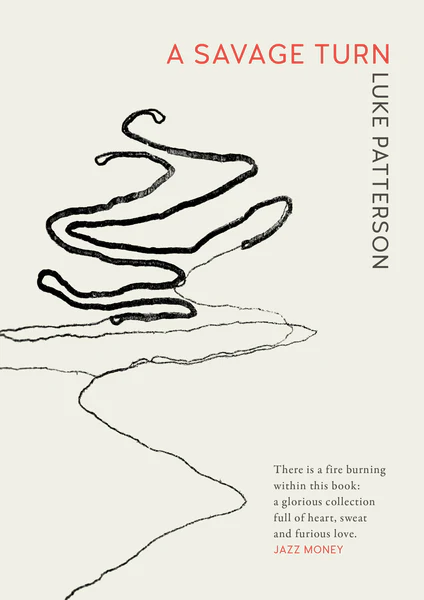
 A Savage Turn
Luke Patterson
Magabala Books
Hachette
ISBN: 9781922777928
Reviewed by MICHAEL GRIFFITHS
The opening poem of the third and final section of Luke Patterson’s A Savage Turn sees the speaker partly attached to but mostly scathing about his place of birth, Kurnell—the suburb of Sydney’s Sutherland shire that sits at the location of Cook’s landing in 1770. The poet writes, beginning almost in media res:
lined with Norfolk-pining nostalgia-thin
myths of peaceful settlement I’m wondering
why I return to your history strung out
in clay-bone-coloured rhythms—
kurnell seaside hometown crooning 250
years on I’ve come tumbling back to you
(81)
Patterson’s lines are affectionate even as they draw a line at settler colonial myth. They love the place but not the justification of colonial invasion that are laden across its shores, riven with “myths of peaceful settlement.” This poem evinces a clear predilection on Patterson’s part to combat colonial narratives that cover over colonisation, occupation, incarceration and other practices with a tone of deep irony.
This is a brilliant and perceptive, comedic and cutting collection. In particular, I find Patterson’s collection to strategically deploy sardonic critique—with its biting humour at the worst abuses that Indigenous people in Australia have been subject to. This is not to say that there are not many poems of deep affection for lovers and friends, places and people; but the mode of the sardonic is, I suggest, a frequent and highly effective critique of A Savage Turn.
The collection begins with several poems that set this tone: the opening “Waratah,” all this themes of conquest and colonisation are also undergirded by culturally grounded sadness and survival:
You know the way
The story goes
Reading legends
At the flowering stage
Brimstone and blood
Men treading to war
In the dream you have
Grief grows a totem
(3)
“Waratah”—named as it is for a beautiful native flower, is shown to be caught up in a cycle where the beauty of Indigenous cultural practice is reduced to grief and “legends / at the flowering stage” take on a settler state sensibility (like the flower itself an emblem for New South Wales). From this opening poem, we are led to a direct reflection on James Cook’s story and legacy in “Australia: A Creation Myth.” As “old man cooky” arrives, the titular trope of the “savage” gets turned on its head throughout this second poem (4). Australia becomes “savage, a state of nature / for the taking” (4). The final lines of the poem superbly move the trope of savagery in all its senses: as a projection onto Aboriginal cultural life even as the colony itself is seen to be savage:
[The colony] swallowed the flowering
medicines, sweet abundance sustenance, and shat out pox
and profit. It swallowed earth’s
custodians, exquisite, ingenious, savage, always savage
but could not consume them.
(p.4–5)
The note of the scatological (“shat out”) here, draws in the way critique in A Savage Turn is at times oriented through an effective use of the vulgar, sometimes also through sexuality. Indeed, the poet’s apparent alter ego (it’s his social media handle on several platforms, for what it’s worth) is the “smutty paperbark,” and this trope lends its name to a poem in the collection. Much of the poem “Smutty Paperbark—a Postcolonial,” takes on the colonial appropriation of the very cultural apparatuses of healing and resistance that remain as the purview of Indigenous autonomy; take for instance:
I’m Blackapedia
As british as tea
I thought I was black
jesus with a secret/sacred
constellation of freckles speckled
on my arse
but then the southern cross
became a symbol for bashing
people of colour.
(p.29)
But returning to the colonial, this concern only intensifies after “Australia—A Creation Myth,” not least with a series of nine poems running through the entire collection, which play with the light and shade of the font colour on the page; the aforementioned “Transit of Venus” poems. These poems play with not only hermeneutic critique but the form of printing itself and playing with form becomes a further theme as Patterson takes up fixed and traditional forms such as the Rondolet (in “Rondolettatat” [16]) and the Triolet (in “Triolet x2” [87]). Since the Triolet uses a repetition of rhyming words, Patterson uses this to both vary and refer to the sacred dimension of life and language:
as aunt shows me her lagoon
The sun sets and even the moon
is listening to a story born.
Aunt is the lagoon
where she was born.
(p.87)
Patterson is a trained folklorist, a practice that comes out in poems such as “The Informants,” and “Eclair Noir (Flash Blak),” the latter of which declares the speaker a “gap-trapped fulla caught / reading Claude Lévi-Strauss / in the lingua franca: English” (14–15). Yet, Patterson’s engagement with colonial knowledge is not only with that anthropological paradigm that can be productively drawn on (not without risk of course) but also the carceral nature of much black relation with the Australian state. A consistent participant, engaged with Wadi Wadi elder, Aunty Barbara Nicholson’s “Dreaming Inside” project of teaching and workshopping poetry within prisons in New South Wales, Patterson includes in his collection several poems drawn from the experience of acting as a tutor on the project. As the speaker of “Under a Wiradjuri Sky,” goes through the process of entering a prison as a visitor he wonders about the role these institutions are meant to play in a so-called postcolonial society:
Scanned, checked, finger printed
Identity disassembled
(intentionally?)
This visitor’s lanyard around my neck
and the light wanes to an institutional white.
(p.73)
Patterson’s concerns with colonial violence and institutional power are continuous both between the modes of power themselves and the historical continuum that marks them as an ongoing structure of dispossession. In the prison poems, the sardonic tone is replaced by one more solemn as the speaker and the poet remain in recognition of the immediacy of the ongoing colonial practice of incarceration.
There are many other crucial dimensions to this resplendent collection beyond these questions of colonisation’s critique (which is there, ever present), the sardonic, institutional violence and the emphasis on sexuality (and the queering of critique soars in “Losing a Love Language and a Brother” [100]). This is a collection to look over and reread, revisit and resituate as you situate yourself from Kurnell to Wiradjuri Country and many places between and besides. But while the poems are signed and signified in a deeply personal way, Patterson refuses the spectatorial and colonial gaze throughout. As the title poem notes, while “This is the poem / where I’m meant to spill my guns and you read the entrails [ . . . ]” but, playfully “this” poem is deferred, with the poem closing, “and I promise to add it to my next collection / if we live that long.” May we live to read Patterson’s further iteration on iterability.
MICHAEL GRIFFITHS is Associate Professor of English Literature at the School of Humanities, University of Wollongong. His latest book is The Death of the Author and Anticolonial Thought.