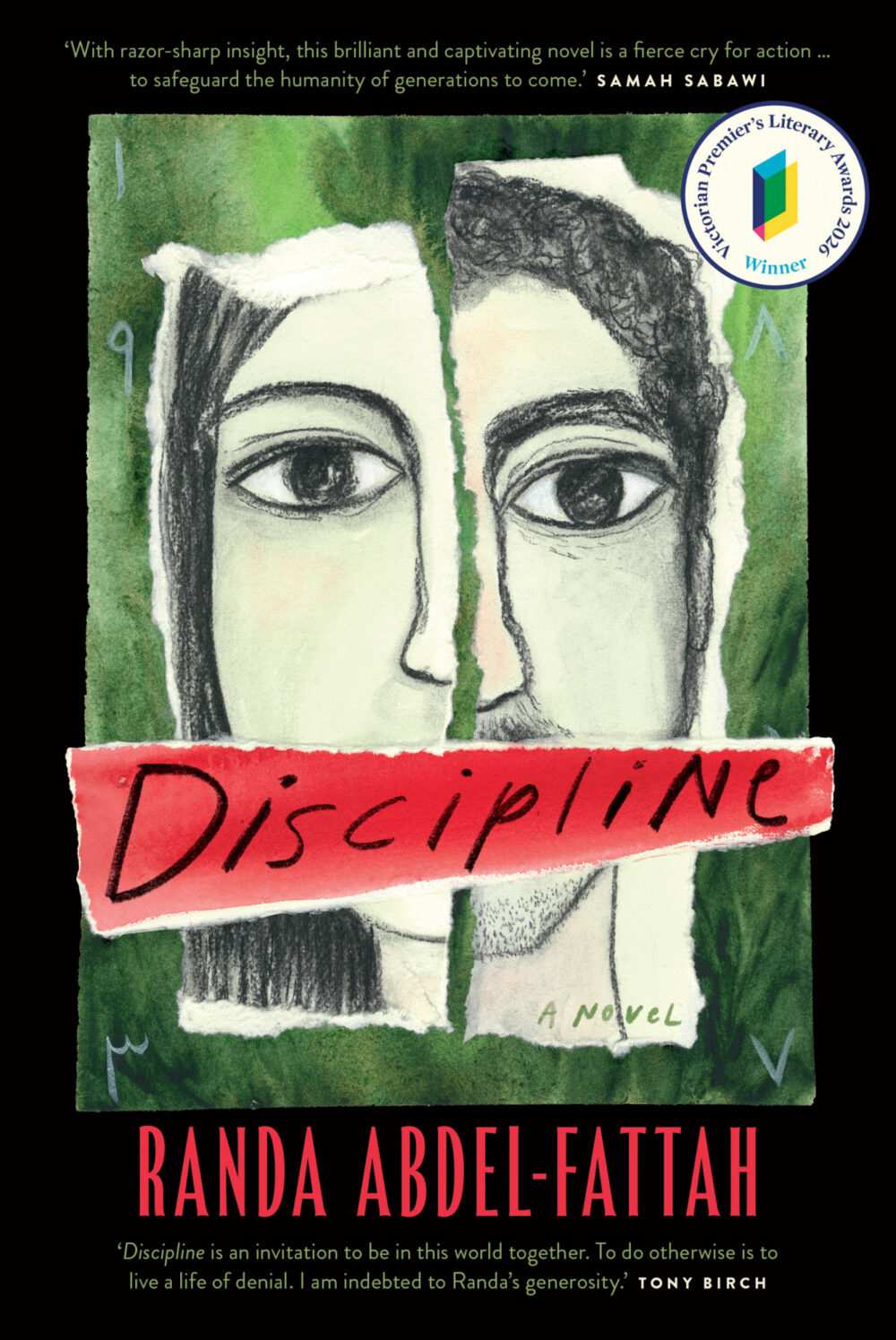
 Discipline
by Randa Abdel-Fattah
ISBN 9780702271014
Reviewed by KORALY DIMITRIADIS
Dr Randa Abdel-Fattah’s political fiction Discipline is an important novel about politics, activism, power, and the hierarchies that exist within it. Narrated in third-person through Ashraf, a university academic of Lebanese descent, and Hannah, a journalist of Palestinian descent working for a right-leaning newspaper, Abdel-Fattah hooks you in immediately with relatable, vulnerable, witty and intelligent protagonists, characters and observations, her prose effortlessly shifting between melancholy, feminism, and humour, smashing stereotypes and giving us a real taste of multicultural Australia.
Hannah is a young mother, married to Jamal, from Gaza. Ashraf is divorced, navigating a complex digital co-parenting dynamic, lamenting why ‘religion make[s] such fools of people’ (p.2) after his wife abandoned feminism for a strict Islamic life, moving to Yemen with their daughters and remarrying. As a single mother who has co-parented, I felt Abdel-Fattah captures the struggles of co-parenting, and motherhood, accurately.
Set in Sydney-Australia’s Middle Eastern diaspora during Israeli-Palestinian conflict in Gaza, Discipline explores the guilt, privilege and responsibility of living so far away from your homeland when it’s hurting.
Hannah knew that Jamal had learned to compartmentalise his rage and grief, had learnt a level of self-restraint that can perhaps only come from living through slow-cooked trauma (p.62)
Abdel-Fattah paints a picture of the diaspora and the way it functions and lives. Hannah mocks motherhood with an infectious dry sarcasm, clearly showing the reader that while she does follow some aspects of her culture like fasting, she certainly does not live a lifestyle of consumerism like many in the diaspora. Hannah cares more about human rights than being ‘pretentious enough to spend two hundred dollars on a [baby] dress that would end up covered in pureed apple and carrot stains’ (p.10).
While Hannah and Jamal’s marriage operates in a more equal fashion than one might expect in immigrant communities, Abdel-Fattah still highlights disparity in gender expectations within such communities. When Jamal is confused about where the Dior baby dress is as Hannah is rushing out the door to work, Hannah instructed the night prior by her mother to ‘dress up’ Aya up because she has plans to ‘show off her grandchild’, Hannah responds to Jamal, ‘you’re capable of doing a PhD. Find it.’ (p.10).
Hannah navigates frustrations like road rage and why we have to pay for toll roads that are slower than free roads, balancing her rage with her faith, relatable to those who are religious or grew up religious, as I did:
She banged her hand on the steering wheel as she considered: Does swearing invalidate my fast? […] She lent out of the window and yelled, ‘Dickhead!’
(p.17)
This is how she begins, how she captivates you, her prose masterful, gently weaving in her politics as the novel unfolds, until you’re having uncomfortable conversations you’re not sure you should be having. But too bad. By that time, you’re invested.
Discipline mimics the current toxic, entitled, white-washed status quo in Australia’s media and academia. While the Australian literary landscape is not covered, it most certainly isn’t any different, as all three sectors are interconnected. One would expect Discipline to be a dense read due to the subject matter, yet it isn’t, it’s light and engaging. Abdel-Fattah is controversial and brave in what she puts on the page, presenting arguments from many angles, even perspectives she might not agree with, gaining trust with the reader and giving them space to form their own judgments.
People like Jamal and these flag-burning protesters were delusional if they didn’t comprehend that their moral absolutism only resonated with their echo chamber of keyboard warriors and angry rent-a-crows. […] The world was selfish, ugly, unjust and expensive to live in. Free Palestine, sure, but nothing in this world was for free […] (p.161, p.162)
Discipline depicts such an unbelievably sad state-of-affairs that the prose actually tips into black comedy just to keep itself from jumping off a cliff.
There was a moment of silence between them, interrupted by Hannah letting out a short, forced laugh in an attempt to diffuse the tension […] Hannah felt as if she might explode and, at the exact same time, she wondered what Peter would make of her thinking about exploding.
(p.33)
What’s uncanny is that Discipline explores censorship and cancel culture and Abdel-Fattah was cancelled from Adelaide Writers Week where she was programmed to speak about Discipline. Judging by the redacted names of people and institutions in the Acknowledgments, Abdel-Fattah repeatedly experiences such censorship. Abdel-Fattah in early 2025, also had her research grant into Arab & Moslem Australian social movements suspended.
There were people who tried to stop this book from being published. They failed.
(p.245)
Fifteen years of being in this industry and the way it operates still baffles me. It is a tokenistic, racist, hypocritical, unethical system where who you know and what your politics are matters more than the quality of your writing. And when you are given the opportunity to write, you better behave. Through the character of Hannah, Abdel-Fattah captures the frustrations of journalism and how a writer’s words are often re-written without consultation when you are at the bottom of the pecking order.
[…] why was she such a naïve fool looking for poetic justice in an industry that was driven by a corporate model of subscriptions and advertising? […] She was sandwiched between racism and sexism by people who gave speeches at international Women’s Day breakfasts and pasted Acknowledgements of Country in their email signatures.
(p.21, p.29)
Systems and structures are controlled by white people, and you either sell your soul to cater to their narratives and be rewarded, try to find a way to work within their system but the compensation won’t nearly be as good, or take the gamble and abandon the system all together and who knows how you’re going to survive but at least your soul is intact. The system is designed to pit us against each other, and it takes a tremendous amount of ‘discipline’ just to survive.
He was exhausted. The academy was like one big chess board […] he would never have the power of checkmate, not in a game that was rigged against him […] he would at least try to make his small corner […] strong (p.196, p.197)
As a Cypriot-Australian writer who has worked in journalism and academia, and who writes fiction and non-fiction; as a writer who has been cancelled unjustly in her career, I don’t agree that this book was published because of the ‘artistic freedom’ Abdel-Fattah believes her publisher University of Queensland possesses (p.246). I am too jaded and have had way too many knives stuck in my back to believe that. Yet, I don’t think I am naïve to believe that Abdel-Fattah wrote her book for people like me. After reading Discipline, I agreed with author Michael Mohammed Ahmad, ‘[…] the very existence of this book provides hope […]’.
It is relevant to talk about the politics surrounding Discipline because Discipline explores those very dynamics. My perception of Abdel-Fattah before reading Discipline was that she belongs to a politically correct, literary-industry-accepted-and-supported popular clique. Recently, these cliques have come under threat, as powers greater than them yield their own agendas. While I didn’t agree with the government interference regarding Adelaide Writers Festival, at the time I questioned why Abdel-Fattah was complaining when she had been part of campaigns to cancel other writers she didn’t politically align with.
At times in Discipline I felt Abdel-Fattah was criticising the very behaviours she has engaged in. As I read on, the same question resurfaced: who is allowed to speak? Should I, now, be further vilified and blacklisted if I write an opinion someone doesn’t like, even when I, myself, belong to a marginalised community? Should I be crucified for it? Our world has become fast-paced, judgmental, no time to breathe in social media land
‘[…] if you are a journalist of colour […] and you’re using diluted language, you’re really just a stenographer perpetuating the pro-Israel status quo […] ’ […] She was no stranger to the comments section […] she didn’t feel […] upset […]. She just felt gross (p.186, p.187)
There are times in Discipline where Hannah’s rage spills over, even towards the marginalised.
Stupid cow, Hannah thought. Fine, keep your head down. I wasn’t expecting anything from you (p.75)
Discipline shows us clearly where the power lies. Gatekeepers don’t need permission to speak, they simply assign permission when they feel comfortable to do so, in their devaluating manner.
Barnaby explained [to Ashraf] that he was fed up with the way institutions used diversity as window dressing instead of valuing the decolonial, alternative knowledge and perspectives of scholars of colour […] ‘You need to find a way to tap into that, prove that our diverse JBU community here is not cynical tokenism but meaningful on its own terms.’ (p.36, p.37)
and the rest of us are left to fight it out amongst ourselves
Were his mother and sister safer now that he was facing a possible misconduct case? Always acting with emotion, never intellect, never diplomacy or reason. It was the miserable fate of Arabs, indeed the Arab and the Muslim world (p.221, p.222) with gatekeepers oblivious to their privilege:
Faye had grown us in Yass, for crying out loud. He’d asked her: why Middle Eastern politics? She said she’d […] ‘fallen in love with Arabs’
(p.15)
Abdel-Fattah had to make us laugh in this book; it was the only way to win us over, to give us hope.
The convention centre was doing an excellent job of burning the planet in order to run the air conditioning at uncomfortably cold levels as they all discussed decolonial approaches to climate change (p.12)
My rage was captured in the character of Hannah, and in the character of Ashraf, who represent opposing ways of operating within systems. I emerged from Discipline teary, to be honest, questioning my black and white thinking. But not in a way that made me feel ashamed, quite the opposite, I felt heard by Abdel-Fattah, which is quite ironic in the context of it all. One can only conclude then that Abdel-Fattah is a skilled writer. I found comfort in this novel. It made me feel less alone as a writer, as a Cypriot in the diaspora fighting for the freedom of my homeland from occupation and colonisation, and as a human fighting for a free Palestine and end to war.
[…] to my readers. May we remain undisciplined. It is the only hope for this broken world
(p.247).
I have to be honest, when I was asked to review Discipline, I hesitated. I didn’t think Abdel-Fattah writing, based on what I knew about her, would be to my liking. But So, I am shocked to say that I fell in love with Abdel-Fattah’s writing reading Discipline. Any preconceived ideas I had about her have been challenged and shattered. This is despite the hurdle I had to overcome on the Dedication page, which risks alienating readers Abdel-Fattah might otherwise convert through her exquisite prose
I humbly dedicate this book to all the Palestinian academics and journalists skilled in Gaza who would be alive if academics and journalists in the west had spoken and acted when they had the chance (p.0).
Discipline is a highly educational, politically informed book, told through very real characters and real-life situations. It has the potential to shift opinions, create change. It took me time to learn about the politics surrounding Gaza. I am not to blame for the war crimes of others.
This is where I must raise one of the downfalls of this book. While it does begin strongly, with the characters and their story and trajectory key narrative drivers, a third of the way in the characters start to feel like vehicles for delivering politics, the author’s voice and rage interjecting, with scenes sometimes feeling rushed, without enough build-up.
It was at these times that I questioned the intended audience. Was Discipline written for a well-educated audience? Or for an audience that wanted to know more? At times I would have preferred the latter, more accessible language, and a little more explanation for those who might not know as much, more character emotional depth, thus bringing the reader closer and widening the reach and impact of the book. I would have liked more in the way of relationship dynamics, especially between Hannah and Jamal.
But I forgave Abdel-Fattah for this. I have an exceptionally high bar for fiction. It is rare I am hooked from the first page. I read the book quite quickly, another difficult thing to achieve for me. Her words grabbed at my heart very early on and refused to let go, her pain and frustrations became mine, her rage shrilled with mine, even at times when I felt extremely resentful and uncomfortable with the words I was reading, I sat with her, because by that time, she had already won me over. We forgive her transgressions and minor issues because we come to understand that as a Palestinian author, Abdel-Fattah is navigating one of the most difficult political terrains, and she does it eloquently, with class, though nobody’s perfect.
KORALY DIMITRIADIS is a Cypriot Australian poet, writer, actor and performer.