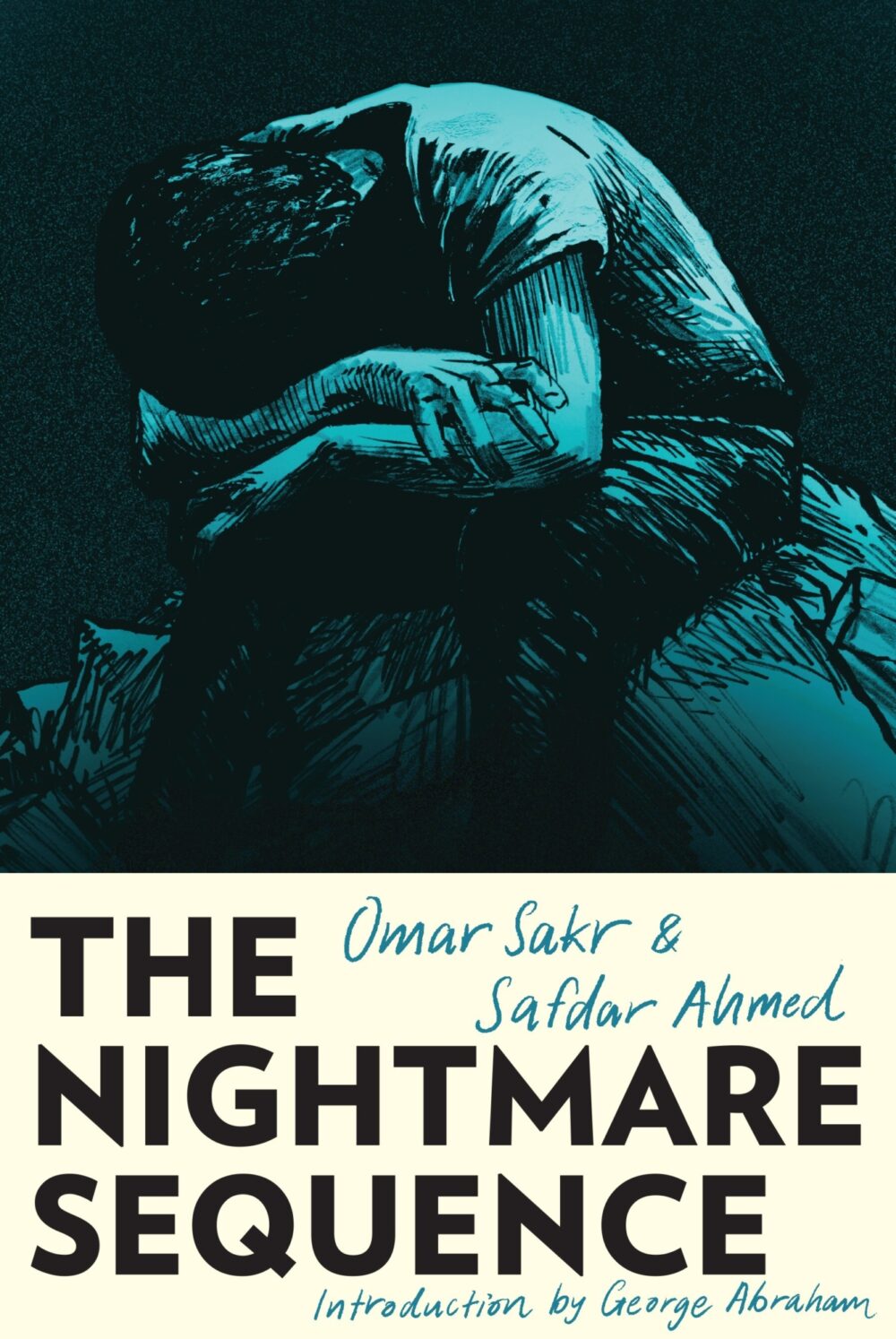
 The Nightmare Sequence
Omar Sakr and Safdar Ahmed
ISBN 9780702268908
Reviewed by KATIE HANSORD
Omar Sakr, readers will already know as an incredibly talented, prolific, and award-winning writer. Yet this collection is beyond, and so crucial in this moment. It is immensely powerful, intense, raw, and immeasurably heavy, yet it is at the same time delicately crafted, deeply sensitive, and soft. The poems are illustrated with beautiful artworks by Safdar Ahmed. This is a collection of poetry and illustrations that is on another level. Sakr’s poetic voice is a call to moral clarity and humanity that is so desperately needed in this moment. A call to humanity from the soul of heartbreak. The collection is a series of poems titled variously ‘…in the genocide’. A circling repetition that situates us always within the nightmare that the media and powerful would prefer to ignore, minimise, or outright deny, yet which cannot be unseen and must be confronted. As Randa Abdel-Fattah notes, this book is an “astonishingly original collaboration by two artists who are committed to the intimacies of humanity, the details of injustice, and uncompromising truth-telling” (n. pag.). These poems that Sakr originally shared on Instagram, as the genocide unfolded on our screens in horrific unbearable footage of children, babies, bodies, unfathomable destruction and anguish before our very eyes, forever changing everything. Some of these Nightmare Sequence poems were also originally published in various journals such as Westerly, Cordite, and Southerly, ‘Walking to day care in the Genocide’ (Southerly p.108), and have also appeared as translations, such as ‘Graze in the Genocide’ appearing in Cordite and Point de Chute, in which personal parenting experiences are simultaneously contextualised and contextualising the genocide within these deeply realised themes of love, protection, human connection, and care. The poems each hold a light of truth, grief, witness and care, like the many candles of a vigil, lit from the flame of love, together forming a beacon of hope to insist that this genocide is always the context, that this cannot be forgotten, normalised, accepted, and that we can never become numb to it.
In the face of such extreme dehumanisation and disregard for the enormous number of people, and the extreme number of children killed in Gaza – Sakr writes: ‘Every child’s corpse is mine, I fear / Not being able to undo this grim fatherhood, / I fear its undoing even more’ (‘Limits in the genocide’ 80). This profoundly emotionally honest collection opens with two quotations, and each poem intricately carries their traces, in its own ways. The first, from Isabella Hamad, who wrote the lines “To remain human at this / juncture is to remain in agony. Let us remain there: /It is the most honest place from which to speak.”, which is echoed in Sakr’s dual fears of not only ‘this grim fatherhood’ but the fear of ‘its undoing even more’ (80) – the undoing which would mean the undoing of truth, and of humanity itself. As this repetition in the titles continuously calls the reader back to this context of the unfolding nightmare, and the ongoing acknowledgement that each thing, each day that takes place does so ‘…in the genocide’. It is recalled, remembered, re-centred, repeatedly in a sequence of days, in the passage of ‘normal’ time and abstract, in its usual calendar of days marked and unmarked by holidays and observances of altered importance: in the minutia of the day-to-day, and in the cumulations of days – ‘100 days in the genocide’, ‘300 days in the genocide’, Ramadan, Mother’s Day, Father’s Day, Easter, in the genocide, and of specific dates. Sakr’s poems insist, rightly so, that everything we experience, is occurring ‘in the genocide’ – even that one date so centred by the western media, is here ‘October 7th in the Genocide’ a poem in which Sakr writes:
You think I fear to enter October 7th?
Habibi, I never left. I’m still there with you
Dying as I do every day. I admit I can’t see
the murdered you heap murder on.
…
For me the world breaks every day.
(65)
We, as readers, are reminded repeatedly that there need be no such reminder, and that nothing, for people of conscience, can ever be experienced ‘as usual’ without this outrage beyond comprehension being the wider context, and without its relationality to this unthinkably inhumane imperial genocide, being brought continuously back into both questioning and heartbreak. To not see things as the western media has presented them, but rather in terms of ‘humanity’ and its antithesis, hearts beating with love or death for us all – including the death of the heart. Sakr writes ‘My hands are cramped around a million epitaphs. / It will take me roughly all the time in the world to get there.’ (65)
On the facing page to ‘October 7th in the genocide’ is a high contrast black and white illustration by Safdar Ahmed. These artworks are interspersed throughout the collection and interact powerfully with the poetry. In this image, part of the ‘Genocide Culture’ series, there is a young, frightened child being held in a choke hold by a soldier with their military uniform, hat, gloves and equipment strapped on and wearing dark glasses covering the face, while the child is in a plain t-shirt with wide open eyes, this juxtaposition of power imbalance with the words ‘GENOCIDE’ and ‘CULTURE’ placed top and bottom in alternating black and white. A similar illustration faces the poem ‘Say in the genocide’
Say this has no purpose.
Say no one reads it.
Am I not alive to myself?
Say it is meaningful.
Say everyone reads it.
More, say it’s understood.
Now we’re talking.
Say my feeling meets yours
And together they deepen…
(p.54)
This precise meeting and deepening of feeling, in reading Sakr’s poems, feels impossible not to experience. This is the emotional level on which they operate, and readers in reading it enter into the second option, the creation of meaningfulness. Facing this poem is the illustration of men rounded up, sitting on the ground, their eyes covered with blindfolds, their hands tied behind their backs while an armed soldier stands over them. In the notes to these illustrations, these are described as ‘a series of images that attempts to highlight what our leaders cannot be brought to admit: that a ‘close friend’…is committing the most abhorrent crime humanity is capable of” (158).
Bearing witness to this nightmare, and embracing remembrance, solidarity and truth-telling, are linked themes. These are ways of maintaining our humanity, in the face of inhumanity, evoked here from the outset. We bear witness. Poems that emerge from living through a nightmare, terror, something that seems so horrific and so abhorrent to our moral values as human beings as to be beyond reality – the disbelief of immense grief as it is experienced.
This response recalls again the quotation from the eminent Palestinian poet Najwan Darwish:
“‘Who remembers the Armenians?’
I remember them
and I ride the nightmare bus with them
each night”
‘I remember them’ from Darwish’s 2014 Collection Nothing more to lose, the first collection to appear in English language. Darwish’s poem continues: “and my coffee, this morning /I’m drinking it with them” . Not only collective remembrance is being signified here but also a collective poetic solidarity, a reminder that, despite cultures of individualism, mythologies of the lone poet, we are not actually alone in our grief, or resistance, in our remembrance and our speaking against genocide, we are part of a larger thing, a collective of people who refuse to accept this horror. It recalls in turn Sarah M. Saleh’s lines from the poem ‘Say free Palestine’ – ‘for I love you say free Palestine’ – conveying this same sense that remembrance, and grief, which may be another side of resistance and liberatory will, permeates everything, each day, from coffee, to words to walks to daycare, to poetry to love to death. In ‘200 days in the genocide’ Sakr writes
I poem this.
Everything in the genocide
Is the shadow of a real
Me: a blunt tear
In the mouth of an angel.
(103)
To face the truth and express our grief and resistance, is a way to reach each other, to do so together.
References
Darwish, Najwan, Nothing more to lose, Penguin, 2014
Sakr, Omar, ‘Walking to day care in the Genocide’, Southerly, January vol. 80 no. 1 2025; (p. 108)
‘Graze in the Genocide’, Omar Sakr, 2024, Cordite Poetry Review, 1 February no 111 2024
‘Graze in the Genocide’ Omar Sakr, 2024, Point de Chute, Spring no. 8 2024
Saleh, Sarah M., The Flirtation of Girls / Ghazal el-Banat UQP 2023
KATIE HANSORD is a writer and researcher working on unceded Wurundjeri lands in Naarm. Her interests include poetry, intersectional feminism, anti-imperialism and disability justice. She is co-editor of Crip Stories (NewSouth). Her work appears in Unusual Work, Mascara, Southerly Long Paddock.