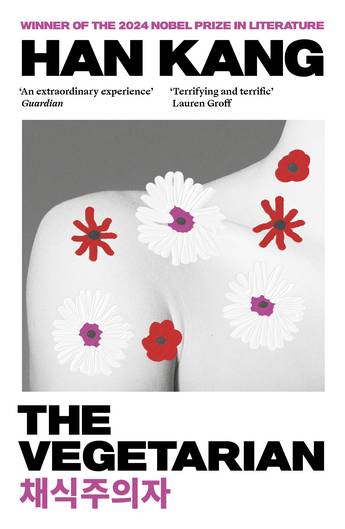
 The Vegetarian 채식주의자
by Han Kang
translated by Deborah Smith
ISBN: 9781846276033
Reviewed by JASMINE DARWIN
Does Eating Meat Make You Squirm? Try Going Without It. No, Really
Set in contemporary South-Korea, The Vegetarian, 채식주의자 written by Han Kang and translated by Deborah Smith, is a gripping novel that follows one woman’s slow descent into insanity as she struggles to come to terms with the threads of her own destiny. Split into three novelettes, in the first, The Vegetarian, we watch protagonist Yeong-hye through the eyes of her husband, Mr Cheong, an egotistical, self-serving salaryman who cannot help but gawk at her downfall through a self-pitying eye. At first, he may gain our sympathies: his diet is ruined, and his wife, who suddenly refuses to eat meat, will not cook the bountiful, blood-adorned meals he once upon feasted. ‘How on earth could she be so self-centred?’ he asks, looking down at his bowl of misty seaweed soup while dreaming of the ‘caramelised deep-fried belly pork’ (p.13) and the ‘wafer-thin slices of beef’ (p.15) his wife once fed him. But our sympathies are short-lived.
As Yeong-hye’s body shrivels, and her sanity slips into a state of clear and utter delirium, Mr Cheong fails to see his wife as a figure worthy of his empathy and instead turns himself into the victim of gross injustice.
I thought I could get by perfectly well just thinking of her [his wife] as a stranger, or no, a sister, or even a maid, someone who puts food on the table and keeps the house in good order. But it was no easy thing for a man in the prime of his life…to have his physical needs go unsatisfied for such a long period. So yes, on nights when I returned home late and somewhat inebriated after a meal with my colleagues, I would grab my wife and push her to the floor…She put up surprisingly strong resistance and, spitting out vulgar curses all the while, one time in three I would manage to successfully insert myself. Once that happened, she lay there in the dark staring up at the ceiling, her face blank, as though she were a ‘comfort woman’ dragged in against her will, and I was the Japanese soldier demanding her services.
(emphasis added, p.30)
Unable to see beyond his own desires, he discounts Yeong-hye’s protest as childish. But Mr Cheong is also not so oblivious. The clarifier is loaded with guilt: So yes, Mr Cheong knows his actions are reprehensible. He actively confesses to the raping of his wife. But his crime is absolved by a patriarchal logic of possession which he weaponizes as her husband to reframe his crime as retaliatory. That is, she failed to live up to the expectations of a wife, and by denying him unfiltered access to her body, he is justified to retaliate.
Riddled with sexual violence, bodily harm and immense physical and psychological suffering, The Vegetarian is an exploration of the violence and the deterioration of women’s bodies under the double-weight of capitalist and patriarchal pressures. In fact, the female body has a particular focus in this novel. When Yeong-hye begins to starve herself, Mr Cheong observes her transformation with a discerning eye. ‘At first she’d slimmed down to the clean, sharp lines of a dancer’s physique,’ he says, ‘and I’d hoped things might stop there…’ But when she doesn’t and continues to fall deathly underweight, he remains blithely ignorant to the dangers of her condition deciding instead that ‘this situation has nothing to do with me.’ (p.17-18)
His cowardice is something to be thankful for, and following their divorce, she seems to be happier and healthier. But it also leaves her open to other men who wish to exploit her. In the second novelette, Mongolian Mark, when her brother-in-law uses her body as a canvas for his own artistic endeavours, he describes her as a body from which ‘all desire had been eliminated.’ (p.80) And yet, this hardly stops him from taking advantage of her, and soon he enacts his own fantasies upon her figure. Yeong-hye attempts to wrestle back control, but her attempt to gain autonomy over her own body presents itself as delirium, which in turn, leads to an increasingly violent intervention as the people in her life struggle to “normalise” her.
Normality, then, becomes more of a question than a given, and the ways in which Yeong-hye’s body is exploited and penetrated by male authority figures doubles as a metaphor for the ways in which the novel grapples with madness. Like psychiatric patients, straight-jacketed and tranquilized, Yeong-hye’s body is manipulated by the men in her life to appear docile or “normal.” But with growing expectations pressed upon women to be a good wife—or maid, mother, cook, cleaner, sister, muse, sexual-gratifier and to be financially and independently successful, it is unsurprising that Yeong-hye goes completely mad. Who wouldn’t?
Yet, to me, Yeong-hye’s madness seems to be more-or-less deliberate. Yeong-hye’s delirium is no simple glitch of the mind. No malaise or malfunction. Rather, she deliberately descends into a cocoon of delirium to protect herself.
This I found incredibly interesting. As an object of desire, she intentionally disfigures her own body, turning herself into a skeletal-like creature to be shunned in a psychiatric ward and away from preying hands, as an act of self-defence. She makes herself deliberately undesirable—mentally and physically—to assert some form of control over herself. But the problem, we learn, is not with the body itself. It is the idea of her body, commodified and possessed by others, which prevents her from ever gaining the autonomy she desires; and—even as a shell of a human—when her cocoon is shattered, and control continues to be wrestled from her grasp, she pushes herself to the absolute extremes to regain her autonomy.
At this point I found the novel particularly difficult to read. The final novelette, Flaming Trees, is jarringly violent and Yeong-hye’s acts of self-harm become more and more sinister. Often, I was forced to put it down. But this struggle, I would argue, is much the point.
The harm Yeong-hye enacts upon her own body is hardly different to that inflicted upon her by the men in her life: her husband rapes her; her brother-in-law chokes and objectifies her; her father beats her blind; and the doctor subdues her body through injections, force-feeding and straightjackets. Yet, when this violence is self-inflicted, it seems all the more unnatural. Why is it, then, that when a woman commits harm against herself that we are only then forced to question it?
Han Kang neatly exposes the fallacy of this position. That when the men surrounding Yeong-hye commit violence against her, it is normalised by discourse. But the violence itself is unnatural, and the reactions provoked by Yeong-hye’s acts of self-harm only prove this. “Normality,” then, has a different twist to it, and the author plays witness to how blame and violence is used to maintain social norms—despite these norms proving to be harmful. Indeed, there are numerous occasions when the novel uses Yeong-hye’s delirium to reflect upon the label of insanity itself. When In-hye, Yeong-hye’s sister, comes to visit her at the psychiatric hospital and witnesses a woman shrieking obscenities in the foyer, she observes how ‘blasé’ she has become to seeing the ‘mentally ill,’ and ‘after all these visits to the hospital, sometimes it’s the tranquil streets filled with so-called ‘normal’ people that end up seeming strange.’ (p.142)
Such strangeness is not without its own complications. Yeong-hye is not a loveable character. She causes nothing but disruption for the lives of those around her. She is sullen, stubborn, and sometimes stand-offish, but the commitment with which she upholds her inconvenience—completing her hour-long headstands, refusing to eat meat, and to the dismay of her husband, sporting her bare chest in public—begs the question: why does she behave in such a way? And what has prompted such a rapid transformation?
Importantly, we never hear the answer from Yeong-hye herself, and as her resistance becomes more sinister and her silence more obsolete, we watch as the character who surround her are forced—through immense violence and psychological contortions—to self-reflect and to consider the answer to these questions themselves.
I will not spoil the conclusion. It is rather beautiful, if not dangerously, and perhaps a little too alluring. But I found it intriguing that the only figure who ever comes close to reaching Yeong-hye’s minds-eye is her sister. While the men in her life, namely, Mr Cheong and Yeong-hye’s brother-in-law, seldom question her behaviour, (Mr Cheong simply ignores her, and while her brother-in-law probes a little—‘Why is it you don’t eat meat?’(p.90)—he is distracted by ‘the sexual images [of her] that were running in his head,’) it is her sister, another woman, trapped in the chains of social expectation, who finally crosses that unspeakable bridge.
The Vegetarian is a haunting and disturbing read and, while it can often feel a little over-indulgent in it’s depiction of violence—teetering into trauma-porn—it is important, nonetheless; and its commentary on the ways in which women can be so casually treated like livestock prompts significant reflection upon the ways in which we treat others—human or otherwise. Not to be corny, but this novel is definitely something to chew on.
JASMINE DARWIN is a Sydney/Eora Based writer with a special interest in feminist writing, literary fiction and nature and ecology. She works as a bush regenerator and when not trampling through the bushland and swimming on the east coast, you’ll find her curled up with a book, a cuppa’ earl grey and a pen and paper.