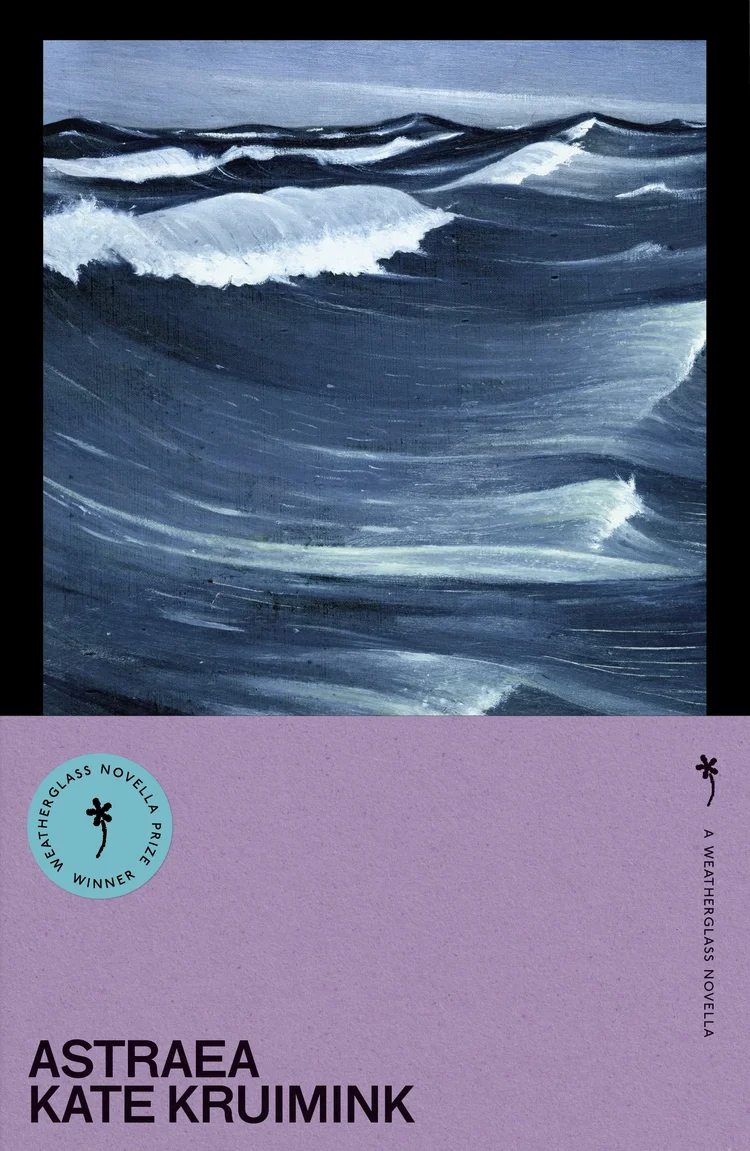
 Astraea
by Kate Kruimink
ISBN: 9781739570767
Reviewed by FERGUS EDWARDS
Astraea is set on board a ship transporting female convicts from England in the early 1800s. We do not see them depart, and we will not see them arrive: they will never be on solid ground. The crew is entirely male, the cargo entirely female, and we share the anxious bemusement of the fifteen-year-old convict Maryanne Maginn as she and her ‘maybe-friend Sarah Ward’ (p.9) negotiate existence inside ‘a series of confines between which she might move but not escape’ (p.44). The two of them join a group of women who might be prostitutes, madwomen, and witches aboard the fictional Astraea: named for an immortal virgin from Greek mythology, the near homophone is surely not accidental. The novella shows us individual and collective persistence in the face of barely constrained institutionalized and systemic violence, and Kate Kruimink ensures that it is the women, and not the violence, who are in the foreground.
The book establishes the truth of these voyages by printing a facsimile image of a ‘List of the Female Convicts on Board the Lady Penrhyn’ (p.2) from the National Library of Australia before its opening sentence. The list is just one of the thousands of surviving contemporary records that we have of transportation; yet from the driest bureaucratic files to the most emotionally charged diary entries, almost every source seems to have been written by a man. Even the pre-eminent study of transportation, Robert Hughes’s The Fatal Shore, which calculates that one in every seven transported convicts was female – ‘about twenty-four thousand’ (1) women in total – quotes from material sent to wives or about female convicts, but does not offer a single extended quotation from a transported woman in the twenty pages (of six-hundred and seven) that are devoted to them.
By contrast, the male voice—and gaze—is a rare, unwanted intrusion in Astraea. Here, women are the subjects of their own sentences, speaking for themselves and among themselves. Mary Christie, for example, can rely on the other women getting the joke when she declares herself to be either a witch, or a madwoman, or a criminal: they ‘had got the measure of each other […] almost immediately’ (p.10). Less conspicuously, the text resists the administrative division of the women into either specific individuals or undifferentiated groups, often attributing experiences to ‘her,’ ‘she,’ or ‘the girl,’ allowing a meaningful sense of a female collective to emerge.
Giving these women voices is one of the many ways in which Astraea can be read as an exploration of haunting. Haunting requires a past that insists on being present; but it also requires that the present is resisting the past. Colonial England attempted to forget these women by transporting them to the other side of the world; but we forget them a second time if we fail to notice the absence of their voices in the written record. That makes their re-apparition here very welcome.
Other hauntings are more complicated. The central character was christened ‘Marie Antoinette’, but, through a crude act of abbreviation by a lazy bureaucrat writing a list of convict names, she has been re-named ‘Maryanne’. Numbed after her newborn child was stripped from her at birth, she is determined to entertain only those thoughts that will help her survive transportation,
Maryanne welcomes the new name as an opportunity to obliterate her past self. She actively chooses to ‘scrape her mind clean like a farrier scraping a horse’s hoof’ (p.15) as she tries to create an untrammeled self; one that might be ‘fifteen in body, but truly, as a person, […] far younger even than that. She was quite new’ (p.18).
While she observes and occasionally engages with life on the ship, Maryanne is haunted by memories she does not want. Surrounded by water she cannot drink, she recalls ‘a poem about that, […] precisely that’ (p.14), though she does not ‘know it beyond a few words and a suspicion that it might speak to her’ (p.15). Those few words are, naturally, ‘water, water, everywhere,’ (p.15), from Coleridge’s ‘The Rime of the Ancyent Marinere,’ Coleridge’s poem of a sailor’s ‘thirsty and unlucky’ (p.15) survival at sea. Despite Maryanne’s reaffirmation that ‘memory was not her business’ (p.15), the words trigger memories of her mother ‘joyless and grey and with no heart for poetry’ (p.14). Maryanne’s attempt to reject a traumatic past and choose an untainted future has a clear emotional logic, but the lines from the poem recur twice more in the novella, again accompanied by unwanted memories ‘of the mother of the girl with the French name’ (p.32) as the memories will not be resisted. The use of the poem resonates further, suggesting that Maryanne may even be haunting her future self: Kruimink’s first, Vogel award-winning novel, A Treacherous Country, is set in van Diemen’s Land some years after Astraea, and it quotes both ‘The Rime of the Ancyent Marinere’ and ‘Kubla Khan’ as it follows a young man searching for ‘a woman called Maryanne Maginn’ (2).
On board the Astraea, Maryanne is committed to the solitary darkness of the coal hole as a punishment with not a dead albatross but ‘a thick glass bottle of water […] hung on a cord about her neck’ (p.57). Amidst desperate hallucinations of her lost child, she hears the cry of an actual newborn and her ‘breasts began to prickle with milk’ (p.65). Her body remembers her own baby and Maryanne is overwhelmed by the ‘ache of a particular absence’ (p.65). Later, barely aware of what she is doing, Maryanne acts as a wet-nurse, able to offer relief and sustenance and a degree of hope only because of her own loss. Kruimink’s spare, emotive writing presents these as human acts without comparing, measuring, or justifying them; the absence of a utilitarian calculus suggesting that each of our griefs is irreducibly private. In Maryanne’s case, it is only when she allows herself to fully acknowledge the suffering ‘she knew and had always known’ (p.65) that she can begin to live again.
One question raised by Astraea’s hauntings is whether we can, or, perhaps more properly, whether we should, try to forget experiences of trauma. Are we right to be frightened by the fate of the mariner, cursed never to forget his own dreadful story? In the case of the real-life women who were transported the answer seems obvious: effacing their lives means misunderstanding our own Australian history. Even if the story scares us, their lives are worthy of remembrance in and of themselves. We owe them each the belated recognition of their own particular human dignity. Memorialising them is necessary work, and Astraea aids it. In the case of the individual human being, especially a mother suffering the immeasurable pain of losing a child, the answer is far more difficult. Perhaps we cannot understand ourselves without acknowledging our deepest traumas. Perhaps our integrity, our dignity, our sense of self depends upon such an acknowledgement, however unutterably painful. Not the least of Kruimink’s achievements is creating a space in which we can consider such a confronting possibility.
Cited
- Robert Hughes, The Fatal Shore (Vintage, 2003), p. 244
- K. M. Kruimink, A Treacherous Country (Allen & Unwin, 2020), p. 14.
FERGUS EDWARDS is a Lecturer in English at the University of Tasmania. His research interests centre on the relationships between literature, performance, and philosophy, particularly the plays of Tom Stoppard and the philosophy of Ludwig Wittgenstein. Fergus’s next academic publication will be in Modern Drama, discussing Stoppard, Havel, and plays of censorship.