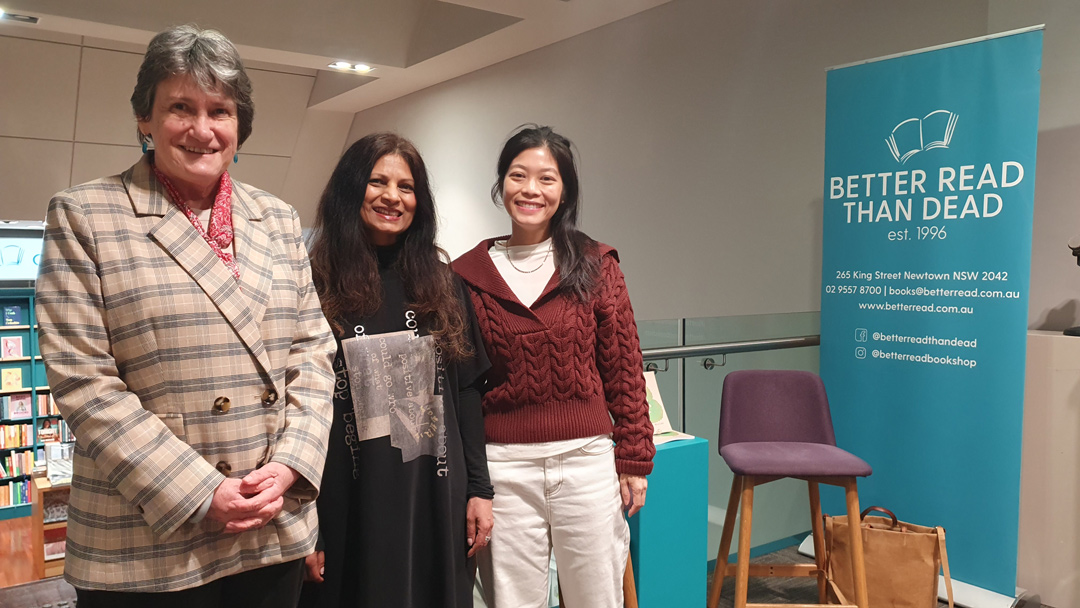
I would like to pay my respects to the traditional owners, the Gadigal people, their elders past present and emerging. I thank them for their laws, their languages and their cultures and acknowledge that sovereignty was never ceded.
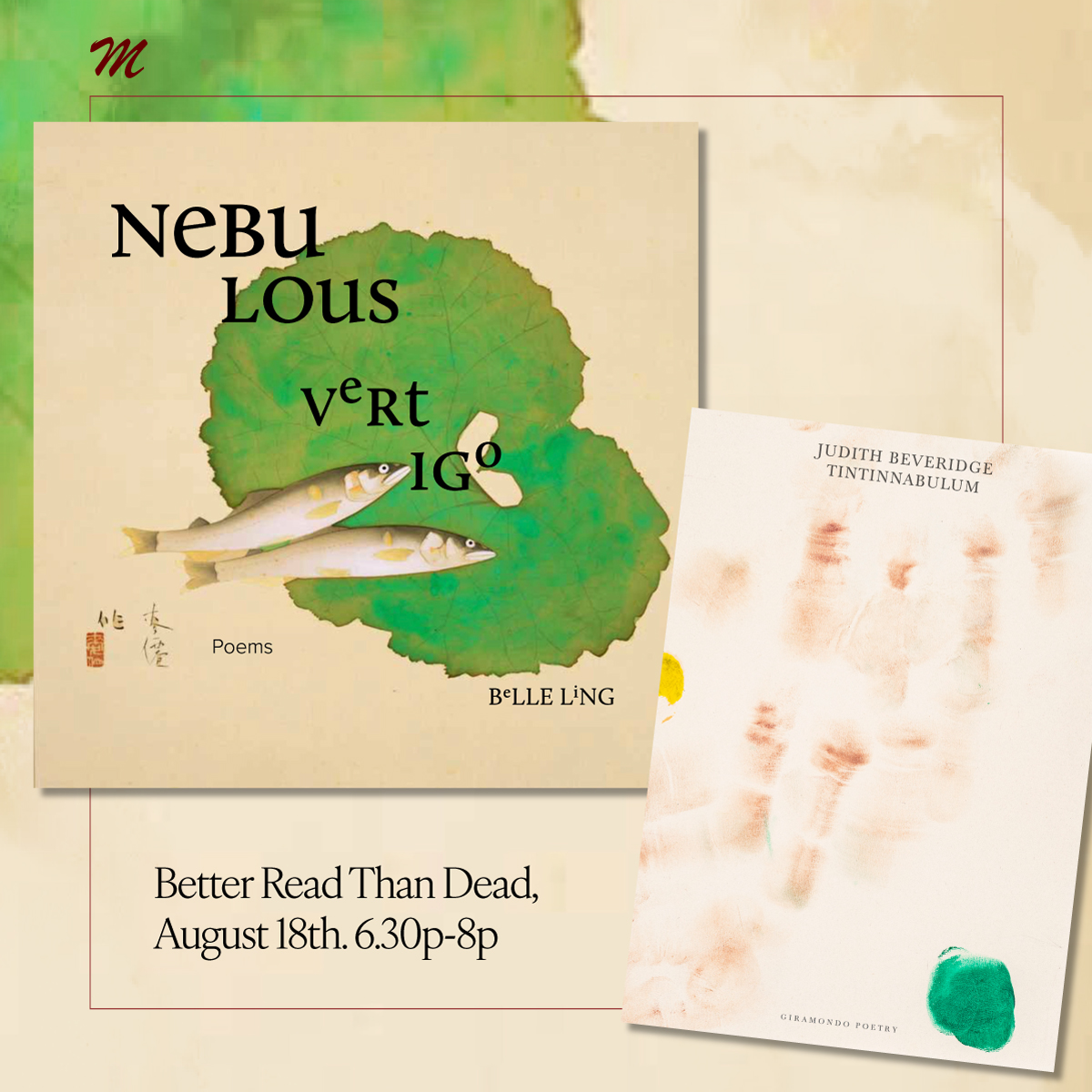
I would like to congratulate Belle on her debut full length collection, Nebulous Vertigo, and I would also like to thank her for entrusting me with this honour. A warm and glowing congratulations to Judy on being shortlisted in the Laurel prize for Tintinnabulum, an international prize for Nature poetry and for her listing in the ALS Gold Medal.
It’s truly a rare privilege to be introducing two gifted and highly esteemed poets whose work touches us with its technical craft and spiritual beauty. Belle Ling’s poetry inflects the complexities of culture, language, the displacement of diaspora, and most interestingly is a fusion of Western and Chinese philosophies through the subjects of food and eating rituals as well as relationships, between family members, community and between lovers. You will find in this book poems about ordinary things like miso soup, cod, tofu and beans. They delve into the nature of experience, fate and harmony. The auditory evocations are visceral; also delicate, layered, sometimes contrary, dialogic and polyphonic. In sharing these complexities and intensities, this flow of energy between subjects and objects, Ling’s poems circle mysteries, they become transcendent yet remain open and in living flux. Like the Tao, this is a poetry that emphasizes such virtues as effortless action, naturalness, simplicity.
Nebulous Vertigo engages both profoundly and deeply in a committed way with classical Chinese philosophy and undoubtedly there are comparisons with collections such as Sarah Howe’s Loop of Jade and Eileen Chong’s Burning Rice. Ling has studied poetry at the University of Sydney and University of Queensland, and her work manifests the influences of Murakami, Pablo Neruda and popular cultural references like Cantopop and Cha Chaan Teng. The collection is intertextual, with poems in conversation with Sharon Olds, Wang Wei, Neruda and Borges. However, through her remarkable shape-shifting syntax and polyphonies attuned to discovery of an inner reality, there is never a shadow here of a derivative poetics. What I loved most was Ling’s wholly unique voice, daring to take the risks of ‘nebulous vertigo’, both grounded in task and ambitious in reach. Her techne includes careful repetitions: ‘hurray, hurray,’ ‘squawks, squawks’; rhetorical elements and play:
what’s split
within me is a gastro-choke
where the shock’s burped, and the storm
girdling the drowned whose asymmetrical body
rowing, rowing—
In doing all this and being selected by Tupelo for its annual prize from a pool of international poets the book is a major achievement.
Judith Beveridge has mentored many CaLD poets over the years, including Belle Ling, Omar Sakr, Luke Fischer, Dimitra Harvey, Debbie Lim, Eileen Chong and myself, as well as many, many others. Her selfless support of emerging writers has helped our community enormously. Judith stands on the ground of a poetics that embraces allyship, mentorship and community.
In Tintinnabulum, Judith Beveridge’s seventh collection of poetry there is a re-engagement by the poet with the natural world’s acoustic dimensions, a celebration of nature as a part of our daily lives. The book is also a portal into surprising moments of beauty, the soundscapes are often baroque, technical and virtuosic.
Indeed, the soundscapes of both Belle’s and Judy’s poems are like Deleuzian folds where the baroque is not merely about ornamentation in representation but a replicating or a folding energy that stems from sensuous flows between subject and object, becoming an original and transcendent force.
Judy’s poetry has always been notable for its images and the originality of its similes, as well as a particular lexicographical flair. In Tintinnabulum this is evident again, in my reading in a new way where the lyric has been stretched and expanded into more narrative poems as well as poems that have adapted their engagement to new technologies.
One of the things that I love about this book is way it returns without the slightest fatigue to previous subjects that the natural world permits: the animals, insects, blowholes, estuaries, weather, bays and harbour parks with different tonalities, so that there’s much pleasure and latent surprise in this subtlety-changed persona, altering her perspective and insights with maturity and age. This flux is a shift that a reader who may be familiar with Beveridge’s earlier books, will discern.
I also want to say that I found comfort in reading these poems that celebrated poetry’s transcendent and everyday music at a time when there has been a lot of noise in the social and artistic spaces often heavily infused with polemic, with official or institutional or social media reportage, content, and propaganda. The timeliness of this context made these books very powerful for me since I have been myself questioning how we live through these times? What can be achieved for the better good through art?
What is silence, surveillance and censorship? How do we live with the truth of our lives as poets, as writers, as humans? These questions I ask myself remain unresolved as this poetry is, refusing to be cancelled, the poets insisting in gentle ways on what sustains us: the simplest of foods, beauty, compassion and on the journeys we take with our many tongues, our wits and our languages to find our way through all this.
I would like to thank Belle Ling and Judith Beveridge for sharing their poetry with us this evening, and for allowing us to celebrate the value of community and mentorship for our cohort.
Michelle Cahill
August 18th, 2025
Better Read than Dead