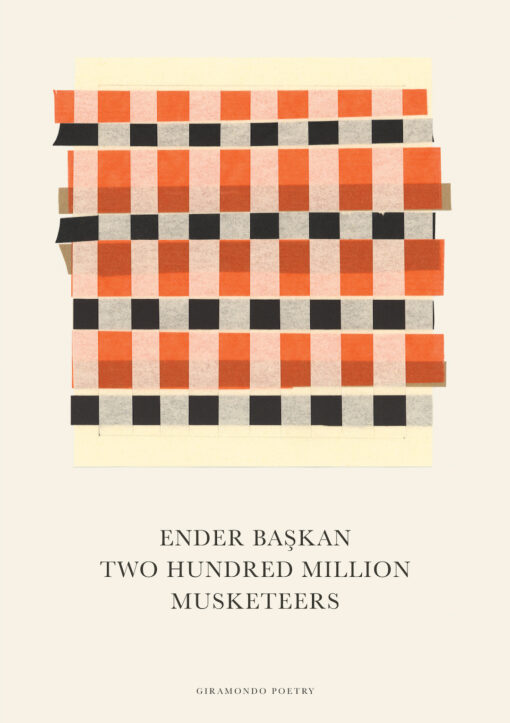
 Two Hundred Million Musketeers
Ender Başkan
ISBN 9781923106482
Reviewed by BRIAN OBIRI-ASARE
One of the distinct pleasures of reading poetry is when the fluidities of sense awaken the senses of meaning. When poems reach for this sweet spot, when language is so taut, so refined, it’s able to suggest – even trigger – unknown resonances, they demand to be unpacked.
This demand, really an insistence, finds its root in curiosity. It seeks to answer the question of how sense coheres into meaning. It draws from all the muck and mystery of existence, from our memories, obligations, dreams, from our interactions with others, from listening, talking, empathising and disagreeing. At the same time, it also draws from the human’s background and beyond, from all the aspects of being, the noise constantly in our ears, memory, politics, the ghostly, subliminal messages from our Instagram reels, movies, computer games, those nightmares, the seductively simple propaganda manufacturing our desires, those reminders that there’s more things in heaven and earth than can be dreamt of in our human, all too human, philosophies.
In Australia, where the majority of us have ancestral ties to an elsewhere, any investigation into how sense coheres into meaning is further complicated by the works of poets who, both consciously and subconsciously, draw from a mix of cultural and environmental stimulus. Culturally and linguistically diverse, such poets often come at things from a distance, with one foot inside, with one foot outside, occupying an in/out space. Often their work leans into the disorientation this positioning entails. It’s also possible to find new expressions of poetic originality within this invigorating terrain.
Ender Başkan’s Two Hundred Million Musketeers is one such example. In this his debut collection, he offers an extended intercourse with the muck and mystery of existence in poems that blend lyric and narrative modes with a raconteur’s aplomb. Everyday events, their sprawling interiority, their surreal particularity, are often the focus. The frequent use of the first person imparts a consistent partiality to the collection. And yet somehow, someway, sitting with the poems remains alluring, especially if you’re the type who hungers for the resonances of sense and meaning that only poetry can provide.
Opening with a banger, ‘Here Is The Shirt, (Get) Off My Back / Swimming In The Afternoon’ sets the tone for everything that follows. An outpouring of chat, like listening to one of your homies riffing, it starts in the flux of domesticity:
if you want an alarm clock to work
make sure you place it out of reach
but never mind
our mutual friends are awake and so are we
549am
i am dad
im on demand
raaaah-biiiish truuuuuuuck!
i run out to see the bin flung up and over
with you
why is the driver wearing sunglasses?
even if you miss the first truck
you get 2 more chances
sometimes a hot air balloon
milk! daddy can you make me a milk?
you fill the bottle/ start the kettle/ grind the coffee
rumi said you make your own oil as you cook
and as a cooker I say lets cook
(p.1)
The act of making a morning coffee with his daughter is the springboard for the narrator of this poem to leap into the maze of memory’s multifaceted directions. Cherished father daughter time is canvassed. Voices, particularly those of the narrator’s children, are channeled and re-routed into a polyphony of soundbites. There’s steez aplenty. An insistent class-consciousness lurks, hyper-aware and never afraid to announce itself. One gets to witness a mind weighed with awareness as it grapples and engages with the world:
now plunged into an abyss of middle-aged
left-wing melancholia to be recognised by prowling hyper-caffeinated
re-financed class-ascendant former schoolmates lucky my kid
is an anarcho-terrorist anti-capitalist critical-theorist
and disarms their line of enquiry with logic
calls them poo-poo heads…
(p.4)
History is also woven into the poem, making it buzz with the unsettled questions about country, myth, and dispossession that, to this day, still haunt Australia. For example, one discovers that
in 1828 the masters and servants act was passed in australia
aiming to quash the nascent workers movement / put people in their
place / reinforce the imposition of stolen land / free labour and
continuing genocide.
(p.12)
The poems that follow are similarly propulsive, always in motion, staunch in their defence of a way of being and belonging with and for others. They are rooted in family, domesticity, work, friends, history and bask in the mutability of the English language. Readers are introduced to the narrator’s dede, his anneanne, his babaannes, and glean insights into a migrant’s world. Reading Turkish encyclopedias and shopping at a no frills supermarket at Westfield are presented as part of the Australian everyday.
‘Hot Water’ provides a telling example of the mechanics of how these poems work and what choices Başkan makes. It begins at a kitchen counter somewhere in Australia. The narrator is with Sophie, his partner, who’s telling a story. At the wrong moment, the narrator picks up a cup of scalding water, and this act turns into a memory of visiting a friend in Istanbul. This in turn leads the narrator to think about Muhsin Kut, a painter who wanted to be an architect but finds himself propelled to the antipodes in 1969
and locals say to him
you have no choice
youll make as much money as your willingness
to do the dirtiest most tiring work and
so mushsin walks into a Balmain soap factory
and they say
youre a painter!?
(p.37)
Riding the leitmotif of water, the poem goes on to harness a ‘psychic luna park of associations’ (p 48). There’s an internal playfulness as the narrator zigzags from Melbourne to Turkey and back again, boisterously leaning into a type of dislocation very familiar to a child of migrants. Threads are followed, abandoned, and sometimes reemerge. At the poem’s end, a satisfying taste of completion lingers.
Ender Başkan contains multitudes. He’s a father, son, partner, poet, bookseller, and a novelist. He’s the winner of the 2021 Overland Judith Wright Prize and was mentored by the late Ania Walwicz. His poetry emerges from within a tradition of migrant poets writing in the English language who tease and exploit the variations and politics of sound and speech. It is from within this wake that Two Hundred Million Musketeers engages in its act of poiesis – the bringing forth of new wholes and syntheses. It is both an experiment and an invitation to adventure. It demands care and attention on the part of readers to make meaning. With its slant truths and occasional dazzlements, it is a uniquely Australian testament of this thing we call life.
BRIAN OBIRI-ASARE is a writer working across poetry, prose, and drama. He is a recipient of the Northern Territory Literary Award for Poetry and has been shortlisted for the Judith Wright Poetry Prize. His recent poems have appeared in Westerly, Cordite, Southword and other spaces.