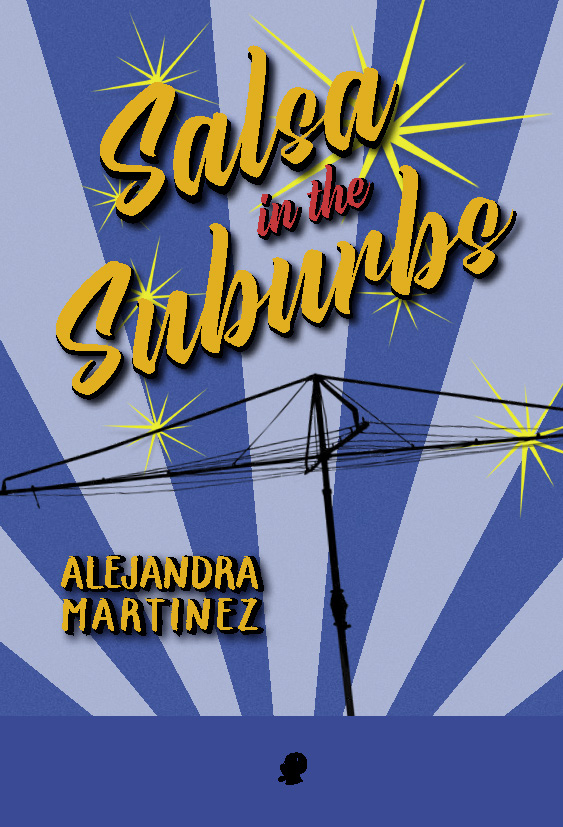
 Salsa in the Suburbs
by Alejandra Martinez
ISBN 9781923099630
Reviewed by ALISON STODDART
Immigration has always been a topic on the Australian socio-political agenda. A talking point that affects all members of our multicultural society and can be heard everywhere, from offices to cafes, gyms to hairdressers. There is no doubt that it is currently on the agenda again, brought to the foreground by Pauline Hanson’s divisive antics in parliament and the rise of anti-immigration rallies. One unfortunate aspect of this debate is the simplistic way it has come to be presented in the media. Going some way to revealing the cultural nuance that permeates every aspect of the immigration process, Salsa in the Suburbs is the story of Juan, a Uruguayan who brought his wife and three young daughters to Australia in the 1970’s to escape a military dictatorship.
The novel is set in the suburbs of Western Sydney, a setting that immediately places the theme of migration and multiculturalism at the centre of the story. And enticingly, the topic of an older generation entering the dating world sets up a storyline that is both tender and humorous.
Juan is a recently bereaved widower in his seventies, in mourning and relying on his daughters, who all reflect varying ties to their heritage. His middle daughter Lola is married to Leo, a fellow Uruguayan and together they have two boys. It is Lola who takes on the role of carer and protector of Juan and the one who clings most to her Uruguayan roots. A trained scientist who opts out to work in a supermarket, she struggles with mental illness and finds it hard to reconcile the life she has to the one she envisioned for herself.
Her older sister Betty, an ex-nurse, has turned her back on the burden of her family and has chosen to take her Australian husband and three Australian-born children to live an alternate life in Mullumbimby, making soaps and candles and experimenting with herbal medicine. She is living in alignment with her values, or so she thinks, but Betty has the conundrum of knowing that her heritage is running through her veins when she discovers that her grandmother too, was a healer.
The third daughter Malena is a thinly drawn character who has fled the Australia embraced by the rest of her family and lives in Italy with her Italian husband. Does she perhaps question her place in the land where her parents chose to settle, and is her fleeing to Italy a way of settling the dissonance in her mind of having to choose between her cultural heritage and her upbringing?
The novel is divided by chapters utilising the narrative technique of internal focalisation whereby a chapter is narrated by a single character. The chapters are prefaced by poetry (Juan), journal entries (Lola) and soap recipes (Betty). These become clues to each character’s state of mind and nicely segue into the actual narrative. We are privy to Lola’s scribbling in her diary, reflecting her increasingly erratic state of mine, and Betty’s distancing from the world around her by entering into the soothing world of soap and yoga. Betty eases the tension of attending the funeral of a beloved aunt by making Lemon Balm soap, but we only know this from the recipe at the start of the chapter.
Juan, the patriarch of the family, is a complex character. He knows all the words to Carlos Gardel songs, a composer, singer and prominent figure in the history of tango. It is unsure if Juan reveres Carlos Gardel because he was a fellow exile, with Gardel being born in France – but unable to return took on the nationality of Uruguay, or because he simply loved the music of Tango that Gardel composed and sang. Probably a mix of both.
Missing his beloved wife Carmen, he nevertheless cannot help comparing her unwillingness to assimilate into Australian society with his own embracing of life in Australia. Carmen never felt at home in Australia and always looked to the future when she and Juan could return to their ‘real’ home. Whereas Juan recognises the opportunities that Australia lays at his children’s feet and the fact that they would never ‘go home’ with him and Carmen. He muses upon this very aspect. “For Carmen the pull of her roots had been stronger than the pull of her children. Not for me, I wanted to be closer to my daughters” (page 105).
Juan is devoted to family but finds it hard to assimilate the changing role of men in society. He loves his three daughters but it’s his first-born grandchild, a boy, whom he dotes on. Juan has a streak of culturally inherited misogyny, and his respect is kept for the men in his family, his grandsons and his sons-in-law, particularly the blue-collar one. His son-in-law Chris who built his own house “brick by brick” is clearly admired over and above Malena’s husband, a university educated lawyer with multiple degrees. “He doesn’t need to fix anything”, contemplates Juan to himself when thinking about his daughter’s husbands. “He pays tradesmen to do it”.
It is Juan who retains the romance and innocence of his youth. Aging as he is, he never loses his belief in love and remains open to it in any form. Whether from his beloved labrador Coco or from an ad placed in the newspaper searching for a lady “to share conversations and outings with” (page 1).
Juan’s story takes a right hand turn when, without the help of the newspaper advertisement, he meets a widowed aboriginal woman at his local park when they are both walking their dogs. Their clashing of cultures is not much subtly highlighted but glaringly obvious with the woman’s attempt at understanding Juan’s pronunciation of his name. “Hooarn” she finally manages after mimicking his accent.
Ultimately though this is the most complex character in Salsa. Her name is Frances, and Juan is initially repelled by her, but comes to understand her and in turn, to love her. Upon first meeting Frances, Juan thinks she is crazy. “You are very rude, the woman tells me. I’m not rude, you are a stupid woman that cannot control her little dog” (page 57).
Martinez brings aspects of intersectionality to the novel through Frances and creates a relationship between her and Juan that is believable and deeply touching. Although their growing love affair puts a strain on the family as the family reassess all that they know about cultural belonging and generational change.
Given the deeply troubled history of political representation, national recognition, the contexts of incarceration rates and more, it is difficult to write an Indigenous character without inflicting settler-colonial assumptions. Martinez brushes lightly over her story. The novel could explore the immigrant and Indigenous persons’ relationship as a way forward, based on a deeper understanding of the violence of dispossession. If an author is going to bring up these themes in 2025, they must handle them in culturally safe and appropriate ways. Frances’ story of her mother being part of the stolen generation is simplistically touched on and feels like a mere gesture. Other references to Indigenous culture and activism, such as the Freedom Ride of 1965, are fleetingly mentioned. There is minimal engagement on the theme of Aboriginal dispossession. It does, therefore, feel like this character is tokenising the Aboriginal presence, the author using Frances’ heritage merely to explain the unity that springs up between her and Juan, both being from violent and unsettled nations.
Martinez writes in a straightforward way. She engages in a lot of dialogue which mostly feels authentic but every now and then the tone of her characters shift. There is a discrepancy between Juan’s inner monologue and his spoken word, which can be jarring.
The novel is ripe with rituals of food, traditions and family. Spanish words like the South American herbal coffee equivalent ‘mate’ and social gatherings, ‘asado’s’ pepper the narrative.
Salsa in the Suburbs is the story of a migrant journey on unceded and unsettled land. It explores the collective confusion that the children of these migrants feel as they straddle two cultures. It is an exploration of immigration and all its inherent obstacles encountered by migrant people, including the internalised racism that simmers beneath benign white Australian of the 1970’s.
An overarching theme of the novel raises the questions of where does a person feel most at home? Is it in their culture or in their geographical location? Where does one get a sense of place? It is also a story that explores the experience of exile and migration across time with the interesting alternative perspective from another culture, one that is over 60,000 years old and displaced in its own land. It covers a myriad of themes that include mental health, ageing and identity.
Martinez is a Blue Mountains, New South Wales based writer who migrated to Australia at the age of seven to escape political turmoil in Uruguay. She was the winner of the 2022 Newcastle Writers Festival Fresh Ink Emerging Writer Prize, which went on to be developed into this novel. She has produced a sweetly told story of a migrant family, ultimately an Australian family and what that entails. It is an engaging example of inclusive fiction with diverse character representations.
ALISON STODART is a country born and bred, Sydney writer who holds a Master’s degree at Macquarie University in Creative Writing. X @a_hatz5