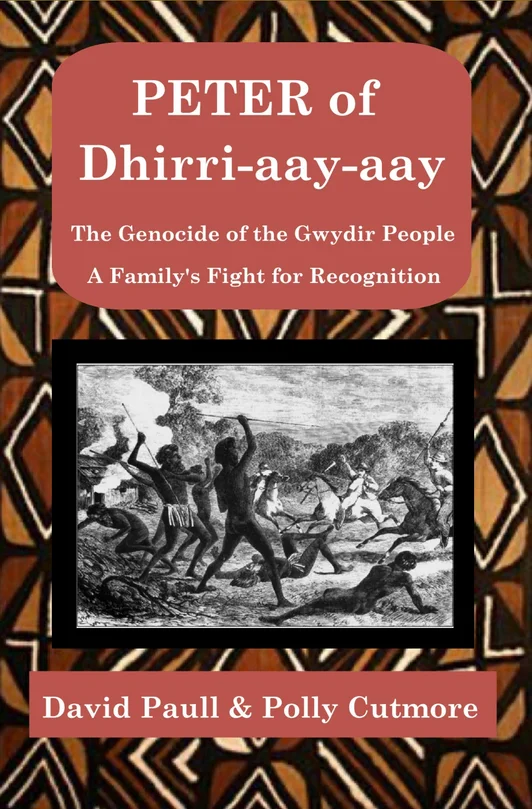
 Peter of Dhirri-aay-aay
by Polly Cutmore and David Paull
Reviewed by Terry Widders
Peter of Dhirri-aay-aay by Polly Cutmore and David Paull, presents a broad history of the (Indigenous) Gamilraay people, pre-colonial to the present, of a region in north-west NSW (cf. general map on p.55). While the account has an often fulsome mix of oral and documentary sources, it’s in order that ‘the words of those who witnessed the events (…) provide the reader with insight into the people who made that history’ (p.5). In my reading, its purpose is to be a history of ‘truth telling (in order to) promote recognition and acceptance of past wrongs (and) not to point blame for the past’ (p.147).
The book’s contents contain a foreword, which presents a forthright “summary” of the book, nine (9) chapters, an epilogue, four appendices and end notes combining source references and a bibliography. In this review, I group the book’s nine chapters into two themes, and provide commentary. Firstly is the theme of Country, Contact and Colonisation (chps. 1-6) for which the general map (p.55) is quite a useful, complementary reference.
In exploring Country, Peter of Dhirri-aay-aay (Chp. 1) describes an ancestral homeland of the Gamilraay nation, its pre-contact geography, economy, social and language structures, as well as material culture (e.g; tools) and archaeological sites. This was home to a large, mature ‘traditional’ society of some 5,000 people, circa 1830.
An ‘historical thread’, Peter (Cutmore 1) is linked to Dhirri-aay-aay, the ‘traditional’ place, and later ‘woven’ into a more complete, historical person through the book’s second theme. A photograph of “old” Peter can be found on p.7.
Notable aspects of the invasion and contact history of Country are the Bigge Report: 1822-’23, War, Gold Rushes and Land Reforms. The Bigge Report, a British parliamentary ‘initiative’, recommended the replacement of the penal colony of NSW by a ‘free’ colony of pastoral landholders and workers. This unleashed a widespread ‘land grab’ after 1823, particularly on the western side of the dividing range, by existing, and potential, landholding interests. The other aspect, that of a ‘free’ colony, was left for later, historical clarification.
Contact history (War) is recorded in chapters. 2-4, and Colonisation in chps. 5,6. This well-documented time span of twenty 20 years (1831 – 1851) begins with early, “benign” (British) contact (a couple of explorers and the odd escaped convict) then a sudden, invasive rush of stockmen (on horses) with guns, sheep and cattle. An armed Gamilraay response ensued, followed by the 1838 massacres (of different, large Gamilraay groups). Intermittent, often sustained, Gamilraay “guerilla warfare” continued up to 1845, then ended.
War: “War” could only officially exist between two, or more, ‘sovereign’ entities. The Crown (colony) considered itself one, and the “natives” (Gamilraay) as subject to the laws of the Crown. ‘Ipso facto’, no war. If the ‘natives’ were ‘sovereign’, a different ‘war’ and ‘post-war’ relationship would exist.
Throughout the so-called ‘armed non-warfare’ period (c 1835 – 1845) official, colonial governance “concerns” were publicly expressed through letter writing and official documentation of “illegal actions”, as were religious/humanitarian protest (e.g; calls for “cease and desist” and/or “protectionist intercession”).
Peter, now a teenager, is presumed to have been among the survivors. He ‘pops up’ as a verifiable, historical adult later in the book. However, two realities became established on this part of the ‘colonial frontier’ by the 1850’s. The ‘pastoral dispossession’ of Gamilraay land became officially authorised: ‘land grabs’ were measured – as acreage – certified and taxed, while the surviving Gamilraay, ‘guess-timated’ at 1,000 or so persons, were officially recognised as being in need of protection!
From 1851 two major goldfields in Victoria, in Ballarat and Bendigo and, by 1867, several ‘secondary’ ones along the eastern side of NSW to Gympie, Queensland had attracted ‘tens of 1,000’s’ of (mainly) men into S-E Australia; an ‘immigration tsunami’! This initially created ‘consumer bases’ on the goldfields then, after the ‘rush(es)’, they merged with town/city populations to create and/or expand their ‘consumer bases’. ‘Urban’ based colonies began developing, though their ‘free’ nature was yet to develop.
‘Mini’, internal migrations of mainly men to these goldfields also happened, drawing labour away from existing pastoral and other workplaces. Consequently, it seems that from the 1850’s a particular trend appeared; Gamilraay labour – female and male – was becoming central to the now established pastoral stations, as paid and/or ‘paid in kind’ workers! Peter, who was now in his late 30’s was a valued general station worker, with particular skills as a ‘boundary rider’.
A second emerging theme which the authors explore in chapters 7 to 9 of Peter of Dhirr-aay-aay concerns ‘re-creation.’
The Gamilraay had barely begun adapting to their “worker niche” in the pastoral industry when three further “winds of change” – Land Reform II, (Aboriginal) Protection Policy and an act of Gamilraay “Self Determination” – propelled them to their current “historical position” of occupying a significant “citizen/worker” niche in the Moree township.
Land Reforms took place from 1861, with further reforms from 1884 – 1901, following the “land grab” phase as the NSW government responded to a rapidly growing need for agricultural produce such as grains, fruit and vegetables, and, an equally growing demand for a piece of the “land pie.” These involved land grants being made, from 40 acres to a maximum of 320 acres, on remaining “crown land” and/or land resumed from existing pastoral “grabs”. These grants had specific ownership conditions, such as fencing.
The three reform phases (1861, 1884 and 1901) were intended to expand the different acreage ‘selections’ proportionately across the east, central and western regions of the NSW colony, particularly so for families. The consequence for the Gamilraay (and other indigenous groupings) was that there became fewer ‘worker niches’ in the pastoral/agricultural industries.
Peter took on the surname of ‘Cutmore’, the same as that of a valued employer.
Aboriginal Protection Policy: 1880 – 1885 (and beyond)
By 1880 remaining Gamilraay “living places” (small, protected Crown land lots), the people and their living conditions became a ‘matter of concern’ for a small group of pastoralists, the ‘Association for the Protection of Aborigines’. The (colonial) state assumed this ‘concern’ in 1883 with the appointment of an official ‘Protector’, then an official, appointed Board in 1885, to create an ‘Aboriginal Protection Board’ (APB). The Gamilraay “living places” came under formal APB control in 1892.
With place (‘reserve’) and people now their official legal responsibility, the APB then ‘re-classified’ Gamilraay ‘native’ as ‘Aborigine/al’, with further ‘visual, sub-categories’; e.g; ‘full blood, half caste’ down to ‘octoroon’. [‘European’ remained a ‘natural’, fixed category].
Then, in 1915, the APB gave itself a key, discretionary, ‘social engineering’ power over ‘Aboriginal’ children: ‘in loco parentis’ [Latin: in place of parent(s)]. The APB could decide ‘why’ an [Aboriginal] child’s/children’s (home) living circumstances were ‘not appropriate’, remove ‘her/him/they’ and place one or more in an APB determined, ‘more appropriate’ setting. And they did. Thus became the ‘Removed Generation’! Now in his late 40’s Peter marries Kate Harrison (from Glen Innes) in 1887.
Gamilraay Self-Determination: 1917 – Present
Due to their rejection of the APB’s ‘in loco parentis’ power, and its increasing use by that body, Peter Cutmore 1 and wife Kate Harrison decided to make the ‘pioneering move’ with their grandchildren from their post-colonisation ‘base’ at Dhirri-aay-aay to what became the Top Camp’ on the fringe of Moree township, and made that their ‘new, independent home’. Their adult family members joined them soon after. The year was 1917.
Other Gamilraay families and individuals followed later (1920’s), some joining Kate and Peter at the ‘Top Camp’ or forming other ‘communities’ at other locations around the fringes of Moree. All were on ‘their’ land – neither APB reserve, pastoral nor crown/local government. ‘Independent’ From such beginnings, described as ‘bases’, there continued the literal re-creation of families, and the ongoing re-creation of ‘new’ social/cultural identities.
Here, a general map would have been useful in illustrating this process, noting physical features such as ‘camp sites’, over time, vis-à-vis Moree township, the Mehi river, other waterways, roads, and a compass. Of historical note to the family, Peter Cutmore 1 died in 1927 (exact age unknown).
The two historical ‘trajectories’ of Gamilraay and Moree merged from 1917. Both ‘pasts’ continuing to live in the same ‘present’, their respective families now seventh generational, and counting. Peter of Dhirri-aay-aay implicitly poses the question: who, and how to make ‘our’ common future?
Polly Cutmore writes that the book celebrates the survival of her great great grandfather and his descendants through decades of colonisation and genocide. It includes previously unpublished accounts of the early massacre period from the Gwydir River region of NSW.