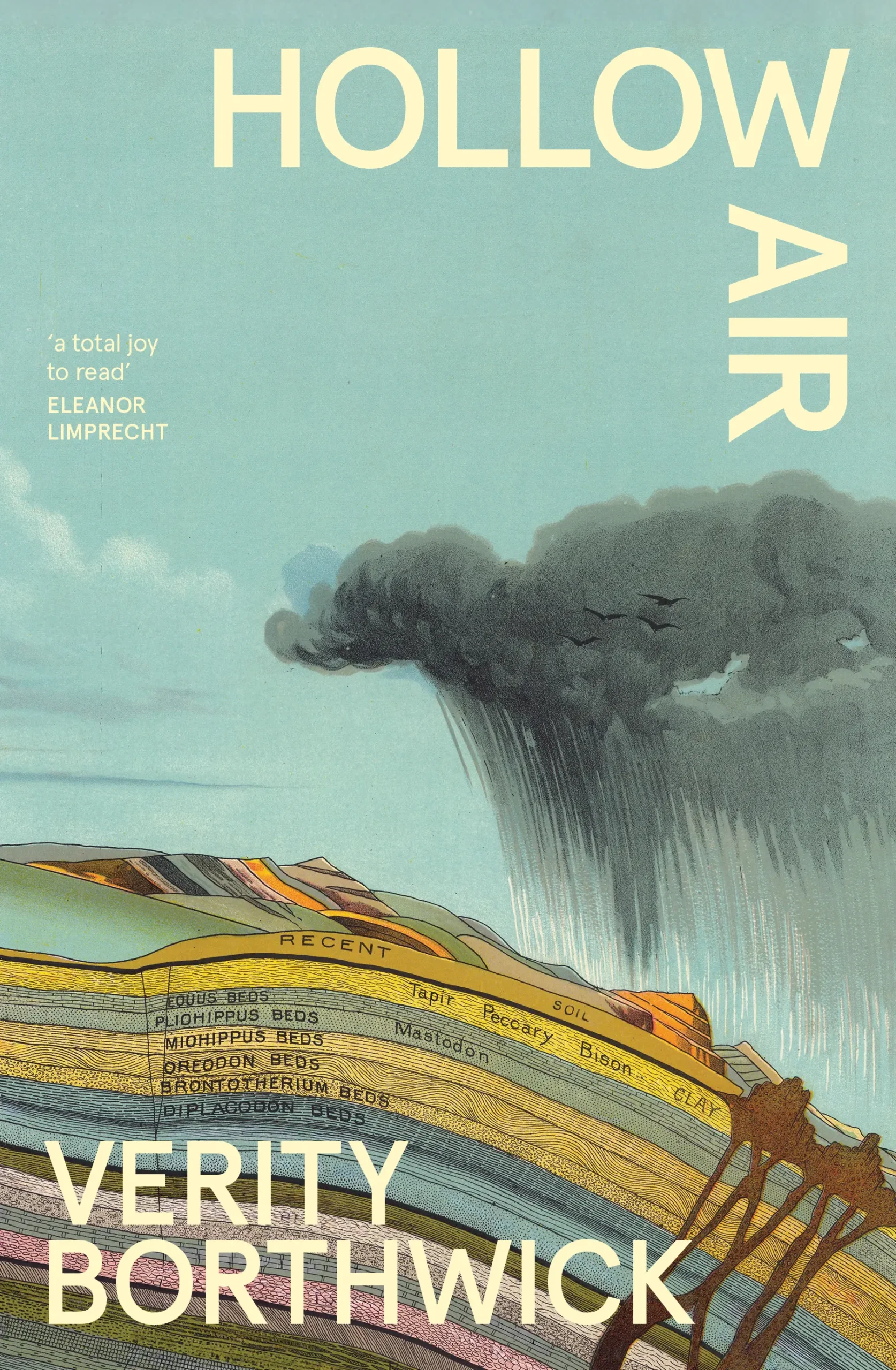
 Hollow Air
by Verity Borthwick
ISBN 9781761154195
Reviewed by LUCY CHRISTOPHER
When I finished Hollow Air by Verity Borthwick and turned off my tiny reading light, it was suddenly tar-dark and death-quiet. Borthwick’s book had swallowed me; I was still stuck deep underground, navigating dusty tunnels, feeling my hand across sharp rock to get out and away. My heart was racing. I breathed deeper and listened to the room’s blackness in the hot late-summer night. Soon, I distinguished their breathing: my husband deep and steady, my daughter lighter and with a musical hum; both very much here, both real. I tried to ascend from the story that had gripped me by the throat until I discovered its end. My skin prickled with sweat, and there was grit stuck to my back and dust caught in the corners of my eyes.
This is how Hollow Air stayed in my body. For days afterward, my mind returned to the twisting underworld of the abandoned mining tunnels in the novel’s final, nightmarish scenes. Over and again, I imagined being trapped in the tunnels, contorting my body through ever-smaller gaps, scaling spider-like up crumbling walls with yawning chasms below. Unlike Sarah, the protagonist who eventually does discover a way through this erebus, I imagined being trapped forever underground, unable to ever see again, relying on touch and smell to find the possibility of an exit. I felt dirty and dusty and ill at ease, with a powerful desire to never visit the abandoned mines of far north Queensland, where the novel is set.
Notwithstanding my strongly visceral reaction, Hollow Air is a curious novel to describe. Various reviews have labelled Borthwick’s debut as a psychological thriller, a piece of rural gothic, or a modern Australian ghost story. Roslyn Jolly, in the Sydney Review of Books describes it as “…the latest addition.. [in the]…flourishing” canon of texts that is the “Australian mining novel.” In truth, it is all these things and yet, it is none of them deeply.
Set mostly in and around a mine in monsoonal, sweltering Queensland, the novel shifts between two timelines: an historical narrative from 1910 about the descent and ultimate death of Samuel and Tom in the Ada Dulcie mine, and the current-day story of Sarah, a geologist stationed alone at the same mine site, tasked with an unenviable job of trying to discover rock valuable enough to reopen it. Sarah’s isolation is shattered when a new team, including the sultry geologist Cole, arrives to start drilling, forcing her to re-navigate and position her body in an all-male environment. Though Sarah’s story is given the most weight, and page time, the back story of Samuel and Tom’s deaths intrudes and infiltrates everywhere, pressuring Sarah’s story with constant threat of ghostly presences and the sense that the past, and the deceit and tragedies that occurred there, will always erode the present.
Hollow Air is no doubt a novel preoccupied with the body. Borthwick’s writing is deeply sensory and atmospheric, her landscape never a passive setting but a seductive and fierce character and body in its own right. Throughout reading, I was tense, uncomfortable, looking over my shoulder for predatory creatures or questionable Australian men. There are many physical jumps and bodily prickles throughout the book – the near miss of a snake bite, the constant feeling of being watched, and many times where Sarah is surprised by a sudden arrival of a human, animal or something dead.
Borthwick cleverly brings the body, and its physicality, into this book in other ways too. Throughout, Borthwick describes the arid land as, and in parallel with, a human body:
“She could never get over the feeling of being the first human to lay eyes on this rock sliced out of the ground – was this how the early anatomists had felt when they cut into the body and saw the sinews tangled there? …. Like a doctor listening to a heartbeat with a stethoscope, you could feel the edges of the organ and wonder at its function, place your palm above it and feel the muscle pulse beneath your fingertips….” (97)
Borthwick also draws parallels between the land and Sarah herself, often suggesting the land is embodied, marked, and vulnerable in ways that mirror her own physical and psychological state: “…like the ground left behind when the ore was removed, she too was riddled with holes.” (49) At times, it even seems that the mine and Sarah’s body become entirely one being: “… she felt she had become part of the mine, that it now flowed in her veins and pooled in her gut.” (287-288)
The threat of danger – both to the land and to Sarah, the novel’s two central “bodies” – is ever-present, as is the potential for exploitation and abuse. Sarah, like the mined land she inhabits, has been shaped and damaged by her interactions with men, and both she and the land must ultimately have their cores cut open and their insides examined to uncover meaning in their own stories. Additionally, both Sarah and the land inflict their own suffering to the men who interact with them. Sarah misses her own engagement party to sleep with fellow geologist Cole, and the land traps and injures men who dare to transgress it. In this way, perhaps Borthwick’s novel seeks to examine how deeply our lives are entangled with the patriarchal and colonial mining industry we hold an uneasy relationship with; an industry that exploits and harms, leaving behind scars that are difficult to heal, yet one we remain dependent on for survival and prosperity in modern, settler Australia.
Throughout, Borthwick’s knowledge of her subject matter is assured and a significant strength of the novel. After reading, I felt not only dusty but as if I’d learnt something about how geologists assess a mining landscape in terms of its value as well as a deeper understanding of a mine’s sedimentary beauty. I also appreciated Borthwick’s female FIFO protagonist, whose capability is consistently evident; as physically and mentally strong as any other mining character ever written. However, while Sarah is no doubt a fascinating character, I did not find her particularly appealing or one always easy to understand. I struggled to grasp what Sarah saw in her fiancé Scott, or why she hadn’t ended the engagement earlier. We’re given little sense of what attracted Sarah and Scott together in the first place, or whether she was always so closed-off towards him. Cole, too, the book’s mysterious and threatening love interest, is not given much character depth. What is he beyond a beautiful body and bundle of secrets? What might he have brought to the story apart from threat and desire? Although, Borthwick’s landscape is layered with remarkable depth and texture, it seems the characters are, at times, afforded less of that same complexity.
Overall, Hollow Air is a significant and vivid Australian novel, one that places women in a role rarely seen in fiction and interrogates Australia’s relationship with its mining industry from the inside out. It’s exploration of the cost of concealing our ‘dirty little secrets’, whether they be personal or public, feels fresh and interesting. Ultimately, though, it is Borthwick’s ability to embed the sensory details of this world inside the bodies of her readers that make this novel linger long and uncomfortably. I am fascinated to see what she writes next.
Cited
Jolly, Roslyn. ‘Critical/Mineral’. Sydney Review of Books, 01 December 2025. https://sydneyreviewofbooks.com/reviews/criticalmineral
LUCY CHRISTOPHER is an award-winning author for young adults, children, and adults, with wide readership. Release, her recent psychological thriller for adults, was shortlisted for a Davitt Award and is currently in development for a TV series. She has worked as an academic in Creative Writing for twenty years, beginning her career at Bath Spa University, where she was a Reader in Creative Writing and Course Director on the world-renowned MA in Writing for Young People. She now works as Senior Lecturer in Creative Writing at the University of Tasmania, while juggling her best creative output yet: her daughter.