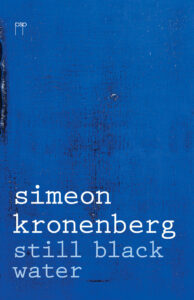
 still back water
by Simeon Kronenberg,
ISBN 978-1-922776-22-8
Reviewed by PAUL SCULLY
Laura (Riding) Jackson and Robert Graves counsel, in A Survey of Modernist Poetry, that a poem is an entity in itself and should be read as such. (1) So, too, a collection, presumably. While these counsels undoubtedly ring true for one level of reading, it is necessary to offend against them to take account of an oeuvre or to detect changes in style or central concerns. Simeon Kronenberg’s still black water, his second collections of pearlescent poetry, can be read satisfyingly in the first way and differentially in the second as an extension or revision of his first collection, distance, given their overlapping themes (2). Perhaps eroticism is the only fascination that does not transition as strongly to the new collection, though love is all pervasive. In a sense Kronenberg has eschewed breadth for depth. I will write here solely of still black water.
Section 1 of the collection, ‘Eclipse’, written mostly in couplets and triplets, has the feel of journeys revisited, of place as exemplified in the poems ‘Darlinghurst, 11pm Friday 27 March 2020’ and ‘Castlemaine, March 2023’, and of lives, the friends he memorialises (‘Diagnosis’, ‘Passing’, ‘Funeral’) and his own, with rural concerns replacing his citified adult past and hints that this frames a return to origins, although this be over-reading the persona in ‘Regulator, For “Benjamin Dodds’–“I too wish to return/ to my country// of rained on hills/ under cumulus skies”. Death is ever present–“I think about death/ most days now” (‘Most days’)–suggesting its cold hand has brushed the poet’s own shoulder through a medical crisis or something equivalent. There is both sadness and affection in remembering his friends:
| There you are | She wore pink floral |
| caught | that swirled around her legs |
| as your life | |
| dissolves | as she swayed and slid |
| to the music” | |
| into not more – | – ‘Passing, i.m. Pat Anderson’ |
| of sherbet | |
| on the tongue |
|
| – ‘Diagnosis, i.m. Helen Johns’ |
|
| (p.16) |
The poems in this section are reflective, indeed wistful, and evocative, with the pithiness and resort to nature that typify the historic Chinese and Japanese poets Kronenberg obviously takes delight in – “I think about the wind in trees// as the old Chinese poet did/ a thousand years ago// in the rambler’s hut/ as he listened to the pine trees” (‘Wind, For Debbie Bird Rose’ ).
Kronenberg has eyes for family through the ‘Window’ of Section 2, a natural concomitant of mood, where forms are more expansive among the now expected short lines, couplets and triplets. He sees his father’s face in the mirror in the eponymous poem and recalls him fondly tending the hearth in ‘Ash’ and with rage in ‘Still’, although these latter memories amount to “nothing”. The affection for his mother is unequivocal, though, in ‘Fog’, he concedes perhaps a child’s ignorance of the whole person as he peers into a starlit night:
What do I know
of my mother?
A migratory light
in the dark
and a deep fog
that came after–
and like a too heavy
quilt it remained.
(p.32)
She features in five poems and her suffering, from depression or melancholia perhaps, and relatively early death hang over the poet, “finally spent, like a moth/ banged on to windscreen glass” (‘Haze’). Kronenberg stretches beyond his parents to his grandparents to their homelands and larger ancestry. His siblings are collectivised into “us” and “the children’ and these memories bring back the thought of his own death, “Someone told me/ he was surprised/ I was still alive // …//…-and know/ really know/ I’m coming up to death” (’Might as well name it’). There is a certain sadness ladling through these reminiscences but it does not tip over into maudlinism or a bewailing self.
The shortest section, ‘Self’, follows and it is almost exclusively set in Bali, a spiritual and artistic sanctuary for the poet, perhaps occasioned by its exoticism and reinforced by having met his partner there. Both inhabit ‘Music’ and ‘Sanur, Bali. April 2022’:
| I think you about you | … I taxied to Sanur where you waited |
| and Pantai Saba | perched inside the fragrance of |
| frangipani | |
| and foam on the reef | |
| as coconut palms shed frond | elegant in a white Javanese shirt, severe and still |
| like discarded shields | like an egret in the shallows. |
| (p.53) |
Death intervenes even here (“the sudden apprehension/ of my death”, ‘Music’), but the context suggests more a revenant than a presiding spirit. The other incursion is the need and will to write and they inform the “promise” he makes in ’It’s not as if’ “to inhabit my life,/ to understand//the yawn/and ache of it.”
Kronenberg loves the arts and the final section, ‘Tracks’, acknowledges and indulges his inspirations. This is the longest section in the collection and the arts seem as much home for him as place. Poets and writers predominate, in harmony with “I’ve never wanted more/ than to write” in ‘It’s not as if’ in the previous section. Despite this he can treat books roughly–“I first break/ their spines–// … By breaking backs/ I release them–// and me” ( ‘Books’). He uses Charles Simic to underline the attempted reconciliations of the previous sections–“I’m more at ease/ with the past/ than I’ve been// as I write/ it’s up ahead/ in clear sight” (‘Past, After Charles Simic’)–and Dick Davis to acknowledge “that awful fact/ means I’m inclined to dwell/ on the bad unfinished business// of my mother’s death/ … // … And still, I write her into poems” (‘Coda, After Dick Davis’). Simic features three times. Adam Zagajewski, Ted Hughes and Anthony Lawrence twice. The poems riffed from Allen Ginsberg, Constantine Cavafy and Bruce Gardiner point to a gay heritage that Kronenberg prizes.
While still black water is infused with reflections on mortality, it is not, as noted earlier, weighed down by them; it is, in fact, buoyed by them. The arts and love elevate life and Kronenberg is an enthusiastic participant in both and his collection fulfils its final lines, “this (perhaps not always) invented life/ in poetry where the mystery/ is all that’s revealed”.
Notes
1. Robert Graves and Laura Riding, A Survey of Modernist Poetry (1927; reprint, Folcroft, PA: Folcroft Library Editions, 1971). This counsel partly inspired the so-called close reading of a poem associated with the “New Criticism” movement of William Empson et al.
2. Simeon Kronenberg, still black water (Sydney: Pitt Street Poetry, 2026); Simeon Kronenberg, distance (Sydney: Pitt Street Poetry, 2018).
PAUL SCULLY is a Sydney-based poet with four published collections, the latest being The Literary Detective and Other Crimes published by Bonfire Press in 2025. He holds a Doctor of Arts from Sydney University. His work has been commended and shortlisted in major Australian poetry prizes and published in print and online journals in Australia, Ireland, the UK and USA. His website is http://paulscullypoet.com.au/.