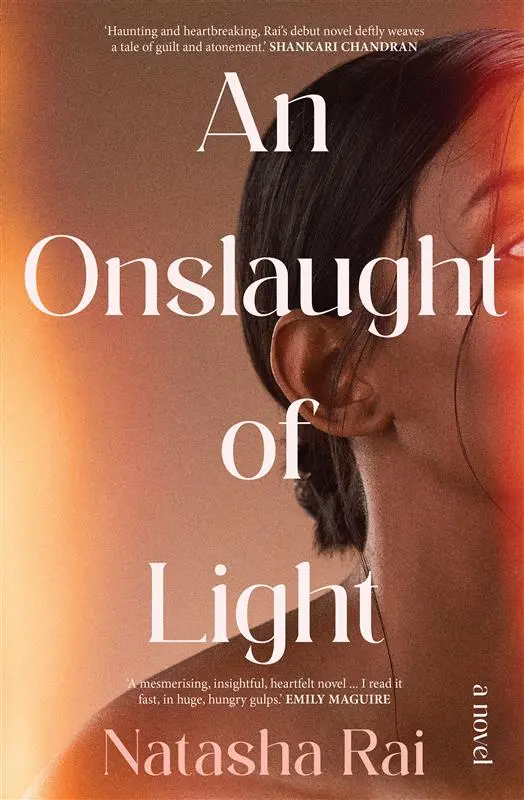
 An Onslaught of Light
Natasha Rai
Pantera Press
ISBN 9780648619093
Reviewed by NINA CULLEY
Natasha Rai’s debut novel An Onslaught of Light opens with Archana, or “Arch” as she is known, stepping onto Sydney’s tarmac, breathing in the damp heat. It’s immediately clear that avoidance is her go-to: she declines a call from her brother, Sunny, pushes away a thought of her Amma, and flees almost immediately to the mountains. She’s running from something, though Rai doesn’t name it outright. Much of the novel is shaped by this sense of distance – not only Arch’s, but her family’s collective inclination to shut out hard truths. As Rai makes clear, however, unresolved trauma rarely stays buried. It seeps, quietly and indomitably, into the present.
Rai’s story unfolds through alternating perspectives – Arch in the present, and her parents, Indu and Vijay, in the past – moving between post-COVID Australia and earlier decades beginning in India in the early 1970s. When we first encounter Arch, now in her late thirties or early forties, she’s living the life of a recluse. Despite her best efforts to remain removed, she is drawn back into her family orbit through Sunny, the youngest child and the family’s gentle mediator. Where Arch is volatile and textbook avoidant – time and again choosing to “push [her emotions] deep inside her, down into the swamp with all the other miseries buried in the depths of her core” (p.269) – Sunny is steady, less burdened by trauma.
The novel then moves backward, first to Indu and Vijay as newlyweds in India, and later to the family’s migration to Australia in the 1980s and 90s, where Rai situates their struggles within a distinctly hostile cultural moment. For migrant families, this was a period of immigration panic, heightened pressure to assimilate, both casual and overt racism, coinciding with the rise of Pauline Hanson’s One Nation party and a broader absence of institutional language or cultural literacy. Emotional suffering definitely existed, but it was rarely articulated; instead, silence, distraction, and endurance were mistaken for resilience.
It’s unsurprising, then, that the family finds the adjustment disorientating. Arch is bullied at school; Indu, grieving her mother and newly estranged from her father, is lonely and unmoored; and Vijay, once a successful architect in India, is forced to start over, working in a laundromat while proudly clinging to his culture through the Indian Association – people who “understand what they have lost and what they continue to lose” (p.114). His frustration often turns into anger and violence toward Arch and, on one occasion, Indu. A devastating loss compounds these tensions, leaving the family fractured and haunted way into the present.
Neither timeline outshines the other. Rai structures the novel so that the past clarifies the emotional logic of the present, while the present becomes a space of reckoning – caught between running and confronting, old patterns and growth. Nowhere is this more affecting than in Vijay’s present-day arc where he’s diminished, reflective, and increasingly fragile, building shrines and seeking atonement for his younger self. His mental health struggles form a small but insistent part of the novel, echoing Indu’s depression, which in the early 1990s was barely understood. Within the context of migration, this feels especially apt: research shows diasporic populations experience high of untreated depression and anxiety, exacerbated by isolation, cultural stigma, and systemic barriers to care. By giving voice to Arch’s parents, Rai invites empathy and nuance without excusing any of the harm.
Arch, too, is shaped by contradiction, a complexity that surfaces most clearly in her discomfort with her own heritage. As a child, she distances herself from her Indianness, embarrassed by her saree-wearing mother, anxious that her clothes smell of curry, and desperate to pass by unnoticed. Later, she insists she is unlike “other Indians,” (p.252) listing temples, rituals, and traditions with both disdain and shame, admitting that being Indian makes her feel ugly. In this, Rai places Arch within a familiar lineage of diaspora protagonists for whom assimilation often demands a painful level of self-erasure.
Arch’s alienation is further complicated by her queerness. As a teenager, she understands her sexuality as inseparable from her Indianness, assuming her family wouldn’t be accepting. Even as an adult, intimacy remains fraught: she avoids defining her relationship with Emma, a singer she meets later in the novel, and remains intensely sensitive about her own sense of belonging and otherness, becoming angry, for example, when Emma asks about her cultural heritage. “I sound like you, I dress like you, but it’s not enough. I have to explain why I look like this. Different,” (p.218) she snaps.
*
As well as the novel’s engagement with Indian traditions and food, An Onslaught of Light features a distinctly dreary Australianness. There’re beers in shrubby backyards, drinks on the water, suggestions of hitting the RSL, beach swims and silky summer days. Suburban inertia is thickly coated as characters watch David Attenborough on the couch or eat doughy pizza at a new restaurant in town.
This slowness may frustrate readers searching for dramatic climaxes, but it’s also what makes the novel so convincing. Rai’s pacing is deliberate and wise, moving across decades to reflect the reality that sadly there’re no quick fixes for anger or trauma – only community, small and imperfect acts of care, and a lot of time. It’s a realisation that Arch finally registers as she watches her niece Zoe navigate racism with a vocabulary she herself never had, allowing her to see, at once, how much has changed and all that persists.
NINA CULLEY is a Thai-Welsh writer and critic based in Naarm. Her essays and reviews have appeared in Kill Your Darlings, Liminal, Aniko Press, Mascara Review, and more. As a theatre, arts, and literary critic, her work is regularly published in Time Out, Limelight, and ArtsHub. In 2024, she was named one of Mascara Review’s Emerging Critics. She previously worked as Editorial Assistant at Kill Your Darlings.