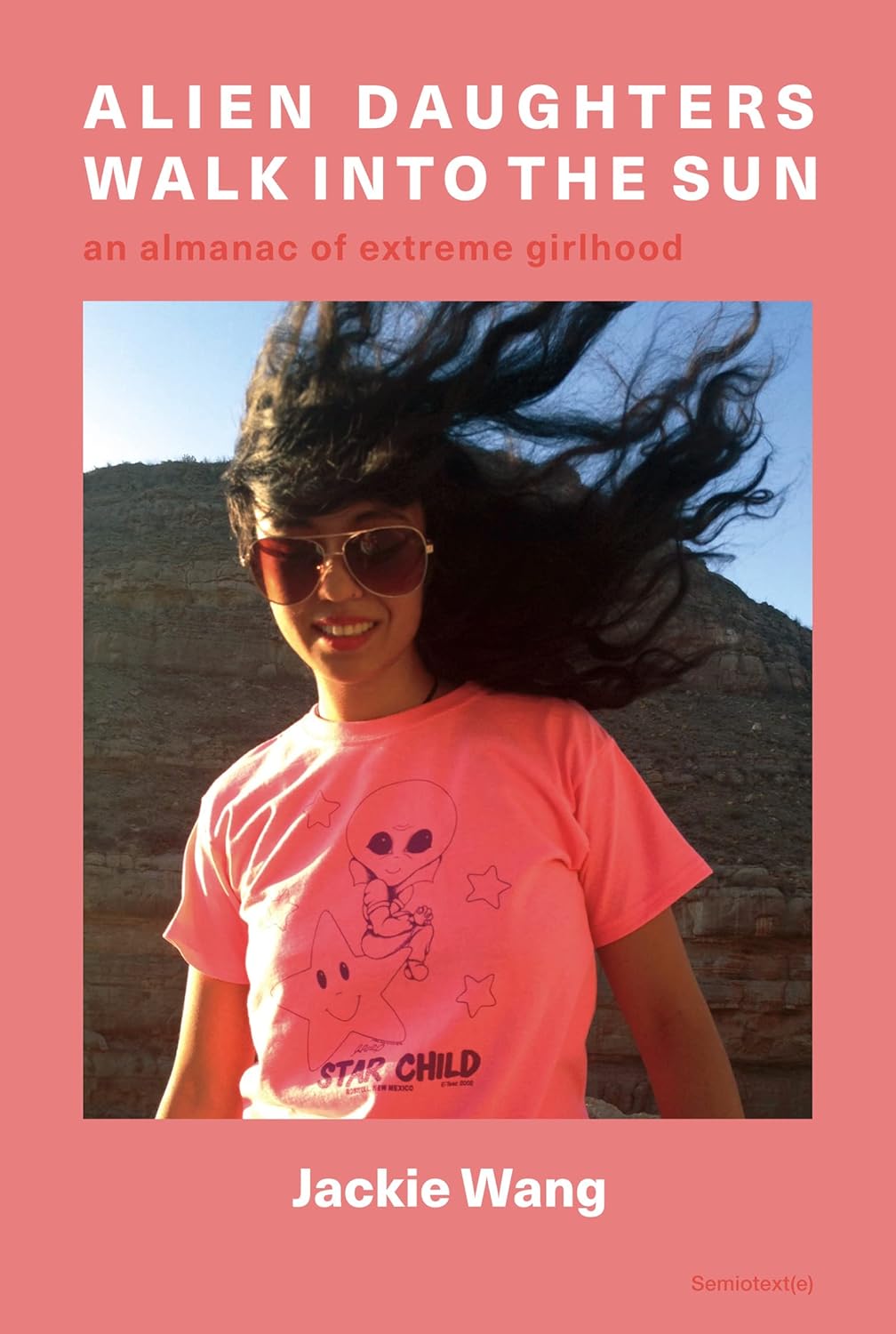
 Alien Daughters Walk Into the Sun:
An Almanac of Extreme Girlhood,
Jackie Wang
9781635901924
Reviewed by TIMMAH BALL
Who is the type of person who writes books?
Channel that violence. I want to live in language in a way that makes sense to me. I want to use these words in a way that doesn’t feel alienating. But when I sit down to write, everything is filtered through their way of saying things, their judgments. Who gives a shit about literary manners and their monopoly on speech? The task is to blow up the language.
-Jackie Wang
Wang’s exhilarating mandate reads like a punk manifesto but is taken from an essay Aesthetic Forms of Respect for the Status Quo- in her recent non-fiction collection Alien Daughters walk into the Sun: An Almanac of Extreme Girlhood (2023). Within it, writings stretch across categories: blog posts collide with verse, diaristic writing with monologue and out of print pamphlets sit alongside cultural criticism. The book collates writing previously distributed as zines, Tumbler posts, DIY outfits and in small independent journals making its ability to shit all over ‘literary manners and monopoly’ palpable. The result is a raw deviation from the constraints of commercial or even indie publishing houses. Engaging with the collection was thrilling but given the contrast between the writing’s origins and its eventual packaging as a book another feeling emerged as I read it. An awareness that it arose through the frameworks it was determined to critique – distributed in this continent through Penguin Books Australia. A curiosity triggered by Wang’s own doubts and analysis of where her career had landed.
In the collections introduction Wang reveals a level of unease reflecting on her early twenties lifestyle and politics formed around punk squats and queer kinship. It is these communities that supported her activism and sustained a radical writing practice that would over time creep into the literary canon. These reflections provided insights which I wasn’t quite aware of and having invested in zine-making and self-publishing over the past few years, it felt like I had arrived at the collection in reverse. I never followed her Tumblr or blog and didn’t attempt to track down the zines she made while living in activist communities – because I wasn’t aware of them. I had discovered Jackie Wang’s monograph (and print debut) Carceral Capitalism (2018) Semitext(e)/ MIT unaware of her zine-making origins, returning to the book obsessively and with increased intensity after reading her poetry debut and National Book Award Finalist The Sunflower Cast a Spell to Save Us from the Void (2021) Night boat Books. To uncover her early writing practice so late – now bound as a prestigiously published book – suggested that my own reading tastes were becoming conventional even though I remained critical of the dominant industry. But my contradictory reading habits seemed to reflect Wang’s own uncertainty about the way her writing had moved outside of DIY contexts. She describes this transformation and questions the sharp change in the introductory essay:
At the time they were written, they were not meant to be arranged into a book. It still surprises me that I have become the kind of person who makes books.
I have a PhD from Harvard now. I put money away into a retirement account while I write from the comfort of a tenure-track job. I’m not cleaning up broken glass or wrestling knives from my lover’s hands while flitting from punk house to punk house, in search of a place to land.
In another essay, she recounts the transition chronologically, with a casual tone as if it happened by accident:
For a year I lived out of a suitcase, bouncing from couch to couch, from Chicago to Glasgow to Albuquerque to San Francisco to New York City and back to Florida, to deal with my brother’s hearing and appeal. At the end of my sojourn, I washed up on the cobblestone shores of Cambridge, Massachusetts, to do a PhD at Harvard.
The essay ends on the above sentence, leaving us to wonder about the moment she landed as if it happened so fast and unexpectedly, it’s impossible to explain in detail and as a result harder for us to understand how she achieved it or what it was like to leave those punk houses for the Ivy league. Part of me imagined the loneliness she must have felt when she washed up on those cobblestone shores, even if she chose this trajectory. But on further reading it also reveals how hard it is to articulate the choices we make in ways that don’t resort to clichés like “overcoming hardship” or success as the “underdog” or even the inevitability of choosing “safe options” as we grow up. Transitioning from living out of a suitcase to elite study is extreme and, in some ways, it would have been interesting to understand more about the onerous task of applying for a PhD at Harvard. The omission also falls into the Gen Z/ Millennial malaise that seems uncomfortable with status, choosing to downplay our achievements like they are meaningless. But I also liked the way she skims over the details as if the experience was akin to the types of drifting she had done previously, rather than a conscious decision to ‘better herself’ by pursuing an academic career. She obscures her success and while her decision to do this might be attached to guilt or imposter syndrome, I appreciated her slight indifference towards career progression. Decisions which she eventually reveals are about financial survival as much as anything else. She explains how:
If I could have seen that the path I stepped on would lead me here, would I have stepped off? I didn’t even know I was on a path. But every decision is a path, even decisions I made for the sake of survival, like going to grad school when I ran out of money.
To lessen her achievements and the gains associated can feel disingenuous but captures how discombobulating and difficult it is to make career decisions and move into certain circles because we need money. And while the privilege is enormous, it’s normal to question how much we’ve compromised to reach the type of financial security that comes with success. Wang situates her choices and achievements as a form of financial security in Life Shit, originally published on Tumblr in 2014, she writes:
Now here I am. The immediate class ascension has been jarring – not that I’m making that much money, but I guess the Harvard brand is worth a lot in social capital. Now when people ask me what I do I don’t have to shrug and say, ‘You know … living the bullshit bohemian life.’ Have I been bought out? I hope not.
I don’t want to default to a secure/comfortable life because it’s easier. I don’t want to be neutralized, either actively by Harvard or indirectly by my new material situation (which could shift my priorities).
Alien Daughters, often feels like it was written in the frantic moments between cleaning up broken glass, showing that Wang seems unlikely to be neutralized. Her priorities haven’t shifted. If she struggles to articulate how the Harvard brand happened, her uncertainty also shows a refusal to absorb into these institutions uncritically. Instead, it exposes life under capitalism – what other options exist, when you’ve run out of money. But still, I remained intrigued by the presentation of these texts in the new format, worried that the strange and unruly writing (predominantly distributed as zines or on Tumblr) might lose their original intent and politics when re-packaged as a book. It’s an odd issue to raise, particularly when I never followed Wang with the type of devotion that leads some fans to uncover every piece of writing that an author has ever written. I missed that opportunity, yet started to crave the original format, in search of the essence of these pieces that might read or feel different outside of the book.
The desire to experience her work as it was originally published was nostalgic and risked inflating the marginality of DIY practices as if there’s never been crossover between these scenes and mainstream publishing. But I remembered an essay by Kate Zambreno where she grieved the commercialisation of New York’s literary community when she moved there in 2013 – even though she was never part of the writing circles that she longed for. She writes, ‘I have been walking around looking for ghosts. Is it possible to mourn a city and time that I never knew?’ And I also questioned why I missed Wang’s original publications even though I never read them in their early self-printed form. A medium and distribution method which Wang describes in Alien Daughters passionately, which only increased my longing.
I got a random email tonight from a stranger who said he read my zine in Alabama, of all places! I have no idea how it got there. Some traveller kids in Baltimore said they saw my zines all over the South and I didn’t believe them because I only print a few copies and give them to hardly anyone. The magic is hitting me hard.
It is this magic, and the intimacy of these connections which I miss, craving those small interactions where it felt possible to reach out to a zine maker you admired after finding their work in a co-op and receive an appreciative email back. Connections that often disappear as writers professionalise and the pressure to promote yourself and what you’re doing next takes over everything else. But the magic of zine making lacks something too. I want friendship and inspiring exchanges but maybe I’m the only one and no one really has the desire or time to connect anymore when the objective is to win and opportunities to do are scarce.
These misaligned longings became brutally obvious during a panel discussion with Michael Winkler on self-publishing for Writers Victoria. I had agreed to participate hoping to connect with audiences ready to “blow language up” – people committed to a medium that let you ‘shit and bleed all over white linens’ as Wang describes in Aesthetic Forms of Respect. Instead, what I got was a predominantly white boomer crowd eager to get as many tips as possible from Winkler, whose self-published novel Grimmish was later picked up by Puncher & Wattmann and successfully found its way onto the Miles Franklin shortlist. Trapped in a two-hour Zoom conversation, I hid the awkward realisation that I had expected a much younger group looking to challenge literary systems. But the writers I had anticipated were probably already publishing their first books, having found a place within the industry. And I humbly accepted that people weren’t interested in self-publishing because they wanted to avoid, as Wang described, ‘the interminable hum of the canon, the bullshit standards of certain literary white men.’ For many, self-publishing was just a different pathway to success and future book deals, another way to fast track their careers if other options hadn’t worked out.
While I left the panel disappointed, I also wondered if I was overly invested in the binary between the underground and literary industry which missed the point. Because don’t all writers fantasize about making it in some way, seeing their work reach audiences beyond zine sub-cultures or social media niches? Kathy Acker, one of the figureheads of punk lit, made it abundantly clear that she was chasing fame by delving into the deranged crevices of her imagination, creating anti-narratives that repelled mainstream tastes while desperately seeking literary notoriety. In her 2017 book After Kathy Acker: A Literary Biography, Chris Kraus – a member of Acker’s alt lit circles and coincidentally Wang’s publisher, having established Semiotext(e) – closely examined Acker’s desire for fame. She writes that ‘Acker knew, in some sense, exactly what she was doing. To pretend otherwise is to discount the crazed courage and breadth of her work’.
Today, a huge range of successful authors have established themselves through non-traditional publishing platforms like zine making, blogs or social media. The cultural critic Mark Fisher developed his first influential book Capitalist Realism: Is There No Alternative? (2009) from his blog K-punk. To literary juggernauts like Melissa Border’s whose first commercial success was her essay collection So Sad Today (2016), a book which evolved from her Twitter/X account of the same name. It’s a pathway mapped out by so many cult figures that it could suggest that there isn’t really an underground or a margin to emerge from anymore, just a boundary between obscurity and recognition that most hope to cross. Given this trajectory it’s not particularly unusual that a significant publishing house is interested in Wang’s DIY oeuvre consisting of Tumblr posts and out-of-print zines. Wang just seems more aware of the moment she crossed over, concerned by what she may have lost through the obvious gains. Or, as Zambreno writes:
But how to avoid feeling sold? Because I want to be successful, I want to be a success. What I would do sometimes for success, to not feel like failure all the time, but success, I think comes at a price, perhaps one’s integrity.
If I’m still over analysing whether a collection of DIY-published non-fiction withstands the rigor and ‘bullshit standards’ that often occurs in literary publishing I think it is because I am also seeking to understand how the two forms can borrow from each other, without undermining the other. Can writing from the outside (where many authors begin) move to the centre in ways that encourage new and hybrid styles, rather than assuming that the outside is just a temporary space that we work in until we are recognised in established industry contexts. Although Wang’s climb into the academy and literary elite risks compromise and change she confronts this openly rather than suggesting that she can perfectly blend the Harvard brand with her punk origins. She remains tapped into subcultures as her status rises as if the only way to manage the incongruities of each world is through hybrid overlap – while being honest that this coalescent is in itself a privilege and a loss. A scenario that forces the reader to question whether Alien Daughters would have been published without the Harvard brand and literary back catalogue.
One of the most compelling essays in the collection Bitches of Color in a White Boy World: Innovative Others and Identity Aesthetics directly speaks to this and the possibility of moving between worlds without heavy reproach or self-criticism. Instead, it asks that we re-imagine DIY practices and commercial publishing as having potential for reciprocity rather than existing in opposition to one another. She argues that the more we critique industry structures that ignore us and feel impenetrable, the more we reinforce their power while indirectly undervaluing the work we do that remains on the outside. She writes:
You covet what you can’t have and so you devote your time to making those who do have power feel bad or guilty about having it. They’re never going to listen, and the closer you get to the centers of power you cannot access, the more infuriated you feel. And you pray that nobody notices that the underlying motivation for battling these people is the desire for a few crumbs of recognition, or, if you can’t get that, the desire to wreck their blithe and jolly rise to literary stardom (and perhaps to even make a career out of calling white people out).
Her sentiment articulates the problem with over identifying ourselves as outsiders to an industry that we think we hate or feel powerless too, wasting our time attacking it while we secretly hope it will offer us something over time. It is embarrassing to admit that such criticism is partially motivated by the chance of receiving some recognition for doing it – or worse still making ourselves feel better by ridiculing those who have made it. I’m attracted to the magic of the zine making community Wang speaks of and the urgent tone of writing created during her years of drifting. But I also recognize the danger of assuming that the original work is better than the book it eventually became, cautious of the type of mythmaking that worships the underdog and condemns those with status. I don’t want to write to call anyone out, particularly as those on the rise are less likely to be white anymore. The more I return to Alien Daughters the more I realise that I am looking for respect and reciprocity between the literary margins and the mainstream.
Wang models a porosity that shifts boundaries, she uses the traditional publishing form to archive a radical practice and preserve work which is easily lost. She remains unsure of her success but embraces it with the same candour as her active Tumblr account now used to promote her acclaimed books and the juxtaposition fits. A post highlighting the sell-out Alien Daughters book launch, embodies the unease and gratitude fitting for someone critical of her new literary status.
***
Her post echoes the tone of many other writers I follow who promote their work and share their success with gratitude and ambivalence – the act of selling oneself being as essential as it is unpleasant. She’s an author who deserves a massive audience even if this required entry into an elite institution that doesn’t reflect her values.
If I still crave the edges, I’m also aware that I create work that pivots the industry. The last publication I made resembled an art book, was funded by an arts festival, and cost $30,000 to make. The last zine I made was difficult for Sticky Institute to stock because it looked too much like a book. I order publications from Rosa Press, Stolon Press, Common Room Editions, No More Poetry, Subbed In, Discipline and others because I can’t find books like Andrew Brooks’ Inferno or A Brief History of Australian Terror by Bobuq Sayed anywhere else. But I’m also interested in the overlap or the way such outfits draw from the aesthetics and content of prestigious publishers like Wang’s own Semiotext(e) / Intervention Series who published her first book. Wherever I fit within these binaries I’m increasingly conscious of stepping too far into critique which risks feeling resentful or as Wang attests, becoming known for calling people out while hoping to gain cred for doing it.
Invariably some critique of institutional publishing is important, but Alien Daughters demonstrates the power of moving on, because as Wang describes:
The more you hate people for winning the game, the more you will believe in the game yourself.
Wang shows the possibilities that unfold when we let go of the game and allow ourselves to move between intuitional spaces while acknowledging the uncertainty that persists. In the essay ‘Epistolary Review: Dodie Bellamy, the Buddhist’ she describes her relationship to Bellamy, a friend and writer she admires deeply who was primarily known as a blogger before moving into book publishing. Like my own experience of reading Alien Daughters she also questions what happens when you read a book that was originally published as a blog. She writes:
I think about how the BLOG became your space to go wild (perhaps because it’s not Real Writing, as you wrote). The blog format ended up giving the book a spontaneous quality—it’s immediate and has a real life temporal progression marked by shifts in emotion and fake-out endings. Even though I was following your blog in real time, reading the book was still special and a totally different experience.
And similarly, Wang shows us that books beginning in those ‘wild’ spaces can maintain their form, providing a different experience for readers that remains special. She is creating the type of writing that pulses with energy and freedom because it didn’t start out as a book and retains something unique even when it comes to you in this form. Wang wrote much of the collection on the outside of literature because she didn’t think she was the type of person who wrote books; and this is what excites me: watching her work cross a threshold into an industry and cultural landscape that is conservative but slightly more malleable with her there. The pathway remains complex and unclear, but her work shows that it might be possible to get that Harvard brand while channelling violence and make books without being completely neutralised.
(Note: I started working on this essay before the annihilation of writers and artists freedom to speak about the genocide in Gazza, the interconnectedness of other global events and growing fascism within this continent. While I still recognise the creative potential of moving between the margins and literary institutions; from a political and moral perspective it feels increasingly ethical to divest and forge new ways to share our work.)
References
Madeline Howard, Jackie Wang’s New Book of Essays Is a Rich Excavation of Girlhood, Another magazine 2023
https://www.anothermag.com/design-living/15257/jackie-wang-alien-daughters-walk-into-the-sun-interview-semiotexte
Chris Kraus, After Kathy Acker: A Literary Biography, Penguin Press, 2018
Kate Zambreno, New York City Summer, 2013, in Screen Tests, Harper Collins, 2019
TIMMAH BALL is a writer, editor, and zine maker of Ballardong Noongar heritage. In 2021 she published the chapbook Do Planners Dream of Electric Trees? through Glom Press/ Arts House and has featured in a range of anthologies such as This All Come Back Now (UQP) and Best of Australian Poems 2022 Australian Poetry.