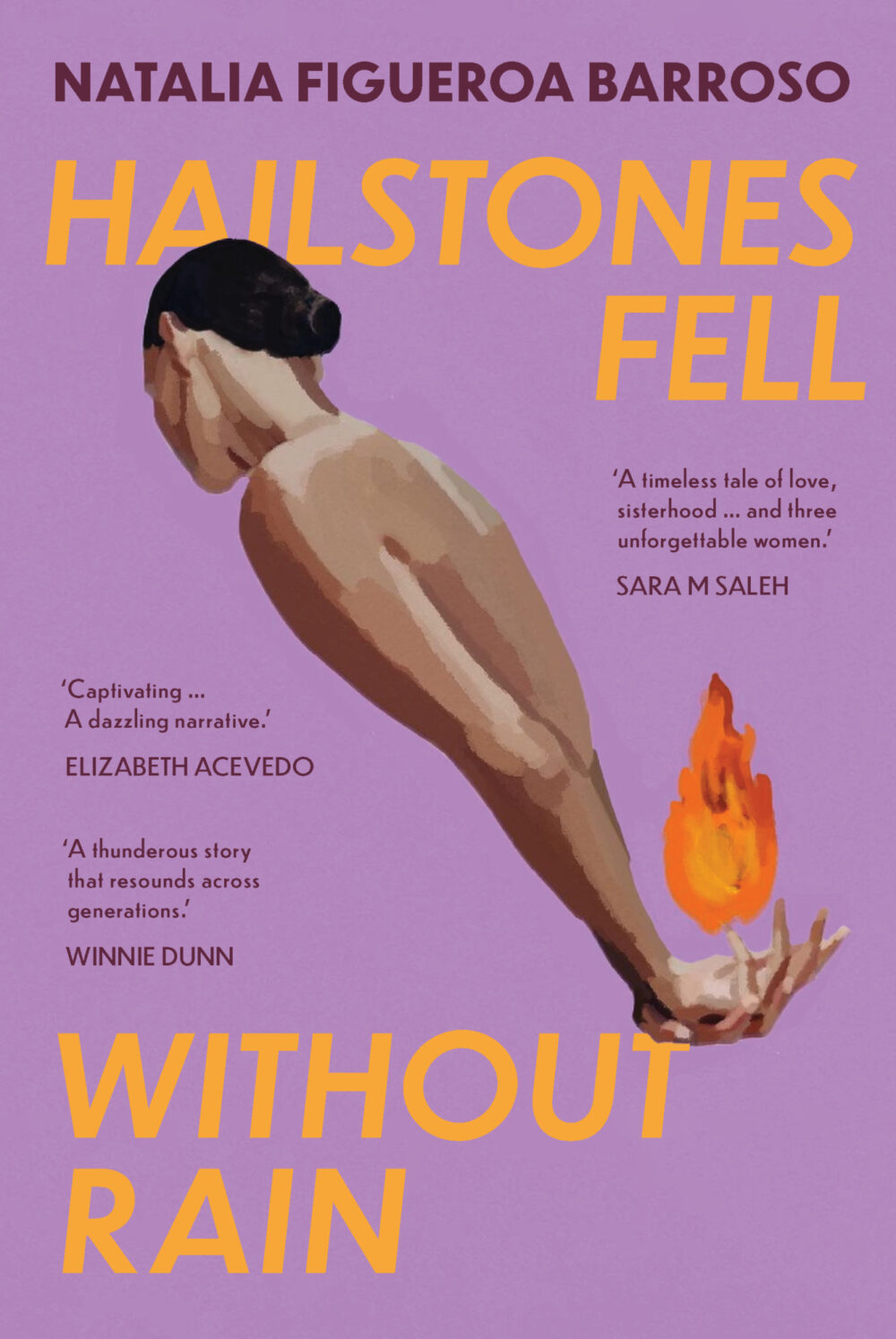
 Hailstones Fell Without Rain
by Natalia Figueroa Barroso
University of Queensland Press
ISBN: 9780702268816
Reviewed by ANNA MERLO
Hailstones Fell Without Rain is a complex story of culture, immigration, sacrifice and, above all else, love. Natalia Figueroa Barroso’s debut novel takes a tri-partite form, with a brief interlude, following the lives of Grachu, Chula and Rita. All three Ferreira women are part of the Uruguayan diaspora, scattered across time and place, but united by the strength of the women in their bloodline.
In every chapter, Figueroa Barroso expertly code switches throughout, weaving between Spanish and English effortlessly. The novel also jumps around in time, from contemporary Australia in 2023 to Uruguay in the 1970’s. The voice of the novel is that of a close third person, allowing us to see into the heads and hearts of several characters at once. Sometimes our nameless narrator addresses the reader directly (with an affectionate ‘dear reader,’) to give additional cultural context and insights. In these moments the story pauses – record-scratch like – while we are given a moment to breathe, absorb and re-centre. The novel as a whole is intensely layered and rich. I got the sense while reading that there were dozens of other stories within this one that could be told in separate novels. The Figueroa Barroso-verse contains multitudes.
In the novel’s first part, we are introduced to Grachu, a hard-working Uruguayan immigrant and mother of three daughters. Grachu is at once deeply practical and no-nonsense in her tradie pants and high vis. It’s clear even from the opening scene that she is a woman on a mission to give her daughters the best life she can possibly provide, even if the best she can do for now is a living room sleepover on a purple secondhand sofa from Facebook marketplace. I found myself rooting for Grachu at every bumpy turn.
Chula, Grachu’s elderly aunt who lived through the fear and violence of the Uruguayan civic-military dictatorship in the 1970’s and who still lives in Uruguay today, raised Grachu for the most part due to her sister, Grachu’s mother, disappearing under the military’s rule for her staunch political beliefs. Chula holds in her hands, heart and memory the trauma of the civic-military dictatorship, of tanks parked in the streets and loved one after loved one being ‘disappeared’. Despite her immense suffering, her resilience and hope outshines all. She weaves Charrúa (Indigenous Uruguayan) wisdom and culture lovingly into her niece’s childhood like a work of macramé. This care and stewardship of culture resounds through generations, carrying right through to Chula’s great-niece Rita in Sydney, who acknowledges her baptism in ‘the Charrúa way – with moonlight – and so speaking to nature is innate and liberating for her’ (p. 216). Chula carries her ancestors’ oral history and generations of tradition on her back. She is a keeper of culture and maternal sacrifice personified.
Briefly, in a short but impactful interlude, we hear more about Tata, a fearlessly staunch political activist, Grachu’s biological mother and Chula’s sister. Tata is taken as a political prisoner and is eventually killed by the military for her beliefs. Her disappearance and death is a major turning point in the novel, and later the discovery of her bones and scattering of her ashes is a commemoration that brings all three of the other women together.
Rita, Grachu’s eldest daughter navigates her identity as a bisexual Latinx person in the film and TV industry. The relationship between Rita and her mother is tense in the wake of Rita’s coming out. As the reader, we bear witness to the melting pot of resentment, longing, bewilderment and guilt bubbling just under the surface in both of them. It’s compelling, gut-wrenching and hilarious, sometimes all at once. Throughout her story, Rita grapples with the vast chasm of generational differences between herself and her mother, a sense of disjointment from her culture and language due to growing up in Australia, and a deep longing for connection and representation.
Now we need to talk about mate. Not the Australian ‘maaaaate’ but yerba mate, the strong herbal tea consumed at an almost religious level by many Uruguayans. Mate is mentioned dozens of times in Hailstones Fell Without Rain. As a plot device, it serves as a beat for the characters to pause and reflect on what’s happening in their lives. It’s also a way for them to avoid talking about hard things: ‘El termo runs out of water and Chula runs out of excuses: she has to say yes or no’ (p. 187). Figueroa Barroso’s voice is a patchwork of Uruguayan cultural context and references, like when Grachu explains how she makes her mate: ‘Place boiling water into el Che Guevara and hammer-and-sickle and BLM sticker-covered termo. Place metal bombilla precisely so. Pour a little cold water and a little hot by la yerba mountain’s shore. Let it rest and expand. And finally, it is ready’ (p. 17).
Growing up in the outer suburbs of Brisbane, I did not know any Uruguayans apart from my family. Whenever I played hangman in primary school, I always used “Uruguay” as my word because it was un-guessable; nobody had ever heard of Uruguay, apart from maybe an episode of The Simpsons where it’s mispronounced. I’m mentioning this because I think it sums up why Natalia’s book was so significant for me. Growing up, I felt disconnected from the Uruguay my family knew. It felt as if my family was a tiny, isolated island on a slightly bigger, isolated island thousands of kilometers away from South America. I watched my tía go by her middle name instead of her first because Graciela was apparently too difficult for Australian mouths to swallow. I heard my family pronounce it ‘pay-yella’ instead of paella (with the Rioplatense ‘sh’ sound) when Australian friends came to visit. I watched my abuela stop buying yerba for mate because it became too hard to find after they moved to Brisbane.
Suddenly, here is Hailstones Fell Without Rain in my hands: funny, honest, warm and quintessentially Uruguayan. The main characters drink mate, sing ‘sana sana colita de rana’ when comforting their children and eat tortas fritas when it’s raining (‘a tradition that goes back generations to when los gauchos – aka Indigenous peoples mixed with Europeans – working the land would take advantage of the bad weather by collecting rainwater to make the dough and have a well-earned break… a dark cloud above is a reminder of what life is about: living, not just working without end’ (p. 237-238)).
On a deeper level, this novel understands the trauma of living under the thumb of the Uruguayan civic-military dictatorship in 1973 and the immigration tug-of-war so many families have gone through: on one side, a better life for their children, and on the other, losing their culture ‘by assimilating into a new one, and eventually they would become gringos too’ (p. 187). The novel is a love letter to immigrant communities and all of their strength, resilience and joy, because ‘community knows what community needs’ (p. 261).
As a second generation Latina, I have often wondered if I was ‘Uruguayan enough’. This novel was a reminder of how powerful it is to see yourself reflected in stories. With immigration comes the pressure to assimilate to the dominant culture, and with assimilation often comes a loss of one’s previous language, culture and traditions. In some Latino immigrant families, children are not taught Spanish for fear of giving them an accent they could be bullied for, or for slowing down their adjustment to Anglo-Saxon life. With every generation, culture and language changes. Hybrid languages like Spanglish are born, serving as an intergenerational bridge connecting family members on both ends of a Spanish-English language continuum. Rita’s struggles with Spanish, as she fumbles for the right vocabulary word and feels embarrassed in conversation with relatives resonated with me. Despite this, Rita finds her Latinidad in other ways, through making mate, cooking with familiar spices and sofrito, and working within Latinx storytelling.
The traps of cultural stereotypes are flagged when a colleague suggests that Rita would love a new show they’re producing, simply because the family in it is from Chile. The novel’s narrator reminds the audience that Rita isn’t Chilean – but ‘because there are so few representations of the Latinx community on our screens in so-called Australia, Rita is interested in all things Chilean, Colombian, Argentinian… and hopefully one day she will see a Uruguayan with un mate in hand mirrored back at her from her TV. Drinking it properly’ (p. 212). Hailstones Fell Without Rain is a tribute to Latinx women, Latinx families and the indomitable resilience and deep love that runs beneath immigrant communities like a current. The novel holds space for three diverse experiences of the same immigration journey in the same family, emphasising that there is no ‘one size fits all’ approach to writing Latinx stories. Chula balances the fear of leaving her home with the fear of staying, and wonders what will become of her family after assimilation into Australian society. Grachu struggles to make ends meet in Australia, working many jobs – from manning construction sites to cleaning mansions – just to keep a roof over her children’s heads. Rita encapsulates the longing for belonging that many children of immigrants feel: a yearning to be seen, heard and understood. Figueroa Barroso reminds us that all of these stories have a place and deserve to be told.
Disclaimer: The author is a member of Sweatshop Literacy Movement’s Latinx writing fellowship and her work will appear in an upcoming Sweatshop anthology.
Anna Merlo is a writer and lawyer living on Turrbal/Gubbi Gubbi land. She has degrees in Law and Writing from the University of Queensland and her work has been published in Jacaranda Journal, StudyBreaks magazine, and the UQLA’s Nota Bene newsletter.